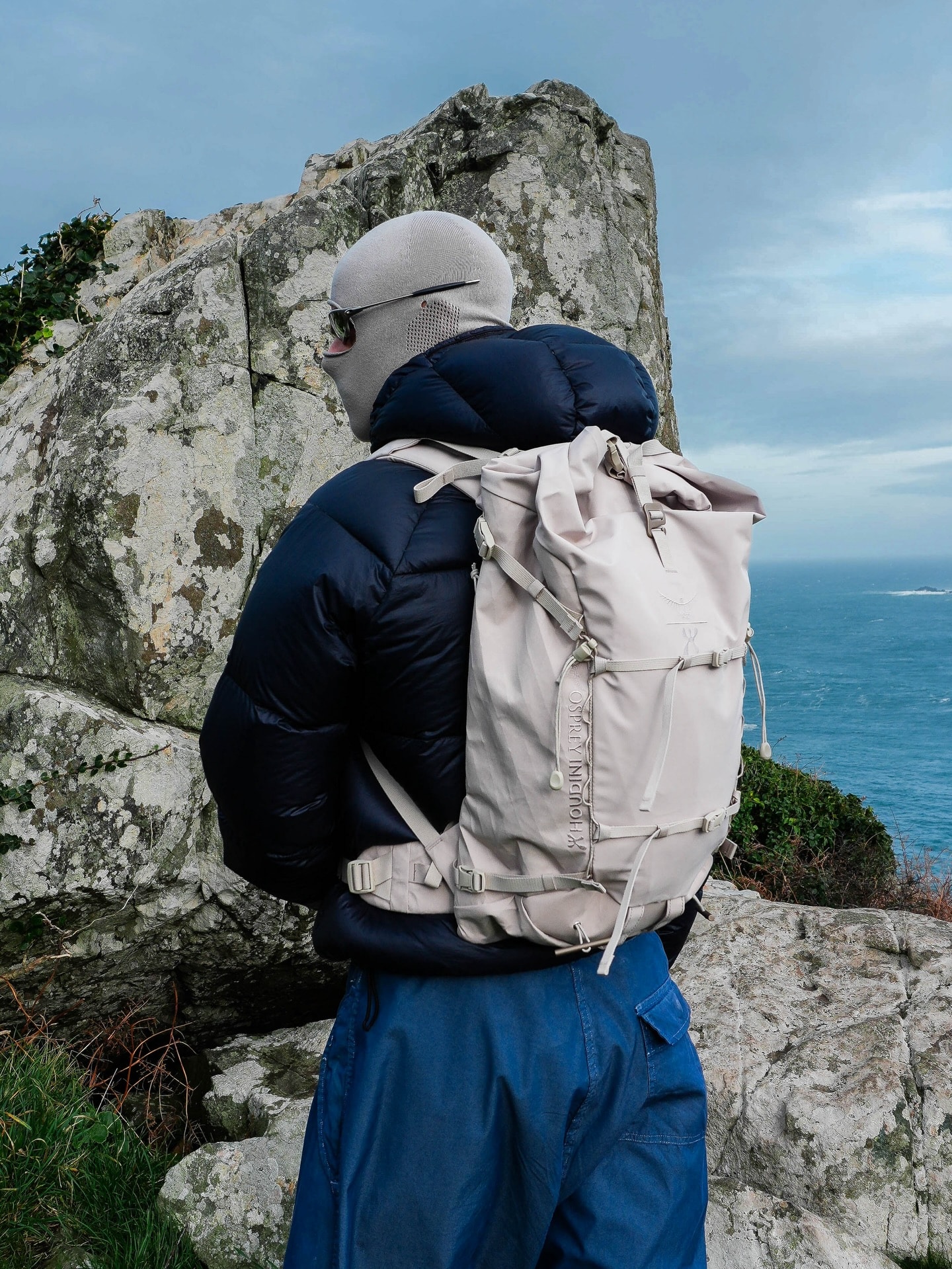
There are backpack brands. And then there is Osprey. In a market crowded with competent products, Osprey has managed something rarer: it has become a reference. The pack hikers reach for when they want to stop thinking about their pack. The brand guides recommend without hesitation. The gear that gets handed down, repaired, and carried for a decade before anyone considers replacing it. That reputation was not built on marketing. It was built stitch by stitch, starting in 1974 at a single sewing machine in Santa Cruz, California.
Born at a Sewing Machine in Santa Cruz
Mike Pfotenhauer was not satisfied with the backpacks available to him. As a young outdoor enthusiast growing up in Oregon, he found the fit poor and the construction mediocre. His response was characteristically direct: he learned to sew from his mother and built his own. That instinct — to make rather than accept — became the defining impulse behind Osprey.
By the early 1970s, Pfotenhauer had opened Santa Cruz Recreational Packs, a tiny operation where hikers and backpackers sought him out for custom-fitted, made-to-order packs. The brand officially became Osprey in 1974. It remained a deeply independent, craftsman-driven company for the better part of three decades, relocating to Dolores and then Cortez, Colorado, where a team that included Navajo sewers helped scale production while maintaining the obsessive attention to fit that had made the brand’s reputation.
In 2021, Osprey was acquired by Helen of Troy Limited — the consumer goods conglomerate that also owns Hydro Flask and OXO — for $414 million. It was a significant moment, and one worth acknowledging honestly: Osprey is no longer an independent brand. What it remains, however, is a product company with deep engineering DNA and a legacy of genuine innovation that a corporate parent cannot easily dismantle.
The Innovations That Actually Matter
Osprey’s technical contributions to pack design are not the kind of press-release innovations that disappear by the next season. They are the kind of ideas that become industry standard — or remain distinctively Osprey for long enough that every serious hiker knows them by name.
Breathable mesh back panels appeared in 1976 — two years into the brand’s existence. Adjustable sternum straps came in 1977. These seem obvious now because Osprey helped make them obvious. The AirSpeed suspended mesh back system — a tensioned trampoline of mesh that creates an air channel between the pack and your back — remains one of the most copied ventilation approaches in the industry. The AntiGravity system, introduced in 2015, takes this further by integrating the hipbelt directly into the mesh, distributing load in a way that genuinely changes how a heavy pack feels on long days.
Other signature features include Stow-on-the-Go trekking pole attachments (grab your poles without removing your pack), Fit-on-the-Fly adjustable hipbelts, and the LidLock helmet attachment. These are ergonomic quality-of-life features, and they represent something important: Osprey has always designed with the actual experience of carrying in mind, not just the appearance of a pack on a shelf.
The women’s-specific line launched in 1993 with the Isis — among the first anatomically designed packs for female torso geometry in the industry. In 2022, Osprey introduced its Extended Fit line with hipbelts sized up to 70-inch hips, extended shoulder straps, and repositioned pockets: a rare acknowledgment that backpackers come in all body sizes and that gear should work for all of them.
The All Mighty Guarantee: A Real Policy, Not a Slogan
Osprey’s All Mighty Guarantee deserves a mention that goes beyond PR language. Introduced in its expanded form in 2009, it offers repair or replacement for any defect or damage — period, regardless of age. Osprey has repaired packs twenty years old. They have replaced buckles broken by airport baggage handlers. In a market where warranties are increasingly filled with exclusions, the All Mighty Guarantee is a genuine differentiator and a signal of how the brand thinks about product longevity.
It also reflects something about Osprey’s sustainability philosophy: a pack that lasts twenty years and gets repaired twice has a far smaller environmental footprint than three cheaper packs that get discarded. By 2024, Osprey had extended bluesign® certification across 12 core technical product families — a meaningful commitment to responsible material sourcing.
Packs Worth Knowing: The Osprey Lineup
Osprey’s catalog is extensive, but a few lines stand out as genuinely essential references for hiking and backpacking.
The Aether / Ariel series (men’s and women’s respectively) are the benchmark for large-volume backpacking packs. Available in sizes from 55 to 85 litres, they offer Osprey’s most capable load-bearing suspension and are the packs serious long-distance trekkers reach for when the itinerary involves multi-week expeditions. The Aether Pro 75, launched in 2024, strips the design down for alpine use: lighter construction, strippable lid, maximum versatility.
The Exos / Eja line answers a different question: how light can an Osprey pack get without sacrificing the fit the brand is known for? The Exos 48 comes in under a kilogram for the pack itself — genuinely ultralight by any standard — while still offering multiple size torso options and the AirSpeed back panel. For fast-and-light hikers who still want proper load distribution, these are difficult to beat.
The Talon / Tempest family covers the day hiking and trail running end of the spectrum, with the 2024 Talon Tempest Velocity adding a running-vest-inspired harness for active adventure use. And for everyday carry, the Arcane range offers clean urban aesthetics with bluesign-certified materials — proof that Osprey can speak lifestyle without abandoning its technical roots.
What Osprey Does Better Than Anyone
Fit. That is the honest, blunt answer. Osprey packs — particularly in the mid-to-large range — offer torso sizing options that most competitors still do not match. The combination of gender-specific geometry, multiple back lengths, adjustable harnesses, and intelligently shaped hipbelts means that a well-fitted Osprey pack genuinely disappears on your back in a way that cheaper or less considered alternatives do not.
Osprey also wins on finish quality. Zippers run smoothly and keep running smoothly. Buckles are solid. Seams hold. This is less glamorous than innovation, but it is what actually matters when you are two weeks into a trek and the nearest gear shop is a long day’s walk away.
The Honest Limitations
Osprey’s weaknesses are real, even if they are minor relative to the brand’s overall quality level. The pack range is so broad it can feel overwhelming — the sheer number of models makes comparison difficult, and some overlap in ways that are hard to justify except commercially. A first-time buyer can spend significant time lost in the catalog before finding the right product.
Weight is another honest limitation for certain use cases. While the Exos and Eja lines are genuinely ultralight, most of Osprey’s mid-range hiking packs carry more grams than comparable offerings from brands like Hyperlite or even some of Deuter’s lighter options. That weight is not dead weight — it buys you suspension quality and durability — but it is a real consideration for gram-counters doing fast and light trips.
And the corporate acquisition is worth keeping in mind. Not because Osprey’s products have deteriorated since 2021 — they have not — but because the All Mighty Guarantee, the long-term repair program, and the sustainability commitments all depend on continued investment. The incentives of a publicly traded consumer goods company are not always aligned with the kind of generational thinking that makes those commitments meaningful.
Where Osprey Sits in the Outdoor Gear Landscape
Osprey occupies a specific and valuable place: technically serious enough for demanding expeditions, accessible enough for first-time backpackers, and durable enough that it genuinely competes with European stalwarts like Fjällräven and the German engineering tradition that brands like Deuter represent. It is the kind of brand that sits comfortably in the pack room of a mountain guide and on the back of someone doing their first overnight trail, and that is genuinely rare.
For lighting and navigation, Osprey packs pair naturally with brands like Petzl or Silva — the kind of equipment that shares Osprey’s philosophy of lasting performance over fashionable novelty. For cooking, MSR and Jetboil are natural companions in the backcountry kitchen.
Fifty years in, Osprey remains exactly what Mike Pfotenhauer set out to build at that sewing machine in Santa Cruz: a backpack brand that takes carrying seriously. That is harder to do than it sounds, and harder still to sustain. Osprey has sustained it. That matters.