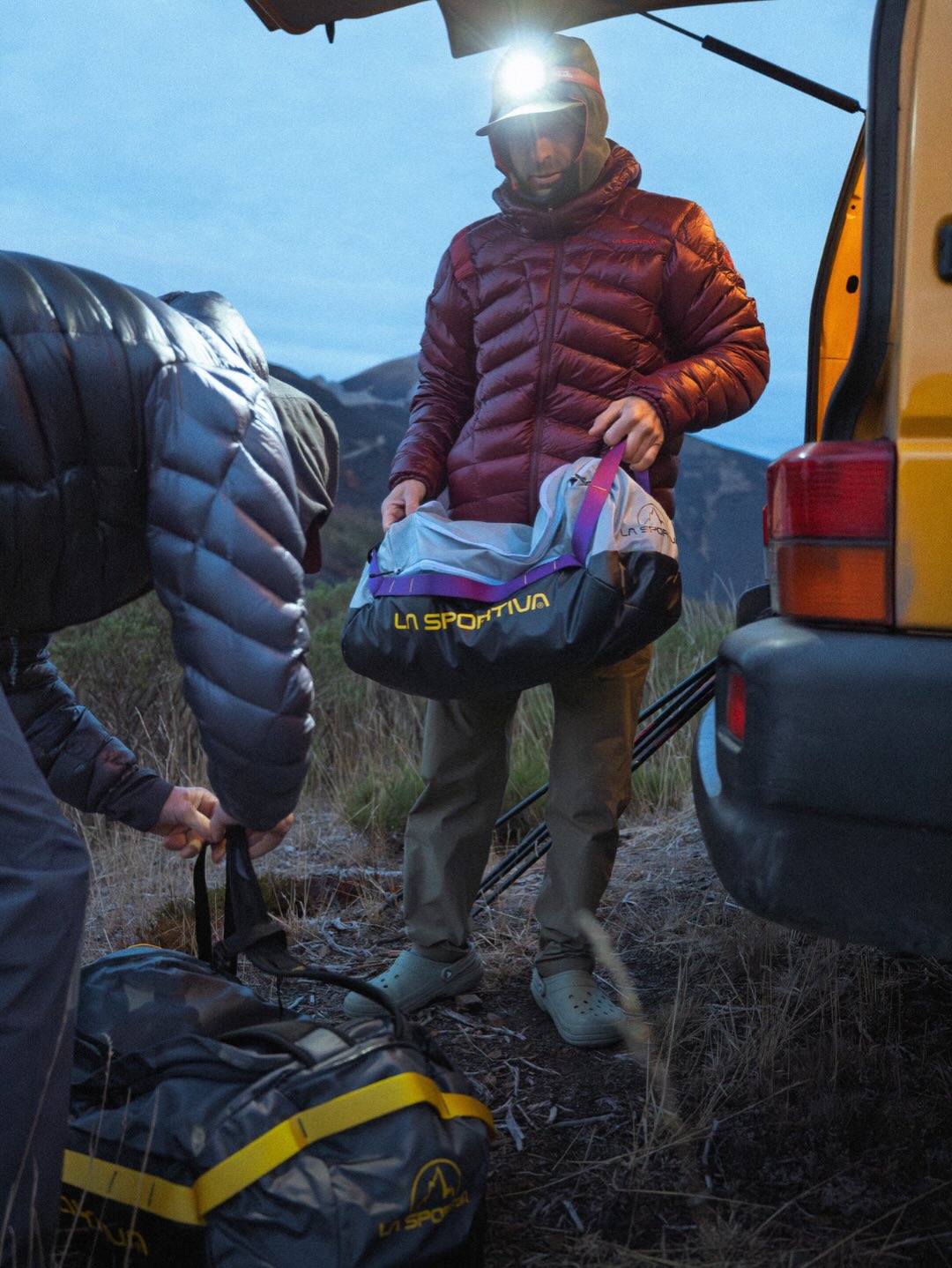
There are outdoor brands, and then there are brands that seem to belong to the mountain itself. La Sportiva is one of the latter. Founded in 1928 in Tesero, a small village in the Val di Fiemme at the foot of the Dolomites, the brand started as a modest cobbler’s workshop — « La Calzoleria Sportiva » — run by a shoemaker named Narciso Delladio. Nearly a century later, it remains family-owned, still based in the same mountain homeland, and still making every performance shoe in its Trentino factory. In an industry where manufacturing has migrated offshore almost universally, this is not a detail — it is a statement of intent.
For context on the wider world of trail footwear, our guides on Hoka and Salomon profile two other brands that have shaped the same landscape from very different starting points. For shoe comparisons, our Speedgoat vs Speedcross and Norda 001 vs Speedgoat articles cover the competitive field La Sportiva operates in.
From Wooden Boots to WorldTour Climbing
Narciso Delladio’s first products were rugged wooden-soled boots designed for the forest workers and farmers of the Val di Fiemme — people who spent their lives on steep, unforgiving terrain and needed footwear that matched it. That founding philosophy, of making gear that serves the actual demands of real mountain use, never left. When the Italian climbing and mountaineering boom of the post-war decades arrived, La Sportiva was already positioned to respond. The brand became the choice of alpinists, then of rock climbers, and eventually of the athletes who would push both disciplines to their modern limits.
The shift from local cobbler to global brand happened across generations of the Delladio family. Each generation expanded the scope — from hiking into technical climbing, from Italian markets into export across more than 80 countries — while keeping manufacturing rooted in Trentino. The factory in Ziano di Fiemme, which today employs around 240 craftspeople, remains the physical heart of the brand. Left and right shoes are made on the same day to ensure identical characteristics. Critical operations like rand tensioning — the rubber strip that holds a climbing shoe’s sole in place — are done by hand, by experienced craftspeople, because the brand has concluded that no machine does it as well.
The Climbing Shoes That Defined a Generation
La Sportiva’s reputation in climbing is built on a handful of products that have become genuine milestones in the sport’s technical development.
The Miura, introduced in 1997, is the most enduring. A high-asymmetry, lace-up climbing shoe built around precision edging, it became the tool of choice for some of the strongest climbers of its era and has never stopped being relevant. Adam Ondra — the Czech climber widely considered the greatest sport climber of all time — used a prototype version of the Miura XX to complete « Change » in Norway in 2012, establishing what remains one of the hardest climbing routes in history. The Miura XX was subsequently released as a signature edition celebrating the shoe’s 20th anniversary and Ondra’s modifications to its geometry.
The Solution, released in 2007, took a different direction: a heavily downturned, aggressive performance shoe built for overhanging sport routes and bouldering. Ondra has described it as his favourite shoe for rock climbing, and the evidence of that preference runs through some of the most celebrated ascents of the modern era — including his use of a Solution on his right foot during the first ascent of the world’s first 9C graded route. The Solution’s patented P3 (Permanent Power Platform) system, which maintains the shoe’s downturned shape over time rather than allowing it to deform and flatten, remains one of the most technically significant innovations in climbing footwear.
The Nepal Top, though from a different discipline entirely, deserves mention for a different reason. In the mid-1990s, it single-handedly convinced the global ice climbing community to abandon plastic boots — the stiff, heavy double-boot system that had dominated alpine climbing for decades — in favour of hybrid leather mountaineering boots. Competitors scrambled to release their own versions in the following seasons. The Trango series that followed cemented La Sportiva’s position as the reference in multi-purpose mountain boots.
Mountain Running: A Category La Sportiva Helped Build
La Sportiva uses the term « Mountain Running » internally to describe the discipline it helped develop — the practice of running on genuinely technical mountain terrain, not the manicured trails more commonly associated with trail running. The distinction matters because it explains the design philosophy behind the brand’s running shoes: they are built for grip, precision, and protection on loose rock and steep gradients, not for maximum cushioning on runnable paths.
The Bushido is the most celebrated product in this lineup. First released in 2014 and now in its third generation, it is a lightly cushioned, narrow-last trail shoe with outsole grip that reviewers consistently compare to a climbing shoe. On dry technical terrain — loose rock, scree, steep descents — it remains the reference for a specific type of mountain runner who values precision over comfort. The Bushido III, released in 2024, extended the line with a wide-width option for the first time, acknowledging that the shoe’s narrow heritage had excluded a significant portion of potential users.
The Jackal series addresses a different profile: more volume, more versatility, better accommodation for wider feet. It has become La Sportiva’s most broadly accessible trail running platform. More recently, the Prodigio and Levante represent a newer direction — supercritical foam midsoles (XFlow technology), more cushioning, and a ride character closer to the maximal trail running mainstream while retaining the brand’s characteristic grip and ground feel.
The Athletes
Adam Ondra is the most prominent figure in La Sportiva’s athlete programme, and arguably the most accomplished climber in the brand’s history. His relationship with the brand goes beyond sponsorship — he taught himself Italian after signing with La Sportiva, and has been directly involved in developing multiple shoe models. His ascents on La Sportiva shoes include the world’s first 9C (Silence, Norway, 2017), multiple 9B+ routes, and competitive victories at World Cup and World Championship level. La Sportiva celebrated 2025 as the tenth anniversary of the Skwama climbing shoe, launching a « Skwama Diaries » narrative series documenting achievements from its climbing team athletes.
Angela Eiter, the Austrian climber who in 2017 became the first woman to climb a 9b route (La Planta de Shiva, Spain), is another key figure in the La Sportiva team — a result the brand itself lists as a landmark moment in its competitive history.
Brooke Raboutou, the American competition climber who took gold at the first Bouldering World Cup of 2024 in Hachiōji, Japan, represents the next generation of La Sportiva’s climbing roster — a programme that has long prioritised the highest level of technical performance over commercial visibility.
Sustainability and the Made-in-Italy Commitment
La Sportiva’s insistence on Italian manufacturing is increasingly framed as a sustainability position as much as a quality one. Shorter supply chains, better oversight of materials and labour conditions, and direct control over production processes all contribute to a lower and more transparent environmental footprint than offshore manufacturing allows. The brand has published sustainability reports since 2017 and uses photovoltaic panels at its production facility. La Sportiva North America has been certified Climate Neutral. The Bushido III’s outsole uses recycled rubber — a step that the brand positions as part of a longer-term materials transition rather than a standalone gesture.
In a market crowded with brands making sustainability claims of varying credibility, La Sportiva’s manufacturing position gives it an unusual degree of accountability. When everything is made in one factory in the Dolomites, it is harder to hide what that production actually looks like.
La Sportiva occupies a position that very few outdoor brands manage to hold: genuinely iconic without becoming generic, technically serious without losing accessibility, and commercially successful without abandoning the mountain culture that built it. From a shoemaker’s workshop in Tesero to the hardest routes in the world and the most demanding alpine races, the brand’s trajectory is one of the more coherent stories in outdoor gear. Explore the full range on the La Sportiva official website.