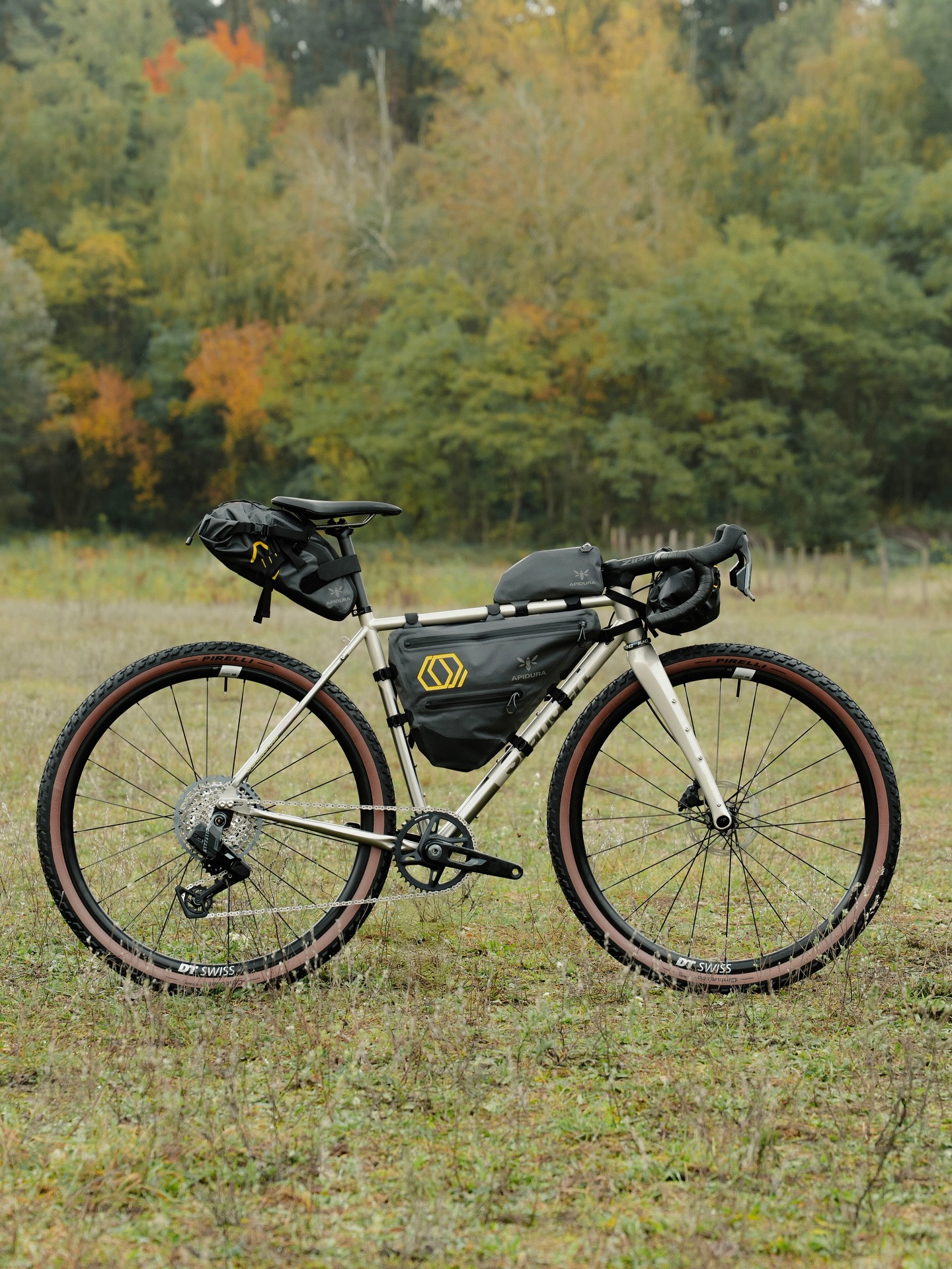
There are brands that enter the bikepacking market because it looks like a good business opportunity. And then there’s Apidura — a brand that entered because its founder couldn’t find bags worthy of the rides she was already doing.
That distinction matters. It shows in every product Apidura makes.
From the Tour Divide to a London Kitchen Table
The idea behind Apidura came from Tori Fahey, a cyclist who had already ridden from the Arctic Ocean to the Pacific, through Patagonia, Egypt to South Africa, Turkey to France, and across Central Asia — before attempting the Tour Divide in 2011. Frustrated by the lack of genuinely technical gear available for the kind of riding she was doing, she decided to build it herself.
Apidura was officially founded in 2013 by Tori and Pierre Coeffe, two Londoners who set out to create a benchmark brand in bikepacking. From her kitchen table in a rented flat share, Tori launched a brand focused on improving bikepacking packs through technical materials and precision production.
The name itself is a portmanteau of two Latin words: api, meaning bee — an animal with personal significance for Tori and a powerful symbol for cyclists — and dura, meaning durable. Together, they encapsulate the brand’s promise: built to last.
One thing worth clarifying upfront for riders who may assume otherwise: Apidura is not a French brand. They have offices in both the UK and France, and a supply and distribution chain that spans most continents, but the company is headquartered in London and deeply rooted in the British ultra-endurance cycling scene.
A Brand Shaped by Racing
Apidura didn’t grow by chasing trends. It grew by putting its bags on the bikes of some of the most demanding long-distance racers in the world — and iterating based on what came back.
In 2016, Apidura launched the world’s first waterproof bikepacking bags. In 2018, they released the world’s first ultralight race-focused packs, designed in partnership with ultra-endurance champion Kristof Allegaert. In 2022, they unveiled the world’s first aerodynamically optimised bikepacking system.
The brand has supplied equipment to athletes including Kristof Allegaert and Bjorn Lenhard, receiving data and feedback in return — a closed loop between field performance and product development that few competitors can match.
In 2018, Apidura also set up Dotwatcher.cc, a centralized platform covering major bikepacking races worldwide. It wasn’t a marketing move — it was a reflection of how deeply embedded Apidura is in the ultra-cycling community it serves.
Three Collections, One Clear Philosophy
Apidura organizes its lineup around three distinct use cases, each built from different materials and prioritizing different trade-offs.
The Expedition Series — For Gravel and Long-Distance Touring
This is the range most relevant to gravel riders and adventure bikepackers. The Expedition collection is built around a three-layer laminate called Trilon, developed exclusively for Apidura — lightweight, abrasion-resistant, and completely waterproof thanks to RF-welded seams.
The Expedition Saddle Pack comes in three sizes (9L, 14L, and 17L). It attaches to the saddle rails and seatpost without requiring a rack, sitting firmly even when loaded on road or off-road. The largest version is capable of carrying a full three-season sleeping bag alongside clothing and camp essentials — though as any bikepacker will tell you, the 17L version has a way of filling itself.
The Expedition Handlebar Pack is available in 9L and 14L. Dual roll-down closures and an air release valve allow you to customize the bag’s capacity, while a reinforced attachment system removes the need for a front rack, improving stability and handling. The 9L is ideal for endurance road racing; the 14L is better suited to large gravel bikes with flared handlebars — the kind you’d find on a Canyon Grizl or a Cannondale Topstone. One heads-up: attaching the handlebar pack with gloves on is genuinely fiddly, since the buckle system requires careful finger work. A minor gripe on an otherwise excellent bag.
The Expedition Frame Pack fills the triangle of your frame and comes in five sizes to accommodate different geometries. It uses Velcro straps on the top tube and buckled straps at the head, down, and seat tubes. Soft Hypalon material is used wherever the bag contacts the frame — protecting paintwork even on carbon frames.
The Backcountry Series — For MTB and Technical Gravel
The Backcountry Series is designed for technical riding, singletrack, and challenging mountain trails. Built with dual-laminate construction and precision-cut for tough terrain, it’s shaped to work on non-standard bike frames — mountain bikes, hardtails, and aggressive gravel bikes where frame geometry makes standard bags awkward to fit.
If your riding takes you beyond groomed gravel paths — into proper trails, loaded singletrack, or multi-day backcountry routes — this is the range to consider.
The Racing Series — For Ultra-Distance Speed
The Racing Series is designed for the specific demands of ultra-distance competition. It uses Hexalon, an ultra-lightweight custom laminate developed exclusively for Apidura: a tightly woven nylon with a TPU laminate on one side and a PU coating on the other — waterproof, ultralight, abrasion-resistant, and resistant to sweat and tears.
This is the range for riders who want the absolute minimum weight without sacrificing waterproofing. Bolt-on top tube bags, minimal closure systems, nothing superfluous.
What Actually Sets Apidura Apart
The bikepacking bag market has gotten crowded. Revelate Designs, Ortlieb, Restrap — there’s no shortage of competent options. So why does Apidura consistently land at the top of most serious bikepackers’ shortlists?
Construction quality that survives real adventures. Patterns are laser cut and seams are ultrasonically welded, reinforced with Hypalon patches — the same ultra-tough rubberized nylon used in proper inflatable dinghies. These are not bags designed to last one season.
No seasons, no sales, no artificial urgency. Apidura refuses to push impulse consumption through discounts or artificial scarcity. Their gear is designed for considered investment, and they pursue an evergreen iterative approach — introducing improvements as soon as they’re tested and ready, rather than waiting for an annual launch cycle.
Independent and family-owned. Apidura has no external investors, which allows it to take a long-term and holistic view on the role the brand should play — avoiding the short-term KPI distortions common in investor-backed businesses.
PFAS-free materials. In 2015, Apidura pioneered the transition to TPU coating as an alternative to traditional DWR treatments in the bikepacking industry, and subsequently eliminated PFAs from its supply chain entirely.
The Revive Program: Buying Less, Buying Better
Revive is Apidura’s circular economy second-life marketplace, where repaired, refurbished, and sample packs are made available for purchase. Revive products have lived varied lives — from pre-production prototypes to Transcontinental Race veterans — and often show the signs of their journeys. But by the time they enter the program, they’ve been checked, repaired, and cleaned to perform to their original standard for many years to come.
Apidura achieved B Corp certification in 2022, a process that scrutinized every aspect of the business — from supply chain and input materials to employee benefits and charitable giving. Their B Impact score of 95.1 compares to a median of 50.9 for ordinary businesses completing the same assessment.
This isn’t greenwashing. It’s a company that built its sustainability commitments before they became a marketing advantage.
Is Apidura Worth the Price?
Apidura bags are not cheap. A saddle pack will run you well over €150 depending on the size, and a complete setup — saddle pack, handlebar roll, and frame bag — is a meaningful investment.
But the honest answer is: yes, if you’re serious about bikepacking. The bags hold up over years of use, the construction is genuinely superior to most of what’s competing in the same price bracket, and Apidura runs repair stations at race finishes and through its store network, alongside a Revive marketplace and DIY repair guides to extend the life of your gear.
If you’re just getting started with occasional overnight gravel trips, there are cheaper ways in. But if bikepacking is a real part of how you ride — multi-day adventures, loaded gravel routes, self-supported racing — Apidura is the kind of gear you buy once and stop thinking about.
That’s exactly the point.