This article is a synthesis of independent field tests, specialist press coverage, and verified consumer feedback. hill.camp does not conduct first-hand product testing.
620 grams. Two people. Dyneema Composite Fabric. And a Decathlon price tag. The Simond Dyneema Sprint Tarp 2P is one of the most talked-about ultralight shelters of 2026 — not because it comes from a niche Californian brand, but precisely because it doesn’t. Simond, founded in Chamonix in 1860, is relaunching its trekking lineup with a clear ambition: bring alpine-grade technical standards to modern bikepacking and backcountry shelters, without adding zeros to the price tag.
Simond: 160 Years of Mountain DNA
Before talking about the tent, you need to understand where it comes from. Simond is not a new entrant in the lightweight shelter space. It is the brand whose ice axes accompanied Maurice Herzog on Annapurna in 1950, and Hillary and Tenzing Norgay on Everest in 1953. Based at 150 route des Papillons in Chamonix, it remains the only mountain brand manufacturing all of its metal hardware — ice axes, crampons, carabiners — in the Chamonix valley itself.
In recent years, Decathlon made a strategic decision to consolidate its mountain activities under the Simond banner, absorbing Forclaz — historically its dedicated trekking brand. The goal: a single, more coherent mountain identity, backed by genuine alpine credibility. The practical result of that repositioning is two new collections launched for 2026: Sprint and Wilder.
Sprint vs Wilder: Two Philosophies of the Bivouac
Simond has structured its 2026 trekking offer around two distinct approaches, each aimed at a fundamentally different kind of mountain traveller.
Sprint is the ultralight collection. It targets fastpackers, thru-hikers, and anyone who counts grams before counting days. Every gram saved is a performance lever on long-distance routes — a logic well understood by anyone already familiar with DCF materials like Dyneema and what they offer over conventional nylon shelters.
Wilder takes the opposite route. More robust, more comfortable, designed for extended autonomy in demanding and unpredictable conditions — Iceland, Scandinavia, multi-week traverses in variable weather. The logic here is not speed but endurance: staying out longer, not moving faster.
Both collections share the same underlying commitments: durability, accessible pricing, and reduced environmental impact through PFAS- and PFC-free treatments across sleep systems.
The Simond Dyneema Tent: Sprint Tarp 2P in Detail
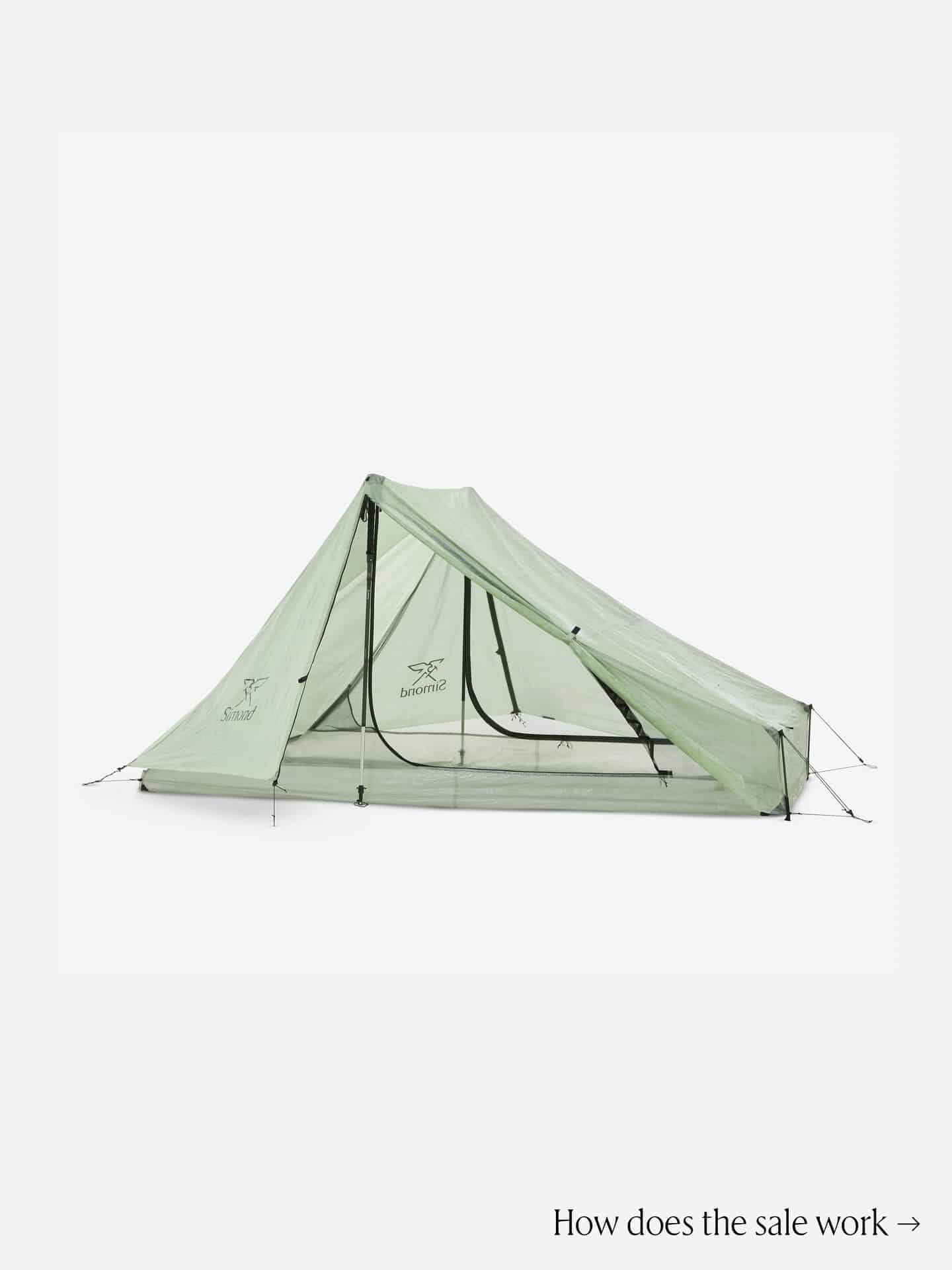
This is the shelter that put Simond on the radar beyond the Decathlon ecosystem. The Sprint Tarp 2P is a single-wall two-person tent weighing 510 g for the tent body alone, and 620 g all-in. That figure places it squarely in the premium ultralight category — the territory of specialist brands like Zpacks, Gossamer Gear, and Six Moon Designs.
Fabric: DCF 0.55 and DCF 0.96
The choice of Dyneema Composite Fabric (DCF) is a deliberate and significant one. As we covered in our full guide to Dyneema tent fabric, DCF offers a strength-to-weight ratio that nothing else in the outdoor textile industry currently matches. It is waterproof, non-hygroscopic (it doesn’t absorb moisture), and doesn’t degrade over time the way nylon does under UV and repeated wet-dry cycling.
Simond uses two distinct DCF weights depending on the zone:
| Zone | Material | Waterproofing |
|---|---|---|
| Fly / outer | DCF 0.55 — 19 g/m² | 15,000 mm Schmerber |
| Groundsheet | DCF 0.96 — 33 g/m² | 20,000 mm Schmerber |
Those waterproofing ratings deserve emphasis. At 15,000 mm on the fly and 20,000 mm on the floor, this shelter comfortably outperforms the vast majority of conventional trekking tents, which typically sit between 1,500 and 3,000 mm. Serious protection, at a fraction of the conventional weight.
Structure and Setup
The tent is a single-wall design with no poles of its own — it relies on two trekking poles set to 115 cm to pitch. That structural choice is the single biggest contributor to its sub-700 g total weight. Packed volume is just 2 litres, making it one of the most compact two-person shelters currently available.
Interior dimensions are optimised for two occupants without sacrificing minimum livability:
| Dimension | Measurement |
|---|---|
| Width at head end | 120 cm |
| Width at foot end | 110 cm |
| Maximum interior height | 115 cm |
| Wind resistance (wind tunnel tested) | 70 km/h (Force 8) |
The wind tunnel certification at 70 km/h is a figure many competing ultralight shelters don’t publicly claim. The tent also features dual vestibules — a genuinely welcome detail at this weight class.
Field Testing
Simond reports having tested the prototype on demanding long-distance routes including the Haute Route Pyrénéenne and the Pacific Crest Trail — two itineraries that expose shelters to weeks of consecutive use in genuinely variable conditions. This kind of extended field validation, which the brand calls « Durability Missions, » is built into the development process for all Sprint and Wilder products.
Price and Availability
€750 — sage green colourway — available from May 2026. A price point that may raise eyebrows on a Decathlon product, but that sits well below the €900–1,200 range of comparable DCF shelters from specialist brands. For what it is, the value case is real.
The Rest of the Sprint Collection
The Dyneema tent doesn’t launch in isolation. Simond has designed Sprint as a coherent system, where every piece is built to the same weight and performance logic.
UL MT900 Backpack — 880 g / 50 L
880 grams for 50 litres. Roll-top closure, curved and ventilated back panel, compatible with a 2 L hydration bladder, 100D high-tenacity polyamide shell. Maximum carry load: 12 kg. Made in the Czech Republic, 10-year warranty. Available now from Decathlon at €250. This pack targets the same user as the tent: someone who has already decided that pack weight is a variable they control.
UL Sprint Sleeping Bag — 710 g / Comfort 0°C
900-fill goose down insulation, comfort rating 0°C / limit -5°C, compressed volume 6.2 L, PFAS- and PFC-free treatment. €350. A 900-fill bag under 720 g at this temperature rating is a strong technical proposition by any measure.
Sprint Quilt 0°C — 640 g
For those who prefer quilt modularity over a traditional mummy bag: 640 g, 900-fill goose down, intended use range between 7°C and 0°C. €300. A coherent option for summer-altitude bivouacs or shoulder-season traverses where a hood and full zip feel like unnecessary weight.
MT900 Insulating Mat — R-value 5.4
R-value 5.4 — a rating that puts this pad firmly in four-season territory, well above the three-season standard. Weight: 570 g in size L, 675 g in size XL. Inflation via integrated pump sack with dual anti-return valve. Anti-slip surface treatment. €130 (L) / €140 (XL), available now.
Sprint Carbon Trekking Poles — 184 g each
184 grams per pole. Carbon shaft with aluminium lower section for impact resistance, fully repairable construction, 3D-machined foam grip, aluminium external locking system, adjustable from 110 to 130 cm. €120. Worth noting: these are the poles dimensioned to pitch the Sprint Tarp 2P tent.
The Wilder Collection: When Durability Comes First
MT900 Tunnel Tent — 2.08 kg
2.08 kg, packed volume 13.6 L, double-wall construction with a fly rated above 2,000 mm Schmerber and a groundsheet above 3,000 mm, wind resistance certified to 70 km/h. 60 cm width per occupant, 95 cm interior height, one vestibule, four interior pockets, mesh inner door and dual vents to limit condensation. €340. That price is aggressive for a two-person tunnel tent designed for mountain conditions — for context, equivalent offerings from MSR, Big Agnes, or Hilleberg typically run €500–700.
MT500 AIR Backpack — 1.77 to 1.95 kg
Four versions covering men’s 50+10 L and 60+10 L, and women’s 45+10 L and 55+10 L. Height-adjustable back system with reinforced frame and tensioned mesh panel, maximum carry load 15 kg, rain cover included, 8 pockets. Field-tested over five consecutive weeks of itinerant trekking. €120–125 — pricing that puts it in direct competition with entry-level Osprey and Deuter packs, with a serious ventilated back panel proposition.
MT900 Down Sleeping Bag 0°C — 940 g
Duck down 90/10 fill, comfort 0°C / limit -5°C, PFAS- and PFC-free DWR treatment, compressed volume 6.2 L. €220. Heavier than its Sprint equivalent (940 g vs 710 g), but €130 cheaper — the classic weight-versus-budget trade-off that defines the Wilder range’s positioning.
Who Is the Simond Dyneema Tent Actually For?
The Sprint Tarp 2P in Dyneema is a shelter for experienced mountain travellers. Single-wall construction means active condensation management. No integrated poles means knowing exactly how to read a pitch and place your bâtons correctly. And at €750 — competitive as that is within the DCF category — it remains a considered investment.
For a fastpacker regularly covering 5–10 day routes — the GR20, the HRP, the Tour du Mont-Blanc at pace — this is a hard proposition to ignore. The Sprint Tarp + MT900 backpack + UL Sprint sleeping bag + MT900 mat adds up to a coherent two-person system under 2.8 kg, at an all-in price that would be significantly higher assembled from specialist-brand equivalents.
For those prioritising comfort over extended autonomy in unpredictable northern conditions, the Wilder collection — and the MT900 tunnel tent in particular — is a credible alternative to established technical tent references, at prices that genuinely shift the value equation in this category.
FAQ — Simond Dyneema Tent
How much does the Simond Sprint Tarp Dyneema 2P weigh?
510 g for the tent body alone, 620 g all-in with all components. Packed volume: 2 litres.
Does the tent require specific stakes or poles?
It requires two trekking poles set to 115 cm to pitch. Simond’s own Sprint carbon poles are sized for this purpose, but any adjustable pole reaching that height will work.
What is the waterproof rating of the Simond Dyneema tent?
15,000 mm Schmerber on the fly (DCF 0.55) and 20,000 mm on the groundsheet (DCF 0.96). Both figures are high even by the standards of technical four-season tents.
Where can I buy the Simond Sprint Tarp Dyneema 2P?
It will be available from Decathlon in-store and online from May 2026. Single colourway: sage green. Price: €750.
Is Dyneema actually stronger than nylon for a tent?
Yes — at equivalent weight, DCF is roughly 15 times stronger in tensile resistance than nylon. It is also non-hygroscopic, meaning it doesn’t swell or lose its properties when wet. We covered this in detail in our full technical guide to Dyneema tent fabric.
Is the Simond Dyneema tent suitable for beginners?
No. This is a technical shelter that assumes real mountain bivouac experience. Single-wall construction generates condensation in humid conditions. Setup without integrated poles requires knowing how to read terrain and position your poles precisely. It is built for seasoned fastpackers and experienced thru-hikers, not first-season trekkers.
The full Simond Sprint and Wilder 2026 ranges are available via the official Decathlon website. The Sprint Tarp 2P Dyneema tent launches in May 2026 — confirm the direct product URL on Decathlon.fr once the listing goes live.