hill.camp does not conduct first-hand product testing. This review is a synthesis of independent field tests, specialist press articles, and verified consumer feedback gathered from multiple sources. All technical data and performance observations are drawn from those sources and attributed accordingly.
Before the H1, the T1, and the C1, there was the R1. Launched in April 2024 as Mount to Coast‘s debut shoe, it arrived with a clear purpose and no apology for its niche: a road shoe built specifically for ultramarathon distance. Not a marathon racer softened for long runs, not a daily trainer that happened to survive 100 miles — an actual, deliberate attempt to solve the specific problems that ultra-distance road running creates. Swelling feet. Midsole compression. Uneven lockdown needs. The R1 addressed all three before most brands had acknowledged they were problems worth solving.
What the R1 Is
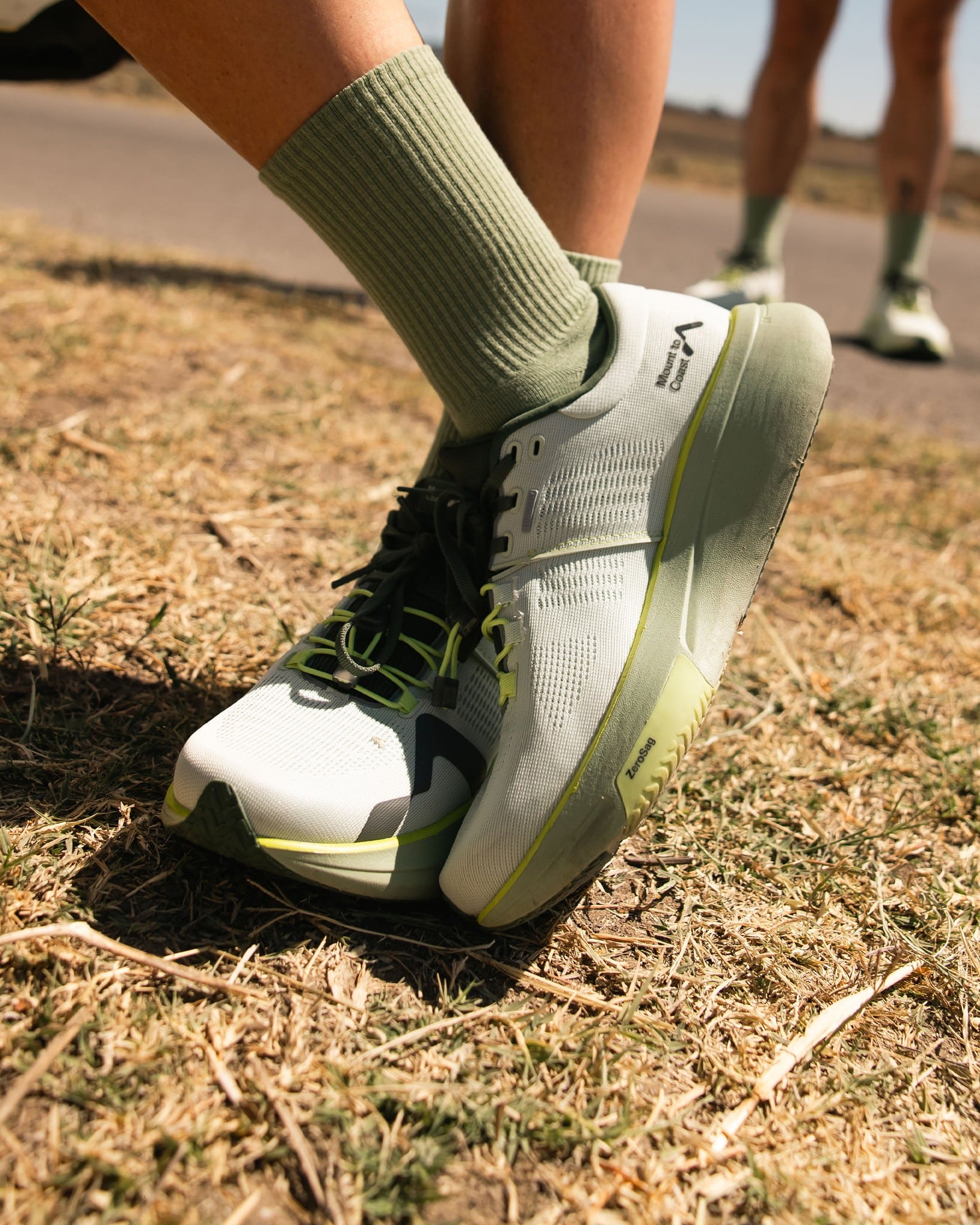
The R1 is a non-plated road ultramarathon training and racing shoe. It features a PEBA-hybrid midsole (LightCELL), a ZeroSag polyurethane insert, and the TUNEDFIT dual lacing system — the same system that would go on to define the T1 and C1. Conceived after 18 months of R&D and tested by athletes running 450+ miles over stage races, it won the 2023 ISPO Award in prototype form. The production shoe arrived with the same core philosophy: make something that holds up and holds its feel across distances that break other shoes.
Justin Montague famously completed the JOGLE — John O’Groats to Land’s End, 854 miles across Britain — in a single pair of R1s over 18 consecutive days. That one data point did more for the brand’s credibility than any marketing campaign could have.
Quick Specs
| Stack height | 35 mm heel / 27 mm forefoot |
| Drop | 8 mm |
| Weight | 241 g / 8.5 oz (men’s US 9) |
| Platform width | 90 mm heel / 80 mm midfoot / 120 mm forefoot |
| Midsole | LightCELL (supercritical PEBA hybrid, nitrogen-infused) + ZeroSag PU insert |
| Outsole | Lightweight compound with GOFLOW guidance structure |
| Upper | Double-layer jacquard engineered mesh |
| Lacing | TUNEDFIT dual lacing system (traditional top + quick-pull forefoot) |
| Plate | None |
| Sizing | True to size (slightly lower volume — some runners with wider feet may prefer half size up) |
| Price | $160 / £150 |
The Upper: Comfort as a Design Principle
The R1 upper is built from a double-layer jacquard mesh — soft against bare skin, perforated for breathability, and structured enough to maintain its shape over extended mileage. Multiple testers noted it as one of the more comfortable road uppers they had tested, particularly for sockless running, though some caution is warranted there: stitching at the lower lace zone can cause rubbing at that contact point over long efforts.
The heel collar is highly padded — notably so — with a firm heel counter beneath providing structural support. In practice, the combination delivers secure heel retention without the harshness of a purely rigid counter. The gusseted tongue is moderately thick and stays in place cleanly across the range of paces the shoe is intended for. Breathability held up well across warm-weather testing, and the upper retained its shape and comfort after 300+ miles in one documented long-term test, showing no meaningful signs of wear.
One consistent note: the upper runs at normal to slightly lower volume. Runners with wider feet may find the forefoot more snug than the generous toe box dimensions suggest, as the lower overall volume limits how much the width can express itself. The TUNEDFIT system compensates for this to a meaningful degree, but those between sizes may benefit from going half a size up.
TUNEDFIT: The System That Started It All
The TUNEDFIT dual lacing system on the R1 divides the upper into two independently adjustable zones: a traditional lace at the midfoot-to-ankle section, and a quick-pull toggle cord at the forefoot. The logic is straightforward and sound — over ultra distances, feet swell unevenly, and being able to loosen the forefoot without compromising the ankle lockdown is a genuine functional advantage that no standard single-lace system can replicate.
In testing, the system worked as intended. Runners appreciated the ability to dial in different tensions at the two zones, particularly on longer efforts where forefoot volume increased. The forefoot toggle in its original R1 incarnation is simpler than the clip-equipped version introduced on the C1, and some testers found it required more active management. Robbe Reddinger at Believe in the Run compared it to a budget alternative to the BOA Fit System used on Speedland shoes — accurate in spirit, if not in mechanical refinement. The point holds: for a $160 shoe targeting the ultra segment, offering this level of fit adjustability at launch was a meaningful decision.
LightCELL + ZeroSag: The Midsole Argument
The R1 midsole is the heart of the shoe’s proposition. LightCELL is Mount to Coast’s supercritical PEBA-hybrid foam, nitrogen-infused for a claimed 50% weight reduction versus standard EVA and 45% more energy return. In feel, it sits firmer than most pure PEBA compounds — notably so. Multiple testers described it as firmly cushioned rather than plush, providing consistent protection without the squishy, energy-sapping feel of softer max-cushion foams. Doctors of Running noted that the foam feels better the longer you run in it, softening slightly under sustained load — a characteristic of the compound’s durability profile rather than premature compression.
Beneath the LightCELL sits the ZeroSag insert — a polyurethane component developed with BASF, inspired by race car suspension gaskets. It runs in an S-shape from the lateral midfoot to the medial forefoot, adding stiffness and guided support at the transition zone. Its primary functions are preventing midsole sag over long miles and providing mild medial guidance through the midfoot and lateral guidance at the forefoot. Testers with a neutral to slightly supinating stride noticed it most; for heel strikers it added a degree of structure to an otherwise neutral platform. Running Attitude’s test noted the cross-reinforcement explicitly as a key stability feature, finding it effective at keeping the foot aligned during fatigue.
The overall ride character is smooth and consistent at easy to moderate paces. At faster efforts — strides, tempo segments — the R1 feels flat. It does not reward pace increases the way a more reactive foam does, and testers consistently noted that pace changes above easy running felt slightly awkward. This is not a design flaw. It is the correct expression of the shoe’s purpose: a foam tuned for durability and consistency over many hours, not peak energy return over short intervals. Runners who tested it within that framing uniformly rated it well. Runners who pushed it toward tempo use found it wanting — which tells you more about expectation management than about the shoe itself.
The Outsole: Lightness, GOFLOW, and the Clicking Issue
The R1 outsole prioritises weight reduction over grip density. There are no deep lugs and limited rubber coverage — the contact surface is largely the outsole foam compound itself, with the GOFLOW structure providing the visible geometric differentiation. GOFLOW is an S-shaped ridge running through the outsole aligned with the natural stride path, intended to guide the foot through its gait cycle and contribute to the smooth ride multiple testers observed.
Grip on dry and damp road surfaces was rated adequate across all tests. Running.Reviews tested it on gravel and light off-road as well as wet pavement without meaningful issues. Doctors of Running avoided trail use deliberately given the shoe’s white colorway — a relatable choice.
The one documented issue with early R1 production units was a clicking or squeaking noise on wet surfaces and certain indoor floors. Believe in the Run’s Robbe Reddinger described it memorably, noting it was loud enough to be a dealbreaker for some runners. Mount to Coast acknowledged the issue and addressed it in an inline production update; later units and the subsequent R1R model with a rubber outsole resolved it. Runners ordering today are unlikely to encounter it, though individual variation in floor surfaces may produce occasional noise from the ZeroSag insert cutouts.
Durability on the outsole has been a consistent strength. After 300 miles, minimal wear was observed in the Running.Reviews long-term test. After 35 miles in early Doctors of Running testing, the outsole showed barely any wear — in line with the brand’s durability claims and consistent with what the LightCELL and ZeroSag components were engineered to deliver.
On the Road: What Testers Said
Across six independent reviews spanning physical therapists, competitive ultrarunners, daily mileage runners, and a French specialist press test, the R1 lands in a clear and consistent position: an excellent easy-pace and long-run shoe that has no ambition to be anything else, and is better for it.
The Meta Endurance multi-tester panel — one an experienced ultramarathoner, one a high-mileage everyday runner with no ultra background — converged on the same conclusion from different starting points. Ivan found it impressively smooth despite the absence of a rocker geometry he typically prefers, noting that the materials produce a ride that improves with distance. Andy, approaching it as a daily trainer rather than a racing shoe, called it an instant favourite: comfortable, unobtrusive, and entirely suited to accumulating mileage without drama.
Road Trail Run’s John Tribbia, a former sponsored mountain and trail racer, found the wide toe box and TUNEDFIT system a genuine step forward for longer efforts. His one consistent note — midsole responsiveness at faster paces — echoes every other source without being a complaint: it’s what the shoe is, not what it fails to be.
Running Attitude’s French-market test gave it 19/20 for comfort, 20/20 for cushioning, and 17/20 for stability — noting it was well-suited to runners of all body weights on long road efforts. The score of 13/20 for dynamism is the honest acknowledgement that pace is not the point.
The one area of genuine structural feedback from Doctors of Running is worth noting: the heel bevel on the R1 is smaller and more centred than would be ideal for a shoe targeting heel-striking ultramarathoners. A larger, more lateral bevel would ease rear-foot transitions for that population. David Salas also suggested a slightly larger forefoot rocker would reduce calf load in the final miles of very long events. These are development observations rather than dealbreakers, and both were addressed in subsequent Mount to Coast models.
Where the R1 Sits in the Mount to Coast Lineup
The R1 is the origin point. Everything that came after it — the S1 daily trainer, the P1 stability model, the H1 hybrid, the T1 trail shoe, the C1 max-cushion trainer — builds on the foundation the R1 established: PEBA-hybrid foam, TUNEDFIT lacing, ZeroSag guidance, clean aesthetics. Understanding the R1 is understanding what Mount to Coast is trying to do as a brand.
Within the lineup, the R1 occupies the road specialist position at a lower stack height and firmer character than the C1. Where the C1 is the high-cushion daily trainer for road mileage, the R1 is the more connected, lighter option for runners who want more road feel and less foam between foot and ground. Where the H1 bridges road and light trail, the R1 is for pavement only — but handles it with precision.
For runners building toward a road ultra, the R1 pairs naturally with a structured approach to long-run nutrition and hydration. Our guide on trail running nutrition and hydration covers the principles that apply equally to road ultra efforts, and our overview of choosing a hydration pack is worth reading for anyone planning efforts beyond marathon distance.
Who Is the R1 For?
The R1 is for runners who log serious mileage on road — not as a casual hobby, but as a committed training practice — and want a shoe that prioritises durability, consistent cushioning, and adjustable fit over peak responsiveness or pace flexibility. Road ultramarathoners are the stated primary audience, and the shoe delivers for them. But the profile extends to any runner who wants a reliable, honest daily trainer for easy and long runs and does not need the shoe to also serve as a tempo or race-day option.
Runners with normal to slightly narrow feet will find the fit most natural. Runners with wider feet will need to work the TUNEDFIT system carefully and may prefer going half a size up. Runners who want softness will find the R1 firmer than expected for its stack height — which is a feature, not a flaw, for anyone prioritising durability and ground feel. Runners who want a shoe that feels better after 20 miles than after 2 will find exactly that here.
Frequently Asked Questions
Is the R1 suitable for marathon racing?
For standard marathon distances at competitive paces, most runners will find the R1 less suited than a more reactive plated or high-energy-return shoe. For marathon distances run at ultra pace — slower, consistent, with fatigue management as the priority — the R1 is entirely appropriate, and runners have used it successfully in that context.
What is the ZeroSag insert and what does it actually do?
ZeroSag is a polyurethane component co-developed with BASF, designed using principles from race car suspension engineering. It sits within the midsole running from the lateral midfoot to the medial forefoot in an S-shape, adding structural resilience to the foam stack. Its primary roles are preventing midsole compression sag over very long distances, providing mild medial guidance at the midfoot, and adding lateral guidance at the forefoot. Runners with neutral to slightly supinating strides notice its presence most.
Is the clicking noise still an issue?
Mount to Coast addressed the clicking issue with an inline production update to the R1. Current production units are significantly improved, and the R1R model introduced a rubber outsole that resolves it entirely. Runners ordering today are unlikely to encounter the problem that affected some early pairs.
How does the R1 compare to the H1?
The H1 is a road-to-trail hybrid with a VersaGrip outsole and CircleCELL foam — suited to mixed surfaces and daily training across road and light trail. The R1 is a pure road shoe with LightCELL foam and a lighter, less grippy outsole — suited to pavement-only efforts where durability over extreme distance is the priority. The H1 is the more versatile everyday option; the R1 is the more purpose-specific choice for road ultra training.
Does the R1 work for heavier runners?
Yes. Running Attitude’s test specifically noted the R1 as well-suited to runners of all body weights on long road efforts, citing the ZeroSag insert and consistent midsole behaviour as key factors. The foam’s firmness means it does not bottom out under higher loads, and the platform width provides adequate stability across body types.
The Mount to Coast R1 is available directly from mounttocoast.com, priced at $160 USD / £150 GBP.