hill.camp does not conduct first-hand product testing. This review is a synthesis of independent field tests, specialist press articles, and verified consumer feedback gathered from multiple sources. All technical data and performance observations are drawn from those sources and attributed accordingly.
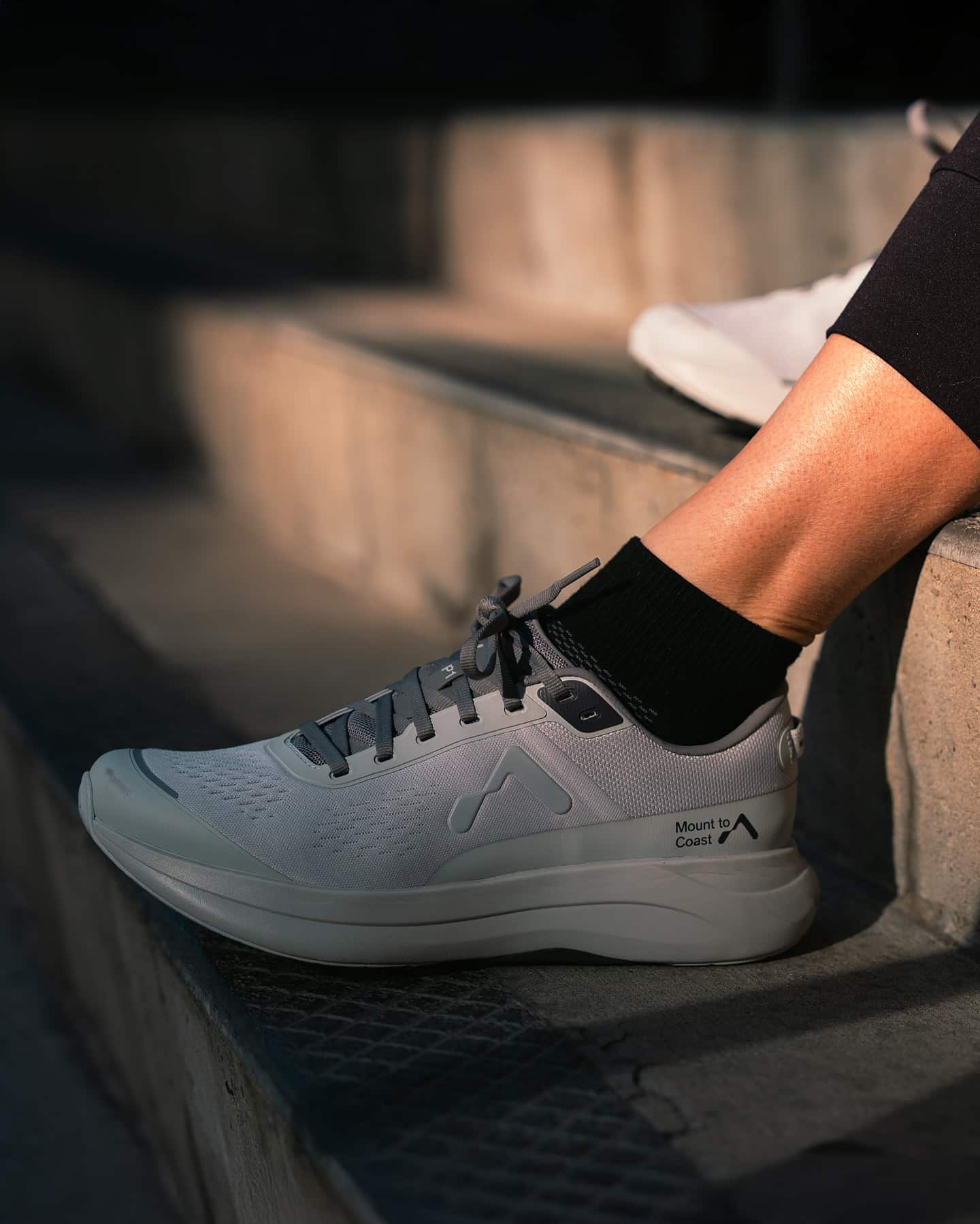
Most stability shoes solve the same problem in the same way: add a medial post under the heel, stiffen the arch zone, and trust that rearfoot control cascades forward through the stride. Mount to Coast disagreed. The P1, the brand’s stability model, concentrates its guidance primarily at the forefoot — the moment in the gait cycle where the foot pushes off, where pronation-related issues most often express themselves in distance runners. It is a genuinely unusual approach in a category long dominated by medial wedges and dual-density foams, and it produces a genuinely unusual shoe.
What the P1 Is
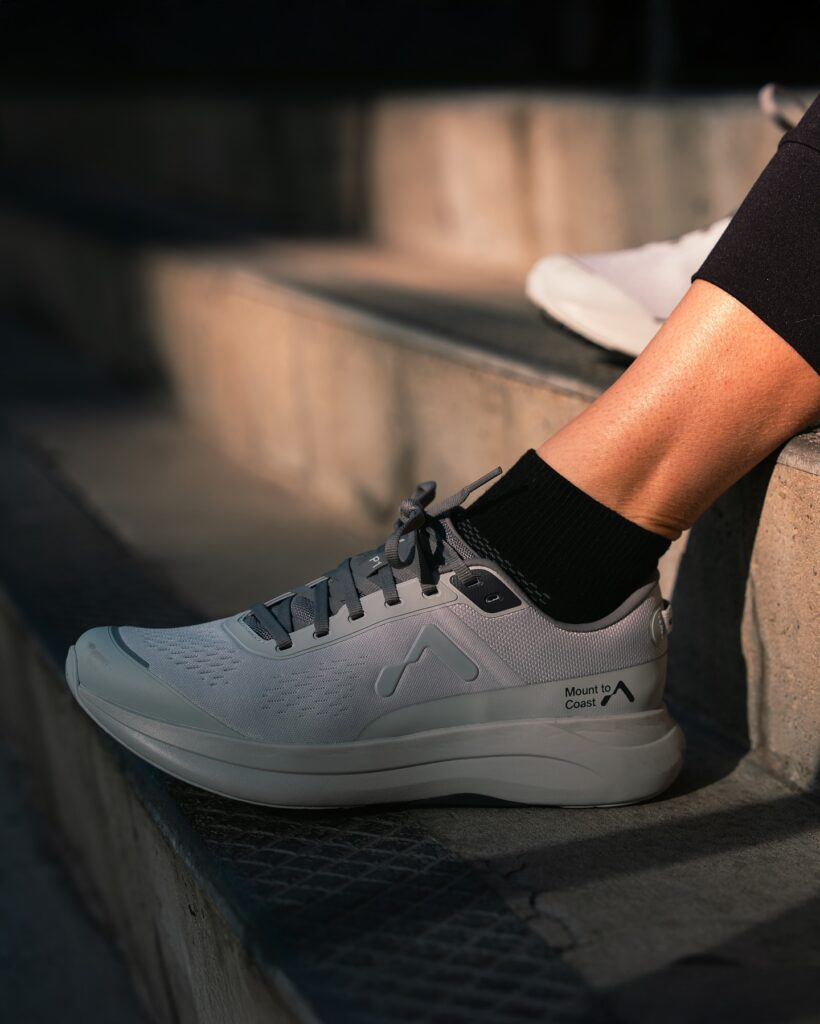
The P1 is a mild stability daily trainer and ultramarathon shoe built around the same LightCELL PEBA-hybrid midsole as the R1, with two additional structural elements: the 3D Archrail and a dual-zone insole. Neither is a traditional post. Neither pushes aggressively into the arch. Together, they create forefoot guidance that most testers described as subtle and effective rather than prescriptive — a stability approach designed for runners who find conventional support elements intrusive or who have struggled with forefoot control specifically.
Quick Specs
| Stack height | 37 mm heel / 27 mm forefoot |
| Drop | 10 mm (runs closer to 6 mm in feel) |
| Weight | ~280 g / 9.9 oz (men’s US 9) |
| Platform width | 97 mm heel / 78 mm midfoot / 122 mm forefoot |
| Midsole | LightCELL (supercritical PEBA hybrid) + 3D Archrail + dual-zone insole |
| Outsole | Rubber with GOFLOW geometry |
| Upper | Circular knit engineered mesh, fully gusseted tongue, midfoot support cage |
| Lacing | Asymmetrical flat lace system with adjustable midfoot loops |
| Plate | None |
| Sizing | True to size; snug midfoot — half size up recommended for ultra distances or wider feet |
| Price | $160 |
The Upper: Comfort First, Security Second
The P1 upper combines two materials: a soft circular knit engineered mesh across the forefoot and midfoot, and a more abrasion-resistant fabric at the rear quarter. The result is an upper that feels plush against the skin — multiple testers confirmed it as one of the more comfortable against-skin experiences in the road stability category, with several running long efforts sockless without issue — while maintaining structural integrity around the heel and ankle.
The heel counter is semi-rigid and extends slightly further forward than most, providing a secure cradle without requiring aggressive padding compression to achieve it. A thick, fully gusseted tongue stays in position throughout runs and contributes meaningfully to the overall comfort on longer efforts. Reflective details on the upper are positioned practically for low-light visibility rather than decoratively. The lacing pattern is asymmetrical — angled toward the lateral side, reminiscent of race-oriented setups — which caught some testers’ attention aesthetically but caused no functional issues.
The one consistent fit note across all sources: the midfoot is narrower than the platform width implies. Runners with normal to slightly narrow feet find this a positive — a snug, secure hold without any sense of constriction. Runners with wider feet, or those who swell significantly over ultra distances, may find the midfoot cage limiting. The adjustable midfoot lacing loops can compensate to a degree, but the fundamental shape of the last is built for a medium to slightly narrow foot. Going half a size up is the recommended approach for those at the edge.
One minor entry-of-shoe note: on first step-in, the dual-zone insole shape creates an arch pressure sensation that several testers initially mistook for an aggressive shank. It disappears entirely once running begins and did not recur as a complaint in any subsequent test session — but worth knowing so the first impression does not become a false deterrent.
The 3D Archrail: A Different Kind of Stability
The 3D Archrail is the P1’s defining feature and its most meaningful departure from conventional stability design. It is a plastic stiffening structure embedded in the midsole running from the lateral midfoot into the medial forefoot — the same S-shaped trajectory as the ZeroSag insert in the R1, but here oriented specifically to provide medial forefoot stability rather than general midsole resilience. At the medial forefoot edge it rises slightly, creating a firm lateral-to-medial guidance ramp that the foot pushes off against.
In practice, the Archrail adds rigidity and a stable platform at the forefoot without creating the post-like feeling that many runners find intrusive in traditional stability shoes. Doctors of Running’s Matt Klein — a physical therapist who writes extensively on the evidence base for stability footwear — noted that the Archrail delivers genuine medial forefoot guidance without a wedge, making it one of a very small number of stability options that address this specific mechanics problem. For runners who struggle with forefoot pronation or abduction but do not respond well to traditional posts, this is a meaningful distinction. Runners who land farther forward and want a stable push-off platform will benefit most; heel strikers will find the guidance less immediately relevant until they reach the forefoot portion of their stride.
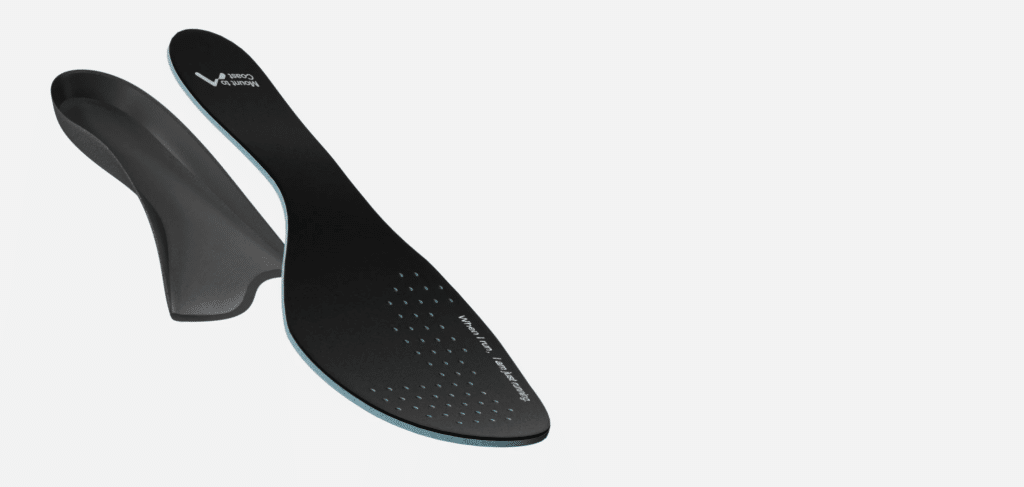
The dual-zone insole complements the Archrail with additional structured support, particularly in the heel cup zone. It reads — and feels — more like a quality aftermarket insole than a standard OEM liner, a detail Trail & Kale’s Alastair Dixon specifically called out. The combination of Archrail and insole creates heel and forefoot guidance without a post, which is why multiple testers — including runners with flat feet who had not previously found stability shoes comfortable — reported a smooth, stable ride with no sense of intrusion.
LightCELL on the P1: Dense, Controlled, Consistent
The midsole compound is the same LightCELL PEBA hybrid used in the R1 and H1, but it behaves differently here because the Archrail and platform geometry change what the foam is asked to do. Rather than acting as the primary cushioning and guidance system, the LightCELL is working alongside structural elements — which means it can be tuned slightly firmer without the ride feeling harsh, because the guidance comes from geometry rather than foam density variation.
The resulting feel is one that several reviewers struggled to categorise using standard language. Road Trail Run’s Maciej Kolat described it as dense without being firm, with a slow, controlled energy return rather than a quick snap — comparing it to a grip-strength ball rather than a spring. Doctors of Running called it shock-absorbing with little bounce. Trail & Kale noted a balanced blend of cushioning and responsiveness. The common thread is that the P1 does not feel like a PEBA shoe in the conventional sense of that word — it does not have the lively, reactive quality associated with race-day foam. Instead it has consistency, protection, and a ride that holds its character across long efforts without compression or energy drain.
One note on durability perception: Believe in the Run’s Sam Sheldon observed the LightCELL feeling slightly less plush after 50 miles, though unchanged structurally after 100 miles. This aligns with the compound’s design intent — durability over softness — and is an honest observation for runners who prize initial softness above all else. Those who prioritise long-term consistency over peak plushness will find what they are looking for.
The rocker geometry is moderate. There is an early forefoot rocker that makes for a smooth transition off the front of the foot, which is the P1’s strongest point geometrically. The heel bevel, however, is the shoe’s weakest geometric element — small, centred, and producing a slightly clunky rearfoot transition that Doctors of Running flagged as the clearest area for improvement. Both Matt Klein and Bach Pham noted the heel feels jarring in the first miles, particularly for heel strikers and on fatigued legs. The 10 mm drop, somewhat unusually, reads lower in feel — multiple testers estimated 6 mm on the run — which takes some pressure off the calves and makes the higher number less relevant in practice.
The Outsole: Durable, Grippy, Quietly Effective
The outsole is a full-coverage rubber construction with GOFLOW geometry — the same guidance structure as the R1, here also carrying the visual indicator of the stabilising zones through a grey colourway within the outsole pattern. The rubber coverage is more extensive than on the R1, which used a lighter compound more selectively. On the P1, durability is prioritised: after 40 miles of testing including daily walking, Doctors of Running observed zero outsole wear. The Road Trail Run tester completed runs on snow-melt conditions — notoriously slippery — and reported no grip issues.
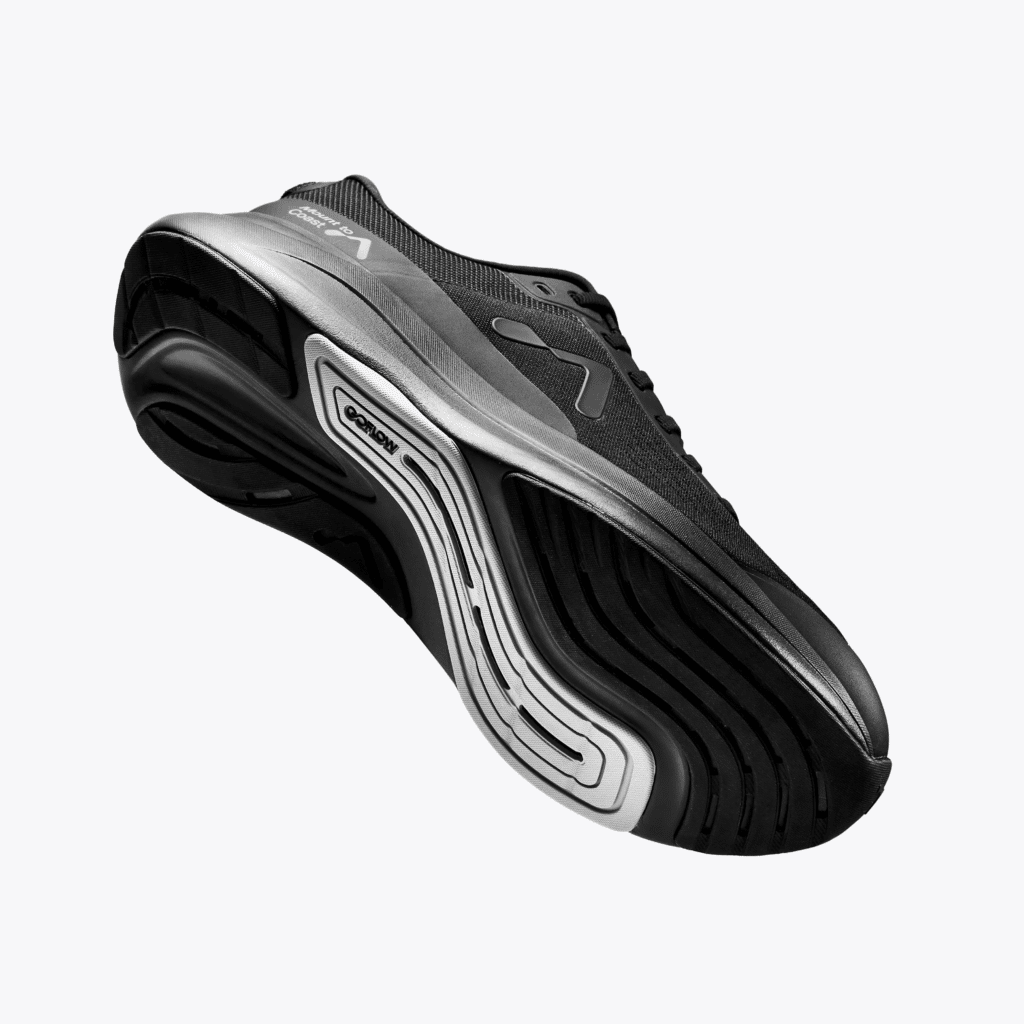
Traction in wet conditions was consistently rated as adequate to good. The grooves are not deep, but the rubber compound compensates in adhesion. For road and light trail, the outsole is well-matched to the shoe’s purpose. The GOFLOW pattern contributes to the flexible, natural-movement feel of the outsole — allowing it to conform to the ground rather than bridge across uneven surfaces — which supports the stability the Archrail creates from above.
On the Road: What Testers Said
The P1 generated unusually consistent enthusiasm across very different tester profiles, which is notable for a stability shoe — a category that tends to polarise based on how aggressively the support elements are felt.
Run and Become’s tester, who had historically struggled to get on with stability shoes finding them stiff and overbearing, reported that the P1 felt natural and unobtrusive within 20 minutes of the first run — and subsequently adopted it for gym cross-training days as well. Trail & Kale’s Alastair Dixon, who typically avoids high-drop shoes, found the on-foot feel closer to a 6 mm shoe and praised its versatility across easy runs, long runs, and tempo efforts. Road Trail Run’s Maciej Kolat — a heel striker with a wider-than-average midfoot, running on Scottish winter pavements — gave it 9.5/10 and called the stability feel genuinely effective across foot strike patterns, not just at the forefoot.
Believe in the Run’s Sam Sheldon, approaching it as a performance-interested runner, found it capable of handling workouts and strides as well as easy mileage — a broader use case than the shoe’s marketing implies. Lindsay Agro noted the forefoot stability approach was new to her and worked, allowing her to focus on form elsewhere in her stride rather than managing foot placement.
Doctors of Running’s assessment is the most granular and the most useful for runners considering the P1 specifically for its stability claims. Klein’s conclusion: the 3D Archrail is one of a very small number of forefoot stability mechanisms on the market that does not use a wedge and that genuinely addresses medial forefoot guidance. He notes it as a valuable tool for runners who need this specifically — and emphasises, clearly and at length, that the brand’s marketing language around pronation being a cause of running injuries requires updating to reflect current biomechanical evidence. The shoe design is sound; the marketing context around it is not. Hill.camp aligns with this position.
Where the P1 Sits in the Mount to Coast Lineup
The P1 completes the original Mount to Coast road trilogy alongside the R1 (ultramarathon racer/daily trainer, neutral) and the S1 (daily trainer, neutral). Of the three, the P1 is the heaviest — approximately 280 g versus the R1’s 241 g — which reflects the additional structural elements and broader platform. The midsole character is similar: consistent, durability-oriented, and better suited to sustained easy paces than reactive fast efforts.
Against the broader Mount to Coast lineup, the P1 shares the LightCELL DNA of the R1 and the road-only outsole approach, while the H1 and T1 represent the hybrid and trail directions of the same philosophy. Runners who have found the R1 or H1 comfortable but want forefoot guidance have a clear path to the P1. Runners looking for maximum cushion on road should consider the C1 instead.
For runners building toward longer road efforts who are also thinking about nutrition and hydration strategy, our guide on trail running nutrition and hydration covers principles that apply equally to road ultras, and our guide to choosing a hydration pack is worth reading alongside any shoe review for efforts beyond marathon distance.
Who Is the P1 For?
The P1 is for runners who need forefoot guidance specifically, or who want mild stability without the obtrusive post-and-wedge feel of most traditional stability shoes. It is particularly well-suited to mid-to-forefoot strikers, to runners who have struggled with conventional stability designs, and to anyone who accumulates high mileage on road and wants a consistent, protective shoe that holds its character across hundreds of miles.
It is less suited to pronounced heel strikers who will not benefit from the Archrail until late in the gait cycle — though the heel guidance from the platform width and insole is still present. It is not a workout or tempo shoe. Runners with wide feet need to try before committing, as the midfoot cage is the most divisive fit element across all tested populations.
For the runner who has never found a stability shoe that felt right, the P1 is a genuinely different proposition — and for many of those runners, the first one that works.
Frequently Asked Questions
How is the P1’s stability different from a traditional stability shoe?
Most stability shoes use a denser medial foam wedge (post) under the heel and midfoot to limit inward roll on landing. The P1 instead uses a plastic stiffening element — the 3D Archrail — positioned in the midsole from the lateral midfoot to the medial forefoot, creating a guided push-off surface rather than a landing correction. This makes it particularly useful for forefoot pronation and mid-to-forefoot strikers, and less intrusive for runners who dislike the feel of traditional posts.
Is the P1 suitable for heel strikers?
Yes, with some caveats. The heel platform is wide and the insole provides rearfoot structure, so the shoe is genuinely stable at heel contact. However, the primary stability mechanism (the Archrail) is most effective at the forefoot — meaning heel strikers benefit less from the P1’s unique technology than midfoot or forefoot strikers do. The clunky heel transition noted by several testers is also more noticeable for consistent heel strikers, particularly when fatigued.
Does the 10 mm drop feel aggressive?
No — multiple testers independently noted the on-foot feel is closer to 6 mm. The geometry of the shoe, particularly the early forefoot rocker, distributes the drop in a way that avoids the calf-loading sensation typically associated with high-drop shoes. Runners who normally avoid 10 mm drop footwear may find the P1 more accessible than expected.
How does the P1 compare to the R1?
Both use LightCELL foam and share the same general ride character: consistent, durable, best at easy to moderate paces. The P1 is heavier by approximately 40 g, has a higher stack at the heel (37 mm vs 35 mm), a wider platform, and adds the 3D Archrail and dual-zone insole for forefoot guidance. Runners who found the R1 comfortable but wanted more structure at push-off should consider the P1. Runners who want the lightest option should stick with the R1.
Is the P1 appropriate for marathon and ultramarathon distances?
Yes. The durability, consistent midsole, and wide platform are well-suited to very long efforts. Runners targeting marathon or ultra distances should consider sizing up half a size to accommodate foot swelling, particularly given the snug midfoot cage. The shoe has been tested at high mileage across multiple sources with no structural degradation reported.
The Mount to Coast P1 is available directly from mounttocoast.com, priced at $160 USD.