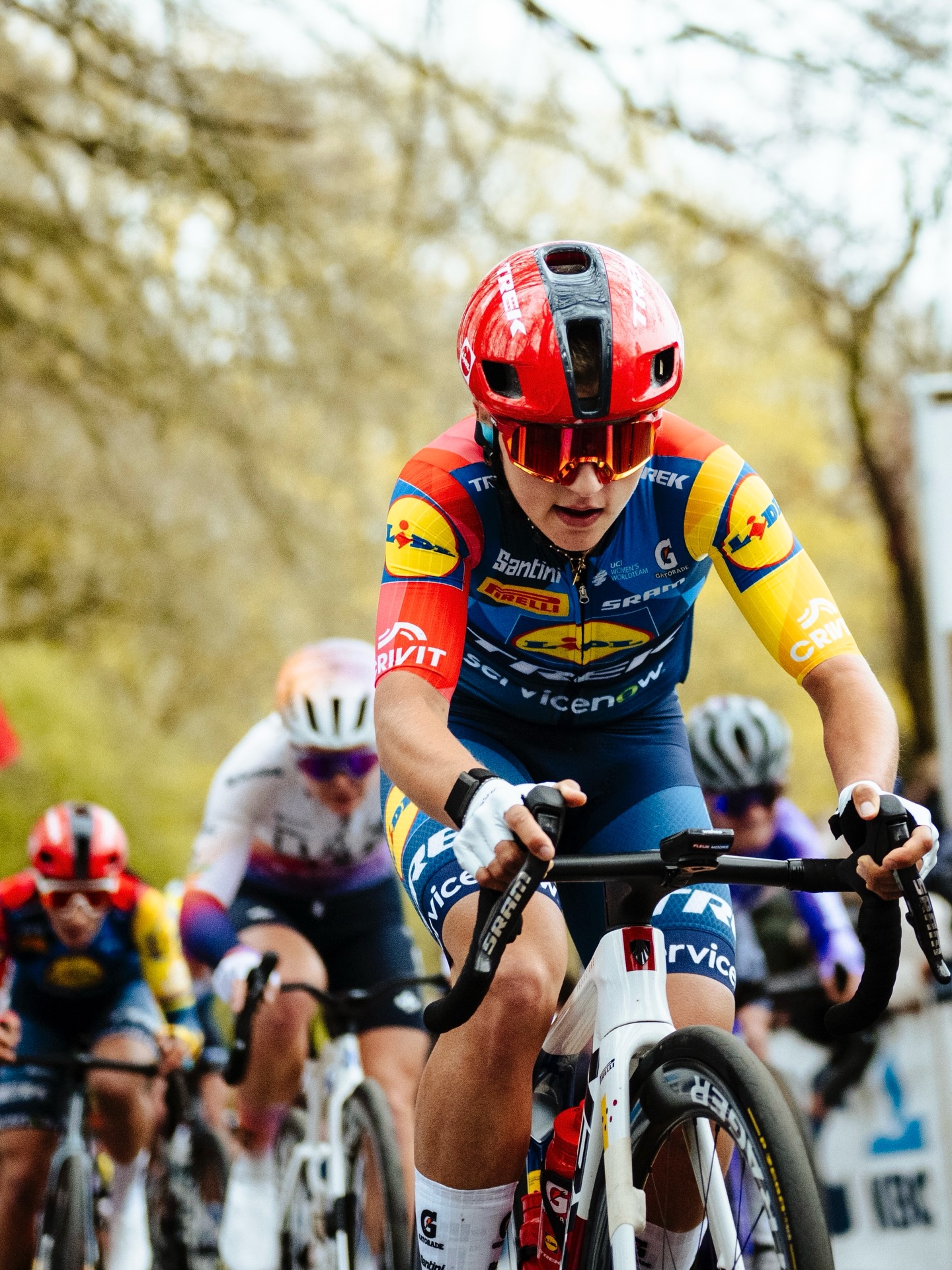
The name comes from Afrikaans — it means journey, or travel on foot across difficult terrain. Richard Burke and Bevil Hogg chose it in 1976 for the five-person company they were starting in a rented red barn in Waterloo, Wisconsin, making hand-brazed steel touring frames. Nearly nine hundred of those first frames left the barn in the first year, each one selling for just under $200. Fifty years later, Trek is one of the three largest bicycle companies in the world, with bikes in 90 countries, Tour de France victories, and a lineup that runs from beginner hybrids to WorldTour race machines. The journey from the red barn to that level of reach is a story about what sustained investment in technology and athlete relationships produces over decades.
Waterloo to the World: The First Decades
Trek’s early competitive focus was road racing. By 1982, the company had moved beyond touring frames into road race bikes. By 1983, it had entered the mountain bike category, which was still in its infancy as a commercial product. The pattern was consistent: Trek identified where cycling was going and committed manufacturing and engineering resources to be ready when the market arrived. The first aluminium Trek appeared in 1985; the first carbon fibre model in 1989. The carbon programme was initially tentative, but a pivotal moment came in the early 1990s when Trek’s technology director attended an aerospace composites demonstration and returned convinced that carbon fibre was the future of high-performance bicycle frames. Heavy investment in OCLV — Optimum Compaction Low Void — carbon fibre manufacturing followed, and it became the proprietary material technology that would underpin Trek’s premium bikes for the next three decades.
The Lance Armstrong years — seven Tour de France victories from 1999 to 2005, all on Trek machines — gave the brand a global profile that no amount of marketing could have purchased. Whatever the subsequent history of those victories, the technical exposure was real and the brand recognition it created was permanent. Trek’s OCLV carbon frames were ridden to the most scrutinised finish lines in cycling for seven consecutive years. The engineering credibility that established remained after the controversies.
IsoSpeed: Trek’s Defining Technology
Trek’s most significant and original engineering contribution to road cycling is IsoSpeed — a decoupler mechanism at the seat tube junction that allows the seat tube to flex independently of the rest of the frame under vertical load. The system was introduced on the Domane in 2012, developed in part through the experience of Fabian Cancellara, who rode a prototype to victories in both the Tour of Flanders and Paris–Roubaix in the same year — one of the most remarkable weekend doubles in classics cycling history.
IsoSpeed is not a marketing story. It is a patented mechanism with measurable compliance characteristics that reduce vertical vibration transmission from the road to the rider without the weight, complexity, or lateral compliance penalty of a suspension fork. On cobblestones, rough tarmac, and mixed-surface riding, the Domane’s IsoSpeed system produces a measurably smoother ride than conventionally coupled frames. The technology has since been extended to the front end of the bike (front IsoSpeed on the current Domane) and refined across multiple generations. It remains Trek’s clearest technical differentiator from the field.
The Checkpoint: Trek’s Gravel Reference
Trek entered the gravel market with the Checkpoint, a purpose-built gravel bike developed with wide tyre clearance, integrated storage solutions, and geometry that sits between a road endurance bike and a light touring platform. The Checkpoint is available across a wide price range — from aluminium ALR versions at accessible price points to the Checkpoint SLR with OCLV carbon and SRAM Red AXS at the performance end.
The Checkpoint’s defining characteristics are its versatility and its storage integration. Internal cable routing, IsoSpeed-derived compliance on higher-end versions, up to 45mm tyre clearance, and a comprehensive system of frame bags and mounts make it one of the most expedition-ready gravel bikes in the mainstream market. Where the Giant Revolt emphasises D-Fuse compliance and the Canyon Grizl prioritises adventure geometry and tyre clearance, the Checkpoint’s strength is the breadth of its capability across race-day, bikepacking, and everyday mixed-surface riding. Our gravel bike guide covers where it sits in the broader category context.
Key Product Lines
| Model | Category | Best For |
|---|---|---|
| Madone SLR | Aero road | Racing, sprinting, aero priority |
| Emonda SLR | Climbing road | Mountains, lightweight performance |
| Domane SLR | Endurance road | Cobbled classics, long-distance, all-road |
| Checkpoint SLR | Gravel race | Gravel racing, mixed-surface speed |
| Checkpoint SL | Gravel adventure | Bikepacking, multi-day gravel |
| Fuel EX | Trail MTB | All-mountain trail riding |
| Top Fuel | XC MTB | Cross-country racing, marathon |
Project One: Customisation at Scale
Trek’s Project One programme allows riders to customise the colour, finish, groupset, and componentry of selected models through an online configurator, with assembly handled at Trek’s Waterloo facility. It is not the same as true custom geometry — you are choosing from Trek’s frame sizes — but the level of visual and component personalisation is extensive, and the result is a bike that no one else at your sportive will be riding in exactly the same specification. For cyclists who want something distinctive without committing to a boutique framebuilder, Project One occupies a unique market position.
What Makes Trek Different
OCLV carbon. Trek’s proprietary Optimum Compaction Low Void carbon manufacturing process produces frames with fewer voids (air pockets) in the carbon layup than standard methods, resulting in higher structural consistency and strength-to-weight ratios. The 800 Series OCLV used in the current Emonda and Madone SLR represents the most refined version of a technology Trek has been developing in-house since the early 1990s.
IsoSpeed differentiation. No other major brand has an equivalent patented compliance mechanism at this level of refinement. The Domane’s dual IsoSpeed system — front and rear decouplers in a single frame — produces a ride quality that is genuinely different from competing endurance road bikes, not merely differently specced.
Dealer network depth. Trek sells through a network of independent specialist bike dealers rather than direct-to-consumer. This means most cyclists can see, touch, and test ride a Trek before committing. In a market where Canyon‘s online-only model requires purchasing without a test ride, Trek’s dealer presence is a genuine advantage for buyers who want in-person fit and service relationships.
Honest Limitations
Trek’s dealer-network model means prices are generally higher than direct-to-consumer equivalents from Canyon or direct brands. For equivalent specifications, a Trek Checkpoint SLR will cost more than a Canyon Grizl CF SLX at a comparable component level — a difference that reflects dealer margin rather than manufacturing quality. For buyers who prioritise value-per-specification over the in-person retail experience, Trek’s pricing requires justification against the online alternatives.
Trek also carries Lance Armstrong’s Tour de France victories in its brand history, a fact that remains complicated regardless of the quality of the bikes involved. For most cyclists this is historical context rather than a present-day concern, but it is worth acknowledging for completeness.
Our Take on Trek
Trek is one of the most complete bicycle companies in the world, and its best products — the Domane, the Checkpoint, the Emonda — are genuinely excellent rather than merely competent. IsoSpeed is a real technology that produces a real difference in riding experience. OCLV carbon is a real manufacturing advantage. The dealer network provides a real service infrastructure that online-only brands cannot match.
For gravel riders, the Checkpoint is one of the most versatile and thoughtfully integrated bikes in the category, and it competes directly with Specialized’s Diverge, Canyon’s Grizl, and the Giant Revolt. For endurance road riders, the Domane’s IsoSpeed system is still unmatched by any competitor with an equivalent compliance mechanism. For climbers, the Emonda SLR competes with the lightest machines in the category.
Explore the full Trek road, gravel, and mountain range on the Trek official website.