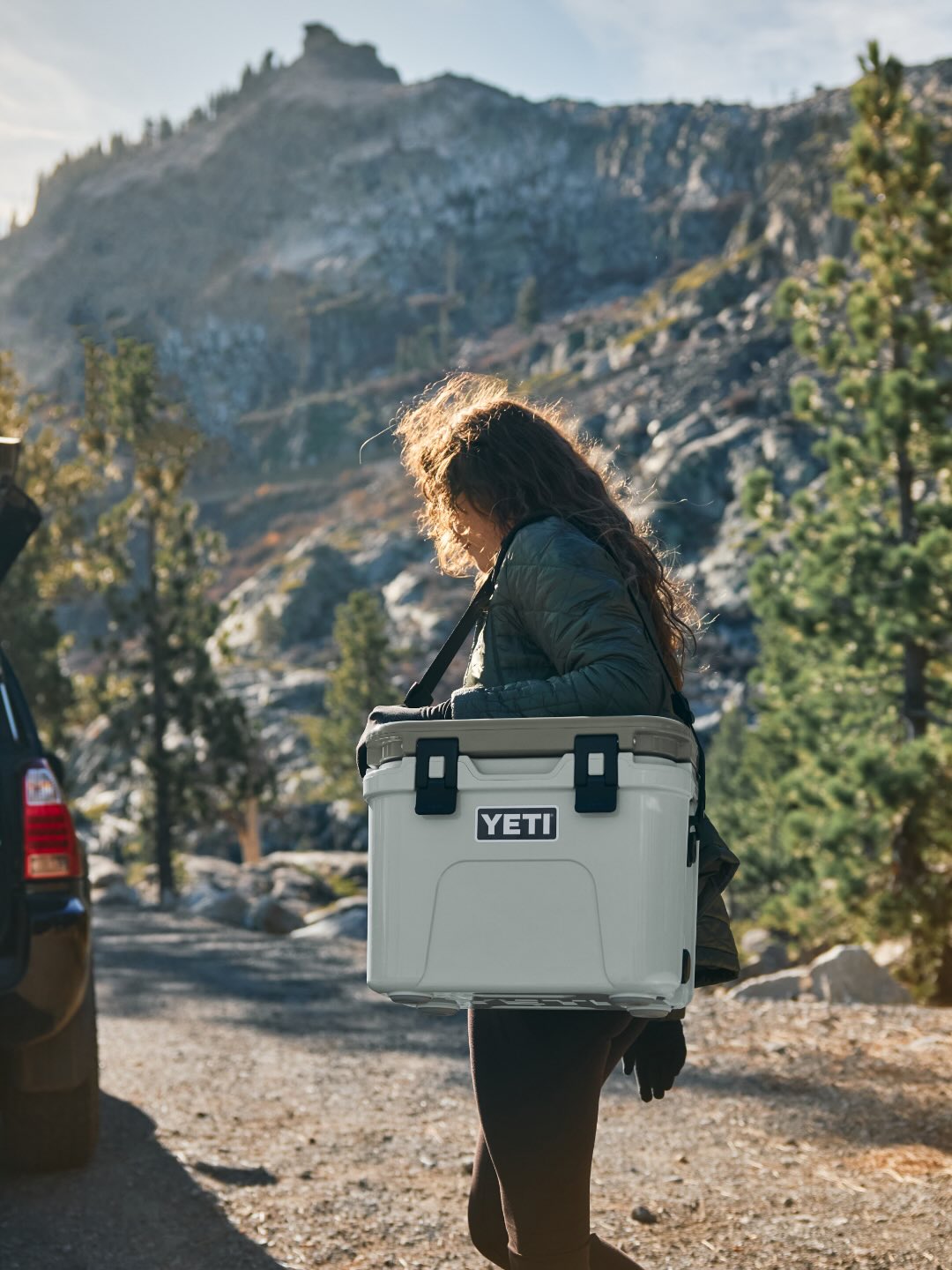
There are very few gear brands that manage to transform an everyday object into something people are genuinely proud to own. YETI is one of them. The Austin, Texas company turned the humble cooler — a piece of equipment most people never thought twice about — into a status symbol for serious outdoor enthusiasts, a product that commands prices between $300 and $1,300, and a brand with revenues exceeding $1.8 billion in 2024. Whether you think that’s genius or madness probably says something about how hard you push your gear.
Two Brothers, One Big Problem
YETI’s story starts where most good gear stories start: with real frustration in the field. Roy and Ryan Seiders grew up in Driftwood, Texas, the sons of Roger Seiders — a shop teacher and avid fisherman who had already turned his own outdoor frustrations into a small business, developing a two-part epoxy coating for fishing rod guides that became a commercial product.
The entrepreneurial DNA was planted early. Roy grew into a custom boat builder. Ryan launched a fishing rod company. Both spent serious time outdoors in the demanding heat of the Texas Gulf Coast, and both kept destroying coolers. Flimsy plastic, broken latches, ice gone in a day. They were installing $50 coolers on $30,000 custom boats, and it made no sense.
The solution they arrived at was almost deliberately extreme. Rather than finding a slightly better cooler, they decided to build the best cooler possible — period — and price it accordingly. The name YETI came to them on a flight back from Asia in January 2006, after they found a manufacturer in the Philippines willing to build something entirely from scratch to their specifications. The company was officially founded on March 15, 2006.
Rotomolding: The Technology That Changed Everything
To understand why YETI coolers cost what they cost, you need to understand rotomolding. It’s a manufacturing process where plastic is heated and rotated inside a mold, producing a single seamless shell with no weak points, no joints, no seams to crack under stress. YETI was among the first cooler manufacturers to apply this technique to consumer ice chests, and the results were dramatic.
The Tundra — YETI’s flagship hard cooler — is built around this rotomolded shell, then pressure-injected with commercial-grade polyurethane foam up to two inches thick throughout, including the lid. The gasket is freezer-quality. The latches are over-engineered. The result is a cooler that can keep ice for up to five days under normal summer conditions, is certified bear-resistant by the Interagency Grizzly Bear Committee, and has survived being hit by a falling tree in a professional gear test (the cooler was later restored and used on river trips for five more years).
That kind of durability is what YETI calls « PermaFrost Insulation » — a proprietary designation for their pressure-injected foam system. It sounds like marketing language, and partly it is, but the underlying engineering is real.
The Product Range: More Than Just Coolers
YETI launched with hard coolers and spent nearly a decade perfecting that single category before expanding. It wasn’t until 2014 that they released the Hopper — their first soft-sided cooler line — and 2015 before they launched the Rambler drinkware series that today accounts for the majority of the company’s revenue and profits. That patient approach to product expansion is part of what built the brand’s credibility.
Today, the range is extensive:
| Product Line | Key Models | Best For |
|---|---|---|
| Tundra Hard Coolers | Tundra 35, 45, 65, 110, 160 | Basecamp, car camping, fishing |
| Roadie Hard Coolers | Roadie 24, 48 (wheeled) | Day trips, tailgates, solo use |
| Hopper Soft Coolers | Hopper Flip, Hopper Backpack | Hiking, backpacking, day outings |
| Rambler Drinkware | Tumblers, bottles, jugs (10oz–1 gallon) | Everyday hydration, outdoor use |
| Bags & Cargo | Panga duffels, LoadOut buckets | Water sports, expedition use |
For camping and outdoor use specifically, the Tundra line remains the core of the YETI appeal. The Tundra 45 — often cited as the sweet spot between capacity and portability — retails at over $300 and has become one of the most recognisable pieces of gear at any campsite or tailgate in America.
How YETI Built a Lifestyle Brand
The technical story only goes so far. What really separates YETI from every other cooler company is the brand story — and that was largely the work of Walt Larsen, founder of an advertising agency who approached the Seiders brothers after spotting the YETI booth at a trade show and immediately understanding what the product could become. Larsen had built premium brand positioning in the hunting industry before. He knew how to make a tool feel like a statement.
The strategy was to go deep into the communities that would value the product most: hunters, anglers, competitive fishermen, offshore boaters. These are people who understand gear failure at the worst possible moment. They were willing to pay a premium for something that worked, and they talked to each other. Word spread through fishing tournaments, through guide networks, through hunting camps. By 2011, sales hit $29 million. By 2014, $147 million. By 2015, YETI had become a cultural phenomenon well beyond its original audience.
In 2012, private equity firm Cortec Group acquired a majority stake for a reported $67 million — a turning point that enabled scaled manufacturing and a wider retail push through REI, Bass Pro Shops, Cabela’s, and Academy Sports. YETI went public in 2018. Its net sales for 2024 reached $1.8 billion, with direct-to-consumer representing 56% of revenue.
YETI in the Field: What Campers and Outdoor Users Actually Say
Spend any time reading real-world reviews of YETI hard coolers and a consistent picture emerges. The ice retention is excellent — five days under normal conditions, longer if you pre-chill the cooler and pack it correctly with block ice or frozen jugs rather than cubed ice. The build quality is undeniable. Owners consistently report using their Tundras for years, sometimes a decade or more, with no meaningful degradation. The lid holds body weight. The latches don’t fail. The gasket seals properly.
For demanding use — multi-day fishing trips, extended camping in Texas heat, overlanding, offshore boating — YETI hard coolers genuinely deliver. A Tundra 45 packed properly will keep ice longer than a Coleman XTreme and significantly longer than a Styrofoam chest. That’s not marketing. It’s physics, and the insulation system earns it.
The Hopper soft cooler line gets more mixed feedback. The zippers are a weak point — some users report failures after heavy use — though YETI has improved them across generations. For hiking and backpacking where you want something lightweight and packable, the Hopper Flip and the Hopper Backpack are solid options, though they don’t insulate quite as long as the hard coolers by design.
The Price Question: Honest Verdict
Here’s where it gets complicated — and where we’ll be straight with you.
YETI coolers are expensive. The Tundra 45 at $325 is roughly ten times the price of a basic cooler and two to three times the price of a decent mid-range alternative. And in recent years, the competition has caught up considerably. Brands like RTIC, Orca, Pelican, and Engel are building rotomolded coolers with comparable insulation and comparable durability at meaningfully lower price points. In independent ice retention tests, the gap between YETI and some of these alternatives is often measured in hours, not days.
Some testing has shown that a RTIC cooler of similar size retains ice for around 27 hours compared to YETI’s 35 hours — better performance from YETI, but not dramatically so, at roughly double the price. Pelican and Engel, according to some reviewers, actually outperform YETI in cold retention while costing less. The « Made in America » angle that once differentiated YETI has also largely disappeared — most of their production now happens in the Philippines, China, Mexico, and Malaysia.
So is a YETI worth it? Our honest take: it depends on how hard you use it and whether brand credibility matters to you. If you’re doing serious multi-day camping, fishing trips, overlanding, or any use case where the cooler takes real abuse and ice retention genuinely matters, a YETI hard cooler is an excellent investment that will likely last you a decade or more. The cost per use over ten years on a $325 cooler is genuinely reasonable.
If you’re doing weekend camping trips with the family and opening the cooler twenty times a day, an RTIC or a high-end Igloo will serve you well at half the price. The YETI premium — and there’s no way around this — includes a meaningful brand component. You’re partly paying for the name. Whether that matters to you is a personal call, not a gear question.
What we’d push back on is the idea that YETI is purely hype. It isn’t. The build quality is exceptional. The ice retention is among the best available. The resale value is remarkably high — a used YETI holds its price better than almost any other cooler brand. For demanding outdoor use, it earns its price. For casual use, there are smarter choices.
YETI and the Broader Outdoor Kit
What makes YETI interesting from a gear philosophy standpoint is how well it fits into a broader approach to outdoor equipment — the idea that certain foundational pieces of kit are worth spending serious money on because they last, because they work when it matters, and because reliability in the field has real value. It’s the same logic that justifies spending properly on a quality headlamp from Petzl or trusting your camp energy system to BioLite’s engineering rather than buying cheap and replacing it every two seasons.
There’s also a sustainability argument hiding inside the premium price. A $50 cooler that you replace every three years generates more waste and more total cost than a $325 cooler that lasts fifteen. It’s not a free pass for the price, but it’s worth factoring into the calculation.
Key Specs: YETI Tundra 45
| Spec | Detail |
|---|---|
| Capacity | 45 qt / 42.6 L |
| Can capacity | ~26 cans (2:1 ice ratio) |
| Ice retention | Up to 5 days |
| Construction | Rotomolded polyethylene |
| Insulation | Pressure-injected polyurethane foam (2 in / 5 cm) |
| Lid gasket | Freezer-grade rubber seal |
| Weight (empty) | ~15 lbs / 6.8 kg |
| Bear certification | IGBC-certified bear-resistant |
| Retail price | ~$325 USD |
The Bottom Line
YETI didn’t invent the cooler. They reinvented what a cooler could mean — and built a brand so strong that even its critics can’t ignore it. The technology is real. The durability is real. The ice retention is real. And yes, a portion of that $325 price tag is buying into one of the most successfully marketed outdoor brands of the last twenty years. Both things are true simultaneously.
For serious outdoor use — camping trips where the cooler gets thrown in a truck bed, opened by wet hands, sat on, and expected to keep your catch cold for three days — YETI hard coolers are among the best available. If your use is lighter, spend your money on something else. But if you want a cooler you’ll never need to replace, YETI is still one of the strongest answers in the market.