There are brands that enter a category. And then there are brands that create a category. Ultimate Direction belongs firmly to the second group. In 1985, out of a garage, two outdoor enthusiasts in Colorado stitched together the very first hydration waist-pack ever made — three years before any other company on the planet had the same idea. Everything you now know about running vests, soft flasks mounted on chest pockets, and bounce-free hydration systems traces its origins back to that moment. That is not marketing copy. That is history.
And yet, if you ask most European trail runners about Ultimate Direction, you will often get a blank stare or a vague sense of recognition. The brand remains largely a North American phenomenon — hugely respected in the United States, deeply embedded in the ultrarunning community, but frustratingly hard to find on European shelves. That gap between reputation and availability is something worth talking about.
Born in a Boulder Garage
Ultimate Direction was founded in 1985 in Boulder, Colorado — a city that has since become one of the world’s most important hubs for trail running, ultrarunning, and mountain sports. The original idea was almost absurdly simple: give runners a way to carry water on the go. Before UD, you either ran with nothing or stopped at streams. The first products were basic waist-packs and handheld bottle carriers, but they solved a real problem that nobody else had bothered to address.
The brand spent its early decades building credibility in the endurance community. Then, around 2010, it nearly disappeared. What saved it was a hire: Buz Burrell, a veteran of the outdoor industry with deep roots in Boulder’s running scene, took over brand management and did something smart. Instead of trying to compete with the growing market on price and volume, he doubled down on the people who actually knew what the gear needed to do — elite athletes.
The Signature Series: When Ultrarunners Design Their Own Gear
In 2012, Ultimate Direction launched the Signature Series — a line of running vests co-designed by some of the most accomplished ultrarunners in the world. The move was immediately influential and is now widely considered a turning point in the history of trail running gear.
The first collection featured three vests designed in collaboration with Scott Jurek (seven-time winner of the Western States 100 and Appalachian Trail speed record holder), Anton Krupicka (two-time Leadville 100 winner and icon of the minimalist running movement), and Peter Bakwin (co-founder of the brand and record-setting adventurer). Each vest was built around each athlete’s specific philosophy and running style. The SJ Ultra Vest was designed for long hauls and maximizing capacity-to-weight ratio. The AK Race Vest was built around minimalism — the lightest possible platform, nothing unnecessary. The PB Adventure Vest was the versatile, go-anywhere option.
These were not celebrity endorsements. These were athletes sitting with designers and making real decisions about materials, pocket placement, sternum strap geometry, and flask dimensions. The result was a vest category that the entire industry then scrambled to imitate. Today, the chest-mounted soft flask pocket — now standard on virtually every trail running vest on the market — was popularised by the Ultimate Direction Signature Series.
If you are curious about how to pick the right vest for your needs, we have covered the key criteria in detail in our complete guide to trail running hydration packs. Ultimate Direction products check most of the boxes we list there — and invented several of them.
The Key Products: What Ultimate Direction Actually Makes
The product range has expanded significantly since the early vest-only days. Here is a breakdown of the main categories:
Running Vests and Vestas
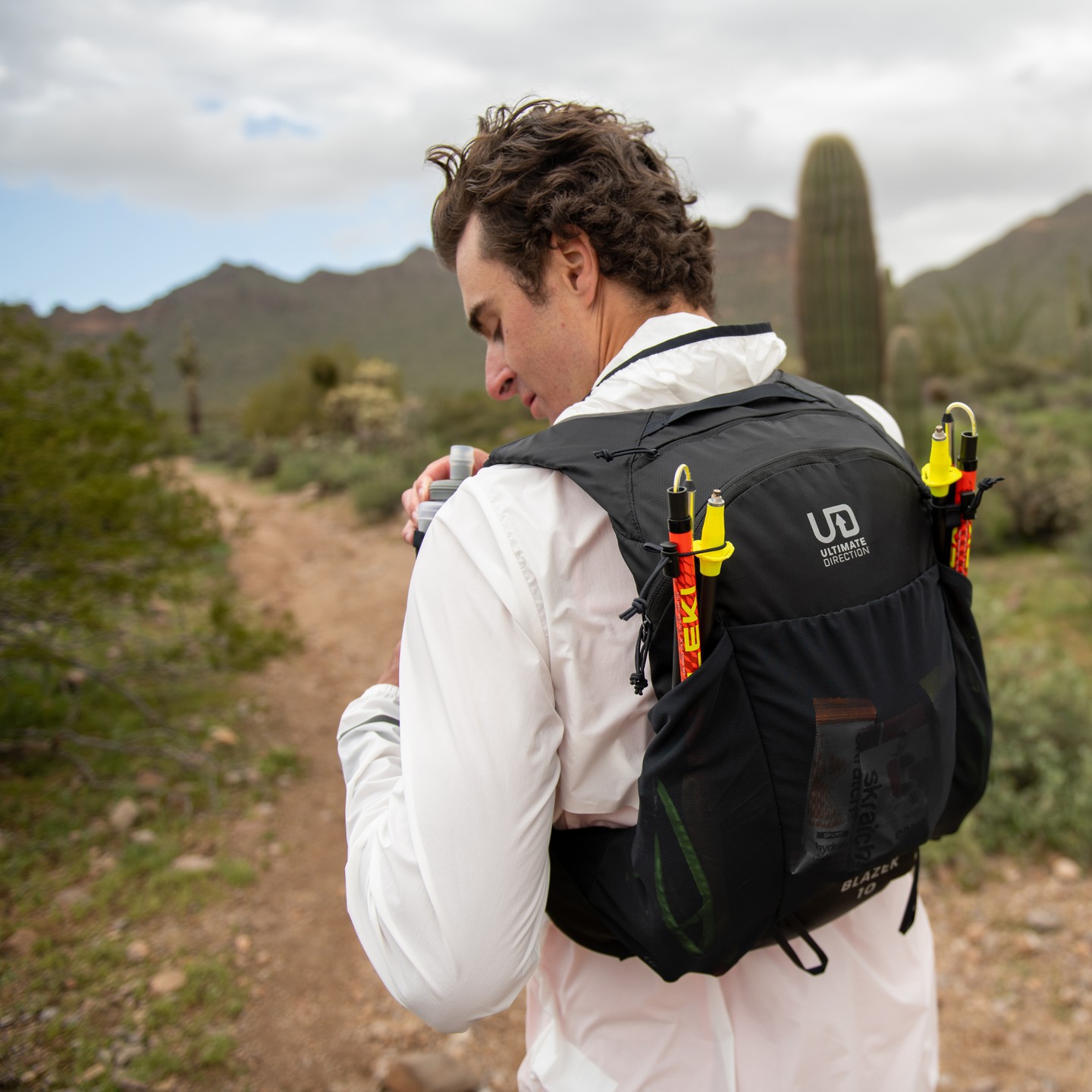
The core of the range. UD offers vests from race-oriented minimalist designs (2–5 litres) to fully loaded ultra-distance platforms (up to 12 litres). The Ultra Vest line — currently in its 2025 iteration at 12 litres — is the brand’s most iconic product. Built with a breathable monomesh lining, a torso-hugging fit, front soft flask pockets, and a trekking pole carry system, it is designed specifically for long-distance racing and unsupported backcountry runs. The Xodus Vest, newer and bolder in its approach, features an underarm zip entry, 13 pockets of varying sizes, and a military-influenced front storage system. Women’s equivalents (called Vestas) are designed with gender-specific fits rather than simply scaled-down versions of men’s models.
Fastpacks
The Fastpack range bridges the gap between trail running vest and lightweight backpack — 20 to 30 litres of capacity, designed for fast hiking, alpine starts, ski touring approaches, and multi-day FKT (fastest known time) attempts. If you need more volume than a race vest but cannot accept the bulk and weight of a traditional hiking pack like an Osprey or a Gregory, the Fastpack is an elegant answer. It is the product that arguably best demonstrates UD’s ability to think across disciplines.
Handhelds and Belts
Ultimate Direction invented the handheld water bottle carrier in the 1980s, and they have continued to refine it. The current Clutch Wrap — a deceptively simple elastic strap that fixes a soft flask to your wrist or palm — has been praised as one of the most practical pieces of hydration gear of recent years. Running belts with bottle holsters round out the lower-commitment hydration options for shorter distances.
Bottles and Soft Flasks
UD’s own Body Bottle soft flasks are designed specifically to fit their vest pockets — an obvious point, but one that matters. Third-party flasks often do not fit correctly, which creates bounce. The Body Bottle 500 (500 ml) is the reference model; the Flexform II is slightly more pliable and well-regarded for long runs in cold weather.
Apparel
Since 2021, Ultimate Direction has built out a full apparel line for both men and women — tops, shorts, tights, and outerwear. The Ultra Waterproof Jacket is the headline piece: genuinely packable, seam-sealed, and designed around the movement patterns of trail running rather than hiking. All UD apparel is 100% PFC-free, BPA-free, and a growing share uses recycled or bluesign-certified materials. The brand is not greenwashing — it is making incremental progress and being honest about where it stands.
In 2019, UD went a step further with Hydro Carry apparel — tops with integrated soft flask storage built directly into the garment. The idea is elegant: no vest needed for shorter runs, just a t-shirt or long-sleeve with a dedicated bottle pocket. It has not fully taken off as a category, but it is the kind of thinking that sets this brand apart.
| Product | Category | Capacity | Best For |
|---|---|---|---|
| Ultra Vest 12L | Running vest | 12 L | Ultramarathon, backcountry |
| Xodus Vest | Running vest | ~8 L | Race day, precision fit |
| Fastpack 20 | Fastpack | 20 L | Fast hiking, FKT, alpine |
| Fastpack 30 | Fastpack | 30 L | Multi-day, ski approaches |
| Clutch Wrap | Handheld | ~500 ml | Short trail runs |
| Body Bottle 500 | Soft flask | 500 ml | Vest-compatible hydration |
| Ultra Waterproof Jacket | Apparel | — | Packable trail protection |
What Makes Ultimate Direction Different
Beyond the historical credentials, a few things genuinely distinguish UD from the competition in 2025.
Athletes actually design the products. This is not a marketing angle — it is the founding philosophy of the Signature Series, and it continues to shape how the brand develops gear. When Anton Krupicka says the vest needs to weigh less and carry more, the engineers find a way. When Scott Jurek needs trekking pole access on the move, it gets built in. The result is gear that solves real problems that real runners face — not problems that look good in a product brief.
The fit is taken seriously. Most hydration vests fit adequately. UD vests fit well. There is a difference that becomes obvious after an hour on the trail. The brand’s women-specific Vesta line is genuinely built for different shoulder geometry and chest proportions — not an afterthought. If you do long enough runs to actually notice whether your vest bounces or shifts, this matters enormously. We have explored why proper fit and hydration strategy go together in our piece on trail running nutrition and hydration.
The vest concept, not the pack concept. This sounds obvious in 2025, but it was revolutionary in 2012. A vest wraps around your torso. A pack sits on your back. The distinction in bounce, centre of gravity, and comfort over long distances is enormous — particularly when running technical terrain. UD understood this before anyone else did and designed around it systematically.
Deep roots in ultrarunning culture. UD has always been most at home at the pointy end of the sport — ultra-trail racing, FKT attempts, multi-day adventures. The brand counts among its ambassadors people who hold records on the Pacific Crest Trail and the Appalachian Trail. That culture filters into product decisions and keeps the gear honest. You cannot sell bad gear to people who will use it for 100 miles at a time and then tell everyone they know exactly how it performed.
A Personal View: Why I Rate This Brand
I have used an Ultimate Direction hydration vest for trail running, and it remains one of the best pieces of gear I have owned for the discipline. What struck me first was how quickly I forgot I was wearing it. That sounds like a cliché, but it is actually the most important thing you can say about a running vest. A vest that reminds you of its existence after two hours — through chafing, bouncing, asymmetric load, or tight straps — is a vest that has failed at its core job. The UD vest did not do any of those things.
The front flask system works exactly as advertised. No fumbling, no bottles flying out on a descent. The pockets are placed intelligently — not just numerous, but in positions where you can actually reach them without breaking stride. The overall construction felt durable and well-considered, not like something designed to hold up for one season and then be replaced.
Is it perfect? No. The brand’s mid-range and entry-level vests are less impressive — some reviewers have flagged that the more affordable models sacrifice too much quality for the price difference to make sense. If you are going to try Ultimate Direction, buy at the upper end of the range. The Ultra Vest or the Xodus are the products where the brand’s philosophy is fully expressed. The budget options exist, but they are not where UD shines.
For runners who care about footwear as much as carrying systems — and most serious trail runners do — UD pairs well with brands that share its performance-first DNA. Altra, for instance, occupies a similar position in the shoe world: an American brand rooted in the running community, slightly under the radar in Europe, and building gear around how feet and bodies actually move.
The European Problem
Ultimate Direction’s relative obscurity in Europe is partly a distribution issue and partly a cultural one. The brand has historically concentrated its retail presence in the United States, where it has strong MAP (minimum advertised price) policies that protect specialty retailers. In Europe, pricing wars among distributors have made the brand inconsistent to find and sometimes more expensive than it should be at retail. The result is that European trail runners gravitate toward brands with stronger local distribution — Salomon, Raidlight, Compressport — even when the UD product is technically superior for their needs.
This is genuinely a shame. The ultrarunning world in Europe — particularly in France, Spain, and the Alps — is sophisticated enough to appreciate what UD does. The UTMB circuit, the skyrunning world, the growing FKT community — these are exactly the environments where Ultimate Direction products make the most sense. The brand is available online and through some specialist retailers, but it requires more active searching than it should.
Should You Buy Ultimate Direction?
If you are a trail runner who takes distance seriously — someone who regularly runs more than two hours on technical terrain, or who is preparing for an ultra — then yes, Ultimate Direction deserves serious consideration. The vest range in particular is among the best in the world at its price point, and the brand’s long history means the design decisions are not guesswork. Every pocket, every strap, every gram has been thought about by people who have run further than most of us will ever go.
If you are newer to trail running or primarily running shorter distances, the vest system might be more than you need — and there are simpler options that will serve you well. But if you have hit the point where your current vest is holding you back, or where you are thinking seriously about what you will carry on a long ultra-trail preparation block, Ultimate Direction should be on your shortlist.
The brand that invented the hydration pack has not coasted on that history. It has kept innovating, kept listening to athletes, and kept making products that the people who run the farthest actually choose to wear. That is a harder thing to sustain than it sounds.