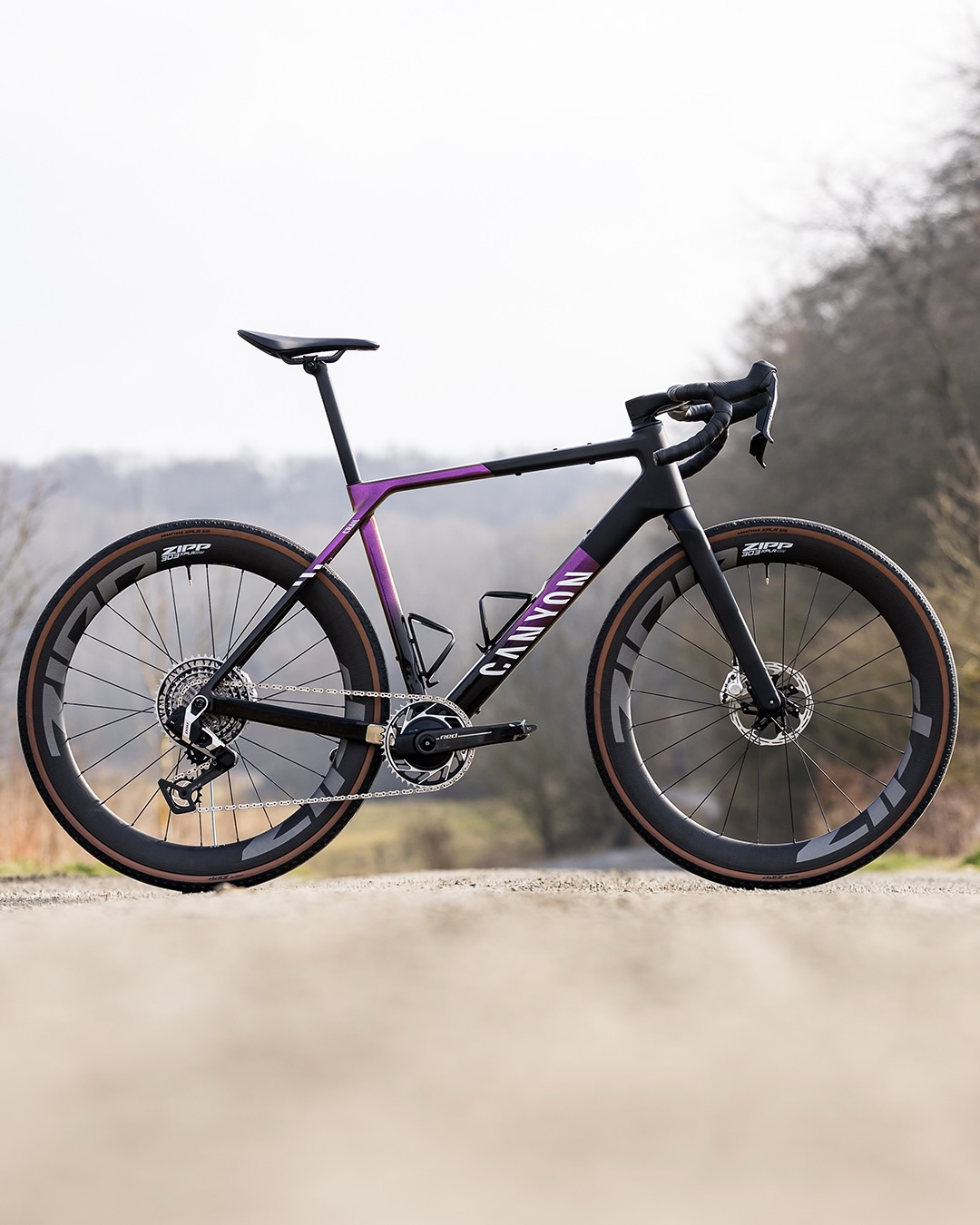
Canyon builds two gravel bikes that, at first glance, seem to be competing for the same rider. Same brand, same direct-to-consumer model, similar terrain. But spend a few minutes comparing them and a much more interesting picture emerges — one that has less to do with race philosophy and more to do with how much you want to spend, and what you actually want from a gravel bike.
The Grail is Canyon’s race-focused gravel machine. It exists in carbon only, starting at a serious price point. The Grizl, on the other hand, is a full adventure platform — and crucially, it’s available in both carbon and aluminium, with the Grizl AL starting at just €1,399. That single fact changes everything about how you should read this comparison.
This guide covers all three angles: Grail CF vs Grizl CF, and the case for the Grizl AL as the most accessible — and often most sensible — entry into serious gravel riding.
The Big Picture: Three Options, One Clear Hierarchy
Here’s how the Canyon gravel lineup actually breaks down once you account for materials:
- Canyon Grail CF — carbon only, race geometry, aero design, integrated cockpit. Built to go fast on unpaved roads.
- Canyon Grizl CF — carbon adventure bike, long-distance and bikepacking focus, wide tire clearance, VCLS seatpost. Built to roam far.
- Canyon Grizl AL — aluminium adventure bike, same adventure DNA as the CF version, significantly more affordable. Built for riders who want serious capability without the carbon price tag.
The Grail and Grizl aren’t really fighting each other. They occupy genuinely different spaces. What makes the comparison worthwhile is the Grizl’s dual-material availability — it opens up a real budget conversation that the Grail simply doesn’t.
Canyon Grail CF SL 7: The Gravel Race Machine
The current-generation Grail represents a clean break from Canyon’s old double-decker handlebar era. This is now a focused, uncompromising gravel race bike: longer reach, aerodynamic tube shaping throughout, a one-piece integrated cockpit, and a carbon chassis tuned for stiffness and efficiency over comfort.
The Grail CF SL 7 is the entry point into the carbon Grail range:
- Frame: Canyon CF carbon, aero tube shapes, integrated downtube storage with QuickLoader bag system
- Groupset: Shimano GRX 2×12 mechanical
- Tires: Schwalbe G-One R, 700x40c
- Cockpit: One-piece Canyon Double Drop Bar (16° flare)
- Seatpost: Canyon CF carbon, vibration-absorbing
- Weight: ~9.2 kg (size M)
- Max tire clearance: 42mm
The ride is stiff and reactive by design. This is a bike that wants to be pushed. It climbs efficiently, holds speed on mixed terrain, and descends with a planted confidence that comes from the race geometry. What it gives up is flexibility: 42mm max tire clearance is a hard ceiling, there’s no aluminium option if budget is a concern, and the integrated cockpit means no swapping bars without committing to Canyon’s ecosystem.
The downtube storage system — a noise-dampening pouch for a tube and inflator, plus a hatch for a mini tool — is genuinely clever. The QuickLoader bag snaps on magnetically and even marginally improves aerodynamics. These are details that make the Grail feel purpose-built and complete.
Who is the Grail for?
Riders who train for and race gravel events, or who want a fast, efficient platform for long days on mixed but not extreme terrain. Budget is not the primary concern — performance is. If you track Strava segments on gravel roads and have a race calendar, the Grail makes sense.
Canyon Grizl: The Adventure Platform — In Carbon or Aluminium
The Grizl is Canyon’s answer to a different kind of question: not how fast can I go, but how far can I go, and over what terrain? The second-generation Grizl is available in two versions that share the same adventure-first philosophy but sit at very different price points.
Grizl CF 7 — The Carbon Adventure Bike
- Frame: Canyon CF carbon, raised top tube/seatstay junction, frame protection on chainstays and downtube
- Groupset: Shimano GRX 1×12 (40T / 10-45T cassette)
- Tires: Schwalbe G-One RX Performance 45mm
- Cockpit: Alloy Canyon bar and stem, 440mm width
- Seatpost: Canyon S15 VCLS 2.0 CF (shock-absorbing carbon)
- Weight: ~9.9 kg (size M)
- Max tire clearance: 54mm (fits MTB tires up to 2.1″)
The carbon version of the Grizl is where the adventure-focused geometry combines with the weight and vibration-damping advantages of carbon. The 71° head angle, longer wheelbase, and more stack height make it feel planted and controlled when descending loaded. The S15 VCLS seatpost flexes to absorb trail chatter without being noticeable on smoother surfaces — on a multi-day bikepacking trip, that passive compliance saves real energy. And 54mm of tire clearance genuinely opens up terrain the Grail can’t touch.
Grizl AL 5 — The Aluminium Adventure Bike (from €1,399)
This is where the comparison gets particularly interesting. The Grizl AL shares the same adventure DNA — same geometry philosophy, same extensive mounting points, same 54mm tire clearance — but in an aluminium frame, with a carbon fork, and at a price that makes it one of the most compelling gravel bikes available right now.
- Frame: Canyon Grizl AL aluminium, Gravel Pro geometry, raised top tube/seatstay junction, frame protection
- Fork: Canyon FK0087 CF Disc — full carbon (518g), three mounting points per side
- Groupset: Shimano CUES 1×10 (40T / 11-48T cassette)
- Brakes: Shimano CUES hydraulic disc, 180mm rotors
- Tires: Schwalbe G-One Bite Performance 45mm
- Cockpit: Canyon HB0050 Ergobar AL, ergonomic design, 440mm width
- Seatpost: Canyon SP0043 VCLS CF — carbon shock-absorbing post (same VCLS tech as the CF version)
- Wheels: Rodi SL25 alloy, 25mm internal width, Center Lock
- Weight: 11.08 kg (size M)
- Max tire clearance: 50mm frame / 54mm fork
- Price: €1,399 (on offer from €1,499)
A few things stand out immediately. First, the fork is carbon even on the aluminium model — that’s unusual at this price and it meaningfully improves both front-end compliance and the overall weight balance. Second, the VCLS seatpost is the same shock-absorbing carbon post found on the CF version, which is a genuine surprise for a €1,399 bike. Third, the Shimano CUES groupset is honest and functional — not flashy, but reliable and well-suited to mixed terrain riding.
Yes, the AL weighs about 1.8kg more than the CF 7, and yes, aluminium transmits more road vibration than carbon. But the AL Grizl is not trying to compete with the CF on weight — it’s trying to give you the same adventure capability, the same mounting ecosystem, and essentially the same riding position, at roughly half the price of the carbon version.
Aluminium vs Carbon: What Actually Matters on the Trail
The aluminium vs carbon debate in gravel bikes is worth addressing directly, because it’s often distorted by either brand marketing or internet tribalism. Here’s the honest version.
Weight is the most cited difference, and it’s real: the Grizl AL comes in at 11.08 kg vs ~9.9 kg for the Grizl CF. That’s roughly 1.2 kg. On flat or rolling gravel, you won’t feel that gap. On sustained climbs over 1,000m of elevation gain, you might. For bikepacking where you’re carrying 5-8 kg of gear anyway, the frame weight delta matters less than the overall system weight.
Vibration damping is where carbon genuinely has an edge — it can be engineered to absorb high-frequency road buzz in ways aluminium cannot. That said, the Grizl AL largely compensates with its carbon fork (which handles most front-end compliance) and the VCLS carbon seatpost (which handles rear compliance). The result isn’t as refined as the full CF version, but it’s far more comfortable than a traditional aluminium road bike.
Durability is an argument that favours aluminium. Carbon can be damaged by impacts in ways that aren’t always visible; aluminium tends to dent rather than crack, and you can see the damage. For expedition-style touring where bikes get handled roughly — loaded onto vehicles, leaned against stone walls, caught in unexpected falls — aluminium is genuinely more forgiving.
Price is where the conversation ends for most people. The Grizl AL 5 at €1,399 vs the Grizl CF 7 at ~€2,699 is not a marginal difference. That €1,300 gap buys a tent, a sleeping bag, a set of bikepacking bags, and most of your first big trip. For a first serious gravel bike, that context matters enormously.
Full Comparison: Grail CF SL 7 vs Grizl CF 7 vs Grizl AL 5
| Grail CF SL 7 | Grizl CF 7 | Grizl AL 5 | |
|---|---|---|---|
| Category | Race gravel | Adventure gravel | Adventure gravel |
| Frame material | Carbon (CF) | Carbon (CF) | Aluminium (AL) |
| Fork material | Carbon | Carbon | Carbon |
| Weight | ~9.2 kg | ~9.9 kg | 11.08 kg |
| Tire clearance (frame) | 42mm | 54mm | 50mm |
| Tire clearance (fork) | 42mm | 54mm | 54mm |
| Groupset | GRX 2×12 mech | GRX 1×12 mech | CUES 1×10 mech |
| Seatpost | Canyon CF compliant | Canyon S15 VCLS 2.0 CF | Canyon SP0043 VCLS CF |
| Cockpit | One-piece integrated | Standard alloy bar/stem | Standard alloy bar/stem |
| Bikepacking mounts | Limited | Extensive | Extensive |
| Suspension option | No | Yes (select models) | No |
| Starting price | Higher (race premium) | ~€2,699 | €1,399 |
Our Take: Three Bikes for Three Types of Rider
We’ll be direct about where we stand.
The Grail is a genuinely great bike — if you’re racing. It’s lighter, more aerodynamic, and built with a clarity of purpose that translates into real performance on gravel race days. But it’s also the most expensive option, and it’s the least versatile. If racing is genuinely on your calendar, the Grail earns its price. If it isn’t, it’s a lot of money for a bike that’s been optimised for a use case you may never actually pursue.
The Grizl CF 7 is our favourite bike in this range for serious adventure riders. The full carbon chassis, combined with the VCLS seatpost and 54mm tire clearance, makes it genuinely excellent on long multi-day routes — it’s light enough to climb, compliant enough to cover rough terrain without destroying you, and loaded with the mounting points and tire clearance that make bikepacking practical. If you’re planning serious alpine routes or long-distance events like Trans Pyrenees or Silk Road Mountain Race, this is the tool.
But the Grizl AL 5 is the one we’d point most people towards, and we don’t say that as a budget compromise. At €1,399, it gives you a carbon fork, a carbon VCLS seatpost, 50mm frame / 54mm fork tire clearance, and the same adventure geometry as the CF version. It weighs more — about 1.1 kg more than the CF 7 — but it’s also roughly €1,300 cheaper. That gap funds your entire gear setup for a first bikepacking trip, or simply leaves money in your pocket while you decide whether gravel riding is the rabbit hole you want to fall into.
The Grizl AL is also more resilient in rough handling contexts, and the Shimano CUES groupset, while less prestigious than GRX, is a solid and reliable workhorse for mixed terrain. You won’t be wishing for more gears on the trail.
Our pick: Grizl AL 5 for most riders. Grizl CF 7 if you’re committed to long-distance adventure and want the weight and comfort advantages of carbon. Grail CF SL 7 only if racing is genuinely in the picture.
Final Verdict
Canyon has built a gravel lineup with cleaner positioning than most brands. The Grail goes one direction — fast — and it does it well in carbon. The Grizl goes another direction — far — and it does it well in both carbon and aluminium. The presence of the AL version isn’t an afterthought or a budget tier: it’s a genuinely capable bike that makes serious gravel riding accessible to a much wider range of riders.
If the €1,300 difference between an AL and a CF Grizl feels significant to you, it probably is. Buy the AL, ride it hard, and if you find yourself wanting to shave weight after two years of serious use — then you’ll know exactly what to upgrade to, and why.