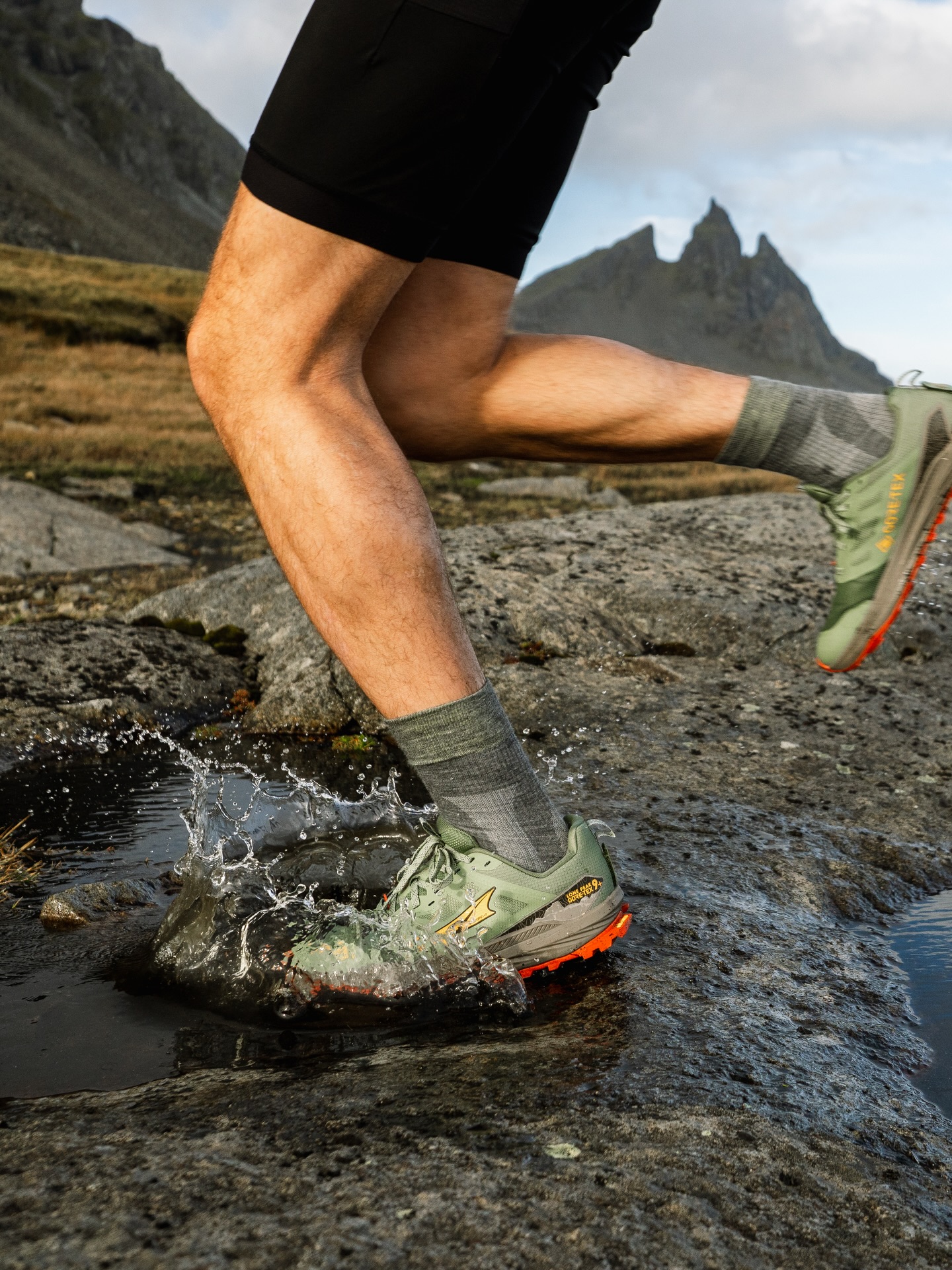
Few comparisons in trail running reveal a philosophical divide more clearly than this one. The Altra Lone Peak and the Salomon Speedcross are not just different trail shoes — they represent different theories of how a human foot should interact with the ground. Altra’s zero-drop, wide-toe-box philosophy says the foot works best when it can function naturally. Salomon’s Speedcross says the foot needs to be held securely and protected from the terrain at its most unforgiving. Neither position is wrong. But they produce shoes that are genuinely incompatible for many runners — and understanding which camp you belong to saves considerable money and frustration.
For broader brand context, see our profiles on Altra and Salomon. And for comparison with the other major trail shoe reference point, our Hoka Speedgoat vs Salomon Speedcross comparison covers the cushioning angle of the same debate.
The Short Answer
The Altra Lone Peak prioritises natural foot movement. Zero drop eliminates the heel-to-toe height difference found in virtually all conventional trail shoes, the wide foot-shaped toe box allows the forefoot to spread naturally under load, and the balanced cushioning system provides protection without artificially altering your running gait. For runners transitioning to natural-movement principles or who have structural foot issues that conventional shoes exacerbate, the Lone Peak is often transformative.
The Salomon Speedcross prioritises secure grip and control on demanding soft terrain. Its deep chevron lugs, narrow Sensifit upper, and Quicklace closure system create a shoe that holds your foot precisely and bites aggressively into mud and loose ground. It makes no concessions to natural foot movement — but on the terrain it is designed for, it does what nothing else does as well.
Specs Side by Side
| Spec | Altra Lone Peak 8 | Salomon Speedcross 6 |
|---|---|---|
| Drop | 0mm | 8mm |
| Stack height (heel / forefoot) | 25mm / 25mm | ~30mm / ~22mm |
| Toe box | FootShape: wide, foot-shaped | Narrow: Sensifit cradle |
| Weight (approx. size UK9) | ~290 g | ~310 g |
| Outsole | MaxTrac rubber + TrailClaw lugs | Contagrip TA (deep chevron lugs) |
| Lug depth | ~5mm (directional) | ~6mm (aggressive chevron) |
| Best terrain | Varied trail, moderate to technical | Soft, muddy, wet forest trail |
| Transition demands | Requires gradual adaptation for most runners | Immediate use, no adaptation needed |
| Price (approx.) | ~€130–150 | ~€130–150 |
Zero Drop: The Foundational Difference
The Lone Peak’s zero drop is not a minor technical detail — it is the defining characteristic of the shoe and the reason runners choose it or avoid it. A zero-drop shoe keeps the heel and forefoot at the same height, meaning there is no elevation of the heel above the ground. Most running shoes have 4–12mm of drop; the Speedcross sits at 8mm, which is conventional.
For runners transitioning from conventional shoes to zero drop, the adaptation period is real and must be respected. The calf and Achilles tendon must adjust to a longer functional range. Moving too quickly into full-volume training in zero-drop shoes causes injury. Altra recommends a gradual transition over several weeks. Runners who have completed that transition typically report improved proprioception, stronger intrinsic foot muscles over time, and relief from knee and hip issues that conventional heel-elevated shoes can perpetuate. Runners who ignore the transition advice often report calf strains and Achilles problems.
The Speedcross requires no adaptation. It fits the conventional shoe geometry that most runners’ bodies are already calibrated for.
Toe Box and Foot Freedom
Altra’s FootShape toe box is wider than virtually any other trail shoe in mainstream production, shaped to match the natural foot silhouette rather than the tapered aesthetic of conventional shoe lasts. For runners with wide feet, bunions, Morton’s neuroma, or any condition where pressure on the forefoot is a problem, the Lone Peak is often the only mainstream option that does not cause issues on long runs. The toe box genuinely allows the forefoot to spread under load — which is what feet do naturally, and what conventional shoes prevent.
The Speedcross’s Sensifit upper holds the foot firmly and does not offer this freedom. For narrow feet or runners who prefer a locked-in feel, this is an advantage. For wider feet or runners with forefoot issues, the Speedcross is often impossible to wear comfortably over long distances regardless of terrain performance.
Grip and Terrain
On soft, muddy terrain, the Speedcross wins. Its deep chevron lugs self-clear mud and bite into soft ground more aggressively than the Lone Peak’s directional TrailClaw lugs. If your running is primarily on soft and wet terrain, the Speedcross’s grip advantage is decisive and not replicable by the Lone Peak.
The Lone Peak performs better across a wider range of surface types: mixed terrain, rocky trails, hard-pack. The TrailClaw lug pattern is versatile without being specialist. On very soft or muddy terrain it lags the Speedcross; on everything else it is more competent.
Who Should Buy Which
Choose the Altra Lone Peak if: you are committed to or curious about natural movement and zero-drop footwear; you have wide feet or forefoot issues that conventional shoes aggravate; you run across varied terrain and want a shoe that performs competently across surface types; or you want a trail shoe that allows your foot to function as close to naturally as current running shoe technology permits. Be honest about whether you can do the transition properly — it takes time and patience.
Choose the Salomon Speedcross if: your running is primarily on soft, muddy, or wet terrain where maximum grip is the priority; you have narrow feet and prefer the security of the Sensifit system; or you are not interested in the natural-movement philosophy and simply want the best tool for your specific terrain. The Speedcross is a better specialist shoe than the Lone Peak on its preferred surfaces. It is also a significantly worse choice for any runner who needs a wide toe box.
These two shoes are perhaps the least interchangeable of any trail shoe comparison we could construct. If you are genuinely torn between them, the answer is almost certainly that you need to think more carefully about your terrain and your foot shape before committing.
See the full Altra running shoe range on the Altra official website, and the complete Salomon lineup on the Salomon official website.