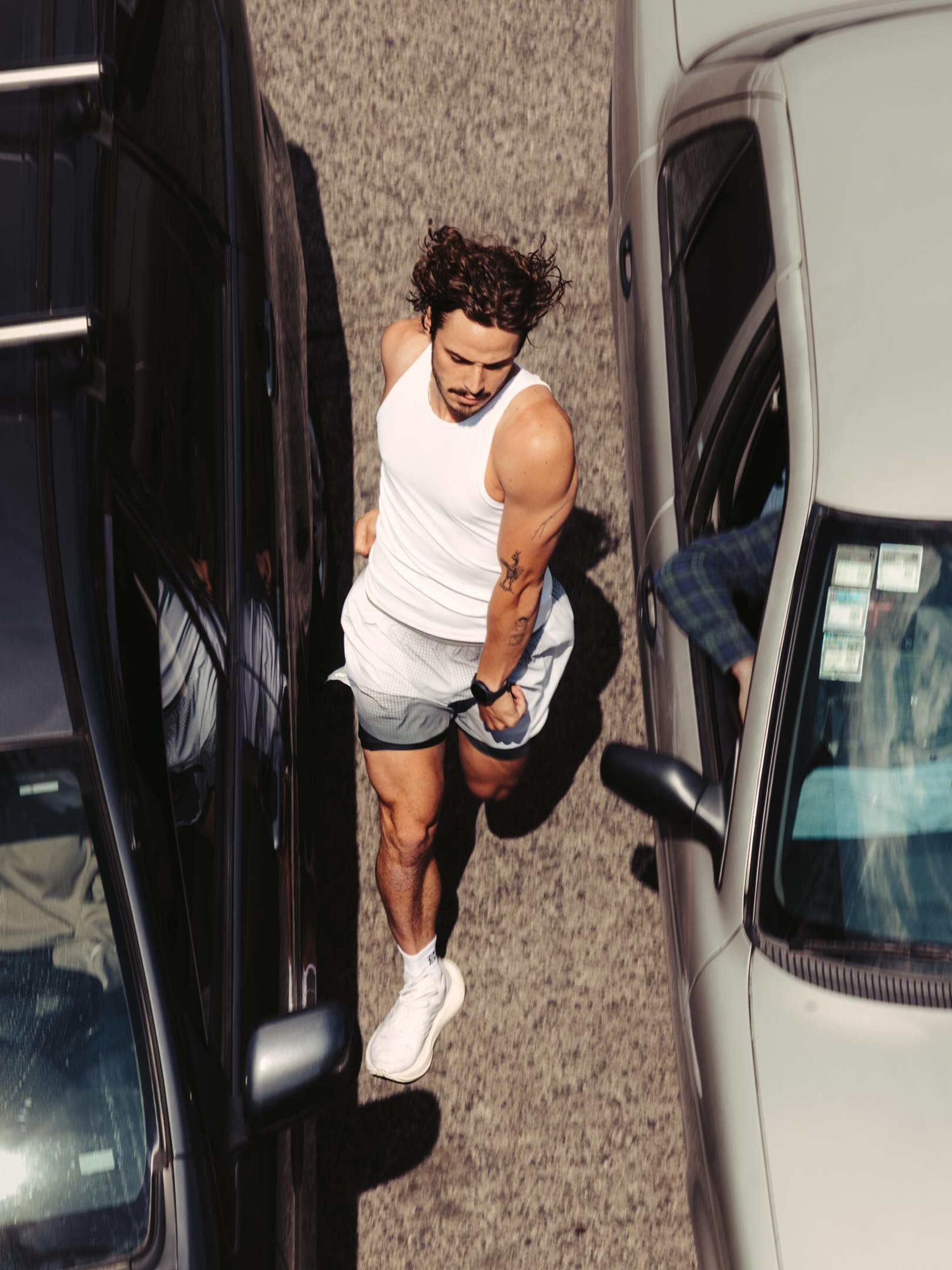
Ask a group of New York runners what they think of Bandit and you will not get one answer. You will get an argument. One person will tell you the pockets are the best in running apparel, full stop. Another will tell you the product is overrated and the brand is a logo people wear to look like runners. Both of these people own Bandit gear. That contradiction is not a flaw in the brand — it is the most interesting thing about it, and it explains how a company that started with a single pair of socks in a Williamsburg basement became impossible to avoid on the West Side Highway in under five years.
From a Basement in Williamsburg to the West Side Highway
Bandit began in October 2020 with one product: a pair of running socks. Tim West made them for the Brooklyn Track Club, the New York run club he belonged to, after one too many races that ended with what he described as puddles in his shoes. The socks were well built — cushioned, properly wicking, designed by someone who had actually run in bad ones — and they carried a name printed along the ankle that did a lot of work.
In running, a bandit is someone who jumps into a race without registering. The term traces back to Bobbi Gibb, who ran the 1966 Boston Marathon after organisers informed her that women were not physiologically capable of covering the distance. She finished. Since then the word has carried a particular charge in the sport: rule-breaking, but the kind that turns out to be right. Putting it on a sock was a small piece of positioning that told you exactly what the brand wanted to be associated with.
The socks caught on inside the club, then outside it. After a year of feedback and organic distribution — with no paid media in that first stretch — Tim concluded the idea was bigger than an accessory. He brought in his brother Nick as CEO in 2021 and took the Creative Director role himself. Both brothers had come out of e-commerce as early employees at Jet.com, acquired by Walmart in 2016, which gave them an operational grounding most apparel startups lack.
The Trio Behind the Brand
The third founder arrived a few months later. Ardith Singh joined as Chief Design Officer from Bandier, the luxury activewear label, where she had been SVP of Design. Bandit’s own investors describe the resulting split cleanly: one founder bleeds the business, one bleeds the brand, one bleeds the product. It is a tidy line, but the division of labour is real and it shows in the output.
The fourth hire mattered as much as any founder. In December 2021, Steve Finley joined as Head of Community. His CV is worth reading twice: five years at Nike Running as Head Coach for Programming and Marathon Training, then Head of Community at Tracksmith — Bandit’s closest philosophical competitor — and, crucially, founder of Brooklyn Track Club, the exact club where the first Bandit socks were seeded. Hiring Finley was not adding a marketing function. It was bringing the community that had incubated the brand onto the payroll.
There is one more piece of the founding story that gets less airtime than the community narrative. Bandit’s first publicised raise was a $14 million round led by Bullish in 2023, followed by roughly $16 million more in 2025, bringing total capital past $30 million. But the scale of the 2021–2022 investment in team, retail space, and inventory strongly suggests a quiet seed round in 2021 that never got a press release. That is standard practice for direct-to-consumer brands protecting a built-from-the-community story, and it is worth naming: the early funding is what bought Bandit the runway to build brand slowly instead of chasing customer acquisition from day one. The community growth was real. It was also well capitalised.
Fashion First, Function Close Behind
Bandit launched its first full apparel line in spring 2022, and Singh’s design approach set it apart immediately. The reference points are not sportswear. They are runways. Bandit has openly cited Dior and Louis Vuitton collections as sources for print work, and reporting on the company notes that you will not find runners on Singh’s mood boards at all. The brand’s own investors characterise it as fashion-led rather than technology-led, which is an unusually honest thing for a performance apparel company to accept as a description.
That choice does real work. It differentiates Bandit visually from every major running brand, it produces gear people are happy to wear to a coffee afterwards, and it sets up an eventual move into everyday apparel. It also, not incidentally, produces clothes that photograph well — which matters more than it should in a category increasingly mediated through Instagram.
But the function is not decorative. Bandit’s credibility with actual runners rests substantially on pocketing, which sounds trivial until you have carried a phone and four gels through a marathon. The men’s half tight — one of the brand’s best sellers — carries seven pockets, and Singh’s stated design goal is that you should be able to spot maybe two or three of them looking at the garment. The phrase she uses is that the pocketing is quiet: available when needed, invisible when not. Sports bras and tights hide phone storage positioned to minimise bounce; a sweatshirt includes an opening for a running watch. These are small solutions, but they are the kind that come from wear-testing with runners rather than from a spec sheet.
Commercially, the range runs on two tracks: limited capsule drops that spike demand and create scarcity, and an always-on core collection of proven sellers. It is a structure that lets Bandit take design risks on trend-driven pieces without carrying the inventory exposure, while keeping steady revenue underneath.
The Community Machine
Bandit’s growth strategy is the one every consumer brand claims and almost none execute. The difference is that Bandit built infrastructure for it.
The Membership launched within months of Finley’s arrival. Members pay $125 and receive a $50 gift card, two pairs of exclusive socks, a 10% discount, early access to drops, event invitations, and partner perks. Run the arithmetic and it is net positive for anyone who was going to buy Bandit anyway — which is the point. What Bandit gets is a structured, addressable community: emails, a Close Friends list on Instagram, and a standing panel to consult on product design. Reported customer lifetime value from members sits around $850.
The programs came next. The OTQ Program, launched in summer 2022, supports runners chasing Olympic Trials qualifying times — and deliberately foregrounds the fact that these are nurses, teachers, physical therapists and copywriters rather than full-time professionals. It buys performance credibility and relatable storytelling simultaneously, at a fraction of what a sponsored athlete roster costs. The Program, launched that autumn, is a marathon training programme with live coaching, extended to non-New Yorkers first via Strava and later through an app. It is now application-based with a $100 fee, which is the clearest possible signal that the programming delivers something people value.
The stores are where the strategy gets genuinely clever. The first opened in Greenpoint, Brooklyn, doing double duty as retail floor and order fulfilment centre — the savings on in-housing fulfilment more than covered the lease. Its position on a popular running route added a third function: Bandit put water out front, turning the shop into a pit stop, then anchored a run club there. The 2024 West Village location, which Bandit calls a Running Room, pushes further: lockers for group runs, a café, a screen for watching races, and 7am opening hours. In 2025 the brand moved beyond New York with a standalone store in Chicago and a pop-up inside Renegade Running in Los Angeles, both built around event calendars rather than shelves.
The comparison that keeps surfacing is Rapha, which built its Clubhouse network on the same logic a decade earlier in cycling: a retail space that functions primarily as a gathering point and only secondarily as a shop. Bandit has taken that template and compressed the timeline.
The Unsponsored Project
Of everything Bandit has done, this is the initiative that comes up most often when you ask runners about the brand — and it is the one that best justifies the goodwill.
The insight came from being embedded in the sport: there is a population of elite athletes training at professional volume without professional pay, who still need kit, and who therefore end up racing in branded gear from apparel-only deals. They provide free marketing to large brands whether they win or finish last, with no salary attached. Bandit’s response was to supply these athletes with all-black race kit carrying no logo at all — not even Bandit’s — so that at championship meets they stand out against the colour-saturated kits of the major brands and signal to agents and brand representatives that they are available. Bandit adds $1,500 in unconditional cash support. Six alumni of the programme have since signed with major footwear brands.
It is worth being clear-eyed about the commercial logic here. Bandit is acquiring visibility and enormous goodwill for a fraction of what a conventional sponsorship costs, and building relationships with athletes on the way up. That is smart. It is also genuinely useful to the athletes involved, which is what separates it from most brand activations that describe themselves as giving back. The Forbes reporting on the programme includes the reaction of sprinter Courtney Okolo — a 400m Olympic gold medallist who had gone two years without a traditional sponsor — when the terms were explained to her: she asked what the catch was. There was an opt-out clause and no catch.
The 2025 Bandit Grand Prix operates on similar principles at larger scale: 5K qualifying heats and a 3K final staged inside a Brooklyn music venue with a DJ set, food, drinks and an afterparty, run on a looped spectator course. Calling it F1-style racing is marketing, but the underlying idea — that competitive running can be presented as a cultural event rather than an endurance test watched by relatives — is one the sport has needed for a long time.
The Hype Problem
Here is where we have to be honest, because a brand page that stops at the success story is an advertisement.
Bandit has a saturation problem, and its own customers say so. The criticisms that circulate in New York running circles are specific and repeated: that the brand has become too mainstream, that everyone wears it, that it is worn to flex rather than to run, that it has become the uniform for people whose identity is being a runner rather than people who are simply running. A customer quoted in a New York Times profile reduced it to a sentence — it is just a logo, so what is the next Bandit? Some runners will also tell you flatly that the product does not justify the price, though others in the same conversation will insist the pockets alone do.
The structural risk has a name, and it is Supreme. That brand also began by serving a specific subculture with credibility earned inside it, also used limited drops to generate queues and free press, and also found that the amplification eventually outran the community — the people in the line stopped being skaters and started being resellers. When the heat dissipated, the original audience had already gone. The parallel is not exact, but the mechanism is the same one Bandit is currently running.
The specific decision point ahead is casualwear. Bandit’s fashion-led design language makes an expansion into everyday apparel commercially obvious, and the brand’s stated mission — evolving the full experience of running — leaves the door open. But that move is exactly what would confirm the criticism that Bandit is a hype label with a running origin story rather than a running brand. Our view is that the brand’s defence against the Supreme trajectory is not brand management. It is product: continued innovation that runners can point to as a reason the gear is worth the money, independent of who else is wearing it.
Prices deserve a mention on that note. Bandit sits firmly in the premium tier alongside Tracksmith, and neither brand competes on cost. The difference is that Tracksmith anchors its premium in heritage, collegiate reference, and a deliberately unfashionable classicism, while Bandit anchors its own in contemporary design and cultural relevance. Heritage ages slowly. Relevance does not.
Our Take
Bandit built something in five years that most apparel brands never manage: an audience that treats the brand as theirs. The community infrastructure is not a marketing veneer — the stores genuinely function as gathering points, the programmes charge money because they are worth money, and the Unsponsored Project solves a real problem for athletes who had no other advocate. Whatever else you think of the brand, that record is not nothing.
The product is better than its detractors allow and less revolutionary than its advocates claim. The pocketing is genuinely class-leading and the fabrics are good; the fit and finish are premium. But this is thoughtfully executed apparel design rather than technical breakthrough, and the price reflects brand position as much as material cost. If you buy Bandit expecting the most advanced running apparel available, you will feel slightly oversold. If you buy it expecting well-made gear that solves practical problems and looks better than anything else in the category, you will be happy.
The honest risk is the one Bandit’s own customers keep articulating. A brand whose value rests partly on cultural currency is exposed when that currency moves, and running has no shortage of well-funded competitors watching this playbook closely. The next few years will show whether Bandit is a durable running brand that happened to become fashionable, or a fashionable brand that happened to start in running. We would like it to be the former — the sport is better with companies willing to stage a race in a music venue or fund unsponsored athletes with no strings attached. You can explore the full range on the official Bandit Running website.
Frequently Asked Questions
Where does the name Bandit come from?
In running, a bandit is someone who joins a race without officially registering. The term is associated with Bobbi Gibb, who ran the 1966 Boston Marathon unregistered after organisers told her women were not capable of the distance — and finished. The word has since carried connotations of rule-breaking authenticity in the sport, which is precisely why it worked printed on the ankle of the brand’s first product.
Who founded Bandit Running?
Tim West started the brand in autumn 2020 in Brooklyn with a single running sock, made for his club, Brooklyn Track Club. His brother Nick West joined as CEO in 2021, with Tim moving to Creative Director. Ardith Singh, previously SVP of Design at Bandier, joined shortly after as Chief Design Officer. Steve Finley — founder of Brooklyn Track Club, formerly of Nike Running and Tracksmith — joined as Head of Community in December 2021.
Is Bandit Running worth the price?
It depends on what you value. The pocketing is genuinely among the best in running apparel — the men’s half tight carries seven pockets designed to be invisible until needed — and the fabrics and construction are premium. But Bandit is fashion-led rather than technology-led by its own positioning, so you are paying partly for design and brand rather than for technical performance unavailable elsewhere. If aesthetics and practical storage matter to you, the value is there. If you want the most technically advanced kit per euro, look elsewhere.
What is the Bandit Unsponsored Project?
It supplies elite athletes without sponsorship deals with entirely unbranded black race kit — carrying no Bandit logo — so they visibly stand out at championship meets and signal to brand representatives that they are available for sponsorship. Bandit adds $1,500 in unconditional cash support. Six athletes from the programme have gone on to sign with major footwear brands. It is the initiative most often cited by runners when they explain why they respect the brand.
How does Bandit compare to Tracksmith?
Both sit in the premium end of running apparel and both build heavily around community, but their aesthetics point in opposite directions. Tracksmith draws on collegiate and mid-century running heritage with a deliberately classical, understated look. Bandit takes its cues from contemporary fashion runways and leans into cultural relevance and drop culture. Tracksmith feels timeless by design; Bandit feels current by design. Which suits you depends largely on whether you want your running kit to reference the sport’s past or its present moment.
Where can you buy Bandit Running?
Primarily online through the brand’s own site, supplemented by physical locations: the original Greenpoint store in Brooklyn, the West Village Running Room in Manhattan, a standalone store in Chicago, and a pop-up within Renegade Running in Los Angeles. Bandit also runs marathon pop-ups around major races including Boston, Tokyo, Berlin and Chicago, where limited capsules routinely sell out on the first day.