There is a question that sits underneath every Speedland shoe, and the two men who founded the brand have built an entire company around refusing to answer it the usual way. The question is simple: what would a trail running shoe look like if nobody ever told you what it was allowed to cost? Most footwear brands start with a price point and design backwards from it, trimming materials until the math works. Speedland started from the opposite end. Decide what the best possible shoe is, build exactly that, and let the price land wherever it lands. When their first model arrived in 2021 at $375, plenty of runners balked. A smaller number understood immediately, and that smaller number is the entire point.
Two Decades at Nike, Puma and Under Armour
Speedland is the work of Dave Dombrow and Kevin Fallon, two designers who have been making shoes together for more than twenty years. They first met working on basketball footwear at Nike, moved together to Puma, and then to Under Armour, where they eventually started talking about doing something on their own. After leaving Under Armour in 2019, a non-compete clause kept them out of the industry for a year, so they spent it filming a YouTube show called SpeedHack, dissecting and rebuilding shoes from every brand on the market to figure out what could be done better. Then they decided to stop critiquing other people’s shoes and build their own.
That long shared history matters, because it explains the brand’s defining trait: Speedland is run by designers, not by athletes who became founders. The distinction is subtle but real. The most obvious comparison is Hoka, another niche brand born from a specific obsession — but where Hoka came from what its founders wanted to wear, the line Dombrow and Fallon repeat is different. They ask what their athletes need. Everything flows from that question.
The « No Compromise » Philosophy
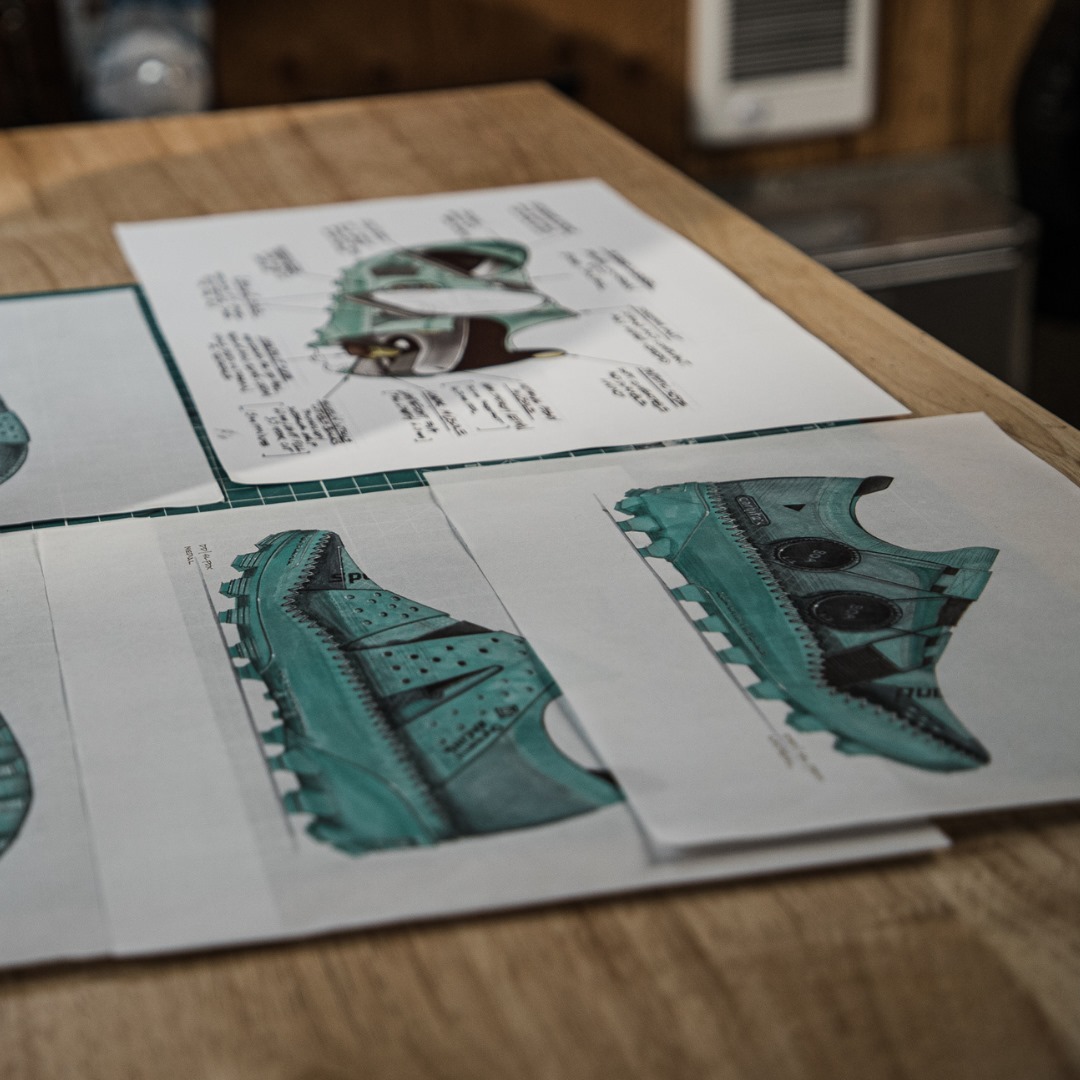
« No compromise » is the kind of slogan that means nothing until you look at the bill of materials. For Speedland it is literal. Rather than designing a midsole and an outsole and a plate in-house and accepting whatever trade-offs that involves, the founders partnered with the acknowledged best in the world for each component. Michelin makes the outsole. BOA handles the fit system. Carbitex supplies the carbon plate. The midsole foam is Pebax, a highly engineered material known for energy return and notoriously expensive to produce. As Dombrow has put it, it is an aggregation of the best of the best at every level — the kind of thing no large brand would ever do, precisely because it produces a retail price that scares the accounting department.
This is also why Speedland describes its shoes as equipment rather than footwear. It is a deliberate framing, and a useful one. They want trail runners to think the way cyclists and skiers already do — that the gear on your feet is a specialized, optimized instrument, not a commodity you replace once a year out of habit. The closest analogy is a track bike: a tightly bound set of constraints (outsole, midsole, insole, upper, fit system, plate) where every single piece can be made the subject of a careful, objective decision once you accept that cost is not part of the conversation.
Why Trail, and Not Road
Speedland’s focus on trail is a strategic choice as much as a personal one. The high-end road market is saturated and dominated by giants like Nike and ASICS, where a small brand has little room to differentiate. Pavement, as the founders point out, is just pavement — asphalt and concrete don’t vary in ways that reward radical design. Trail is the opposite. Arid Southern California desert, the loamy forests of the Pacific Northwest, the rock and root of the Deep South — each demands something different from an outsole, a midsole, a lug pattern. Distances swing from short technical races to hundred-mile ultras. That variety is exactly where an equipment mindset has room to operate, and it is the white space Dombrow and Fallon saw when carbon-plate technology was transforming road racing but had barely touched the trail.
If you want to understand how that terrain-specific thinking plays out across the wider market, our guide on how to choose the right trail running shoes covers the same trade-offs Speedland obsesses over — drop, lug depth, cushioning and protection — from the runner’s side of the decision.
A Deliberately Small Range
Most brands slice the catalogue thin, offering a dozen models that overlap. Speedland does the reverse, keeping the line simple and letting each shoe do more through customization. Historically the range has organized around two families: the GL, a shorter-distance trail shoe, and the GS (Grand Sport), built for the long haul and ultra distances. A road model, the RX:FPY, later extended the brand’s tech to tarmac, and newer commissions continue to rotate through the lineup. Each release is essentially a limited run, tied to a specific athlete and region — the SVT shaped by Avery Collins for the Colorado Rockies, the PDX rooted in Portland’s Forest Park, the GS models informed by ultra and backcountry athletes like Cameron Hanes and Dylan Bowman.
Two models are worth knowing in detail, because they bookend what Speedland does. The original SL:PDX is the founding shoe — a lower-stack, technical trail tool for fast running up to around 50K, and the model that introduced nearly every signature the brand is now known for. At the other end sits the high-stack GS:BLK, the long-distance ultra option with deeper cushioning and aggressive Michelin lugs. Reading both reviews is the quickest way to understand how a single design philosophy stretches from short and sharp to long and protective.
What keeps the range versatile despite its size is customization built into the shoe itself. The Michelin outsole arrives with lugs at 6.5mm that the owner can trim down toward 3mm for firmer ground — a feature genuinely unique to the brand. The Carbitex carbon plate is removable, so the same shoe can be run plated for race day or unplated for easy training. The plate is also asymmetric: stiff in the upward direction for a snappy toe-off, but flexible downward so it conforms over rock and root instead of feeling tippy. The faster you run, the stiffer it gets. This is the sort of detail that only emerges when designers refuse to stop tinkering.
Quick Reference: What Defines a Speedland
| Element | Speedland approach |
|---|---|
| Founded | 2021, Portland, Oregon |
| Founders | Dave Dombrow & Kevin Fallon (ex-Nike, Puma, Under Armour) |
| Philosophy | « No compromise » — best-in-class component at every point |
| Outsole | Michelin, customizable cuttable lugs (6.5mm → 3mm) |
| Fit system | Dual BOA Li2 dials, no laces |
| Plate | Removable Carbitex carbon, asymmetric flex |
| Midsole | Pebax / HTPU premium foams |
| Model families | GL (short trail), GS (long/ultra), RX (road) |
| Price range | Premium — typically $250–$375 |
| Sales model | Mostly direct-to-consumer, limited athlete-driven runs |
Athletes at the Centre, Not the Margins
Plenty of brands sponsor athletes and slap their names on shoeboxes. Speedland’s relationship runs deeper, because each commission is genuinely co-designed with the runner whose name it carries and tested on the terrain they actually train on. The founders are explicit that they want athletes who want to be part of the process, not just collect a paycheck. Their reasoning is that lab tests are poor approximations of real trail running — there is no way to mimic off-camber, technical descending in a controlled environment — so the feedback that matters most comes from feel, reported by people running real miles in real places. It is a slower, more expensive way to develop shoes, which is rather the recurring theme.
That obsession extends past their own catalogue. Speedland also runs a consultancy, advising companies as varied as HP, Arc’teryx, Descente, Tracksmith and their old employer Under Armour. They can do this precisely because, as a hyper-niche brand, they aren’t really a competitor to anyone — which says a great deal about how they see their own place in the industry. If the apparel side of that world interests you, our look at Tracksmith’s brand story covers one of the labels Speedland has consulted for.
Where Speedland Sits in the Premium Trail World
Speedland is not alone at the top of the market, and the comparisons are illuminating. Norda, the Canadian brand built around Bio-Dyneema and obsessive material choice, shares the same premium-at-all-costs instinct but expresses it through a completely different aesthetic and construction philosophy. Hoka is the obvious spiritual cousin, another niche idea that grew large. And brands like Altra and Salomon stake out their own philosophical ground on drop, fit and traction. If you are weighing where Speedland fits among the best options available right now, our roundup of the 10 best trail running shoes in 2026 places this kind of hyper-premium engineering against more accessible alternatives.
Our Take
It would be easy to write Speedland off as expensive footwear for people with more money than sense, and some runners will always see it that way. We don’t. What Dombrow and Fallon have built is something rarer than a good shoe — a coherent philosophy executed without flinching, where the modular plate, the cuttable lugs, the recyclable end-of-life program and the athlete-driven commissions all flow from the same stubborn refusal to cut corners. You can disagree with the price. You cannot easily argue that the thinking behind it is lazy. Whether a Speedland belongs on your feet depends entirely on whether you buy the equipment premise: that a trail shoe is a precision instrument worth paying instrument prices for. For a certain kind of runner, that argument was won the moment they first twisted the BOA dials. You can explore the full current range and the story behind each commission on the brand’s official Speedland website.
Frequently Asked Questions
Why are Speedland shoes so expensive?
Speedland designs from the principle that cost should not dictate component choice. Each part is sourced from a best-in-class specialist — Michelin outsoles, BOA fit systems, Carbitex carbon plates, Pebax foams — and the shoes are produced in limited, athlete-driven runs rather than mass volume. The result is a retail price typically between $250 and $375, which the brand frames as the cost of treating a trail shoe as premium equipment rather than a commodity.
What do the Speedland model names mean?
The lineup is organized into families: GL for shorter-distance trail running, GS (Grand Sport) for long and ultra distances, and RX for road. The suffix on each model — PDX, SVT, RAR and others — refers to the athlete and region the shoe was designed and tested around. PDX, for example, points to Portland’s Forest Park, the brand’s home terrain.
What makes the Speedland fit system different?
Speedland uses a dual BOA Li2 dial system instead of laces — one dial at the midfoot, one at the forefoot — allowing micro-adjustable, multi-directional tightening on the move. It was the first shoe ever to feature BOA’s Li2 system, and the precise, lace-free wrap has become the brand’s most recognizable signature.
Can you really cut the lugs and remove the plate?
Yes. The Michelin outsole ships with 6.5mm lugs that can be trimmed down toward 3mm for firmer or faster terrain, and the Carbitex carbon plate is fully removable, so the same shoe can be run plated for racing or unplated for everyday training. This modularity is how Speedland keeps a small range versatile across very different conditions.
How does Speedland compare to Norda or Hoka?
All three sit at the premium end of trail running, but with different DNA. Norda centres on bio-based Dyneema and longevity; Hoka grew from a maximalist cushioning idea into a mainstream giant; Speedland is designer-led and component-obsessed, built around modularity and athlete-specific commissions. They appeal to overlapping but distinct runners — which is exactly why comparing them is worthwhile rather than redundant.