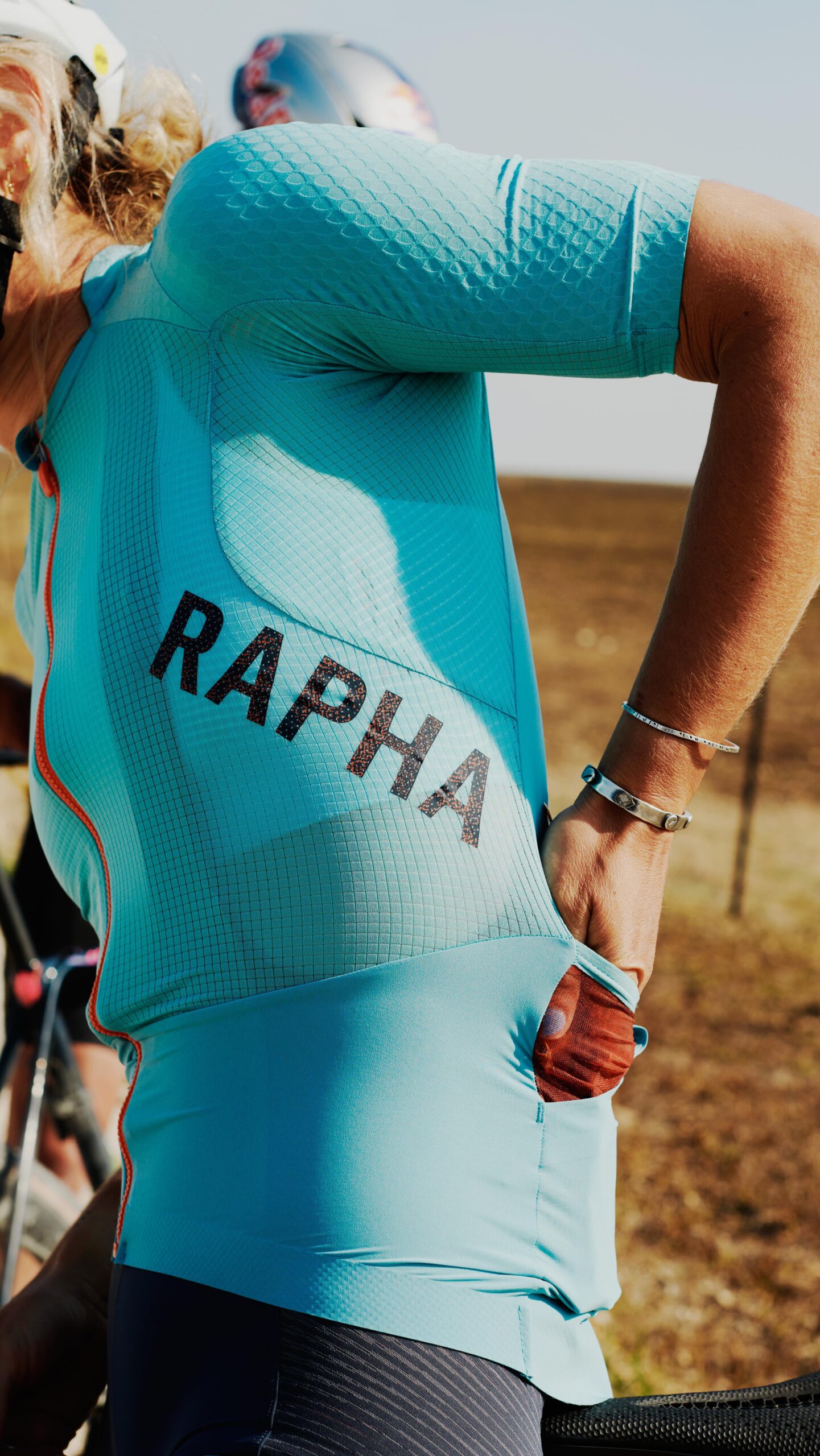
Before Rapha, cycling kit was garish, synthetic, and deeply unfashionable. After Rapha, it became something people actually wanted to wear. This is the story of how a brand born in a Camden Town backroom rewrote the visual and cultural language of an entire sport — and of what happens when you have to defend a revolution you started.
The Problem Simon Mottram Wanted to Solve
In the early 2000s, road cycling occupied a peculiar cultural corner. It was a sport that had produced some of the most dramatic athletic performances in history — riders suffering across Alpine passes, racing through rain and mud with an almost baroque sense of sacrifice — yet its aesthetic was an embarrassment. Jerseys were loud, polyester things plastered with corporate logos. Bib shorts were forgettable. The kit worn by amateurs who loved the sport looked, frankly, cheap. Cycling was seen, in Mottram’s own words, as « this weird niche thing that people thought was sh*t. »
Simon Mottram came from a different world. Born in Rotherham, Yorkshire, he had trained as a chartered accountant at Price Waterhouse before spending fifteen years as a brand consultant and director at Interbrand, where he specialised in valuing luxury and consumer brands. He had developed a precise, almost clinical understanding of what made certain brands feel desirable — and an equally clear sense of what cycling was missing. He could see the raw material: a sport with genuine drama, a rich visual heritage, legendary protagonists. All it needed was someone to translate that into a coherent brand proposition.
The idea that became Rapha was not simply about better cycling clothing. It was about making cycling feel important, beautiful, and worth belonging to. Mottram had been captivated by the era when professional cyclists were as famous as film stars, when riders climbed mountains with panache rather than power meters, when the sport existed in black-and-white photographs of extraordinary suffering and grace. That visual universe — Fausto Coppi, Jacques Anquetil, Raymond Poulidor, Tom Simpson, Eddy Merckx — would become the spiritual foundation of everything Rapha built.
Camden Town, July 2004: A Brand Is Born
In January 2004, Mottram and two colleagues began working from a small room above a shop in Camden Town, London. He had spent eighteen months trying to raise funding for the venture, eventually securing £140,000 — far short of his £400,000 target, but enough to begin. Co-founder and creative director Luke Scheybeler gave the brand its visual discipline and editorial voice. The name came from a 1960s French cycling team, San Raphael, which had raced with a certain elegance that felt right for what they were building.
The launch target was July 4th, the start of that year’s Tour de France — a deadline both practical and symbolic. Just weeks before the planned debut, the UK manufacturer who was supposed to produce the brand’s signature jersey pulled out. The crisis was resolved, the jersey was produced, and Rapha launched on schedule.
The debut was staged as an event, not a product launch. Rapha opened a month-long exhibition at the Truman Brewery in East London, entitled Kings of Pain. It showcased six heroes from cycling’s golden era — Coppi, Anquetil, Poulidor, Simpson, Merckx, and Bernard Hinault — through photography, film, and text. The message was clear from the start: this was not a brand selling clothing. It was a brand selling a way of seeing cycling.
The first jersey — the Classic Jersey — was merino wool, dark, and deliberately understated. It referenced the wool jerseys of cycling’s romantic era while being entirely functional. There was no logo shouting from the chest, no fluorescent panel on the sleeve. The Rapha pink stripe — a subtle nod to both the Giro d’Italia‘s maglia rosa and the old wool jerseys of continental racing — ran along the collar and cuffs. It was, and remains, one of the most quietly radical pieces of cycling apparel ever produced.
The Aesthetic Revolution: What Made Rapha Different
To understand Rapha’s cultural impact, it helps to recall what cycling clothing looked like before 2004. The dominant aesthetic was functional at best, aggressively commercial at worst. Kit was designed to carry sponsor logos as efficiently as possible. Colour palettes were loud — the louder the better, since visibility on the road mattered more than taste. The idea that cycling clothing could be beautiful, that it might be worth photographing for reasons beyond performance data, was essentially absent.
Rapha changed this through a series of consistent choices. The palette was restrained: deep navy, charcoal, ivory, off-white — with that signature pink as the single concession to colour. The typography was clean. The photography was cinematic: long-lens shots of riders on alpine roads, light raking across gravel, the kind of imagery you might find in a contemporary art book rather than a cycling catalogue. The copy was literary, referencing suffering, beauty, and the particular existential drama of spending five hours alone on a mountain pass.
James Fairbank, Rapha’s Head of Design, articulated the underlying logic clearly: « Cycling is one of those aspirational activities that a lot of people want to identify with. Once you get to that stage, the aesthetics of cycling and the way the sport looks is then a transferrable, marketable thing. » Rapha understood this before anyone else in the cycling industry. It was not selling performance. It was selling belonging to a culture worth belonging to.
The premium pricing was a deliberate signal. A Rapha jersey cost considerably more than its competitors — and that gap communicated something important. Luxury, Mottram knew from his Interbrand years, is partly about what the price tells you about the object. The clothing had to be expensive enough to signal seriousness, but functional enough to justify the signal. Rapha’s products, in those early years, were both.
Growing a Community: The Clubhouse and the RCC
Rapha’s most original contribution to cycling culture was not any particular garment. It was the Clubhouse. The first Rapha Clubhouse opened in London, and the concept was immediately legible even to non-cyclists: a café-retail hybrid designed for cyclists, staffed by cyclists, showing cycling films on the walls, hosting group rides before opening hours. The Clubhouse was where Rapha stopped being a clothing brand and became a community infrastructure.
The Rapha Cycling Club (RCC), launched in 2014, extended this community logic globally. For an annual membership fee, members gained access to exclusive products, organised rides, and the network of Clubhouses that Rapha had begun building across major cities in Europe, North America, and Asia. The RCC was, in effect, a subscription to cycling culture — a way of signalling membership in a particular kind of rider tribe. At its peak, the club counted tens of thousands of members worldwide.
The Clubhouse concept has since expanded internationally. In late 2025, Rapha opened its first mainland China Clubhouse in Shanghai, housed in a restored 1925 mansion, designed in collaboration with agency Seen Studios. The space drew on British industrial design principles and mid-century modern aesthetics, with Rapha’s signature pink woven into ceramic tile details and furniture choices. It was described as the first expression of a « next-generation » Clubhouse concept — a sign that the physical community strategy remains central to the brand’s future, even as it navigates a turbulent financial period.
The WorldTour: From Team Sky to EF, a Twelve-Year Presence
In 2013, Rapha became the kit sponsor of Team Sky — the British professional cycling team that had just won back-to-back Tour de France titles with Bradley Wiggins and Chris Froome. The partnership was a statement of arrival. Rapha’s all-black Sky kit, clean and menacing, became the most recognised jersey in the peloton for several years. It was also, at the time, one of the most sophisticated pieces of performance apparel ever made at WorldTour level.
When the Team Sky partnership ended in 2015, Rapha made a choice that revealed something important about its identity. Rather than simply moving to another men’s WorldTour team, it became the kit sponsor of Canyon-SRAM, a UCI Women’s WorldTour team. The design was striking and unconventional — a clear statement that the brand was prepared to invest in women’s professional cycling at a time when few others were.
The partnership with EF Education — which began around 2018 and ran through the 2025 season — produced the most memorable and divisive kit collaborations in modern professional cycling. The team’s base kit was unmistakable: an almost fluorescent pink that dominated the peloton. The annual Giro d’Italia switchout kits, designed to avoid clashing with the race leader’s jersey, became cultural events. The 2020 collaboration with British skateboard brand Palace, complete with duck-print helmets and a clashing geometric pattern, was so radical that the team was fined 4,500 CHF by the UCI for non-compliant clothing. It was also the most talked-about kit in the race.
Rapha ended its EF partnership at the conclusion of the 2025 season, leaving the WorldTour after twelve consecutive years. The decision was announced by incoming CEO Fran Millar as a strategic pivot, not a retreat: « Rapha is leaving the WorldTour — for now. We will be back. » The brand simultaneously announced a long-term partnership with USA Cycling, running through 2029 and covering Olympic disciplines — a different kind of visibility, but a significant one.
The 2017 Sale: Walmart Money Meets a Cult Brand
In 2017, Rapha was acquired by RZC Investments — a private equity vehicle controlled by Steuart and Tom Walton, grandsons of Walmart founder Sam Walton. The reported acquisition price was around £200 million. For a cycling clothing brand founded on £140,000 of seed capital thirteen years earlier, this was a remarkable outcome.
The Waltons are serious cyclists themselves, based in Bentonville, Arkansas — a city that has become one of America’s most significant mountain biking destinations, largely through their own philanthropic investment. The fit, on paper, was plausible. In practice, the acquisition ushered in a period of turbulence. Mottram remained CEO until the end of 2021, then stepped down. His successor, William Kim, brought in from the luxury fashion world — Burberry, Gucci, Abercrombie & Fitch — lasted less than a year. A period of co-CEO leadership followed, before the appointment of Fran Millar in September 2024.
The financial results of this period were sobering. Rapha posted operating losses for eight consecutive years following the acquisition, with a £21.2 million loss in 2023 improving modestly to £17.2 million in 2024. A significant portion of these losses — around £10 million annually — was attributable to the amortisation of goodwill from the acquisition itself, making the underlying trading picture somewhat less alarming than the headline figures suggested. Rapha also closed its North American office in 2024, consolidating operations as part of a broader realignment.
The difficulties were real, but context matters. The broader cycling industry contracted sharply after the Covid pandemic-era boom. Supply chain disruptions, consumer pullback, and heightened competition all contributed to a difficult trading environment across the sector. Rapha was not uniquely struggling — it was struggling in a difficult market while carrying the additional weight of acquisition debt.
The Imitators: A Generation of Brands Rapha Made Possible
Perhaps the most persuasive evidence of Rapha’s cultural impact is the generation of independent cycling apparel brands that followed its lead. Pas Normal Studios, founded in Copenhagen in 2014, built its identity on a similarly restrained aesthetic and a premium positioning. MAAP, founded the same year in Melbourne, took a comparable approach: minimal colour, careful typography, photography that treated cycling as a visual art form. Café du Cycliste, from Nice, extended the tradition into warmer, more southern European tones. Universal Colours approached it with even greater graphic minimalism.
None of these brands would exist in their current form without Rapha having demonstrated, first, that cyclists would pay premium prices for premium clothing; second, that cycling culture had a visual language worth taking seriously; and third, that a brand could build genuine community, not just product loyalty. Rapha wrote the playbook. Its successors, in many cases, are now writing faster.
This is the paradox Rapha now faces. It created a market that has grown to accommodate many serious competitors. In 2004, Mottram was, as he puts it, « founding a niche brand in a niche sport. » Today, cycling kit is a fashion category. The riders who once had only Rapha as an option for tasteful, expensive kit now have a dozen credible alternatives. Rapha’s CEO Fran Millar frames this directly: « We are the originals, we started this. We have a deep credibility and deep authenticity in this sport. » The question is whether that origin story still functions as a competitive advantage — or whether it has become a museum exhibit.
The Product Range: Beyond the Classic Jersey
Rapha’s product range has evolved considerably from the merino Classic Jersey of 2004. The brand now covers road, gravel, and mountain bike apparel; bib shorts in multiple performance tiers; accessories from gloves and caps to saddlebags; skincare; and an increasingly significant off-bike lifestyle offering that includes hoodies, bags, and casual outerwear.
The Brevet line, introduced for long-distance and gravel riding, signalled that Rapha was serious about terrain beyond the traditional European road race. The Explore line, launched in 2018, reinforced this: gravel, bikepacking, and adventure cycling were explicitly part of the brand’s territory, not concessions to a trend. In the context of hill.camp’s coverage of bikepacking clothing and accessories, Rapha’s Explore range remains one of the most coherent attempts to apply the brand’s design sensibility to rougher, more demanding riding conditions.
The collaboration history is also worth noting. The 2007 Paul Smith partnership produced a limited-edition jersey that now changes hands for four-figure sums on eBay. The 2016 collaboration with Apidura brought Rapha’s aesthetic discipline to bikepacking bags. The repeated Palace collaborations with EF Pro Cycling expanded the brand’s cultural reach beyond cycling’s traditional boundaries into streetwear and youth culture.
Fran Millar and the Turnaround
Fran Millar is an unusual appointment. She spent fifteen years at the heart of British professional cycling — co-founding Team Sky, overseeing six Tour de France victories under that banner and a seventh after its rebranding to Team Ineos in 2019, serving as CEO of Team Ineos when Eliud Kipchoge broke the two-hour marathon barrier in Vienna. She came to Rapha in September 2024 having already executed a financial turnaround at Belstaff, where she took the British heritage brand from a £20 million operating loss to break-even by 2024.
Her analysis of Rapha’s situation is characteristically direct. She acknowledges that the brand experienced « a loss of focus » during the years of multiple leadership changes, that competition has genuinely intensified, and that Rapha « has some things to fix. » She also frames the brand’s position clearly: « The imagery from the 1960s and 1970s is quite rock and roll. It’s quite punk. It’s got some glamour to it. Rapha leant incredibly hard into that. » The challenge now is to maintain that heritage while making the brand relevant to cyclists who have grown up with MAAP and Pas Normal Studios as reference points.
Millar’s first major strategic decision — ending the EF Pro Cycling partnership and stepping away from the WorldTour — was counterintuitive enough to generate significant debate. Her reasoning was that WorldTour sponsorship, while generating visibility, had become expensive relative to the return. The USA Cycling partnership, by contrast, offered a different kind of credibility: association with Olympic cycling across disciplines, including track, road, and mountain bike, at a time when Rapha is explicitly trying to broaden its audience beyond the traditional road-racing customer.
Millar also hinted at the product direction. Simon Mottram, still connected to the brand as a board director, suggested in late 2024 that the future would include more one-piece road suits and skinsuits on the performance side, while « performance product for everyday life on the bike » — kit you feel comfortable wearing into a café after a ride — would remain central. Both directions feel consistent with where cycling culture is moving.
Why Rapha Still Matters
It is fashionable, in cycling media, to ask whether Rapha has lost its edge. The question is legitimate: the financial losses are real, the leadership turbulence was damaging, and the competitive landscape has shifted decisively. What was once a near-monopoly on tasteful, premium cycling apparel is now a crowded category.
But the question somewhat misses the point. Rapha’s influence is not measured by whether its current margins are healthy. It is measured by the fact that the entire visual and cultural language of modern cycling kit — the restraint, the photography, the community infrastructure, the idea that cycling is worth dressing well for — was essentially invented by one brand in a Camden Town backroom in 2004. Every brand you buy from today because it looks good and has considered typography is, in some way, a downstream consequence of what Simon Mottram and Luke Scheybeler built.
The Clubhouse network — now extending from London and New York to Mallorca and Shanghai — remains the clearest expression of what Rapha actually is. Not a clothing company. A cycling culture company that happens to make very good clothing. The distinction matters. Clothing companies compete on product and price. Culture companies compete on meaning — and meaning, when it has been built over two decades, is considerably harder to replicate than a jersey cut or a colourway.
Rapha’s current chapter is one of recalibration rather than decline. The brand is returning to its roots: cycling-first, community-first, design-first. It is working with brands that share its commitment to craft and expanding into disciplines — mountain biking, Olympic cycling — where its aesthetic credibility is still largely untested. Whether Fran Millar’s turnaround plan will restore the brand to profitability as decisively as she managed at Belstaff remains to be seen.
What is not in doubt is the legacy. Rapha took a sport that people considered unglamorous and made it beautiful. It took clothing that people considered functional and made it desirable. It took a community of riders who felt slightly embarrassed about their hobby and gave them a tribe worth belonging to. For a brand that started with £140,000 and a room above a Camden shop, that is an extraordinary achievement — and the foundation on which any future chapter will be built.
Rapha — Key Facts
| Detail | Information |
|---|---|
| Founded | 2004, London, England |
| Founders | Simon Mottram & Luke Scheybeler |
| Current CEO | Fran Millar (from September 2024) |
| Ownership | RZC Investments (Steuart & Tom Walton), since 2017 |
| Headquarters | London, England; US office in Bentonville, Arkansas |
| Products | Road, gravel & MTB apparel; accessories; skincare; lifestyle |
| Clubhouses | Major cities across Europe, North America, and Asia Pacific |
| RCC Membership | ~15,000 members globally (2025) |
| Pro sponsorships | Team Sky (2013–15), Canyon-SRAM Women (2015–19), EF Pro Cycling (2018–25), USA Cycling (2025–2029) |
| Website | rapha.cc |
Frequently Asked Questions
Who founded Rapha and when?
Rapha was founded in London in early 2004 by Simon Mottram and Luke Scheybeler. Mottram had spent fifteen years as a brand consultant before launching the company, and Scheybeler served as creative director. The brand launched publicly in July 2004 with the Kings of Pain exhibition at the Truman Brewery in East London, coinciding with the start of the Tour de France.
Why is Rapha cycling kit so expensive?
Rapha’s pricing reflects both the quality of its materials and construction — merino wool, performance fabrics, careful fit — and its deliberate positioning as a premium lifestyle brand. From the beginning, Mottram understood from his brand-consulting background that premium pricing signals quality and aspiration. The price is not just a reflection of cost; it is part of what the brand communicates. Rapha also invests heavily in design, photography, community infrastructure, and its Clubhouse network, all of which contribute to the cost structure.
What is the Rapha Cycling Club (RCC)?
The Rapha Cycling Club, launched in 2014, is a global membership organisation for cyclists. For an annual fee of around $95, members gain access to exclusive products, priority access to new releases, organised group rides, member-only events, and access to Rapha’s Clubhouse network worldwide. The RCC currently has around 15,000 members globally, down from a peak of around 22,000, reflecting the pressures the brand has faced since 2020.
Who owns Rapha now?
Rapha has been owned by RZC Investments since 2017, when the company was acquired for approximately £200 million. RZC is the private equity vehicle of Steuart and Tom Walton, grandsons of Walmart founder Sam Walton. Both Walton brothers are passionate cyclists, particularly in the mountain biking world, and are based in Bentonville, Arkansas, which has become a significant cycling destination through their philanthropic investment.
Is Rapha still a market leader in cycling apparel?
Rapha remains one of the most recognised and influential cycling apparel brands in the world, but the landscape it helped create has become significantly more competitive. Brands including Pas Normal Studios, MAAP, Café du Cycliste, and others have built strong followings with a similar premium, design-led positioning. Rapha’s CEO Fran Millar, appointed in September 2024, has described the challenge clearly: « We are the originals, we started this » — and the task is reasserting that originator’s authority in a market that the brand itself made possible.
Does Rapha sponsor professional cycling teams?
Rapha spent twelve years in the UCI WorldTour, first with Team Sky (2013–2015), then with Canyon-SRAM’s women’s WorldTour team, and then with EF Pro Cycling (2018–2025). The EF partnership in particular produced some of the most iconic — and occasionally controversial — kits in modern professional cycling. At the end of 2025, Rapha stepped away from the WorldTour, simultaneously announcing a long-term partnership with USA Cycling running through 2029, covering Olympic disciplines across road, track, and mountain bike.
To explore the best road and gravel bikes from brands that share Rapha’s commitment to considered design, our comparisons of the Canyon Grizl vs Specialized Diverge and the Trek Domane vs Specialized Roubaix offer a closer look at the machines that Rapha-wearing riders tend to favour. And if you’re piecing together a gravel kit from the ground up, our guide to bikepacking clothing and accessories covers the full picture beyond the jersey. For footwear that applies similarly high design standards to cycling shoes, the brand page on QUOC is a natural companion read — a brand that, like Rapha, understood that cyclists deserved better than what the market was offering them.
For the full picture on Rapha’s current product range, Clubhouse locations, and RCC membership, visit rapha.cc.