The Canyon Grail has always been a polarising bike. In its first generation, that polarisation came from the Hover Bar — a two-level handlebar system that divided opinion cleanly between those who found it genuinely useful and those who found it gimmicky. Since the 2023 redesign, Canyon made a decisive call: drop the Hover Bar, extend the wheelbase, move to a conventional integrated cockpit, and build the Grail into an unambiguous gravel race machine. The CF SL 7 is the entry point into that new generation.
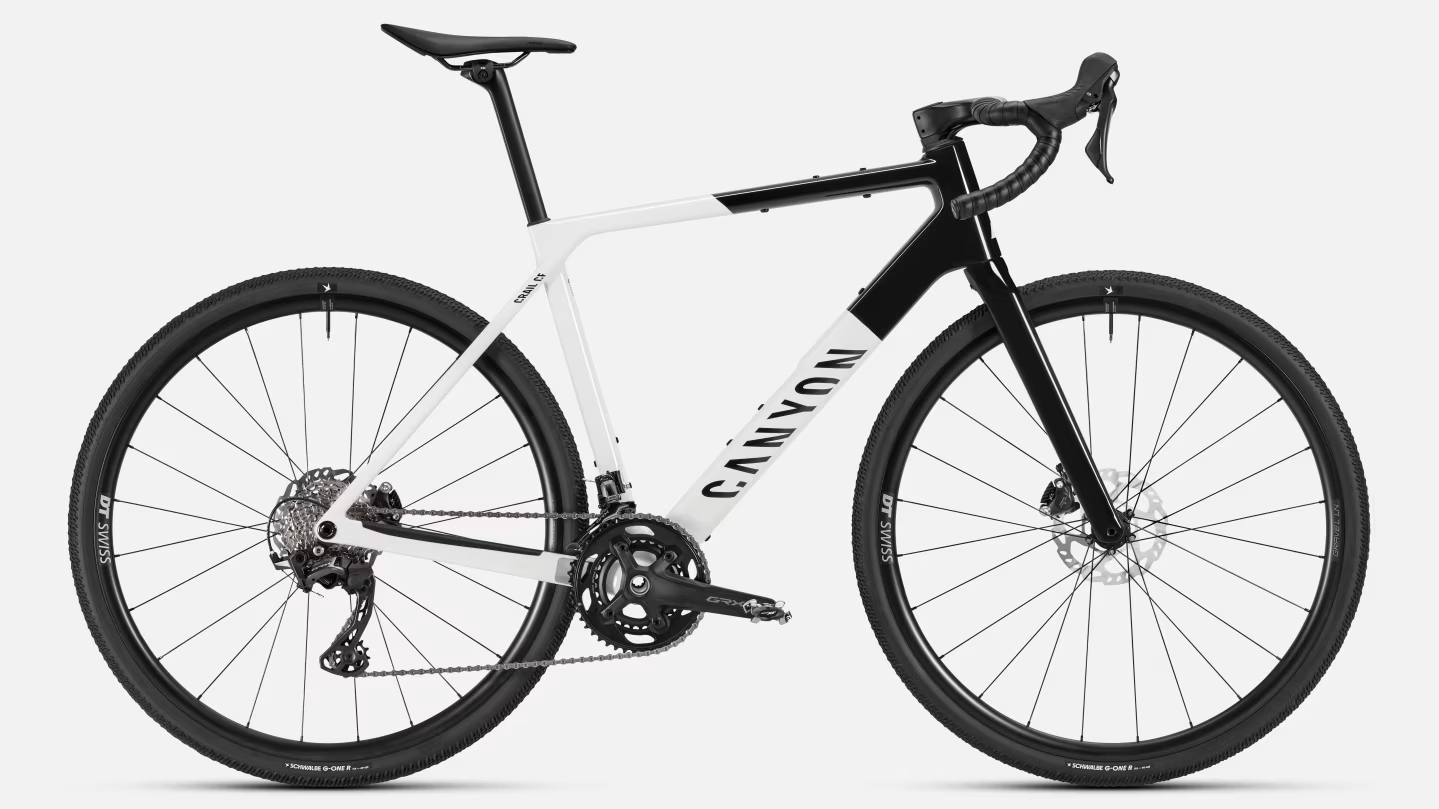
At around €2,699 direct from Canyon, it’s worth being precise about what this bike is and what it isn’t. It isn’t a touring platform, it isn’t an adventure bike, and it won’t carry your bags across the Pyrenees comfortably. What it is: a sub-9kg carbon gravel bike with a Shimano GRX 2×12 drivetrain, aero frame shaping, integrated downtube storage, and geometry refined by the team that put Mathieu van der Poel on a Grail CFR at the UCI Gravel World Championships. That’s a different kind of proposition.
What Canyon Changed in the Current Generation
Understanding the Grail CF SL 7 means understanding how much changed in 2023. The previous generation was built around the Hover Bar cockpit — and as a result, the entire head tube area was shaped around accommodating it. The new Grail starts from a blank sheet: the geometry was extended by 27mm in wheelbase, the head tube angle slackened by one degree to 71.5°, and the stack-to-reach ratio tightened to reflect a genuine race position. The bike now uses Canyon’s Double Drop Bar — a conventional-looking integrated one-piece cockpit with 16° of flare and a built-in Gear Groove computer mount — paired with a D-shaped carbon seatpost that provides a degree of vertical compliance without the complexity of a flexy seatpost system.
The other significant addition is the Aero LOAD system: a noise-dampened downtube hatch that holds a tube and inflator, plus a magnetic FidLock frame bag that Canyon claims reduces aerodynamic drag by 1.5 watts when fitted. These details signal what the Grail is optimised for — race-day self-sufficiency, not bikepacking capacity.
Frame and Build: What You Get at This Level
The CF SL 7 uses Canyon’s CF SL carbon layup — one step below the CF SLX and two below the flagship CFR. Canyon quotes a frame weight of approximately 1,040g, which is credible for a mid-tier carbon gravel frame. The complete bike comes in at around 9.2kg in a size medium, tubeless-ready and without pedals. That’s not the lightest bike in this price bracket, but it’s competitive, and the weight distribution feels right — the bike doesn’t feel front-heavy or sluggish despite the integrated cockpit.
The groupset is Shimano GRX 2×12 mechanical, with 46/30 chainrings and an 11-34 cassette. The 2× setup is interesting in this context: Canyon has moved away from the 1× configuration that most competitors default to at this price, and the reasoning is sound. A 2× drivetrain gives you tighter gear steps across the range — useful when you’re racing and need precise cadence control — and the GRX800 series mechanical shifts crisply without the weight penalty of Di2. The hydraulic disc brakes use 160mm rotors front and rear and provide consistent, progressive bite. Wheels are DT Swiss C 1850 Spline rims, tubeless-ready with rim tape pre-installed, matched with Schwalbe G-One RS 700×40mm tyres — a fast-rolling, lightly-treaded compound well suited to packed gravel and mixed tarmac surfaces. The complete build is well sorted for the price.
Geometry: Race-Oriented, Not Punishing
The current Grail’s geometry is the part that most clearly marks the break from the previous generation. A 71.5° head tube angle (slack by gravel standards, which tend to cluster around 72–73°), extended wheelbase, and a seat tube angle of 73.5° create a position that is unmistakably performance-focused but not aggressively so. Canyon sized our test bike (size L) at a 402mm reach — longer than most gravel bikes in that size, which places you in a stretched, efficient position. If you’re accustomed to a more upright adventure geometry, the first rides will feel purposeful in a way that requires some acclimatisation.
The extended wheelbase is one of the most tangible improvements over the previous generation. On fast, loose descents, the Grail feels planted rather than twitchy, with a stability that allows you to carry speed through sections where a shorter-wheelbase bike would demand more input. The head tube angle keeps the front end sharp enough that it doesn’t feel ponderous in corners — it’s a well-found balance.
On the Road: Climbing, Descending, and Flat Speed
The Grail CF SL 7 climbs efficiently. The stiff carbon frame translates pedalling effort into forward movement with minimal flex, the 46/30 front chainring setup gives you enough range to spin at a reasonable cadence on sustained gradients, and the geometry keeps you in a position where out-of-saddle efforts feel natural rather than awkward. At sub-9.2kg, the bike doesn’t fight you on ascents — it responds.
On descents, the extended wheelbase does its job. The Grail holds a line well at speed, the hydraulic brakes give you precise modulation, and the G-One RS tyres — run tubeless at around 30 PSI — absorb enough surface variation to keep the handling predictable. This is not a bike that will beg you to slow down on fast gravel descents. If anything, it encourages you to go faster than your nerve allows.
Flat speed is where the Grail’s aero aspirations are most noticeable. The tube shaping throughout the frame is clearly informed by wind tunnel work, and the integrated cockpit removes the drag penalty of a traditional stem/bar interface. In a race context, these marginal gains accumulate. For a club rider doing long gravel days, the difference is probably not perceptible in isolation — but the bike never feels like it’s working against you, either.
Comfort over long distances is reasonable but not exceptional. The D-shaped seatpost provides some compliance without being dramatically noticeable; the wider GRX hoods give your hands plenty of positions; and the 40mm G-One RS tyres, run tubeless, take enough edge off the road chatter to make a five-hour gravel day manageable. Riders accustomed to more compliance-focused bikes — full VCLS seatposts, wide-flare bars, 45mm+ tyres — will find the Grail more demanding. Riders coming from road or race-focused gravel bikes will find it familiar.
The Integrated Cockpit: Honest Assessment
The Canyon Double Drop Bar is the element that will divide opinion at this spec level. It’s a one-piece integrated bar and stem: clean, aero, and well-finished. The 16° of flare is moderate — not as aggressive as dedicated adventure bars, but more than a road racing setup. The Gear Groove computer mount is genuinely well thought-out, a central channel that accepts most Garmin and Wahoo units without an adapter.
The limitation is adjustability. You cannot change the stem length independently. You cannot swap to a wider bar if you want more control on technical terrain. If the stock reach works for you, the integrated cockpit is a clean, effective solution. If it doesn’t, your options are limited to Canyon’s own accessories — and that’s a constraint worth understanding before you buy. Sizing correctly on the Grail matters more than on a bike with a traditional cockpit.
CF SL 7 vs CF SL 8: Is the Upgrade Worth It?
Within the Grail CF SL range, the 7 is the entry point and the 8 steps up to a GRX Di2 electronic groupset, upgraded wheels, and a marginal weight reduction. The price gap is roughly €700–900. For riders who shift frequently and want the precision of electronic indexing, the Di2 is worth considering — but the mechanical GRX 2×12 on the CF SL 7 is not a compromise that demands immediate upgrading. It shifts accurately, holds adjustment well, and performs cleanly under load. You’d feel the Di2 in race situations. In everyday training and event riding, the mechanical version is fully capable.
Above the CF SL range sits the CF SLX — a lighter carbon layup, roughly 200g less than the SL frame — and beyond that the flagship CFR. These are substantially more expensive and bring diminishing returns for non-professional use. The CF SL 7 occupies the value sweet spot in the Grail range: enough performance to feel like a real race bike, at a price that Canyon’s direct-to-consumer model makes genuinely competitive.
CF SL vs AL: Should You Consider the Grail AL Instead?
This is a question worth addressing directly, because it comes up frequently. Canyon offers the Grail in aluminium as well — the Grail AL 7 — at a significantly lower price point. The AL frame is heavier (around 11kg complete versus 9.2kg for the CF SL 7), stiffer in a less comfortable way, and built with a more basic cockpit. It’s a legitimate entry into the Grail geometry and the Shimano GRX drivetrain for riders who want that experience without the carbon price.
But there’s a nuance here. If you’re primarily interested in adventure riding, bikepacking, or mixed-use gravel cycling rather than racing, the comparison changes. In that case, neither the Grail AL nor the Grail CF SL 7 is the right bike from Canyon’s range — the Grizl is, in either carbon or aluminium, depending on your budget. It’s more compliant, has wider tyre clearance, and carries gear far more practically. The Grail AL, like the Grail CF, is fundamentally a performance-oriented gravel bike, and buying it for adventure use means accepting its limitations in that role.
If you are choosing between AL and CF SL primarily on budget grounds, and performance is genuinely your use case: the carbon makes a difference on climbs and over long flat efforts. The weight gap is real; the ride quality gap is also real, if less dramatic. Save for the CF SL 7 if you can. If you can’t, the AL is an honest entry point — not a compromise, just a different set of trade-offs.
How It Compares to the Competition
At this price point — around €2,699 — the Grail CF SL 7 competes with bikes like the Specialized Diverge Comp Carbon, Trek Checkpoint SL 5, and Giant Revolt Advanced 2. Each takes a different angle on what a carbon gravel bike should be. The Diverge prioritises comfort compliance through its Future Shock stem and IsoSpeed decoupler. The Checkpoint is a versatile all-rounder that handles bikepacking as well as racing. The Revolt sits between adventure and performance without committing fully to either.
The Grail is more single-minded than all of them. It makes no concession to carrying capacity, offers no suspension system, and limits your tyre clearance to 42mm. What it gives you in return is a more focused, more efficient racing platform at a direct-to-consumer price that undercuts equivalent dealer-sold carbon by a meaningful margin. For riders who know what they want and race gravel events — or who train specifically for them — the Grail CF SL 7 is hard to argue against at the price. We covered the head-to-head with the Specialized Crux in detail, and the direct comparison with the Cannondale Topstone illustrates exactly where the Grail’s priorities diverge from an adventure-focused alternative.
Specs
| Spec | Canyon Grail CF SL 7 |
|---|---|
| Frame | Canyon CF SL carbon, aero tube shaping |
| Fork | Canyon CF carbon, disc mount |
| Frame weight | ~1,040g (size M) |
| Complete bike weight | ~9.2kg (size M, tubeless) |
| Groupset | Shimano GRX 2×12 mechanical |
| Chainrings | 46/30T |
| Cassette | 11-34T (Shimano HG700) |
| Brakes | Shimano GRX hydraulic disc, 160mm rotors |
| Wheels | DT Swiss C 1850 Spline, tubeless-ready |
| Tyres | Schwalbe G-One RS 700×40mm |
| Cockpit | Canyon Double Drop Bar, one-piece integrated, 16° flare |
| Seatpost | Canyon CF D-shaped, compliance-tuned |
| Max tyre clearance | 42mm |
| Storage | Aero LOAD downtube hatch + FidLock magnetic bag compatible |
| Available sizes | 2XS to 2XL (7 sizes) |
| Price | ~€2,699 |
Verdict
The Canyon Grail CF SL 7 is a very good gravel race bike sold at a price that its dealer-based competitors cannot easily match. The 2023 redesign removed the stylistic eccentricity of the old Hover Bar era and replaced it with a cleaner, faster, more race-focused machine. You get a stiff, lightweight carbon frame, a well-chosen Shimano GRX 2×12 drivetrain, fast-rolling wheels and tyres, and geometry that rewards confident, aggressive riding on fast gravel terrain.
What you don’t get: meaningful tyre clearance beyond 42mm, any practical provision for carrying gear, adjustable cockpit geometry, or the ride compliance of a purpose-built adventure bike. If those things matter to you, the Grail is the wrong tool — look at the Grizl instead, and read our full comparison between the two to understand exactly where the line is drawn.
If they don’t matter to you — if you have a race on the calendar or you simply want the most efficient, performance-focused gravel bike your budget can reach — the Grail CF SL 7 is a compelling answer. Canyon’s direct-to-consumer model delivers genuine value at this spec level, and the current generation is the best Grail they’ve made. See the full Grail range on the Canyon official website.