hill.camp does not conduct first-hand product testing. This review is a synthesis of independent field tests, specialist press articles, and verified consumer feedback gathered from multiple sources. All technical data and performance observations are drawn from those sources and attributed accordingly.
Norda 005 Review: Quick Specs
| Weight | ~215–228 g (men, US 9 / EU 42–43) |
| Drop | 7 mm |
| Stack height | 28.5 mm heel / 21.5 mm forefoot (measured: ~34 mm heel full stack) |
| Midsole | 100% Arnitel TPEE (no plate, no blending) |
| Upper | Bio-Dyneema open mesh, seamless construction |
| Outsole | Vibram Megagrip Elite (exclusive compound), 3.5–4 mm Tetris-pattern lugs |
| Lacing | Fit-Lock System + 4 mm Dyneema laces |
| Fit | Broad toe box, standard to high volume midfoot |
| Waterproofing | None (water-resistant mesh, fast-draining) |
| Intended use | Trail racing, tempo efforts, mixed terrain up to ~80 km |
| Retail price | €299–315 |
Context: Where the 005 Sits in the Norda Line
Norda structures its catalogue around the Fibonacci sequence: 001, 002, 003, 005, 008. The logic is more than aesthetic — each number signals a different intent. The 001A is the durable all-rounder, built for long mountain days and technical singletrack. The 002 is the low-stack precision tool, closer to the ground, oriented toward short technical formats. The 005 sits above both: it is the race shoe, the speed shoe, the shoe Norda designed for UTMB, Western States, and Hardrock — events where the terrain is mixed, the pace is high, and both weight and durability matter in the same conversation.
Norda athlete Jason Schlarb wore a prototype of the 005 to third place at the 2024 Hardrock 100 — one of the most demanding and technical hundred-mile races in North America. That result says something about the shoe’s ambition. It also sets expectations that need to be tested against real-world field reports from a wider range of runners.
The Midsole: Pure Arnitel TPEE, No Shortcuts
The 005’s midsole is 100% Arnitel TPEE — the same thermoplastic polyester elastomer compound used in the 001A, but here in its undiluted form, blended with nothing, injected with no gas, carrying no plate. Norda describes it as a « pure » formulation, and the field results back up the claim that it behaves differently from any conventional trail foam.
The sensation is paradoxical: soft when pressed by hand, with clear give under the thumb, yet immediately and firmly reactive when loaded at running pace. Multiple independent testers describe it as simultaneously cushioned and ground-connected — a combination that most foam technologies force you to choose between. The Arnitel delivers more than 80% resilience, a figure comparable to the best PEBA foams used in carbon-plated road super shoes, but with one critical advantage: it does not degrade with use. After 200 km of testing, field reporters confirm the midsole feels identical to day one. The foam does not compress, does not soften, does not go dead. For an ultra-distance race shoe, that consistency across time is arguably more valuable than peak energy return.
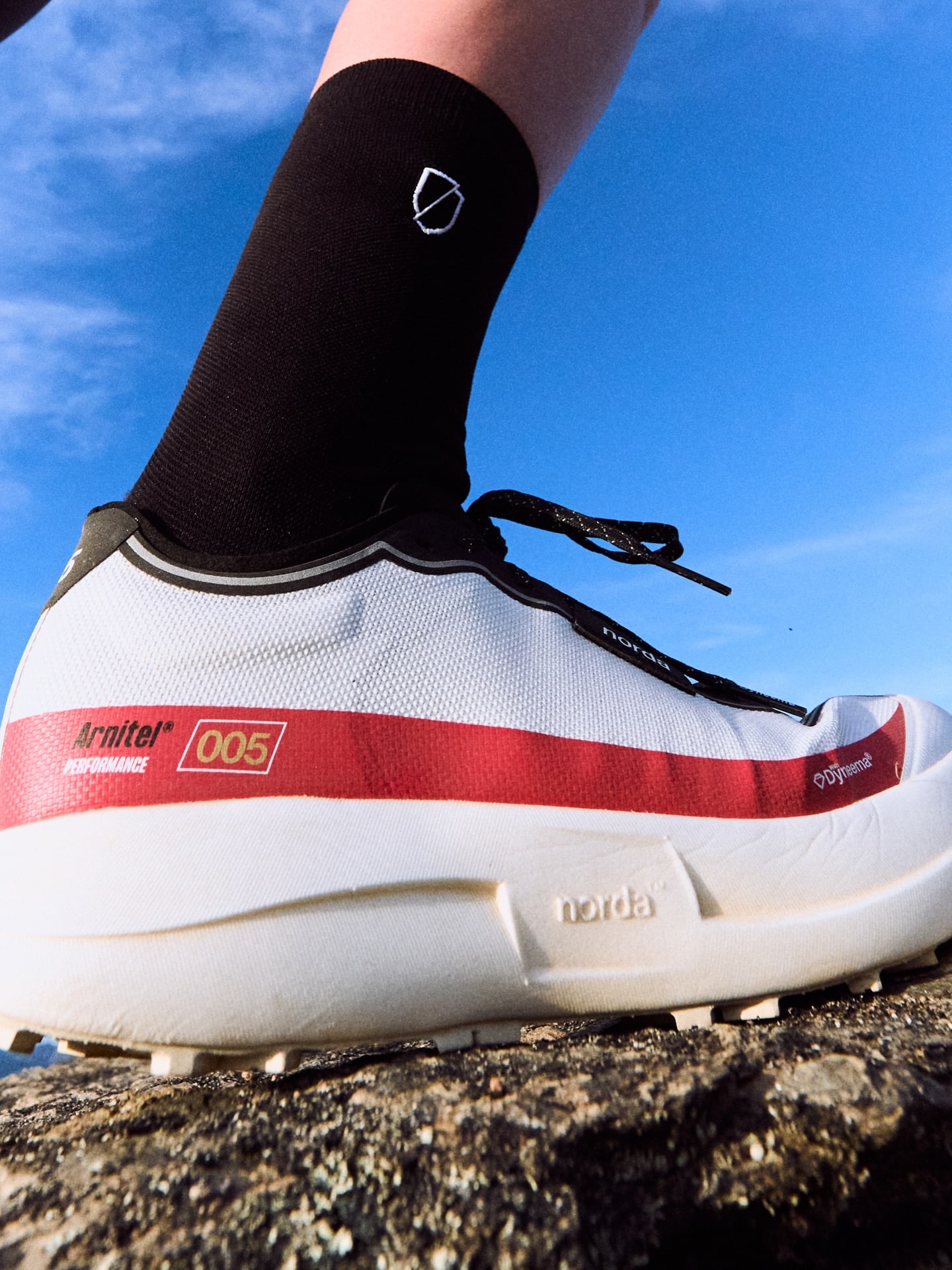
The stack sits at 28.5 mm heel / 21.5 mm forefoot by spec — moderate by 2026 standards, where many competitors have pushed to 35–40 mm. Norda made this choice deliberately: they prioritised the exceptional quality of the Arnitel over sheer volume, reasoning that a truly responsive foam at moderate stack outperforms a mediocre foam at maximum stack. The measured full heel stack (insole included) comes out at around 34 mm across multiple test pairs, which puts it solidly within the range of well-cushioned trail shoes without approaching maximal territory. This plateless approach is itself a statement in a debate we explore in our guide to whether carbon plate trail shoes actually work off-road — where the research increasingly suggests foam quality matters more than the plate.
The platform geometry is relatively flat and broad — 85 mm at the heel, 72 mm at the midfoot, 115 mm at the forefoot. There is no dramatic rocker and no pronounced arch contouring. What this means in practice is a neutral, foot-driven ride that rewards efficient mechanics. The shoe does not propel you forward artificially; it amplifies what your foot already does well. Runners who have built specific leg strength and forefoot running habits will get more from it than those who rely on geometry and plate mechanics to carry them.
The Upper: Bio-Dyneema Open Mesh and the Fit-Lock System
The upper is built from Bio-Dyneema — the same fibre family used across the Norda line, but here woven into a more open, airy mesh that significantly improves breathability compared to earlier Norda models. Dyneema’s properties are extraordinary: at equivalent weight, it is stronger than steel, and its resistance to abrasion, tearing, and deformation is essentially unmatched among materials used in running footwear. After 200 km of testing on abrasive trail surfaces, field reporters find no meaningful wear on the upper — no fraying, no thinning, no pulled threads. Dirt does not cling to the fabric and wipes off easily.
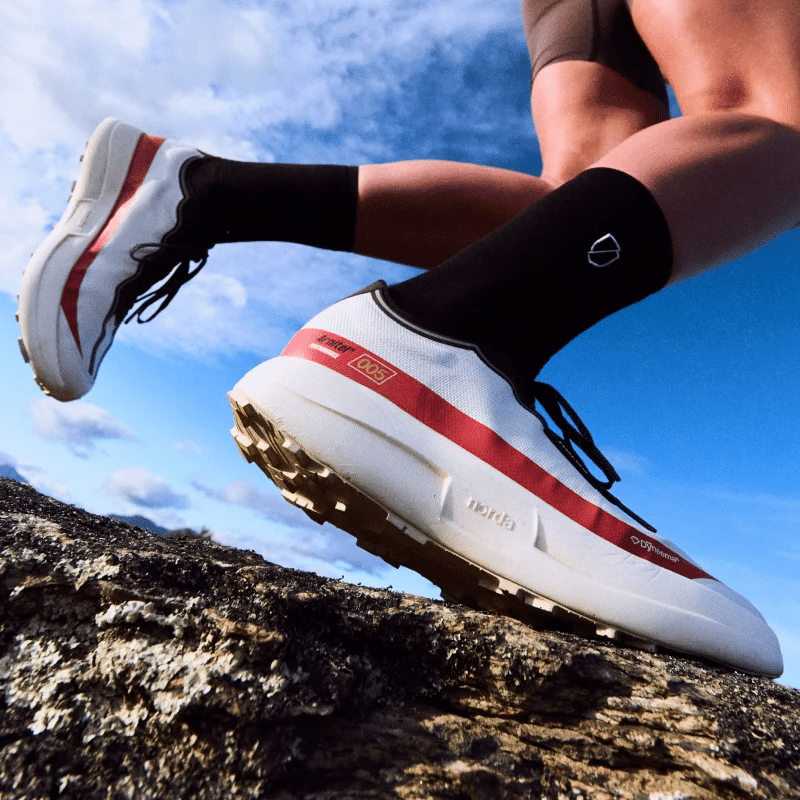
The construction is seamless, which eliminates the friction points that cause blisters and hot spots on long efforts. Despite having no internal padding — the tongue is a single perforated suede-like layer with essentially no thickness — field testers report no lace bite and no pressure points, even after multiple hours of running. This is a function of how precisely the Bio-Dyneema wraps the foot: the material moulds and conforms without bulky intermediary padding.
The Fit-Lock System is the technical centrepiece of the upper. Internal stirrup-like elements at the midfoot connect to a set of double lace gilles on each side, creating a three-dimensional hold that goes beyond what conventional lacing can achieve. The effect is particularly noticeable in descents and lateral movement: the foot stays exactly placed, without the upper migrating around it. This system also means that runners can keep the lower laces slightly looser for comfort while the midfoot stirrups maintain grip — a useful adjustment for long efforts when feet swell.
The laces themselves are 4 mm Dyneema — four times stronger than a conventional lace and significantly lighter. One practical note that emerges consistently from community feedback: the Dyneema laces are slippery by nature and require a double knot to stay tied. This is a minor but recurring complaint that Norda should address.
Two structural limitations deserve honest mention. The heel collar has minimal padding above the Achilles tendon — a deliberate weight-saving choice that works well for most heel shapes but can cause irritation for runners with sensitive insertions or those prone to Achilles tendinopathy. And the tongue is so thin that on very long or very hot efforts, some runners find it inadequate. Neither issue is a dealbreaker, but at this price point they are imperfections that should not exist.
The Outsole: Vibram Megagrip Elite, Developed Exclusively for the 005
The 005 is the first trail shoe to use Vibram Megagrip Elite — a new compound developed in partnership with Norda that is reported to be 15% more adhesive than standard Megagrip and considerably lighter. The lug pattern takes the form of Tetris-shaped blocks, 3.5–4 mm deep, arranged across a full-coverage outsole. Some lugs incorporate fine internal points for additional bite on hard surfaces. The full-coverage design (rather than the segmented Litebase approach used on the 001A) means the outsole also functions as a stabilising platform for the soft Arnitel midsole beneath it.
On dry rock, hardpack, and abrasive mountain trail — the conditions the shoe is designed for — the Megagrip Elite is outstanding. Testers describe confidence levels on wet slab and dry granite that rival the best outsoles available. The full-coverage design combined with the highly flexible midsole-outsole sandwich allows the shoe to contour over irregular terrain rather than bridging it, maximising contact area on complex surfaces.
On loose, steep, or off-trail terrain the picture is more nuanced. The Tetris lug pattern, with its relatively sparse arrangement, sacrifices some mechanical bite on soft or unstable ground in favour of weight and flexibility. One multi-tester report describes foot slippage on a very steep off-trail section during a 20-mile race — a scenario that a more conventionally aggressive chevron pattern might have handled better. On deep mud, the outsole’s self-cleaning properties are limited. The honest conclusion: this is a high-speed outsole optimised for the terrain that makes up 90–95% of most trail races — and it is exceptional in that context. For full mud-specialists or highly technical alpine terrain, more aggressive alternatives exist.
One important durability note: the Megagrip Elite compound is so adhesive that it wears faster on tarmac and artificial surfaces than conventional trail rubber. Runners who warm up or cool down on roads, or who mix significant road mileage into their training in the 005s, will see accelerated outsole wear. These shoes are built for trails, and the outsole rewards that use.
On the Trail: How the 005 Actually Runs
The first thing runners notice — universally, across every field report — is the weight. At around 215–228 g depending on size and insole choice, the 005 is in a category by itself for a shoe with this level of cushioning and protection. That weight advantage is not just a number on a spec sheet; on long climbs, it translates into real energy savings that compound over thousands of metres of elevation gain. Testers describe the sensation of the shoe « disappearing » underfoot on the uphills — a feeling associated with the best race footwear regardless of format.
The Arnitel foam delivers what testers consistently describe as a springy, energetic ride that feels organic rather than mechanical. There is no snap or heel-toe lever action from a carbon plate — instead, the foam simply returns what you put into it, efficiently and without delay. On tempo efforts and uptempo paces, this translates into a shoe that feels genuinely fast without demanding anything unusual from the runner’s gait. On longer, slower endurance efforts, the cushioning is sufficient and comfortable. The 005 handles a wider pace range than its racing positioning might suggest.
In descents, the combination of Fit-Lock midfoot hold, adequate heel wrap, and Megagrip Elite outsole creates a genuinely confident experience on non-technical ground. On very steep or loose descents — particularly off-trail — the minimal heel counter and the sparser lug pattern demand more active foot placement and engagement from the runner. This is not a shoe that forgives passivity on demanding terrain. If you know how to choose and use technical trail shoes, the 005 rewards that knowledge. If you are still building that foundation, another shoe will serve you better.
Water management is handled the same way as on the 001A: no membrane, fast drainage, quick drying. The open mesh upper is more breathable than earlier Norda uppers, and moisture evacuates quickly on stream crossings or in rain. The trade-off is that in sustained heavy rain, the foot will get wet. For trail races in hot or mixed conditions — exactly the formats the 005 targets — this is generally the right call.
Who the 005 Is For — and Who It Is Not
The 005 is at its best for runners weighing under 80–85 kg, running at pace on trails that range from smooth singletrack to moderately technical mountain terrain. It suits tempo training, race efforts from 20 km to roughly 50–80 km, and any context where speed, lightness, and material quality over time all matter simultaneously. Runners who want to prepare for ultra-trail events at UTMB or Western States-style formats — with mixed surfaces, long climbs, and a premium on every saved gram — are exactly the runners Norda designed this shoe for.
For heavier runners — those consistently above 85–90 kg — the Arnitel foam, while resilient, may not provide enough underfoot support over very long or very intense efforts. Community feedback includes reports of forefoot bottoming out from heavier athletes on technical terrain, particularly on downhills. This is not a failure of the shoe; it is a consequence of designing for speed and lightness rather than maximum cushioning volume. Runners who want that extra protection without leaving the Norda ecosystem now have an option: the max-cushion 055, which we put directly against this shoe in our Norda 055 vs 005 comparison.
For very technical terrain — sustained pierrier sections, loose alpine scree, deep mud — the outsole lug design and minimal heel structure place greater demands on the runner’s technique than more conventional trail shoes. Experienced technical runners will adapt; less experienced ones may find it uncomfortable.
Compared to the Norda 001A, the 005 is lighter, more reactive, and better suited to higher paces and race formats. The 001A has a lower stack, a firmer feel, and excels on sustained technical mountain efforts where ground feel and longevity over 6–8 hours matter more than outright pace. The Norda 002 sits below both in stack and weight, a precision tool for short technical efforts rather than distance racing. The 005 occupies the space where performance and protection intersect — and in that space, it has very few equals.
Against the broader competitive field — the Hoka Speedgoat and comparable premium trail shoes — the 005 is lighter, better in upper durability, and more reactive underfoot. What it gives up is outsole aggression in mud and structured support for heavier or more novice athletes. For a direct head-to-head against the maximalist end of the premium spectrum, our Norda 005 vs Speedland SL:PDX comparison sets this plateless, featherweight shoe against Speedland’s plate-and-dials approach. Compared to carbon-plated trail race shoes more broadly, it offers a more organic ride, superior breathability, and dramatically better long-term durability, with slightly less mechanical propulsion. For most trail runners in most race contexts, those trade-offs favour the 005.
Sizing and Fit
The 005 runs short relative to most brands. Norda recommends sizing up half a size from your usual trail shoe, and field experience broadly confirms this — particularly for the length. The toe box is genuinely wide and accommodating, with good height as well, suited to a broad range of foot shapes including those with wider forefeet. The midfoot volume is on the higher side, which benefits high-instep runners and those wanting extra room for long efforts, but may feel imprecise for narrow-footed runners even with careful lacing. Heel volume is also generous — the Fit-Lock system compensates for this in midfoot hold, but runners with very slim ankles may notice some rear movement on technical descents.
The 005 comes with two insoles: a standard moulded version and a 4g lighter flat Race Day insole. Switching to the Race Day insole brings the US9 pair below 8 oz (226 g) — exceptional for a fully cushioned trail shoe with a Vibram outsole.
Our Take
The Norda 005 is the most interesting trail shoe we have reviewed at hill.camp. Not necessarily the right shoe for every trail runner — it is clearly not — but the most genuinely original one. In a market where innovation increasingly means adding more foam, more carbon, more millimetres of stack, Norda went the other direction: a purer material, a lower weight, a higher standard of construction, and absolute confidence in the foam’s ability to deliver without mechanical assistance. The Arnitel TPEE midsole, in its 100% undiluted form, genuinely delivers something different. The Bio-Dyneema upper genuinely lasts. The Megagrip Elite genuinely grips. These are not marketing claims dressed up with data — they are observable outcomes confirmed across multiple independent testers logging real miles in real conditions.
What we respect most is the honesty of the positioning. The 005 does not pretend to be a shoe for everyone. It is designed for a specific runner — lighter, experienced, technically sound, training for fast trail races on mixed terrain — and it serves that runner exceptionally well. The pricing is steep, but the material quality and projected durability make the cost-per-kilometre argument genuinely competitive with cheaper shoes that wear out faster.
The lace-slippage issue needs to be fixed. The heel collar could use a touch more padding. And runners above 85 kg or heading into full mountain technical terrain should look elsewhere, or at least supplement the 005 with a more appropriate second option. But for its intended purpose — fast, light, long trail racing on the terrain that defines the world’s great ultramarathons — the 005 has very little competition and makes a compelling case that the carbon plate era in trail running may be more optional than it looks. You can find out more and explore the full Norda line on the official Norda website.
FAQ
What makes the Norda 005 different from other trail race shoes?
The 005 uses 100% pure Arnitel TPEE foam — a material with over 80% resilience that does not degrade with use — combined with a Bio-Dyneema upper and an exclusive Vibram Megagrip Elite outsole, all with no carbon plate. The result is a shoe that is lighter than most plated alternatives, more durable, and built with materials that maintain their performance over hundreds of kilometres. It represents a genuinely different philosophy from the foam-plus-carbon approach that dominates the market.
How does the Norda 005 compare to the 001A?
The 005 is lighter, more reactive, and better suited to higher paces and race formats up to around 80 km. It has a slightly higher stack and more cushioning than the 001A, but a less aggressive outsole lug pattern. The 001A has a firmer, more ground-connected feel and excels on very technical mountain terrain at sustained lower paces. If you are racing on mixed terrain at pace, the 005; if you are grinding long technical days in the mountains, the 001A.
Does the Norda 005 need a break-in period?
Less so than the 001A. The open Bio-Dyneema mesh is softer and more immediately accommodating than the tighter weave used on earlier Norda models. Most testers describe comfort from the first run. The Fit-Lock system takes a session or two to dial in your preferred lacing tension, but there is no significant structural break-in required. Some runners with sensitive Achilles insertions may need time adjusting to the minimal heel collar padding.
Is the Norda 005 suitable for 100-mile races?
It has been used successfully at Hardrock 100 by a Norda athlete, but elite performance at the extreme end of distance does not translate universally. For mid-pack runners at 100 miles, the 005’s moderate stack and minimal heel structure may not provide enough support in the late stages. Most testers recommend it confidently up to 50–80 km; beyond that, it depends heavily on runner weight, terrain, and personal foot strength. A rotation with a more cushioned shoe for the final stages is a sensible strategy — the max-cushion Norda 055 is the brand’s own answer for exactly those longer, rougher efforts.
How does the Norda 005 size compared to other brands?
The 005 runs short — take half a size up from your usual trail shoe size. The toe box is broad and high, accommodating wider forefeet well. The midfoot has relatively high volume, which suits high-instep runners but may feel loose for narrow feet even with snug lacing. If possible, try before buying, or purchase from a retailer with a good exchange policy.
Can the Norda 005 be used on roads or gravel?
Yes, and it performs well on both — several testers rate it highly as a road speed trainer. However, the Vibram Megagrip Elite compound wears faster on hard surfaces than on trail, so sustained road use will shorten the outsole’s lifespan. Use it primarily on trail, and treat road sections as incidental rather than routine.