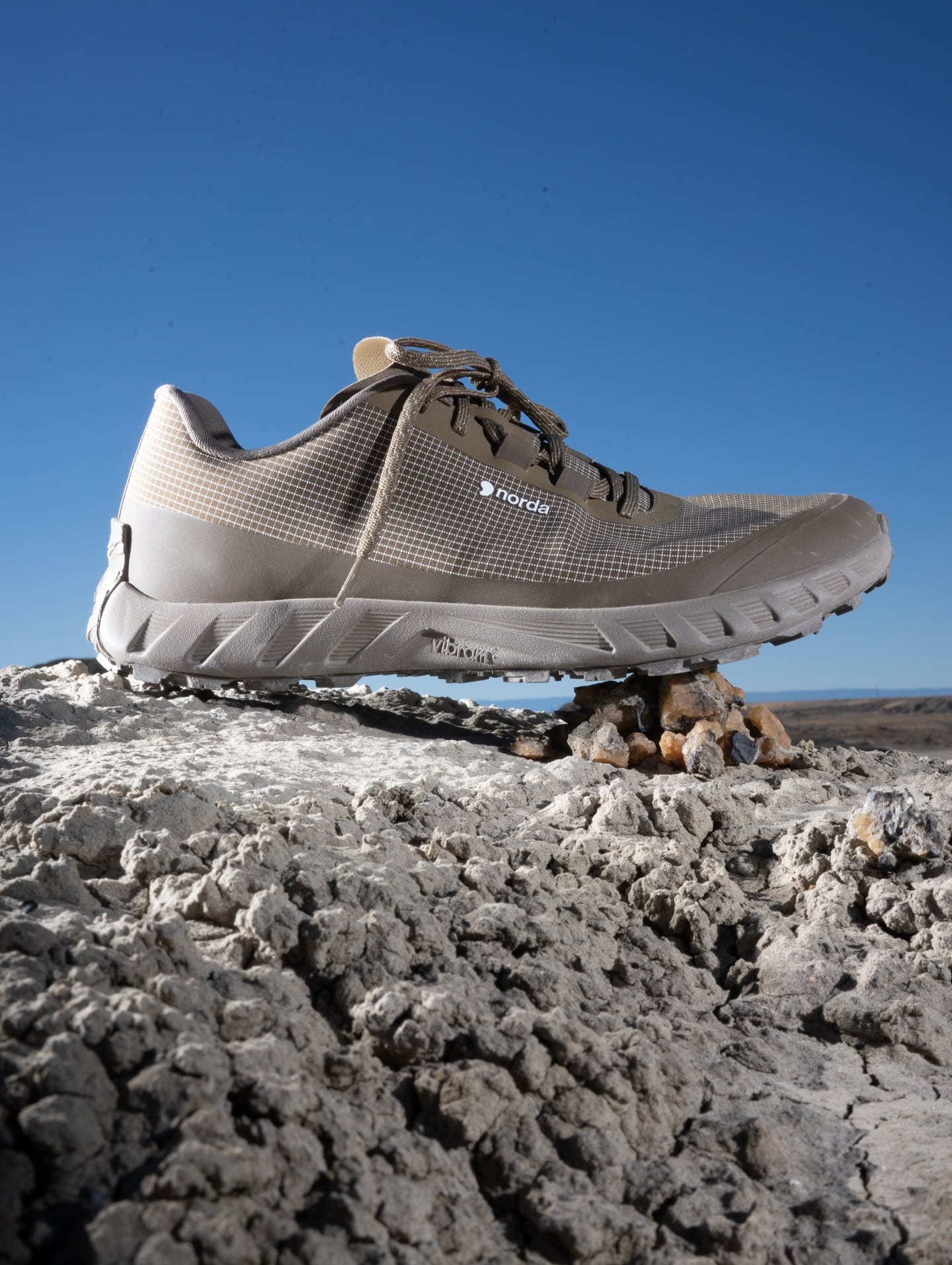
hill.camp does not conduct first-hand product testing. This review is a synthesis of independent field tests, specialist press articles, and verified consumer feedback gathered from multiple sources. All technical data and performance observations are drawn from those sources and attributed accordingly.
When Norda launched the 001, the trail running world took notice — partly because of the Bio-Dyneema upper, partly because of the price, and mostly because the shoe did not look or feel like anything else on the market. The 002 is not a replacement. It is a parallel proposition: lower stack, thinner upper, slightly lighter, and explicitly aimed at runners who want more ground feel and more agility without giving up the material quality that defines the brand. If the 001 and its successor the 001A are Norda’s ultra-distance horses, the 002 is their mountain racer.
Norda 002 review : Quick Specs
| Weight | 266 g (men’s US 9) / 249 g (men’s US 8.5) |
| Drop | 4 mm |
| Stack height | 19 mm heel / 15 mm forefoot (midsole+outsole only) |
| Full stack (with insole) | 24 mm heel / 20 mm forefoot |
| Midsole | Vibram SLE (high-compression moulded EVA) |
| Insole | Custom eTPU (expanded thermoplastic polyurethane) |
| Upper | Bio-Dyneema, seamless construction, thinner weave than 001 |
| Outsole | Vibram Megagrip Litebase, 5 mm lugs, Canadian Shield pattern |
| Lacing | Norda Lock system + 100% recycled Dyneema laces |
| Waterproofing | Water resistant only (no membrane) |
| Intended use | Technical trail, racing, tempo training, all-mountain |
| Retail price | $295 / €275 |
What Norda Changed From the 001
The 002 shares the same Vibram midsole compound and outsole pattern as the 001, but almost everything else has been rethought. The upper uses a thinner, more breathable weave of Bio-Dyneema — less waterproof than the 001’s version (water resistant to light rain rather than a genuine soaking), but noticeably more breathable and slightly lighter. Fewer overlays at the front of the shoe give the toe area more freedom, while the rear of the shoe gains a padded collar and a semi-rigid heel counter that the 001 was criticised for lacking. The net result is a shoe that addresses the 001’s most common complaint — the lack of heel structure — while simultaneously becoming more pliable and ground-connected underfoot.
The stack height reduction is the defining change. At 19 mm in the heel and 15 mm in the forefoot (midsole and outsole combined, before the 5 mm eTPU insole), the 002 sits approximately 5 mm lower than the 001. That number is meaningful: it changes the stability geometry, increases ground feel, reduces protection on hard or sharp terrain, and shifts the shoe’s character clearly toward the technical and the fast rather than the long and the sustained.
The Upper: Glove Fit With a Different Weave
Bio-Dyneema is the upper’s headline — a polyethylene fibre said to be 15 times stronger than steel by weight, non-stretch, and naturally water-repellent. The 002’s version is thinner and more translucent than the 001’s, a change that improves breathability and reduces weight at the cost of some water resistance and a degree of the 001’s almost stiff rigidity. Road Trail Run’s Sam Winebaum described it as « very dense, very thin and pliable, with no stretch » — the upper truly conforms to the foot in a way he called genuinely glove-like. Jeff Valliere, testing in Colorado’s technical mountain terrain, reported the upper as « amazingly thin, flexible and light, yet simultaneously protective and secure, » with a hold that remained consistent regardless of pace, gradient, or sidehilling angle.
The toe box is generous in both width and volume, with a double-layer toe bumper that is more vertical than overhanging — protecting the toes without creating pressure from above. The gusseted tongue, made from the same Dyneema material, stays in place during movement and does a reasonable job of keeping debris out, though it is not a true gaiter-integrated design. The Norda Lock lacing system uses 100% recycled Dyneema laces that are four times stronger than standard laces, and the fibre texture provides a secure, rarely-loosening grip without needing re-tying mid-run.
Trail & Kale’s Alastair Dixon flagged one important nuance: Norda and most retailers recommend sizing up a full size, but Dixon found this left too much space inside the shoe, particularly on steep climbs. His recommendation — sizing up half a size from your usual running shoe — is more broadly supported by the Road Trail Run multi-tester panel, where Dom Layfield confirmed a half-size-up fit perfectly, while Mike Postaski found the standard recommended full-size-up left the toe box too short even at that increase. The takeaway: half a size up is the safer starting point, and runners with lower-volume feet or narrow heels should pay particular attention to fit before committing.
One consistent observation across testers relates to warm conditions: the Dyneema weave, while breathable for its construction, is not as airy as an open knit or standard engineered mesh. Meta Endurance’s Esther, testing near Chamonix in autumn, found the 002 ran warmer than expected for a shoe of its weight. This is worth noting for summer racing or hot-climate use.
The Midsole and Insole: Low Stack, Smart Engineering
The Vibram SLE midsole is a high-compression moulded EVA — lightweight at 0.15 specific gravity, soft enough to compress meaningfully underfoot, and remarkably well-integrated with the outsole below it. The geometry is pyramidal: the heel sits in a slightly wider base that provides stability on landing before transitioning through the midfoot into the more flexible forefoot. There is no rock plate. There is no carbon element. The shoe is as close to barefoot-adjacent as a trail shoe at this price point gets while still being clearly performance footwear.
What makes the 002 feel more substantial than its numbers suggest is the 5 mm eTPU insole — a beaded thermoplastic polyurethane footbed that adds genuine rebound and cushioning above the midsole. Sam Winebaum noted that the Norda eTPU insole is the lightest he tested among comparable options from Inov-8, Craft, and Saucony, and the flex grooves underneath improve forefoot flexibility and ground feel. Dom Layfield observed that this pairing — thin midsole with bouncy insole — follows a similar logic to Inov-8’s boomerang insole system, and delivers a cushioning character that is lively rather than dead underfoot despite the low stack.
The honest limitation is rock protection. With only 15 mm of combined stack in the forefoot, sharp impacts on pointed terrain are felt. Multiple testers noted occasional « zingers » on very rocky singletrack — not dangerous, but noticeable enough that a runner who regularly threads across granite boulder fields at pace will want to consider this carefully. The Road Trail Run team, including multiple ultrarunners, suggested that a very thin flexible rock plate or 2–3 mm of additional stack height would be an improvement. That said, every tester also noted that on typical mountain singletrack — rooty trails, compact dirt, mixed rock and earth — the protection was more than adequate and the ground feel was a net positive.
The Outsole: Canadian Shield, Vibram Executed
The outsole is the same lug pattern as the 001, designed in collaboration with Vibram and inspired by the geological formations of the Canadian Shield. Vibram Megagrip Litebase uses a thinner rubber base to reduce weight while maintaining grip performance — and the grip is, by consistent consensus, outstanding. Five independent testers across trail races, alpine terrain, wet granite slabs, rooty singletrack, and mixed road-to-trail runs all rated the traction highly. Jeff Valliere, who runs Colorado’s most technical mountain terrain daily, called it « exceptionally good in all of these conditions and among the best outsoles out there. »
The 5 mm lugs are slightly softer than the coloured Megagrip found on some competing models — a deliberate choice that contributes to the shoe’s flexible, contouring feel rather than the more rigid bite of a stiffer outsole. This softness also means the outsole conforms smoothly to rock surfaces rather than catching abruptly, which multiple testers noted produced a flowing, confidence-inspiring descending quality. Durability after 30 miles of hard use across trail races and abrasive terrain showed minimal wear — consistent with Megagrip’s reputation for longevity.
The one terrain context where the 002 underperforms relative to specialist alternatives is deep, sticky mud. The lug spacing is not aggressive enough for true cross-country conditions, and Meta Endurance’s Esther, testing on particularly wet and muddy alpine trails, found grip less convincing than the shoe’s marketing implied. On moderate-to-firm trails, wet rock, damp roots, and mixed surfaces, it remains one of the best-gripping trail shoes available at any price. For a direct comparison of grip philosophies in specialist mud conditions, our overview of the Hoka Speedgoat versus the Salomon Speedcross is worth reading alongside this review.
On the Trail: How It Actually Rides
The dominant word across all five test panels is versatile. Winebaum took the 002 through a 7-mile trail race on technical singletrack, a steep rocky hike on New Hampshire granite, paved roads, dirt roads, and recovery runs — and found it capable across every surface. Valliere described it as a « daily trainer or a short-to-mid distance race shoe for just about any terrain, » Quick, agile, confidence-inspiring. Pacing Trail’s Cyril, who tested it on abrasive limestone trails in France, found no upper deterioration where a conventional mesh would have marked badly, and praised the balance between ground feel and adequate protection on mixed terrain up to 50 km.
What the 002 is not is propulsive in the modern sense. There is no plate, no rocker geometry, and no energy-return foam engineered to bounce back quickly. What you get instead is a smooth, flowing, terrain-contouring ride that rewards efficient footwork and punishes neither forefoot nor heel strikers particularly badly. Several testers independently noted it felt more capable on technical terrain than on smooth flat road — the shoe’s flexibility and grip are assets where the terrain is unpredictable, and less of a differentiator where a flat, firm platform and a carbon plate would produce better lap times.
For runners thinking about hydration and nutrition for technical mountain efforts in this shoe’s target domain, our guide on trail running nutrition and hydration covers the fundamentals that matter most on long days in the mountains, and our guide to choosing a trail running hydration pack is a useful companion for anyone building out their mountain race kit.
Norda 002 vs 001A: Which One?
The question most Norda-curious runners ask first is which model to choose. The answer is clearer than it might appear. The 001A is a higher-stack, more cushioned shoe built explicitly for ultra-distance efforts — its Arnitel midsole delivers consistency across very long hours, and the additional 5 mm of stack provides meaningful extra protection for mid-to-late race stages on rocky terrain. The 002 uses the earlier Vibram SLE compound rather than Arnitel, sits 5 mm lower, and is faster and more agile — but demands more from the runner’s legs over extended distances, and the lack of a padded collar on the 001 (now corrected on the 001A) was the original 001’s main ergonomic weakness.
In practical terms: if you are targeting distances from 20 km to around 50 km on technical mountain terrain and want a race-ready tool with maximum ground feel, the 002 is the choice. If you are building toward long ultras or want a training shoe that holds up comfortably across very high mileage weeks, the 001A serves you better. The two shoes are not interchangeable — they represent genuinely different philosophical positions within the same material DNA.
Who Is the Norda 002 For?
The 002 is for experienced trail runners who know their terrain, know their feet, and want a shoe that disappears when they run well. It is a strong choice for all-mountain racing from 20 to 50 km, for technical tempo training, and for runners who prioritise terrain connection over platform cushioning. It rewards efficiency and punishes neither overpronation nor supination particularly — it is a neutral shoe in the truest sense, built for runners who do not need corrective geometry.
It is not suitable for beginners, not well-suited to very long ultras without exceptional leg conditioning, and not the right shoe for sustained deep-mud conditions. At $295, it is one of the most expensive trail shoes in production — but across multiple panels of testers who have accumulated hundreds of miles in it, the upper durability and outsole longevity consistently justify the investment for runners who will actually use it to its potential. The durability argument is real: where a conventional mesh upper degrades visibly after 300 km, the Bio-Dyneema still looks new.
The Norda 002 is available directly from nordarun.com, priced at $295 USD / €275 EUR.
Frequently Asked Questions
How does the Norda 002 differ from the 001 and 001A?
The 002 shares the same outsole pattern and Vibram SLE midsole compound as the original 001, but sits approximately 5 mm lower in stack height, uses a thinner and more breathable Bio-Dyneema upper, and adds a padded heel collar and semi-rigid heel counter that the 001 lacked. The 001A goes in the opposite direction from the 002 — it adds a new Arnitel midsole compound with better resilience, refines the upper further, and is positioned squarely as an ultra-distance tool. The 002 is the faster, more agile, more ground-connected option; the 001A is the more cushioned and long-distance-capable one.
What size should I buy in the Norda 002?
Most testers and Norda itself recommend sizing up half a size from your usual running shoe. Going a full size up, as some guides suggest, tends to leave too much space at the front of the shoe, which creates a sliding sensation on steep ascents. The Bio-Dyneema has very limited stretch, so a precise fit matters more here than in a conventional engineered mesh. Runners with wide feet should note that the forefoot, while generously wide, does not expand under load the way a stretch mesh does.
Is the Norda 002 suitable for ultramarathon distances?
It can be used for ultras, but it is not optimised for them. The 15 mm forefoot stack and Vibram SLE foam deliver adequate protection and cushioning for well-conditioned runners up to around 50 km on technical mountain terrain. Beyond that distance — particularly at mid-pack pace on very rocky courses — the lack of a rock plate and the relatively low cushioning volume can lead to cumulative foot fatigue. For true ultra-distance demands, the Norda 001A is a more considered choice within the same brand.
How does the Norda 002 perform in wet conditions?
The Vibram Megagrip outsole performs exceptionally well on wet rock, damp roots, and wet compact dirt — consistently rated among the best wet-surface grip available. The Bio-Dyneema upper is water resistant rather than waterproof: it sheds light rain and dries quickly after getting wet, but is not a sealed membrane and will allow water entry in sustained rain or river crossings. Where the 002 reaches its limit is deep, sticky mud — the lug spacing does not self-clean effectively in those conditions, and a more aggressively lugged shoe would outperform it.
Is the $295 price justified for the Norda 002?
The price is genuinely high and the honest answer is that it depends on how you will use it. For runners who accumulate high mileage on technical terrain and would otherwise replace a conventional trail shoe every 500–600 km, the Bio-Dyneema upper’s exceptional durability changes the cost-per-kilometre calculation meaningfully. Testers have reported uppers showing no meaningful wear after 350 km, where conventional mesh shoes would be visibly degrading. For occasional trail runners or those whose needs are met by a €130–150 shoe, the 002 is very difficult to justify. For committed trail runners who will genuinely exploit its durability and performance on technical terrain, the investment holds up.
Does the Norda 002 work on road sections as well as trail?
Better than most dedicated trail shoes. The flexibility of the outsole and the softness of the Vibram SLE midsole make road transitions smooth and quiet, without the harsh, percussive feel that more rigid outsoles produce on tarmac. Several testers ran it on road for recovery sessions and found it comfortable. The firm midsole does ask more of the legs than a high-stack road shoe on extended flat tarmac sections, but for the typical trail-race scenario of mixed terrain with road links, the 002 handles everything competently.