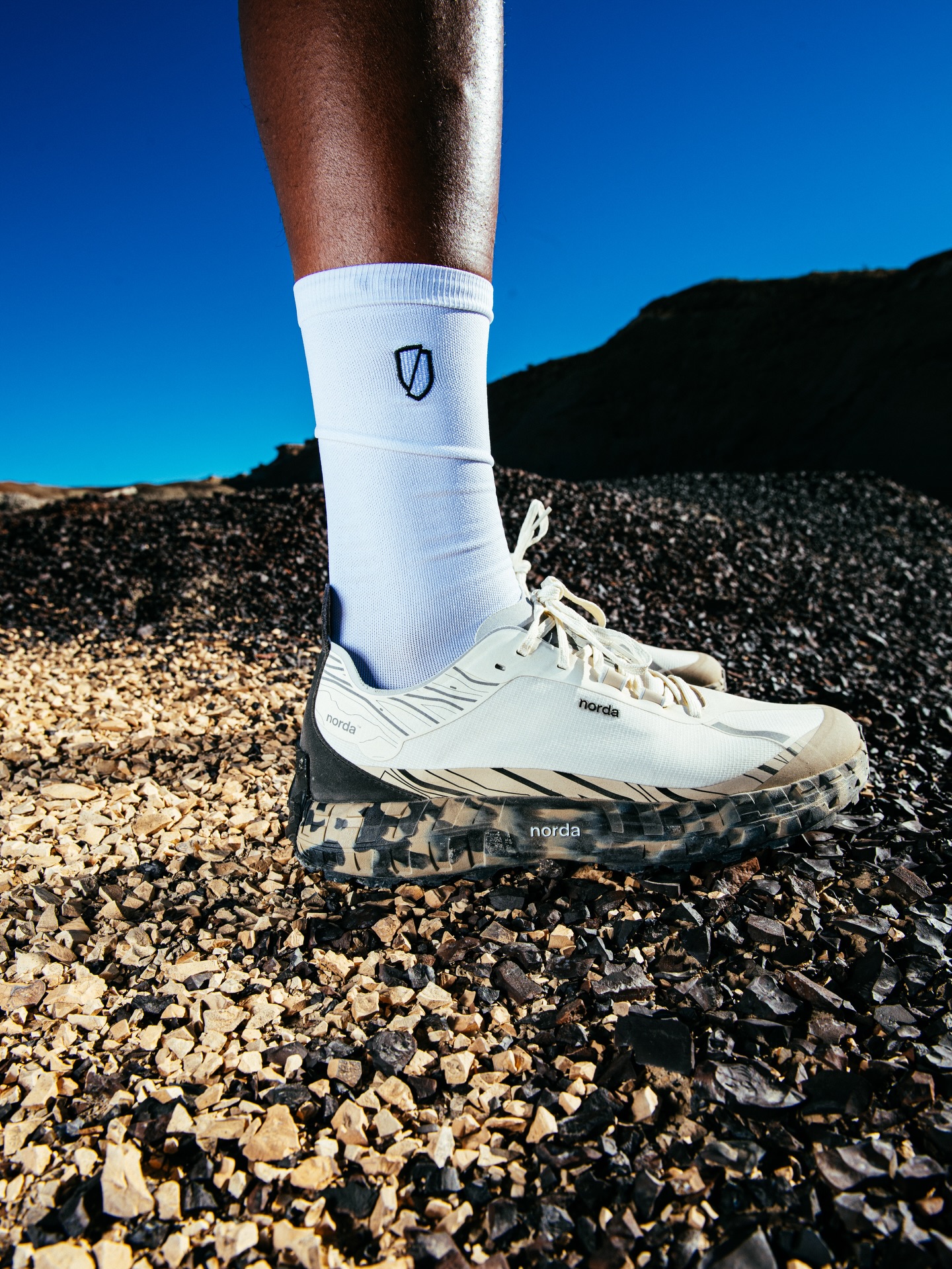
hill.camp does not conduct first-hand product testing. This Norda 001A review is a synthesis of independent field tests, specialist press articles, and verified consumer feedback gathered from multiple sources. All technical data and performance observations are drawn from those sources and attributed accordingly.
There are trail shoes that try to do everything for everyone. And then there is the Norda 001A. Priced at €280 — more than most carbon-plated supershoes — it makes no apologies and no concessions. It is the second version of the 001, the shoe that launched Norda onto the international trail scene in 2021, and it carries the same uncompromising DNA: exotic materials, minimal bulk, and a philosophy that values durability and terrain feel over plushness or marketing spectacle. Whether it is worth it depends entirely on who you are as a runner.
Quick Specs
| Weight | 268 g (men, EU 42) / 238 g (women) |
| Drop | 5 mm |
| Stack height | 26 mm heel / 21 mm forefoot |
| Midsole | Arnitel (TPEE) + thermoplastic polyester elastomer |
| Upper | Bio-Dyneema, seamless construction |
| Outsole | Vibram Megagrip Litebase, 4 mm lugs |
| Lacing | Norda Lock system + Dyneema laces |
| Fit | Standard to slightly wide toe box |
| Waterproofing | None (water-resistant upper, no membrane) |
| Intended use | Technical trail, mountain, ultra-distance |
| Retail price | €280 |
A Brand Built on a Different Premise
Norda launched in 2021 out of Canada with a proposition that cut against the grain of the trail market. While most brands were stacking foam higher and higher, adding carbon plates and chasing the energy-return arms race, Norda asked a different question: what if a trail shoe was built to last, built from materials that matter, and built to feel alive underfoot rather than artificially propulsive? The 001 was the answer. The 001A refines it, with a new midsole compound, a reworked upper structure, and a slightly reduced overall weight. It remains one of the most distinctive shoes in the premium trail segment — and one of the most polarising.
The Midsole: Arnitel Changes the Conversation
The most significant departure from the original 001 is the midsole. Norda has replaced the Super Light EVA with a blend of Arnitel — a TPEE (thermoplastic polyester elastomer) compound — that the brand also uses in the ultra-light 005 model. Arnitel is unusually soft for a material this light, and it delivers more than 80% resilience compared to conventional trail foams. In practice, what this means is a cushioning feel that is genuinely moelleux — the foot sinks slightly into the platform — while still providing meaningful ground contact and a low, 26 mm heel stack that keeps you connected to the terrain.
The sensation is genuinely unusual. You feel the ground clearly, you feel the relief and the texture, but the sharp percussion of roots and rocks is absorbed without drama. Where the 001A separates itself from the pack is in what happens after two, three, or four hours: the foam does not compress or go dead. Runners who have tested it over 60 to 80 km report that the cushioning character at kilometre 70 is essentially identical to what it was at kilometre one. For ultra-distance running, that consistency is worth more than any peak cushioning figure.
There is a trade-off, and it is worth naming clearly. Arnitel offers very little energy return or propulsion. The platform is flat, the geometry does not rock forward, and the shoe asks the foot, ankle, and calf to do more work than a modern max-cushion design. After three hours of running, that muscular demand accumulates. Runners coming from high-stack, high-rebound shoes should expect an adjustment period, and lighter athletes will adapt more easily than heavier ones. The 001A is a shoe for runners who have earned their leg strength — it does not do the work for you.
The Outsole: Vibram Megagrip Litebase, Canadian-Cut
The outsole is Vibram Megagrip Litebase — the thinner, lighter version of one of the most respected compounds in trail running. Norda has designed the lug pattern exclusively, taking inspiration from the geological formations of the Canadian Shield: large, thick chevron shapes, some with sharp internal points for additional bite, arranged asymmetrically across the platform. The outsole also wraps up around the heel, providing extra protection and braking surface in technical descents.
Field tests across multiple surfaces confirm what the design suggests: this is a broadly capable outsole. On dry rock and abrasive mountain trails, the grip is exceptional — arguably among the best available on a non-specialist shoe. On compact dirt, in wet conditions, and on rooty singletrack, confidence is consistently high. The wrap-around heel contributes meaningfully to stability in sideslopes and technical descents at speed. The one context where the 001A shows its limits is deep, sticky mud: the lug spacing does not self-clean effectively, and a shoe with more aggressive, widely spaced studs would perform better in cross-country conditions. For the 90% of trail running that happens on everything else, the Megagrip Litebase is more than adequate.
The Upper: Bio-Dyneema, Seamless, and Built to Last
The upper is where the 001A makes its most distinctive statement. Bio-Dyneema — a polyethylene fibre material used in alpine climbing and marine applications — is woven into a seamless mesh that looks almost impossibly thin yet proves extraordinarily resistant to abrasion, tearing, and deformation over time. After 120 km of use across rocky and technical terrain, testers have reported finding no meaningful signs of wear on the upper. That is not a claim any conventional synthetic mesh can match.
The absence of seams eliminates friction points. Combined with no internal padding — unusual at this price point — the chausson-like feel is initially surprising, but in practice the upper moulds to the foot and holds it precisely without any hot spots or pressure zones. The Bio-Dyneema also has a natural water-repellency: moisture does not saturate the fabric, and drainage is fast when water does enter. It is not waterproof — Norda makes no such claim — but it performs better than many unlined alternatives in moderate wet conditions, and far better than a Gore-Tex membrane in breathability and drying speed.
The norda Lock lacing system, combined with Dyneema laces that are four times stronger than conventional alternatives, creates a three-dimensional hold that goes beyond what a standard lace can achieve. In technical descents and on sideslopes, the foot stays exactly where it was placed. As feet swell over long efforts, the system maintains support without generating the compression points that plague runners in the late stages of an ultra.
One structural criticism has emerged consistently across user reports: the collar at the top of the heel counter can create friction against the Achilles tendon, particularly in the early kilometres. Some runners find this resolves itself after a break-in period of 30 to 60 km. Others have modified the collar with small cuts to increase flexibility — a pragmatic workaround that has circulated in online communities. The rear volume of the shoe is also slightly tight, which benefits runners with standard heel shapes but can cause issues for those with high Achilles insertions or a history of tendinopathy.
On the Trail: Who This Shoe Is For
The 001A expresses itself most clearly on technical mountain singletrack — the terrain where lightweight precision beats padded protection every time. In that context, the combination of ground feel, outsole grip, and structural hold from the norda Lock creates a shoe that moves with the foot rather than around it. On uphills, the 5 mm drop and the flat platform encourage an efficient midfoot strike. On technical descents, the heel wrap and outsole bite give genuine confidence on loose rock and compact stone.
In terms of pace range, the 001A is broader than its minimalist profile suggests. It handles tempo efforts and steady endurance paces with equal composure, though it does not accelerate like a carbon-plated race shoe. The relative lack of rebound means it suits the sustained moderate efforts of long mountain races better than short-distance speed work. Specialist press assessments suggest it is at its most relevant for formats from 20 km up to roughly 70 or 80 km — comfortably suited to marathon-trail distances and medium ultras. For 100 km and beyond at mid-pack pace, the lack of underfoot padding may become a limiting factor for runners who have not built specific leg strength for this kind of shoe.
It is worth comparing this shoe to the broader competitive landscape. Against the Hoka Speedgoat, the 001A offers superior durability, better terrain feel, and a noticeably lighter build — but less immediate cushioning comfort and less outright grip in very muddy conditions. Against carbon-plated maximalist race shoes, the contrast is even sharper: our Hoka Tecton X vs Norda 001 comparison pits the Norda’s plateless, ground-connected philosophy directly against Hoka’s twin-plate super shoe. Against premium alternatives like the Salomon S/Lab Genesis, the 001A scores higher on upper longevity and material quality, while the Salomon edges ahead on rebound and pace responsiveness. Choosing between them is a question of priorities. The 001A is not the fastest, not the most cushioned, and not the most accessible — it is the most considered.
What Changed from the 001
Three concrete changes distinguish the 001A from its predecessor. The Arnitel midsole replaces the Super Light EVA, bringing better feel and greater resilience across long efforts. The upper structure has been refined for improved foot retention and reduced movement at the heel. And the overall weight has come down slightly. If you own a 001 that is still in good condition, the upgrade is real but not urgent. If you are starting fresh, the 001A is clearly the version to choose — every change goes in the right direction.
Norda 001A Review : Sizing and Fit Notes
The 001A runs true to size for runners with standard to average foot width. The toe box is more generous than the overall silhouette suggests, with good volume in both width and height at the front — a welcome surprise given the minimalist aesthetic. The midfoot and heel are fitted but not constrictive for normal foot shapes. Runners with wide feet may find the Bio-Dyneema upper less forgiving than a traditional stretch mesh, as the material has limited elasticity by nature. For those unsure, trying before buying is the safest approach. Norda recommends wearing a well-fitted pair of socks with good volume — this also helps during the Achilles break-in period.
Our Take
The Norda 001A is not an easy sell, and it was never designed to be. At €280, it competes not on price but on principle — the principle that a trail shoe built from the right materials, engineered with precision, and designed without concession to short-term commercial pressures will ultimately serve its runner better than anything built to a budget or a trend cycle. On those terms, it largely delivers.
What we appreciate most is the honesty of the proposition. This is a shoe for experienced trail runners with specific needs: long mountain distances, technical terrain, high training volume, and the leg strength to manage a low-stack, low-rebound platform. It is not a shoe for beginners, not a shoe for mud specialists, and not a shoe for anyone prioritising immediate comfort over long-term performance. The Achilles collar issue is a genuine weak point at this price level, and it deserves to be resolved in the next iteration.
But when the terrain gets technical, when the distance gets long, and when you want a shoe that is still performing at hour six the way it was at hour one — the 001A has very few rivals. It demands something from the runner. In return, it gives something most shoes cannot: the sense that the shoe and the foot are working as a single unit, not fighting each other across a thick slab of foam. In a market that has become obsessed with maximalism, that is a rare and valuable thing.
If you are new to trail running or building your first serious rotation, a more versatile option like the Hoka Speedgoat or Salomon Speedcross may serve you better as a starting point. If you know your feet, know your races, and know exactly what you are asking for — the 001A is one of the most compelling trail shoes available in 2026. You can learn more about the full Norda line on the official Norda website.
FAQ
Is the Norda 001A suitable for beginners?
No. The 001A is a demanding shoe that works best for runners with developed leg strength, an efficient trail stride, and experience on technical terrain. Beginners or runners transitioning from max-cushion shoes will likely find the low stack and minimal rebound challenging, especially on longer efforts.
How does the Norda 001A compare to the original 001?
The 001A replaces the Super Light EVA midsole with Arnitel TPEE foam, offering better feel, superior resilience over time, and a slightly lighter overall build. The upper has also been refined. If you are buying new, the 001A is the version to choose. If your 001 is still in good condition, the upgrade is real but not essential.
Does the Norda 001A work in wet conditions?
Yes and no. There is no waterproof membrane, which Norda considers a deliberate choice in favour of breathability and weight. The Bio-Dyneema upper resists saturation and dries quickly, making it workable in light to moderate rain. In prolonged heavy rain or river crossings, the foot will get wet. In deep mud, the outsole’s lug spacing is less effective than more aggressive alternatives.
What is the Achilles issue users report with the 001A?
The heel collar can create friction or pressure at the top of the Achilles tendon, particularly in the first 30 to 60 km. For most runners this resolves with break-in. For those with Achilles tendinopathy or a sensitive heel morphology, the shoe may never feel right. Some users have addressed the issue by making small cuts at the top corners of the collar to increase flexibility — a practical workaround that has been widely shared in the trail running community.
What distances is the Norda 001A best suited for?
The 001A is best suited to trail distances from 20 km to approximately 70 or 80 km, including mountain marathon formats and medium ultras. Its cushioning consistency over time makes it genuinely relevant for long efforts, but the limited energy return and moderate stack may become limiting beyond 100 km for mid-pack runners who need more underfoot support in the late race stages.
Does the Norda 001A run true to size?
Generally yes, for runners with standard foot width. The toe box is generous despite the minimalist silhouette. Runners with wide feet may find the Bio-Dyneema upper slightly constraining, as the material has limited stretch. Norda recommends wearing well-fitting, appropriately cushioned socks, which also helps manage the Achilles collar during the break-in period.