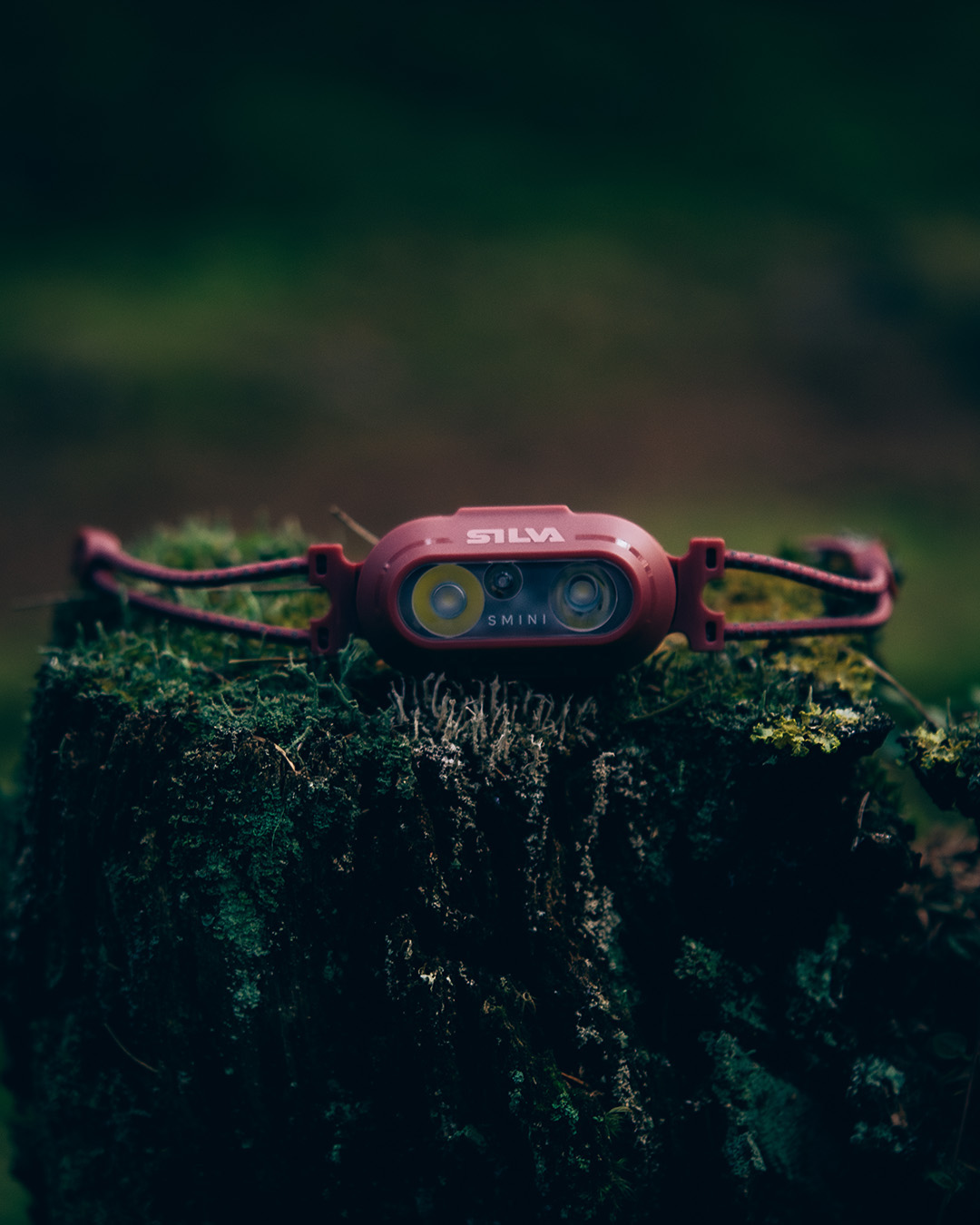
There is a temptation, when shopping for a headlamp, to go big. More lumens, longer burn time, more modes, heavier construction. And for some activities, that logic holds. But there is a whole category of outdoor use — evening trail runs, fast hiking, bikepacking, backpacking where every gram is accounted for — where a 250-gram headlamp is the wrong tool entirely. The Silva Smini was built specifically for these situations, and it makes a compelling case for itself.
What Is It, Exactly?
The Smini — short for Silva Mini — was designed in collaboration with ultra-runner and Silva athlete Philipp Ausserhofer. The brief was simple: the lightest possible headlamp that still functions as a serious piece of kit, not a novelty item. The result weighs 51.5g with the standard setup (headband and rear light included), fits in the palm of your hand, and retails around £49.99 / ~€55.
There are two versions to be aware of: the Smini (15mm padded headband, rear safety light included) and the Smini Fly (3mm bungee-style headband, rear light sold separately, 38.5g). The Fly shaves off weight but removes the rear light from the standard kit. For most users, the Smini makes more sense. For obsessive ultralight runners or multi-day racers, the Fly exists.
Build Quality and Design
First impressions: this thing is small. Genuinely, pick-it-up-and-wonder-if-it’s-a-toy small. But spend five minutes with it and the quality of what Silva has done becomes apparent. The housing is constructed from recycled plastic, the 15mm headband from 65% recycled polyester, and the whole assembly is held together with actual screws — meaning it’s repairable. Silva calls this their first step toward a circular design model, and it shows in the details.
The lamp head tilts 90 degrees in defined steps, so you can point it at the trail in front of you or down at your feet without blinding the person coming the other way. The single oversized button on top is one of the Smini’s best features — you can find it and operate it in gloves, mid-stride, without thinking about it. There are no menus, no long-press combinations to memorise for basic functions.
Waterproofing sits at IPX5 — water jet resistant, not submersible. That’s enough for rain, sweat, and splashing. If you need full waterproofing for serious wet-weather use, the Silva Explore 5 with its IP68 rating is a better fit. Know what you’re buying.
Light Output and Performance
The Smini delivers 250 lumens at max, 100 lumens in medium, and 10 lumens in minimum mode. Beam distance is claimed at 80m on max. For context, the Explore 5 puts out 700 lumens to 115m — but that’s a completely different category of headlamp at nearly double the weight.
Within its own category, 250 lumens is genuinely enough for most realistic conditions: trail running on non-technical terrain, urban night runs, campsite use, map reading, dog walks. The Intelligent Light system — a combination of a long-reach spot beam and a close flood light — works well in practice. You get usable coverage both near and far, which prevents the tunnel-vision effect you get from pure spot beams.
Where the 250-lumen ceiling becomes relevant is on genuinely technical terrain in full darkness. Several reviewers who used the Smini in night trail races noted that on rocky, root-heavy trails at pace, max mode starts feeling like the floor rather than a comfortable working brightness. This is not a criticism of the Smini so much as a statement about what it is: a backup lamp or a primary lamp for moderate conditions. Not a replacement for the Silva Explore 5 if you’re regularly navigating demanding mountain terrain after dark.
The red light for night vision preservation works as expected. The detachable rear safety light — a clip-on red blinker that attaches to the back of the headband — is one of the Smini’s sleeper features. It clips off and attaches to a bag, a dog collar, a bike strap, or anything else with a 15mm band. Runners who regularly share roads with vehicles will find it immediately useful.
Power reserve mode kicks in at 10% battery and gives approximately 2 hours of reduced-output light — a simple safety net that’s easy to overlook until you actually need it.
Battery Life and Charging
The integrated 700mAh Li-Po battery charges via USB-C (cable included) in approximately 3 hours. Burn times are 1.5 hours at max, 3 hours at medium, and 20 hours at minimum. These figures hold up in real-world use.
The non-removable battery is standard for a lamp this light — you accept the trade-off when you choose an integrated design. For the runs and day hikes the Smini is designed for, 3 hours in max mode is adequate, and medium mode gives enough runtime for most longer efforts. For multi-day unsupported races, you bring a power bank. For everything else, the Smini charges from empty in an evening.
How Does It Compare?
The obvious rival is the Petzl Tikkina — slightly brighter at 300 lumens, available with either AAA batteries or a rechargeable Core battery (sold separately), and slightly heavier at around 65g without the battery. The Tikkina is a reliable, proven headlamp, but it doesn’t match the Smini on weight, compactness, or repairability. If battery flexibility matters for long unsupported adventures, the Tikkina’s hybrid battery system has an edge. If you’re optimising for weight and simplicity, the Smini wins.
The Black Diamond Spot 400 offers 400 lumens, IPX8 waterproofing, and weighs around 90g — the right choice if you need both raw power and full waterproofing, but solving a different problem at nearly double the weight.
The Ledlenser MH5 offers 400 lumens and a detachable lamp head that doubles as a handheld torch, but costs more and is heavier. Feature-rich at the expense of the elegant simplicity that makes the Smini what it is.
Within the Silva range itself, the Smini sits clearly below the Explore 5 (700 lm, IP68, 116g) in power and waterproofing, and below the Free H Trail Runner series for dedicated running performance. But the Smini is cheaper than all of them, lighter than all of them, and better suited to the backup or everyday-carry role than any of them.
Our Take
The Silva Smini is a genuinely well-executed piece of gear. It does exactly what it claims, nothing more, nothing less. At 51.5g and around £50, it is the most convincing case for the ultralight primary / backup light category we’ve seen from Silva. The repairability and recycled materials are a bonus that costs nothing in performance. The single-button operation is a design achievement that should be standard across all headlamps but isn’t.
The 250-lumen ceiling and IPX5 waterproofing will matter to some users. If you’re regularly running technical mountain terrain in full darkness, or need a lamp for kayaking where total submersion is possible, you’ll want more — read our full review of the Silva Explore 5 to see where the range steps up. But for the vast majority of evening runners, hikers, and anyone who wants a reliable, pocketable light, the Smini is a very easy recommendation.
Specs at a Glance
| Spec | Value |
|---|---|
| Max output | 250 lm |
| Weight (Smini) | 51.5 g |
| Weight (Smini Fly) | 38.5 g |
| Waterproofing | IPX5 |
| Battery | 700 mAh Li-Po, integrated |
| Charging | USB-C (~3h) |
| Modes | 3 white + red |
| Beam distance (max) | 80 m |
| Rear safety light | Included (Smini) / optional (Fly) |
| Price | ~£49.99 / ~€55 |