hill.camp does not conduct first-hand product testing. This Tracksmith Eliot Racer review is a synthesis of independent field tests, specialist press articles, and verified consumer feedback gathered from multiple sources. All technical data and performance observations are drawn from those sources and attributed accordingly.
In a race day shoe market drowning in volt yellow, neon pink, and aggressive futurist geometry, the Tracksmith Eliot Racer arrives looking like it has somewhere better to be. White and gold. Clean lines. A silhouette that reads more like a refined training flat than a carbon-plated super shoe. And yet, under that composed exterior, Tracksmith’s debut race shoe packs a legitimately competitive midsole stack, a full-length carbon plate, and a construction philosophy that prioritises durability and versatility alongside raw speed. This Tracksmith Eliot Racer review unpacks whether the shoe delivers on that promise — or whether the aesthetic is doing more work than the foam.
The Eliot Racer is the second shoe Tracksmith has ever made, following the well-received Eliot Runner launched in 2022. Where the Runner was a daily trainer — balanced, versatile, understated — the Racer steps into the most competitive category in running: the carbon-plated super shoe, priced at $280 and positioned alongside the Nike Vaporfly, Adidas Adios Pro, and ASICS Metaspeed. That is a considerable ambition for a brand whose core business remains apparel. The question this Tracksmith Eliot Racer review sets out to answer is whether that ambition is justified.
Tracksmith Eliot Racer — Quick Specs
| Price | $280 / £275 |
| Weight | 218g / 7.7oz (men’s US9) |
| Stack height | 38mm heel / 30.5mm forefoot |
| Drop | 7.5mm |
| Midsole | Drop-in ATPU sockliner + Pebax chassis + full-length carbon plate |
| Upper | Engineered woven mesh, microsuede collar and tongue |
| Outsole | Full-coverage rubber |
| Release | March 2025 |
| Category | Carbon-plated race day shoe |
First Impressions: The Most Elegant Super Shoe on the Market
Every Tracksmith Eliot Racer review worth reading starts here, because the unboxing experience is genuinely unlike anything else in the category. The shoe arrives in a premium box, accompanied by a canvas shoe bag in navy with a red and white sash, and a letter from Tracksmith CEO and founder Matt Taylor. Inside the shoe itself, motivational quotes are printed beneath the removable midsole. The laces feature a rubberised underside to prevent slipping during a race. The microsuede collar and tongue feel, to every tester who has reviewed the shoe, expensive in a way that running shoes rarely do.
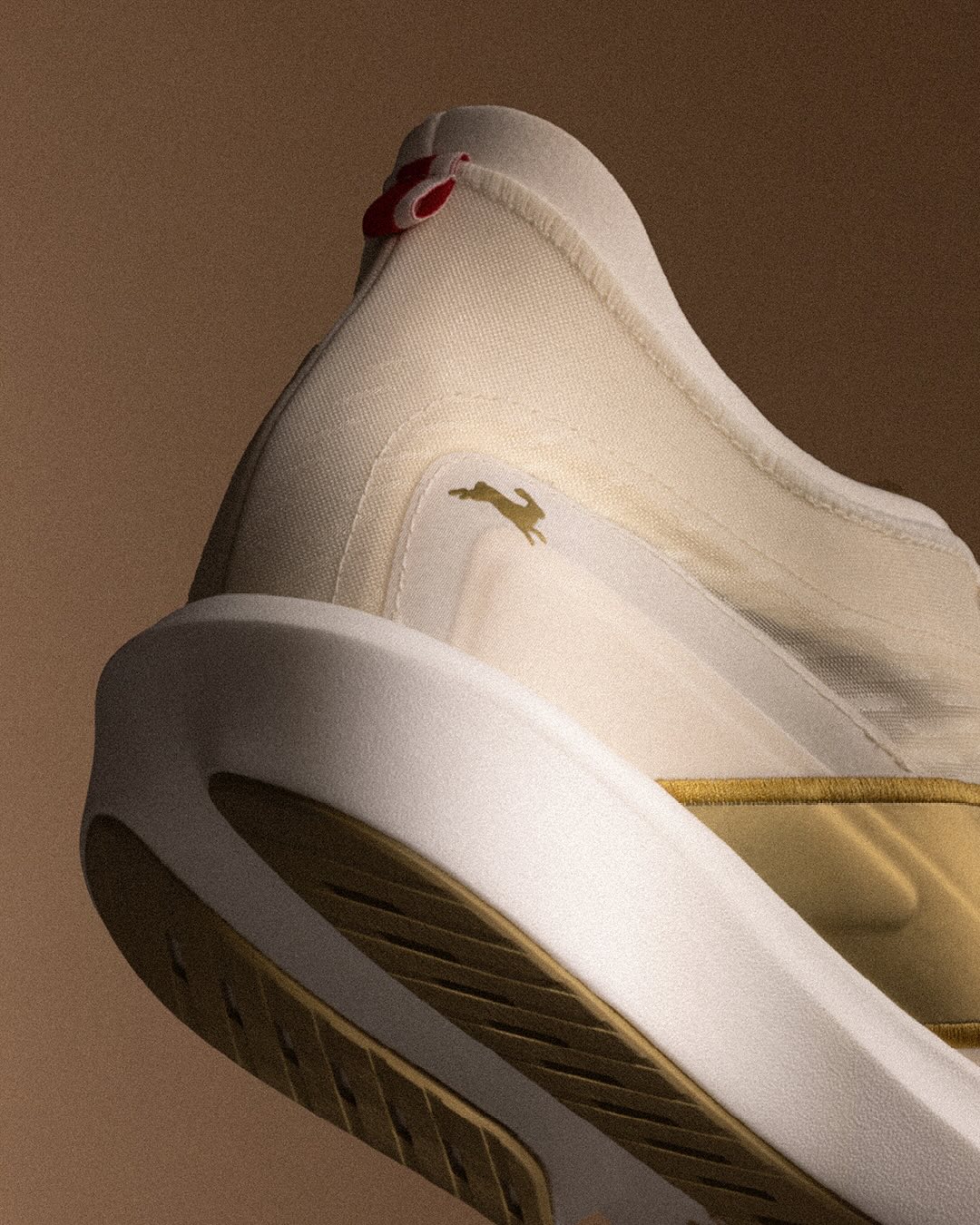
Visually, the Eliot Racer is striking precisely because of its restraint. The white and gold colourway — the sash aligned with the carbon plate beneath, serving both an aesthetic and a structural function — looks nothing like the competitors it is priced against. Outside magazine described it as « a Bentley Continental GT in a market full of Lamborghini Veneno Roadsters. » That is an apt comparison. The Eliot Racer does not announce itself. It simply looks correct.
This aesthetic consistency with Tracksmith’s wider brand identity — the same philosophy that has made their running apparel a cult object among serious amateur runners — is not cosmetic. The gold sash connects directly to the carbon plate and the Pebax foam layer below, providing midfoot lockdown while simultaneously referencing the brand’s visual codes. Form and function, in other words, are genuinely aligned here.
Upper: Premium Materials, Nuanced Fit
The Tracksmith Eliot Racer upper is built differently from most race day shoes, and most Tracksmith Eliot Racer reviews flag both the advantages and the trade-offs of that choice. The engineered woven mesh is thin and sleek in appearance but carries a slightly plasticky feel to the touch — a recurring observation across multiple independent testers. It is not the soft, sock-like engineered knit found on the Vaporfly or the Metaspeed; it is more structured, more contained, and more durable.
The microsuede collar and tongue lining set the Eliot Racer apart from every other carbon shoe at this price point. Runners consistently describe step-in comfort as exceptional once the shoe is on — zero heel slippage, excellent midfoot wrap, and a toe box that accommodates a range of foot shapes without feeling loose. The lower section of the upper features a semi-rigid rubberised shell that holds the drop-in midsole in place, providing structural integrity around the perimeter and contributing to the shoe’s distinctive silhouette: lower-stacked in appearance than its 38mm heel height would suggest.
Two caveats appear consistently across this Tracksmith Eliot Racer review synthesis. First, the gusseted tongue — held by stretchy fabric on either side — makes entry difficult, requiring care to avoid straining the attachment points. Several testers describe the process as a minor struggle on every wear. Second, the upper’s breathability is limited, particularly in warmer conditions. The layering and the thick gold sashes that provide midfoot support impede airflow more than a standard engineered mesh upper would. For a spring marathon in mild temperatures, this is unlikely to be a deciding factor; for a hot-weather race, it warrants consideration.
The laces deserve a mention of their own: rubberised on the underside, they grip against themselves and stay tied without double-knotting in most conditions — a small detail that reflects the obsessive finish quality the Tracksmith brand applies to everything it makes.
Midsole: A Clever Construction That Divides Opinion
The midsole of the Tracksmith Eliot Racer is its most technically interesting feature — and the most debated in every Tracksmith Eliot Racer review we have consulted. The architecture is a drop-in construction: a removable ATPU (A-TPU) foam sockliner sitting directly beneath the foot, approximately 22mm deep at the heel and 12mm at the forefoot, resting on a Pebax midsole chassis. Between those two layers sits a full-length carbon plate, positioned relatively close to the ground due to the drop-in design. The result is a 38mm heel stack that reads visually as considerably lower.
The rationale for this construction is sound. By eliminating the traditional lasting board, the glue between layers, and the conventional sockliner, Tracksmith maximises cushion depth while staying below World Athletics’ 40mm heel height limit. The lack of adhesive between the plate and the upper foam layer also means the shoe has a degree of flex not found in most super shoes — the layers move somewhat independently, creating a ride feel that testers variously describe as « forgiving, » « mellow, » and « surprisingly stable. »
Where Tracksmith Eliot Racer reviews diverge is in the assessment of energy return. Elite-pace testers — sub-2:20 marathon runners — consistently describe the ride as lacking the explosive pop and aggressive toe-off that defines the Nike Alphafly, Adidas Adios Pro 4, or Saucony Endorphin Elite. The carbon plate is present and contributes structure, but positioned beneath a deep, soft ATPU layer, it does not generate the snappy propulsion of shoes where the plate is in direct tension with a firmer foam. The ride improves at higher cadences and faster paces, but at no point delivers the « trampoline » sensation that characterises the market leaders in the category.
For mid-pack runners — those targeting times in the 3:00 to 4:30 marathon range — the picture looks considerably more positive. At more moderate paces, the Eliot Racer’s cushion, stability, and smooth rocker geometry work in concert to deliver a genuinely enjoyable ride. The rocker profile curves gradually before steepening toward the toe, providing a comfortable stance phase before a clean roll-off. Several testers describe it as one of the more versatile carbon shoes they have used — comfortable enough for long training runs, capable enough for race day. The comparisons that appear most frequently in Tracksmith Eliot Racer reviews are to the On Cloudboom Strike: a similar drop-in construction philosophy, a similar emphasis on ride quality over explosive propulsion.
One issue that appears across multiple independent Tracksmith Eliot Racer reviews deserves honest mention: a pronounced squeaking noise emanating from the midsole during running. Multiple testers report this as a persistent characteristic — not a break-in issue — likely related to the movement between the drop-in midsole and the Pebax chassis beneath. It does not affect performance, but at $280, it is a quality control detail that Tracksmith will presumably address in future iterations.
Outsole: The Racer’s Most Unambiguous Strength
Every Tracksmith Eliot Racer review agrees on one thing: the outsole is exceptional for a race day shoe. Full-coverage rubber — significantly more than the minimal patches found on most super shoes — provides grip on wet and dry tarmac without compromise, and contributes to a durability projection that far exceeds most carbon-plated competitors. After 50+ miles of testing across multiple reviewers, the outsole shows minimal wear. Traction on wet roads is consistently rated as reliable; one tester ran successfully in pre-dawn temperatures close to freezing with no stability concerns.
The trade-off is weight and a marginal increase in firmness underfoot — the rubber coverage contributes to a slightly more grounded feel than shoes with exposed foam at the forefoot. At a pace below 9 minutes per mile, this can manifest as a slightly firmer heel landing. Above that pace, it becomes inconsequential. For the majority of runners who will use the Eliot Racer, the durability argument is compelling: this is a super shoe that can realistically be used for both race day and sustained training without the outsole becoming a limiting factor.
Tracksmith Eliot Racer vs. the Competition
Any complete Tracksmith Eliot Racer review must address the obvious: at $280, this shoe competes directly with the flagship racers from Nike, Adidas, ASICS, and Saucony. The honest assessment is that it does not outperform the market leaders in raw energy return or propulsive efficiency at elite paces. The Vaporfly 3 feels snappier. The Alphafly 3 is more explosive. The Adios Pro 4 delivers a more decisive spring. The Metaspeed Edge is more breathable and faster-feeling for sub-3:00 runners.
What the Tracksmith Eliot Racer offers instead is a different kind of value proposition: superior durability, exceptional build quality, a more versatile ride across a broader pace range, and an aesthetic that is — objectively — unlike anything else in the category. For runners who have never found the Alphafly’s geometry natural, or who want a carbon shoe that doubles as a high-quality long run trainer, the Eliot Racer makes a compelling case. The comparison that several testers reach for is the Diadora Gara Carbon — another $280 shoe with premium materials, a smooth and comfortable ride, and a more restrained aesthetic than the Nike/Adidas mainstream. Both prioritise quality and versatility over maximum propulsion.
The Eliot Racer also fits into a broader movement in running that Tracksmith — through its apparel, its brand story, and now its footwear — has done more than almost any other brand to cultivate: the idea that serious amateur running deserves gear that is considered, beautiful, and built to last, rather than gear that shouts about its performance credentials. In that context, the Eliot Racer is coherent in a way that goes beyond spec sheets. It is a shoe that makes sense as part of a complete running identity, in the same way that a Norda makes sense as a trail shoe for runners who care about aesthetics as much as performance.
Who Should Buy the Tracksmith Eliot Racer?
Based on the weight of Tracksmith Eliot Racer review evidence we have synthesised, the shoe is best suited to a specific type of runner. If you are chasing a sub-2:45 marathon and optimising purely for propulsion and energy return, the Eliot Racer is probably not your shoe — the Vaporfly, Adios Pro, or Endorphin Elite will serve you better. If, however, you are a runner targeting times in the 3:00–4:30 range, or a faster runner who wants a carbon shoe versatile enough to train in regularly as well as race in, the Eliot Racer deserves serious consideration.
It is also, genuinely, for runners who care about how they look. That is not a frivolous consideration. The Tracksmith brand has built its entire identity around the idea that serious amateur running deserves a serious aesthetic — understated, elegant, and authentically connected to the sport’s heritage. The Eliot Racer is the fullest expression of that philosophy in footwear form. Founder Matt Taylor put it simply in his letter included with every pair: « We spent over two years building a super shoe that doesn’t look like a super shoe. It’s speed without the spectacle. »
That is an honest description of what the Tracksmith Eliot Racer is. Whether it is what you need depends on what you are looking for on race day.
Our Take
The Tracksmith Eliot Racer is a genuinely impressive debut race shoe from a brand that had no business making one — except that it made it beautifully. The build quality is exceptional. The materials are premium throughout. The durability is the best in the super shoe category by a considerable margin. The ride, comfortable and stable across a wide range of paces, will suit the majority of recreational and semi-competitive runners well. The aesthetic is, for those who care about such things, simply the best in the category.
The squeak is annoying. The energy return does not match the Vaporfly. The breathability could be better. At $280, these are legitimate criticisms that prevent a wholehearted recommendation for elite-pace runners. But for the committed amateur — the Running Class that Tracksmith has always spoken to — the Eliot Racer is a very fine racing shoe. And it will still look good long after the competition has been retired.
Explore the Tracksmith Eliot Racer and the full Tracksmith footwear range at tracksmith.com.
Tracksmith Eliot Racer — Frequently Asked Questions
Is the Tracksmith Eliot Racer a true super shoe?
Yes — the Eliot Racer is a legitimately engineered carbon-plated race shoe with a 38mm heel stack, a Pebax midsole chassis, and a full-length carbon plate. Its construction philosophy (drop-in ATPU midsole, no glue between layers) is unconventional but technically sound. Where it differs from the market leaders is in ride character: it prioritises cushion, stability, and versatility over the maximum explosive propulsion found in the Nike Alphafly or Adidas Adios Pro 4.
What is the Tracksmith Eliot Racer best used for?
The Eliot Racer performs best for runners targeting marathon times between approximately 3:00 and 4:30, who want a race day shoe that is also comfortable for long training runs. Its exceptional outsole durability — far above most super shoes — makes it a viable dual-use option. It is not the optimal choice for elite-pace runners seeking maximum propulsive efficiency.
How does the Tracksmith Eliot Racer fit?
The Eliot Racer fits true to size for most runners, with a roomy toe box and excellent heel lockdown. Entry is slightly challenging due to the gusseted tongue design — patience is required. Once on, the fit is secure, comfortable, and well-suited to narrower to medium-volume feet. Runners with high-volume feet or significant foot swelling during long efforts may want to size up half a size.
Why does the Tracksmith Eliot Racer squeak?
The squeaking noise reported by multiple testers appears to originate from friction between the removable ATPU drop-in midsole and the Pebax chassis beneath it — an inherent characteristic of the layered, unglued construction. It is not universal to every pair and does not affect performance, but it is a noted quality issue across several independent Tracksmith Eliot Racer reviews.
How does the Tracksmith Eliot Racer compare to the Nike Vaporfly?
The Vaporfly delivers more explosive energy return and a snappier, more propulsive ride at elite paces. The Eliot Racer offers superior durability, a more versatile ride across slower paces, and a significantly more refined aesthetic. For runners below approximately 3:00 marathon pace, the Vaporfly is the faster shoe. For runners above that pace, the gap narrows considerably and the Eliot Racer’s additional comfort and durability become meaningful advantages.