hill.camp does not test products first-hand. This review is a structured synthesis of 5 independent sources — specialist field tests, retailer panels, verified owner feedback and manufacturer specifications — assembled with AI assistance and edited before publication. Sources are selected and verified by runners who follow this equipment closely. That method lets us cross-reference more testing than any single reviewer could, and to flag where sources contradict each other instead of smoothing it over.
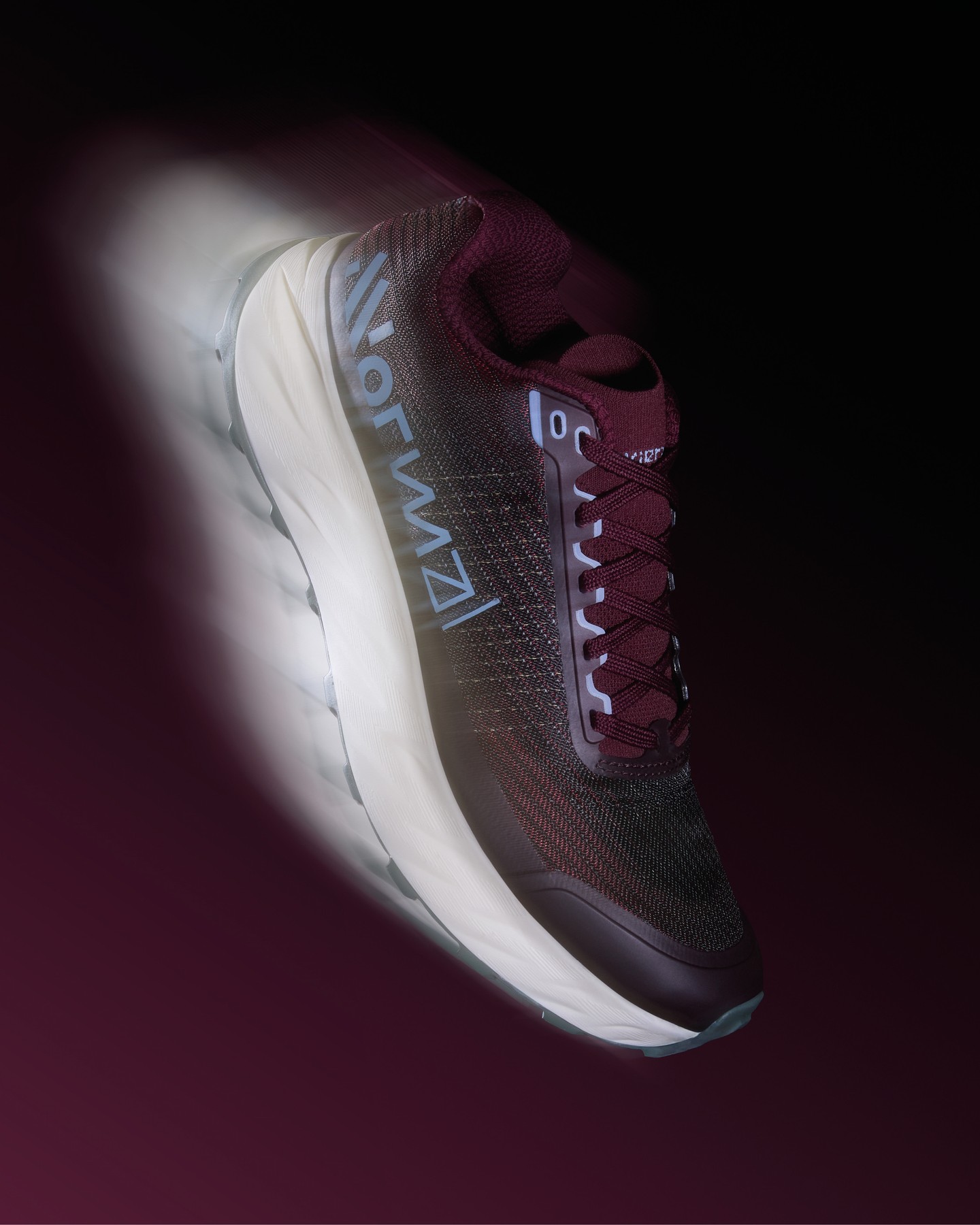
Three years passed between the original Kjerag and this one, which by industry standards is close to negligence and by NNormal’s stated logic is exactly the point — you update a shoe when you have something worth changing, not when the calendar says so. What changed is narrow and deliberate: a new midsole compound, 2.5 mm more foam, and a completely rebuilt upper. The outsole was left alone, because it was already the best part.
The result is a shoe that testers describe in almost identical terms — precise, featherlight, glued to the ground, exceptional on rock — and then immediately qualify. It is not for wide feet, not for heel strikers, not for mud, and not for anyone who wants a shoe to do some of the work for them. Whether that reads as a limitation or a specification depends entirely on how you run.
NNormal Kjerag 02 Review: Quick Specs
| Weight | ~240 g (UK 8.5) to ~258 g (US M10.5) per shoe |
| Stack height | 26 mm heel / 20 mm forefoot |
| Drop | 6 mm claimed (5 mm measured by one tester) |
| Midsole | EExpure+ supercritical TPE, no insole |
| Rock plate | None |
| Upper | Single-layer Matryx Light Jacquard (polyamide + Kevlar) |
| Outsole | Vibram Megagrip Litebase, 3.5 mm rhomboid lugs |
| Sizing | Unisex only, no wide option |
| Intended use | Technical terrain, racing, fast mountain running |
| Retail price | $195–215 / £180 |
What Changed From the Kjerag 01
Three things, and they address the two complaints that followed the original.
The midsole. EExpure becomes EExpure+, a supercritical TPE compound that NNormal claims delivers 45% more energy return. Nobody outside the brand can verify that figure, but every tester independently reports the same thing: the 02 is noticeably livelier on firm ground than the shoe it replaces. Stack rises 2.5 mm throughout, to 26/20 mm.
The upper. The original used a double-layer Matryx Jacquard that was close to indestructible and, by consensus, stiff, warm and slow to give. The 02 switches to single-layer Matryx Light — thinner, more breathable, faster-draining, and with enough flex to accommodate feet swelling on long efforts. The toe box gained 2–3 mm.
The tongue. The 01’s rigid, short, origami-folded tongue was the shoe’s most disliked component. It is gone, replaced by a stretchy knit wrap that testers describe as sock-like and, in one case, as something everyone should experience at least once. Combined with diagonal lacing, it produces lockdown without lace bite.
What did not change: the Vibram Megagrip Litebase outsole, the 3.5 mm lug pattern, and the absence of an insole. All three were working.
The trade-off is roughly an ounce of added weight. Every tester considered it worth paying.
The No-Insole Question
This is the Kjerag’s defining design decision and the one most likely to decide whether the shoe works for you. There is no insole. Your foot rests directly on the EExpure+ foam, with nothing in between.
The rationale is threefold: maximum ground feedback, no insole shifting underfoot during aggressive descents, and fewer blisters because there is one less surface for the foot to slide against. In practice, testers confirm all three. The sensation is consistently described as being closer to the ground than any comparable shoe, and several compare it to climbing footwear rather than running shoes. One tester noted the foam compresses and rebounds faster without a barrier above it, which reduced fatigue over long efforts rather than increasing it.
Every source also reports an adaptation period. Estimates range from a few runs to noticeably longer, and the original Kjerag reportedly needed something like twenty miles before it settled. The 02 is gentler, but it is still not a shoe you put on and forget.
The consequence nobody advertises: if you use orthotics or custom insoles, this shoe is not an option. Adding an insole eliminates the design’s entire point, and the last is not cut with the extra volume to accommodate one. That rules the Kjerag out for a meaningful number of runners before any other consideration — though NNormal’s own Tomir 02 and Cadí both have insoles, which makes either the obvious alternative within the brand.
The Ride: Lively, Not Propulsive
The most useful description came from a tester who kept returning to the phrase « dancing shoe » — light, quick, springy, precise, and completely without the launched-forward sensation of a plated super shoe. There is no plate here at all, and no rocker beyond a modest toe roll added in the 02.
Opinions on how much energy return the foam actually delivers vary more than you would expect. One UK tester called it the first trail shoe to give him the same fun he gets from modern road shoes, and rated it more propulsive than an Altra Mont Blanc Carbon — a shoe with both PEBA foam and a carbon plate. Others land more conservatively: lively for its stack, but firm rather than bouncy, and nothing like sinking into a max-cushion midsole. Both readings can be true. EExpure+ is clearly energetic relative to 26 mm of foam and clearly not a substitute for volume.
Where the shoe unambiguously excels is technical ground. Talus, boulder hopping, scree, rooty descents, ridgeline traverses, even short sections of scrambling — testers describe the Kjerag as composed and planted where higher-stack shoes feel tentative. The low centre of gravity does more for stability here than a wide platform would, and one tester specifically noted feeling secure on steep side-hill traverses with less muscular effort than a taller shoe demands.
The flip side is equally consistent. On pavement, gravel paths and repetitive hardpack, the Kjerag feels harsh and comparatively lifeless — one tester called it simply less fun than a cushioned alternative on that terrain. The lack of a rock plate is felt on sharp rock, with the Litebase rubber being roughly half the thickness of standard Megagrip. And stability breaks down on off-balance heel-strike landings, where the narrow heel-to-midfoot profile offers little to catch you. This is a shoe that rewards efficient midfoot or forefoot form and quietly punishes everything else.
Traction: Outstanding on Rock, Limited Everywhere Else
The Vibram Megagrip Litebase outsole is the least controversial part of the shoe. Full coverage, no foam windows, 3.5 mm rhomboid lugs arranged directionally — denser at the forefoot for climbing traction, more spaced at the heel for braking. Litebase rubber is around half the thickness of standard Megagrip, cutting roughly 30% of outsole weight without changing the compound.
On dry rock the grip is close to universally praised, with testers reaching for approach-shoe comparisons. Granite slabs, sandstone, gritty rock, packed dirt, exposed ridgelines — it holds. Full rubber coverage also means the outsole protects the midsole from puncture damage and wears evenly.
The limitation is lug depth, and it is not marginal. In sustained mud, performance is poor. On steep loose gravel, the shoe slides where a deeper lug would bite. Snow traction is weak. Wet rock is more nuanced than the marketing suggests: rough wet rock stays manageable, but wet smooth granite noticeably reduces grip, and one tester reported real sliding on wet mud. NNormal’s answer is the Kjerag Brut, which swaps to 6.5 mm lugs — a separate shoe for a separate problem. The Tomir 02, with 5 mm lugs, is the better choice within the range for soft and wet ground.
For a broader look at where grip philosophies diverge, our comparison of the Hoka Speedgoat and the Salomon Speedcross covers the deep-lug end of the spectrum.
Fit and Sizing: Where the Sources Disagree
Everyone agrees the Kjerag 02 is narrow. It is snug through the midfoot and heel, the toe box is wider than the 01 but still not generous, there is no wide option, and sizing is unisex only. Runners with wide or high-volume feet should treat this as disqualifying rather than as something to work around. The upper does gain some give after a few runs, but Matryx is a low-stretch material and it will not accommodate a foot it was not cut for.
On length, the published advice directly contradicts itself, and we are not going to pretend otherwise. Two independent test teams — one American gear lab and one hiking-focused outlet — both report that the shoe runs long and recommend sizing down half a size or more; one tester dropped a full size from his usual 7 to a 6. A third reviewer, testing a women’s equivalent, kept her standard size after reading it ran long and concluded she should have sized up, finding it too tight up front.
The most plausible reconciliation is that the shoe runs long in overall length while being tight across the forefoot, so runners hit different limits depending on foot shape. That is a guess rather than a finding. The practical conclusion is unambiguous: this is a shoe to try on in person, or buy from a retailer with a genuinely painless return policy.
Unisex sizing carries a further consequence. NNormal used it deliberately across its early range, to reduce production runs and waste, which is consistent with the brand’s position. But women’s feet frequently differ in heel width and arch height, and at least one female tester noted that runners with narrower heels or higher arches may not find the same locked-in fit that makes this shoe work. NNormal has since introduced gender-specific lasts on the Cadí, so the policy may not hold across future models.
Durability, and the One Caveat
This is where the Kjerag earns its price, and the field reports are genuinely striking.
One tester took the 02 off-trail through the Holy Cross Wilderness in Colorado — over downed timber, up rock ledges, through brush dense enough to scratch her arms and legs, and across a scree field — and found the upper afterwards with no tears, no snags, not a loose thread. A second off-trail day produced the same result. Another tester logged over 500 miles in the original Kjerag across desert and Colorado backcountry, and reports it outlasting shoes several ounces heavier. A third has passed 600 miles and describes the pair as still going strong.
NNormal’s own testing puts the expected lifespan at 1,000–1,200 km for most runners, roughly double the conventional 500–800 km. The full-coverage Vibram outsole and Matryx upper are doing the work, and the shoe can be resoled by any cobbler equipped for Vibram.
The caveat comes from testers rather than the brand, and it is worth taking seriously. The 02’s single-layer upper is thinner than the 01’s double layer, and at least one reviewer flagged it as the likely eventual failure point. Another observed that while the outsole can be replaced, the upper is not indestructible enough to survive a second full outsole’s worth of abuse — meaning the resoling programme has a practical ceiling. The shallow 3.5 mm lugs may also wear faster than a deeper pattern on abrasive rock or tarmac.
Breathability and Small Irritations
The 02’s single-layer upper is a clear improvement on the 01, which was widely described as warm and sweat-trapping. It drains fast — one tester reported full drying in under an hour after submersion — and stays locked down when soaked.
It is still not an airy shoe. The tight Kevlar-blend weave restricts airflow, and testers consistently report warm feet above roughly 30°C. That is the cost of the durability, and it is a reasonable trade rather than a flaw.
One practical note that only surfaces in longer testing: the tongue is not fully gusseted, and on dusty or sandy trails the shoe collects grit that occasionally needs emptying out.
How Far Can You Actually Run in It?
The honest answer is that it depends on you more than on the shoe, and the range in the reports is wide.
At one extreme, Kilian Jornet took third at the Western States 100 in a pair. At the other, several testers describe it as fatiguing beyond two hours, and one was explicit that it is not a good long-distance shoe for ordinary runners. Between those, a UK reviewer ran a 36 km training run over technical ground and moorland with no foot problems at all, and considered it his first choice for a 54 km race.
Our reading: the 2.5 mm of added stack genuinely extended the shoe’s range compared with the 01, which most testers considered a short-distance tool. The 02 is credible up to marathon distance and beyond for runners with efficient form and conditioned feet. If you are not already comfortable in minimal shoes, treat the distance ceiling as considerably lower and build toward it. For where this sits against the wider field, our guide to the best trail running shoes in 2026 is a useful reference.
Our Take
The Kjerag 02 is a precision instrument, and reviewing it as a general-purpose trail shoe would misrepresent it. Independent scores ranged from roughly 7.4 to 4.6 out of 5 depending on the scale used, and the spread reflects testers weighting different things — those scoring it on comfort and protection rated it lower, those scoring it on ground feel, traction and durability rated it near the top of their field.
What NNormal has built is a shoe that does three things better than almost anything else available: ground connection, dry rock traction, and durability per gram. The updates in the 02 fixed the 01’s real weaknesses — the stiff upper, the awkward tongue, the punishing lack of foam — without diluting what made it distinctive. That is a genuinely difficult balance to strike, and the brand struck it.
The limitations are equally clear and mostly non-negotiable. No wide option and a narrow last exclude a lot of runners outright. No insole means no orthotics, ever. No rock plate means sharp terrain is felt. Shallow lugs mean mud and snow are off the table. And $195–215 is a lot, though the durability argument does real work here in a way it does not for most premium shoes — if you genuinely reach 1,000 km, the cost per kilometre is competitive with shoes half the price.
Our recommendation: if you run technical mountain terrain, have narrow-to-normal feet, land midfoot, and want to feel the ground, this is close to the best tool available and we would buy it. If any one of those does not describe you, the Kjerag will frustrate you in exactly the way its testers describe. Try it on before committing, because the sizing advice in circulation is contradictory. You can find it on the official NNormal website.
Frequently Asked Questions
Why does the Kjerag 02 have no insole?
It is deliberate. Removing the insole puts the foot directly on the EExpure+ midsole, which maximises ground feedback, eliminates insole slippage on steep descents, and reduces blister risk by removing a sliding surface. Testers confirm all three benefits, and several note the foam responds faster without a layer above it. The trade-off is an adaptation period of a few runs, and the fact that orthotics or custom insoles cannot be used without defeating the design.
What size should I buy in the NNormal Kjerag 02?
The published advice genuinely conflicts. Two independent test teams found the shoe runs long and recommend sizing down half a size or more. Another reviewer kept her usual size and wished she had sized up, finding the forefoot too tight. The likeliest explanation is that it runs long in length while remaining narrow across the forefoot, so different foot shapes hit different limits. Try it on in person if you can, or buy somewhere with an easy return policy.
Is the Kjerag 02 suitable for wide feet?
No. Every source describes it as narrow through the midfoot and heel, and while the 02’s toe box gained 2–3 mm over the 01, it remains snug. There is no wide version and sizing is unisex only. The Matryx upper gains a little give after a few runs but does not stretch meaningfully. Within NNormal’s own range, the Tomir 02 is noticeably more accommodating and the Cadí has the roomiest toe box the brand makes — though neither is a genuinely wide shoe.
How does the Kjerag 02 compare to the original Kjerag?
Three meaningful changes: a new EExpure+ supercritical TPE midsole with more energy return, 2.5 mm more stack throughout (now 26/20 mm), and a single-layer Matryx Light upper that breathes better and flexes more, plus a stretchy knit tongue replacing the 01’s stiff origami design. The outsole is unchanged. The 02 weighs roughly an ounce more and is considerably more versatile over distance — testers who found the 01 too punishing for long runs are comfortable in the 02.
How long do NNormal Kjerags last?
NNormal’s testing indicates 1,000–1,200 km for most runners, against a typical 500–800 km for trail shoes. Independent testers support this: one logged over 500 miles in the original with the shoe still performing, another passed 600 miles. The shoe can also be resoled by any Vibram-equipped cobbler. The caveat is that the 02’s thinner single-layer upper may become the limiting factor before the outsole does, so the resoling option has a practical ceiling.
Can you run in mud or snow in the Kjerag 02?
Not well. The 3.5 mm lugs are among the shallowest in the category, and while the directional rhomboid pattern makes them more effective than the depth suggests, sustained mud and snow are beyond them. Testers report sliding on wet mud and steep loose gravel. Wet smooth granite also reduces grip noticeably, though rough wet rock stays manageable. For genuinely muddy terrain, NNormal’s Kjerag Brut uses 6.5 mm lugs instead, and the Tomir 02’s 5 mm lugs handle soft ground considerably better.
Is the Kjerag 02 good for beginners?
No, and every tester says so. It has minimal cushioning, no rock plate, a narrow fit, and a design that rewards efficient midfoot or forefoot form while offering little forgiveness for heel striking or off-balance landings. Runners new to trail running or unaccustomed to minimal footwear need a genuine adaptation period, and several reviewers flagged that feet and lower legs need time to handle the reduced protection. If you want a NNormal but are early in your trail running, the Cadí is the brand’s explicitly accessible model — more cushioning, a roomier fit, and built for easier terrain.