hill.camp does not test products first-hand. This review is a structured synthesis of 7 independent sources — specialist field tests, retailer panels, verified owner feedback and manufacturer specifications — assembled with AI assistance and edited before publication. Sources are selected and verified by runners who follow this equipment closely. That method lets us cross-reference more testing than any single reviewer could, and to flag where sources contradict each other instead of smoothing it over.
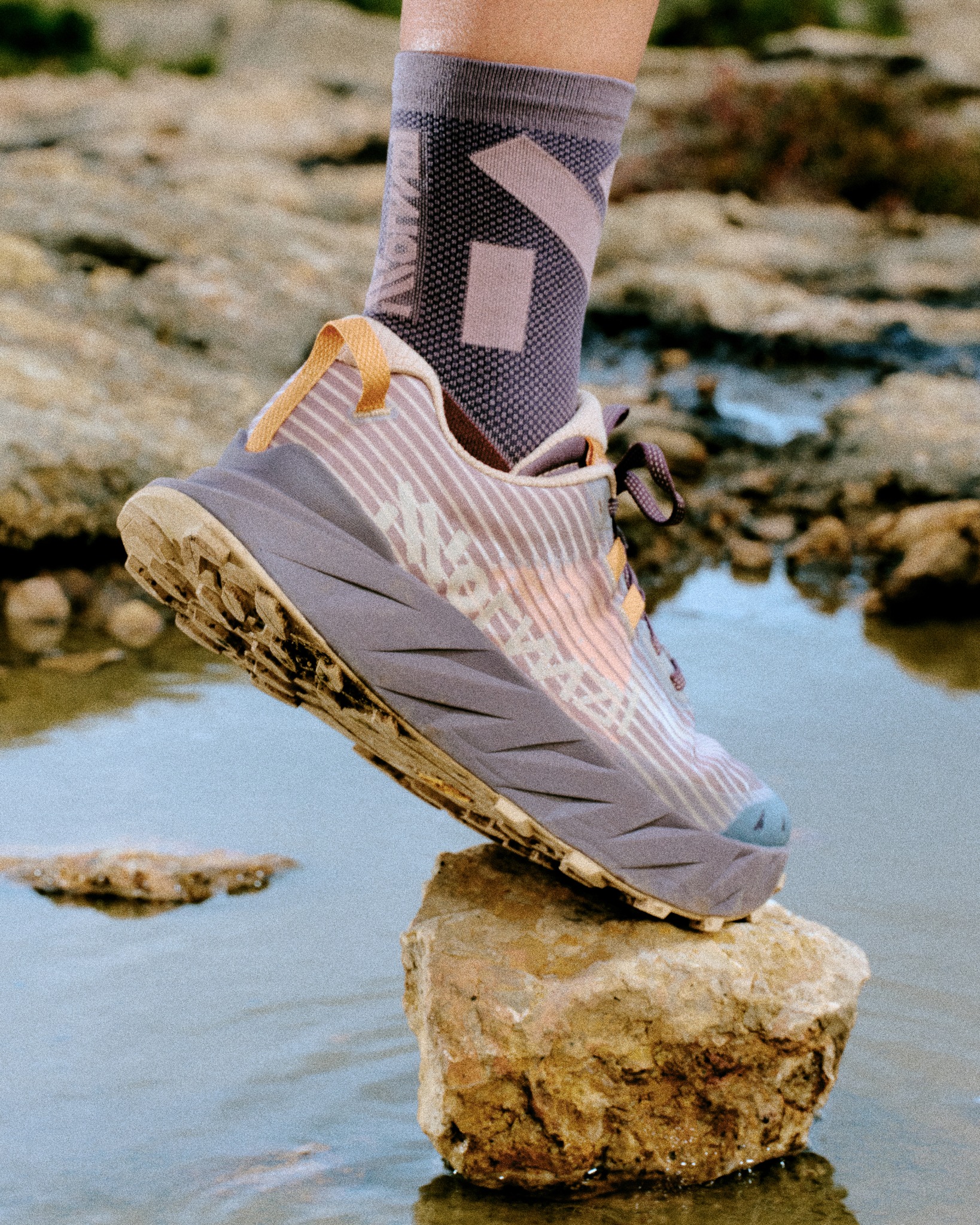
Every shoe NNormal had made until now was, in some sense, built for Kilian Jornet. The Kjerag is a racing instrument that punishes anything less than efficient form. The Tomir is more forgiving but still aimed at technical mountain terrain. The Cadí is the first NNormal shoe designed for people who are not Kilian Jornet — softer, wider, more cushioned, and explicitly tuned for easy ground.
Named after the Serra del Cadí in the Pyrenees, where Jornet grew up and first ran, it is also the brand’s first shoe with separate men’s and women’s lasts and, at €150, its cheapest. Whether it succeeds depends heavily on which review you read: testers split more sharply on this shoe than on anything else NNormal has released.
NNormal Cadí Review: Quick Specs
| Weight | 270–275 g (official); 281–286 g men’s / 264–265 g women’s measured |
| Stack height | 35 mm heel / 29 mm forefoot (official) |
| Drop | 6 mm |
| Midsole | EExpure supercritical EVA + ETPU insole |
| Outsole | Vibram Megagrip, 4 mm lugs (3 mm measured) |
| Upper | Sincetech dual-layer engineered mesh |
| Platform width | 120 mm forefoot / 80 mm midfoot / 95 mm heel |
| Sizing | Men’s and women’s specific lasts — a first for NNormal |
| Intended use | Easy to moderate trails, long distances, daily training |
| Retail price | €150 / £140 / $175 |
Where the Cadí Sits in the Range
NNormal’s own positioning matrix is unusually blunt: Kjerag Brut for fast technical soft ground, Kjerag 02 for fast technical, Tomir 02 for long technical, and Cadí for easy terrain and everyday running. The brand is not pretending this is a mountain shoe.
At 35/29 mm it is NNormal’s highest-stack shoe, 2 mm above the Tomir and 9 mm above the Kjerag. But the more interesting number is the platform width: 120 mm at the forefoot and 95 mm at the heel, dimensions few ultra-focused shoes match at ground level. The design logic is to go low and broad rather than high and narrow, buying stability from footprint rather than from stack.
Two other firsts matter. The midsole uses EExpure Supercritical — a CO₂-injected supercritical EVA that is less dense and softer than the EExpure in the Tomir and Kjerag — paired with a relatively thick ETPU insole. And the Cadí ships in men’s and women’s specific lasts, where every previous NNormal shoe was unisex. The women’s version has a narrower heel, lower instep and reduced volume.
That last point deserves a note, because NNormal has defended unisex sizing elsewhere as a deliberate way to cut production runs and waste. Introducing gender-specific lasts is a clear win for fit — several testers called it out as the shoe’s best feature — but it also means more SKUs from a brand whose founding argument is that the industry makes too much stuff. Both things are true at once.
The Midsole: Where Testers Genuinely Split
This is the most divided verdict we have encountered on any shoe, and the disagreement is not marginal.
On one side, a French tester described the cushioning as night and day compared with the rough midsoles of the Kjerag 02 and Brut — genuinely soft underfoot without becoming spongy, with the arch never sinking in. A multi-tester panel found it densely cushioned, vibration-absorbing and well balanced, with one reviewer noting the extra terrain filtering meant measurably less calf and ankle fatigue over distance than the Tomir. A French magazine praised a natural, fluid ride that accompanies rather than constrains.
On the other, a US reviewer who has tested hundreds of shoes described it flatly as feeling like a brick, with no flex under the midfoot and arches that hurt after 50 miles. Her conclusion was pointed: the midsole is supercritical, NNormal just needs to work out how to make it feel supercritical. A retail test team landed in between — comfortable and protective, but lacking any springy or playful element.
What reconciles this, we think, is body weight and the women’s last. The dissenting reviewer tested the women’s version and specifically wondered whether its narrower heel creates a narrower medial sidewall, restricting midfoot flex. She also noted that the midsole likely feels softer the heavier the runner — and one French review explicitly recommends the Cadí for heavier builds. If the foam needs weight to compress properly, lighter runners in the narrower women’s last will get the worst of it. That is inference rather than established fact, but it fits the evidence better than assuming half the testers are wrong.
Where everyone agrees: this is not a propulsive shoe. Nobody describes bounce or energy return. It is cushioning and protection, not assistance.
Traction: Deliberately Tuned Down
The Cadí uses standard Vibram Megagrip rather than the lighter Litebase found on the Kjerag and Tomir, with 4 mm chevron lugs — measured at 3 mm by one tester — and a notably smooth section through the middle of the outsole. NNormal states the outsole is intentionally tuned for easier terrain, which is a refreshingly honest thing to put in a product description.
On hard ground it works well. Testers reported no slipping on wet rock, wet leaves, dry hardpack, gravel or fireroads, and one specifically noted staying upright on an 85% incline of loose gravel where she normally falls. The shallow lugs and broad contact surfaces make it quiet and smooth on firm surfaces, and genuinely capable as a road-to-trail option.
On soft ground it is the weakest shoe NNormal makes. A French tester found grip mediocre on rocky terrain when wet, poor traction climbing on loose earth, and very little adhesion on muddy off-camber sections — the gap versus the Tomir 2 being obvious, and versus the Kjerag Brut enormous. Another tester found the midfoot lug spacing traps sticky mud. If you run in a wet climate or on leaf-covered forest trails, this is the wrong NNormal.
The Midfoot Problem
If the midsole divides opinion, the midfoot hold produces something closer to a consensus complaint — and it is the shoe’s clearest weakness.
Four independent sources report the same thing from different angles. A French tester found the foot rotating inside the shoe on descents and technical sections, with the upper holding well at the front and rear but slack through the middle. Two testers at a US retailer both found the midfoot narrow: one solved it by loosening the lower laces, the other only got a usable fit after using the runner’s loop, and before that was acutely aware of an uncomfortable geometry under her arch. A fourth reviewer reported arch pain she attributed partly to the narrow medial side.
Note that these are two different problems pointing at the same area: some runners find the midfoot too loose for security, others find it too narrow for comfort. That combination usually indicates a shape mismatch rather than a sizing error — the volume is in the wrong place rather than simply wrong in quantity.
Against this, one multi-tester panel found midfoot and heel hold totally secure and locked down, and a French magazine rated the lockdown as one of the shoe’s best qualities. Both, notably, tested the men’s version.
Two related observations recur. Torsional rigidity is low — the shoe reacts poorly to lateral twisting, which several testers linked to instability on off-camber ground. And the heel and toe box are the roomiest NNormal has made, with more volume than the Tomir including vertical height, so the fit is genuinely accommodating at both ends and pinched in the middle.
Sizing, Breathability and Durability
Sizing is less contradictory than on other NNormal models but still not clean. The manufacturer and one French outlet recommend your usual size. A multi-tester panel found it true to size and explicitly not long like the Kjerag. A US retailer found it slightly short on initial try-on, though both testers ran fine in their normal size. One UK reviewer went half a size up. Your usual size is the right starting point, with the caveat that it may feel snug on first wear.
Breathability is a consistent weakness. The dual-layer Sincetech upper pairs a woven outer with a silky inner liner, and while comfortable, it traps heat and moisture. One tester found the toes warm even in mid-60s°F spring temperatures and questioned why the inner lining could not have been perforated. Another expected it to be excellent in winter but limiting for spring through autumn. Drainage is also slow — the upper takes time to dry after wet conditions, worse than the Tomir or Kjerag Brut. Dust and debris also enter fairly easily on sandy ground.
Durability looks strong, with the usual caveat that these are early reports. No outsole wear after 60 miles in one test. The mesh resists abrasion well against rock and roots without holes forming, though light wear appears at the forefoot flex creases and the collar — the same pattern reported on the Tomir. The midsole is the standout: one reviewer, otherwise critical, called it effectively indestructible and noted it never broke in or softened even at 50 miles. For runners who flatten midsoles quickly, that alone may justify the shoe.
How Far, and How Fast?
The Cadí is NNormal’s most capable long-distance shoe, and the sources broadly agree on why: more foam, more terrain filtering, better muscular economy over hours, and a rocker that reduces ankle and calf work.
One French tester positioned it as the brand’s best option for 100-mile efforts, suitable from 50–60 km races upward, and noted the Tomir becomes uncomfortably firm under the arch over similar distances. A UK reviewer found it credible from short runs to ultra distance. A US retail team called it a long-run and daily-trainer shoe.
On pace, it is more capable than its bulk suggests but not fast. At 270–275 g it is light for the ultra category, and the aggressive forefoot rocker permits midfoot striking when wanted. Testers found it fine for tempo efforts in the 15–20 km range but not for genuinely quick running — one noted faster paces became impossible.
The real constraint is terrain, not distance. Reserve it for gravel, fireroads, forest tracks and wide, smooth singletrack. On technical mountain ground, the low torsional rigidity, mediocre soft-ground traction and midfoot movement combine into a shoe that testers consistently found less capable than the Tomir. For anything genuinely rocky or steep, our guide to the best trail running shoes in 2026 covers better options.
Our Take
The Cadí is the most commercially sensible thing NNormal has done and the least distinctive shoe it makes. That is not a contradiction. The brand built its reputation on precision instruments for mountain athletes, and there is a much larger market of runners on fireroads and rolling singletrack who want comfort and durability without needing Jornet’s biomechanics. The Cadí serves them, at NNormal’s lowest price, with gender-specific fit and a midsole that may genuinely outlast everything else in the category.
The reservations are real and they cluster. The midfoot is the shoe’s weak point — too loose for some, too narrow for others, and low in torsional rigidity, which limits it exactly where NNormal’s other shoes excel. The upper traps heat and drains slowly. Soft-ground traction is clearly the worst in the range. And the midsole verdict depends on who you are: heavier runners and those in the men’s last report genuine softness, while at least one lighter tester in the women’s version found it punishing.
Independent scores ranged from 9.2/10 on one panel down to a C for performance elsewhere — a spread that reflects the shoe’s narrow competence rather than inconsistent quality. Judged as an easy-terrain cruiser it does very well. Judged as a trail shoe in the broader sense it is limited.
Our recommendation: if you run mostly on gravel, fireroads and smooth trails, want long-distance comfort, and value durability over responsiveness, the Cadí is good value at €150 and the most accessible entry into the brand. If your trails are wet, technical or steep, buy the Tomir instead — it is better at all three. And if you are a lighter runner, try the Cadí on before committing, because the firmness reports are not evenly distributed. You can find it on the official NNormal website.
Frequently Asked Questions
Is the Cadí NNormal’s most cushioned shoe?
Yes. At 35/29 mm it sits 2 mm above the Tomir 02 and 9 mm above the Kjerag 02, and it uses EExpure Supercritical — a less dense, softer CO₂-injected foam — plus a thick ETPU insole the Kjerag does not have at all. Whether it actually feels soft is disputed: several testers found it genuinely plush, while others described it as firm or even brick-like. Heavier runners appear to get more compression from it.
Can you use the Cadí on technical terrain?
Not really, and NNormal does not claim you can — its own positioning matrix lists the Cadí under easy terrain. Testers consistently found it less stable than the Tomir on rocky or root-covered ground, with a tendency to twist when the foot lands awkwardly and poor torsional rigidity on off-camber sections. Reserve it for gravel, fireroads, forest tracks and wide smooth singletrack.
Does the Cadí work in mud and wet conditions?
It is the weakest NNormal for soft ground. The 4 mm chevron lugs are relatively flat with a smooth central section, and testers reported poor traction climbing on loose earth and very little grip on muddy off-camber terrain. Grip on wet rock is decent thanks to the Megagrip compound. For mud and winter conditions, the Tomir 02 or Kjerag Brut are considerably better choices.
What size should I buy in the NNormal Cadí?
Your usual size, which both NNormal and most testers recommend. It is not long like the Kjerag. One US retailer noted it feels slightly short on initial try-on though both testers ran fine in their normal size, and one UK reviewer preferred half a size up. The more relevant fit issue is the midfoot rather than length: several testers needed to adjust lacing — including using the runner’s loop — to get a secure hold.
Cadí or Tomir 02?
Terrain decides it. The Cadí has 2 mm more stack, a softer foam, a broader platform, a roomier fit and gender-specific lasts, making it better for long easy miles, gravel and road-to-trail. The Tomir has 5 mm lugs against the Cadí’s 4 mm, better midfoot security, superior soft-ground traction and more stability on technical terrain. For wet, muddy or rocky running, take the Tomir. For comfort on smooth ground over long distances, take the Cadí.
Is the Cadí good for wide feet?
Partly. The toe box is the roomiest NNormal has made, with more volume than the Tomir including vertical height, and the heel is slightly more generous too. But the midfoot is repeatedly described as narrow, and the shoe is best characterised as accommodating at both ends and snug through the middle. Runners who are wide throughout may struggle; those with normal midfeet and wide forefeet should find it works well.
Why does the Cadí come in men’s and women’s versions?
It is the first NNormal shoe to use gender-specific lasts rather than unisex sizing. The women’s version has a narrower heel, lower instep and reduced upper volume. Several testers considered this a significant improvement, particularly for low-volume feet and heel security. One reviewer did wonder whether the narrower women’s heel creates a tighter medial sidewall that restricts midfoot flex, which may explain why some women testers found the midsole firmer than men testing the same shoe.