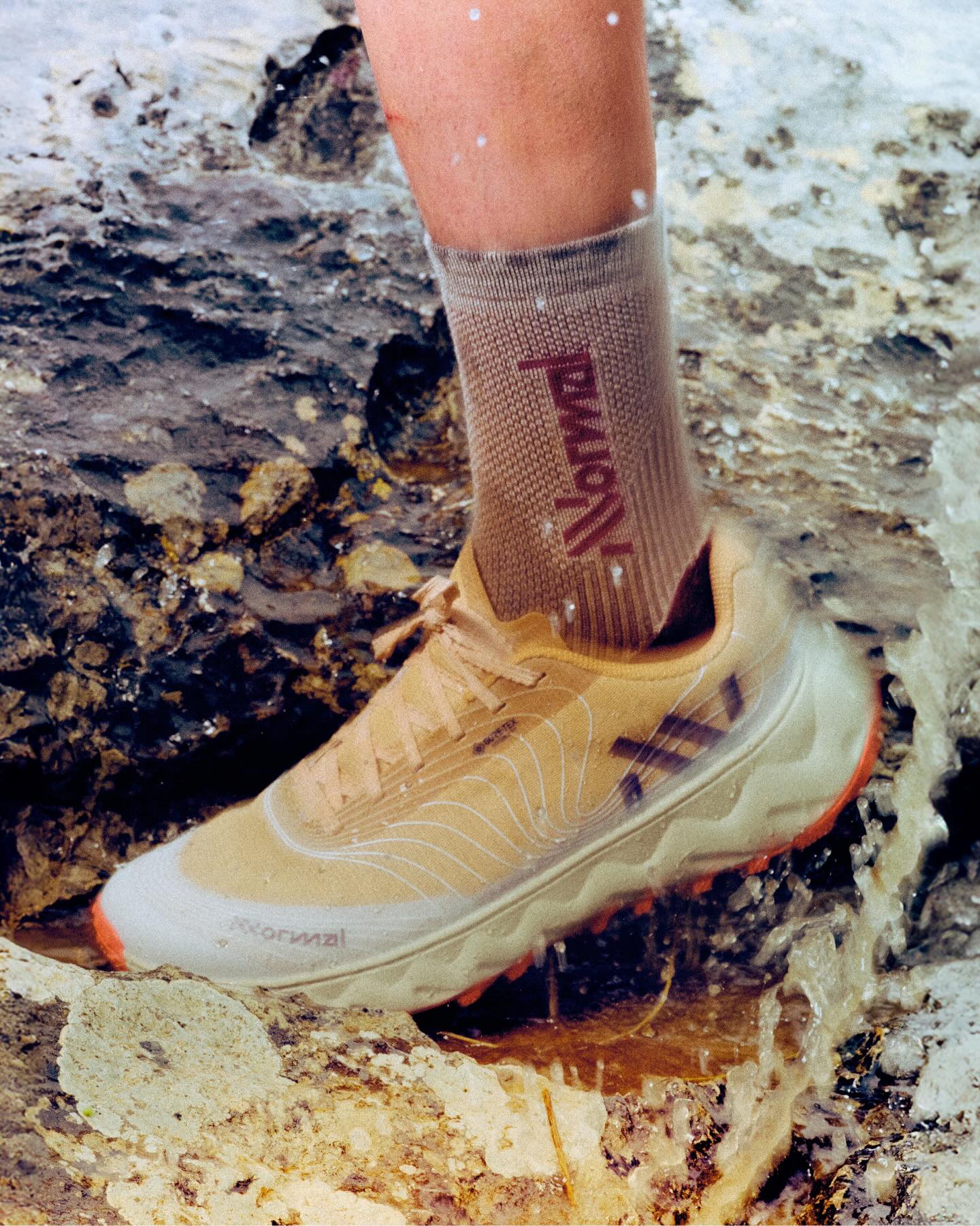
hill.camp does not test products first-hand. This review is a structured synthesis of 8 independent sources — specialist field tests, retailer panels, verified owner feedback and manufacturer specifications — assembled with AI assistance and edited before publication. Sources are selected and verified by runners who follow this equipment closely. That method lets us cross-reference more testing than any single reviewer could, and to flag where sources contradict each other instead of smoothing it over.
The Tomir is the shoe most people should buy from NNormal, and the one almost nobody talks about. It accounts for roughly 60% of the brand’s footwear sales while the Kjerag gets the attention and the elite feet. That imbalance makes sense once you run in both: the Kjerag is a specialist instrument that demands efficient form and narrow feet, while the Tomir is built for the rest of us — cushioned, grippy, durable, and forgiving in ways its sibling deliberately is not.
The 02 exists because the original had a specific problem: a firm EVA midsole that made it feel more like a hiking shoe than a running one. Swapping that for EExpure supercritical foam changed the shoe’s character entirely. What it did not change is a fit that divides testers more sharply than any shoe we have covered.
NNormal Tomir 02 Review: Quick Specs
| Weight | 264 g (UK 8, official); 274–307 g measured across sizes |
| Stack height | 33 mm heel / 25 mm forefoot (official) |
| Drop | 8 mm claimed |
| Midsole | EExpure supercritical foam, removable insole |
| Rock plate | None |
| Upper | Ripstop TPE + monofilament polyester, craft-stitched 360° to midsole |
| Outsole | Vibram Megagrip Litebase, 5 mm lugs with Traction Lug technology |
| Sizing | Unisex, standard width only |
| Intended use | Long trails, mixed and soft terrain, all-day mountain use |
| Retail price | €130–160 / £150 / $170–180 |
A note on those numbers, because published figures for this shoe are a mess. NNormal’s own product page lists 33/25 mm — the widely circulated 31/23 mm figures belong to the Tomir 01 and have been copied forward by several outlets. Independent measurements go higher still, with one lab recording 36 mm at the heel and a measured drop of 12 mm against the claimed 8 mm. Weights vary from 264 g official to over 300 g depending on size. We have used the manufacturer’s figures and flagged the discrepancies rather than picking a favourite.
What Changed From the Tomir 01
The original Tomir was described by more than one tester as a shoe you could walk, hike, run or mountain bike in — which is a polite way of saying it was not really a running shoe. Firm EVA underfoot, competent but uninspiring. The 02 addresses that directly.
The midsole. The single most consequential change. EVA is replaced by EExpure, the same supercritical nitrogen-infused foam used in the Kjerag, though in a softer formulation and a thicker application. One reviewer put it plainly: on paper this reads as incremental, on the trail it changes everything. The shoe went from a glorified hiker to something genuinely enjoyable to run in.
The geometry. Stack rose 2 mm and the platform was widened — by 4 mm and 7 mm at two points either side of the arch, according to the brand, taking outsole surface area from 272 cm² to 290 cm². The rocker is considerably more pronounced, particularly at the heel. Both changes respond to community feedback on the 01’s stability.
The outsole. Same Vibram Megagrip Litebase compound and 5 mm lugs, now with Vibram’s Traction Lug technology — micro-teeth on the lug surfaces that increase contact area by a claimed 50% and traction by 25%.
The details. An upgraded 360° nylon stitch securing the upper to the midsole, a wider tongue, and anti-slip serrated laces that testers praise with unusual enthusiasm — one reviewer wanted every brand to adopt them, another reported his original laces surviving 1,300 km in near-new condition.
The Ride: Dense, Rockered, Long-Haul
EExpure in the Tomir behaves differently from EExpure in the Kjerag — softer formulation, more of it, and the result is a bouncier shoe than its sibling despite being far more substantial underfoot. Testers consistently describe genuine rebound and a propulsive sensation through the midfoot, with one noting it feels plusher than some highly cushioned road shoes.
What stops it feeling like a max-cushion shoe is density. The foam is firm rather than soft, which preserves ground contact and makes the Tomir noticeably more stable and connected than a Speedgoat or a Gel Trabuco at similar stack heights. That is the shoe’s central trade-off, and it cuts both ways: excellent terrain feedback and stability, but a compact cushion that starts producing tension under the arch on very long efforts. One experienced tester placed his personal ceiling around 80–90 km and would not choose it for a 100-miler.
The rocker divides opinion along a predictable line. It is aggressive, especially at the heel, and it works well for heel strikers by guiding the foot forward and preventing heavy landings. Midfoot strikers notice it more than they would like — one described his heel hitting earlier than normal and being pushed onto his forefoot, making the transition less smooth. If you land midfoot, this is worth knowing before you buy.
Where the Tomir clearly excels is scrambling and mixed mountain terrain. A tester based in the Sierra Nevada described it as feeling like an approach shoe on granite, with the aggressive lugs handling both uphill traction and downhill braking, and used it for exactly the run-climb-run pattern that most trail shoes handle badly. Kilian Jornet himself wore Tomirs for much of his 82 four-thousanders project across the Alps.
Traction: The Least Controversial Part
Every source agrees here, which after the fit debate is a relief. The 5 mm Vibram Megagrip Litebase lugs — a combination of long rectangular bars around the perimeter and smaller round nodules through the centre — deliver traction across an unusually wide range of surfaces.
Mud, wet grass, wet rock, granite slabs, snow, stream crossings, dry singletrack, loose gravel, tarmac: testers ran all of it without complaint. One lab ranked the Tomir’s traction second only to the Salomon Speedcross across a 16-shoe field. The Litebase compound’s hardness helps shed mud rather than packing it, and the Traction Lug micro-teeth improve grip on decomposed ground. Crucially, the lugs are not intrusive on hardpack or road — several testers ran road-to-trail sections without the lugs getting in the way.
This is where the Tomir separates itself from the Kjerag most clearly. The Kjerag’s 3.5 mm lugs are outstanding on dry rock and poor in mud; the Tomir handles wet, soft and wooded terrain that the Kjerag simply cannot. For anyone running in a wet climate, that alone decides between them.
Fit: The Genuine Disagreement
We have covered shoes with contradictory sizing advice before. The Tomir 02 is worse, and the disagreement is not just about length.
On width, the split is stark. A British ultrarunner and coach found the toe box so narrow that rubbing on the inside of her big toe ruled the shoe out for anything beyond 20 km, and specifically flagged that women tend to have proportionally wider forefeet. A US reviewer with feet between average and wide called the Ripstop TPE upper unaccommodating and warned it will not stretch. Against that, a French tester with self-described very wide feet found the fit standard and needed only three or four outings to break it in, and another French review described the fit as noticeably more generous than the Kjerag’s, well suited to strong and wide feet.
The most useful reading is comparative rather than absolute: the Tomir is roomier than the Kjerag but slimmer than most mainstream trail shoes, and it sits right at the threshold where genuinely wide feet start having problems. Where you fall relative to that threshold determines everything, and there is no wide option to escape into.
On length, one UK retailer found the 02 fits smaller than the 01 and went up half a size. Two other testers found it runs long. Customer reviews on NNormal’s own site skew toward « large ». Our best guess is that the 02’s snugger midfoot makes the shoe feel shorter to some runners while the actual last runs generous, but that is inference rather than evidence.
On lockdown, there is one significant dissenting report. A US test team found their feet sliding forward on steep technical descents, blamed a slippery insole, and stated the insole could not be removed because of the stitching beneath it — with some runners reportedly going sockless to increase friction. This matters because it contradicts everyone else: multiple sources praise the Tomir’s midfoot hold specifically, and one French review explicitly notes that NNormal added a removable insole to the Tomir, unlike the Kjerag, calling it good news for anyone using orthotics. We cannot reconcile these, and given that the same test team is alone in reporting the slippage, we would treat it as a possible sample issue rather than a design flaw — while noting that if you do run steep technical descents, it is worth testing before committing.
Two points everyone agrees on: the asymmetric lacing, which follows the crest of the foot rather than running straight up the middle, works well and relieves pressure. And the tongue needs repositioning each time you put the shoe on, as it tends to fold forward.
Durability: Excellent, With a Caveat Worth Taking Seriously
The headline evidence is genuinely impressive. A mountain runner in California’s Sierra Nevada logged over 1,300 km on one pair, mostly on coarse granite — terrain that destroys shoes. The outsole began showing significant wear around 900 km, the upper started abrading at the forefoot flex point and finally tore at about 1,100 km, and at 1,300 km the pair was still usable if visibly finished. For a shoe used that abusively, that is roughly double what most trail shoes manage.
Other testers report the same trajectory. One found no marks or dents after a month of road and trail running. Another found the ripstop intact after 120 km of brambles and rocks. A customer reported 750 km with little outsole wear. The 360° stitched construction, the two-layer toe bumper, and NNormal’s two-year warranty all reinforce the impression of a shoe built to outlast its category.
But there is a contrary signal that deserves airing rather than burying. Two independent French commenters report the ripstop upper developing creases and then tearing at around 300 km — one on both shoes of the pair, describing them as barely broken in. A third reports the collar wearing through. One also describes inconsistent midsole density between left and right shoes and a customer service response taking four weeks. These are anecdotes, not data, and they sit against a much larger body of positive reports. But they cluster on the same component — the upper, at the flex point — that the 1,300 km tester also identified as his eventual failure. The pattern is at least consistent: the outsole and midsole go the distance, and the upper is the thing to watch.
Breathability: The Clearest Weakness
The Ripstop TPE upper is what makes the Tomir durable and water-resistant, and it is also what makes it warm. The weave is tight enough that airflow is limited, and multiple testers reported the shoe running hot in warm conditions. One noted the fabric absorbs water readily and is slow to release it after stream crossings — the opposite of the Kjerag’s fast-draining Matryx.
One tester also found the material has a slightly plastic feel and rubbed at the toe flex point when climbing, unpleasant enough to mention though it caused no blisters. He flagged that forefoot strikers would likely feel it more consistently than he did as a midfoot striker.
None of this is disqualifying, but if you run in genuine summer heat, it is a real consideration.
Where It Sits: Tomir, Kjerag or Cadí?
NNormal’s range now covers most of the trail spectrum, and the three shoes divide cleanly by terrain.
Take the Tomir for long distances on wet, soft or technical ground — wooded trails, winter conditions, mixed mountain terrain, and anything where you want cushioning and grip together. Its 5 mm lugs are the most versatile in the range, and it handles the widest spread of conditions.
Take the Kjerag for racing, technical dry rock and skyrunning, where ground feel and low weight matter more than protection. It is lighter, more precise, considerably narrower, and it punishes inefficient form.
Take the Cadí for easy terrain and long comfortable miles — gravel, fireroads, smooth singletrack and road-to-trail. It has more stack at 35/29 mm, a softer foam, a roomier toe box and gender-specific lasts, but its 4 mm lugs and low torsional rigidity make it clearly the weakest of the three on mud and technical ground.
One practical difference that gets overlooked: the Tomir and Cadí have insoles, the Kjerag does not. If you use orthotics, that rules the Kjerag out immediately.
Our Take
The Tomir 02 is the most broadly useful shoe NNormal makes, and the EExpure midsole is what earned it that status. The move from firm EVA transformed a competent hiking-adjacent shoe into something genuinely versatile — dense and connected enough for technical ground, cushioned enough for long days, and grippy enough for conditions that defeat most of the competition. The traction in particular is close to best-in-class, and the durability, for the majority of testers, delivers on the brand’s central promise.
The limitations are real and worth being specific about. The upper does not breathe well and dries slowly. The dense cushion produces arch tension on very long efforts, which caps the shoe’s ultra credentials somewhere around 80–90 km for most runners rather than at 100 miles. The rocker suits heel strikers considerably better than midfoot strikers. And the fit sits at exactly the width where opinions divide — roomier than the Kjerag, tighter than most, with no wide option.
On durability we would add one note of caution against the general enthusiasm. The evidence for 1,000 km-plus is strong, but the scattered reports of ripstop tearing at 300 km cluster on the same flex point that the longest-running tester identified as his failure mode. That is not enough to contradict the broader picture, and it may simply reflect the variance you get with any product. But a brand that markets durability as its core promise should expect that promise to be examined closely, and this is the component to examine.
Our recommendation: if you run long on mixed or soft terrain, land heel-first, and have normal-to-moderately-wide feet, the Tomir 02 is one of the best all-round trail shoes available and the cost-per-kilometre argument is real. If you have genuinely wide feet, run mostly in heat, or need a shoe for 100-mile efforts, look at the alternatives in our guide to the best trail running shoes in 2026. Try before buying if you can — the sizing reports are too contradictory to trust blind. You can find it on the official NNormal website.
Frequently Asked Questions
What is the actual stack height of the Tomir 02?
NNormal lists 33 mm at the heel and 25 mm at the forefoot, with an 8 mm drop. Several reviews quote 31/23 mm, but those are the Tomir 01’s figures carried over in error. Independent measurement has recorded higher still — 36 mm at the heel and a measured drop of 12 mm — which is common with stack measurements taken differently from manufacturer specifications. Use 33/25 mm as the reference.
Is the Tomir 02 suitable for wide feet?
It depends how wide, and testers genuinely disagree. It is clearly roomier than the Kjerag, and two French testers — one with very wide feet — found it standard to generous after a short break-in. But a British ultrarunner found the toe box narrow enough to cause big-toe rubbing beyond 20 km, and a US reviewer with average-to-wide feet warned that the Ripstop TPE upper will not stretch to accommodate. There is no wide version. If your feet are genuinely broad, the Cadí has the roomiest toe box NNormal makes, though its midfoot is narrower still.
Does the Tomir 02 have a removable insole?
Yes — unlike the Kjerag, which has none at all. One French review specifically highlights this as good news for runners using orthotics. One US test team reported theirs could not be removed due to stitching underneath, which contradicts the other sources; given that the same team was alone in reporting foot slippage, this may reflect a sample issue. If orthotics are essential to you, confirm with the retailer before ordering.
How does the Tomir 02 compare to the Kjerag 02?
They are near opposites within the same brand. The Tomir has 33/25 mm of stack against the Kjerag’s 26/20 mm, 5 mm lugs against 3.5 mm, a roomier fit, an insole, and a more protective build — better for long distances, mud, soft ground and wet conditions. The Kjerag is lighter, lower, narrower, has no insole, and delivers far more ground feel — better for racing, dry technical rock and fast efforts. Many testers run both as a two-shoe rotation covering everything.
Tomir 02 or Cadí?
Terrain decides it. The Cadí has 2 mm more stack, a softer EExpure Supercritical foam, a broader platform, a roomier toe box and gender-specific lasts, making it the more comfortable choice for long easy miles, gravel and road-to-trail. The Tomir has deeper 5 mm lugs against the Cadí’s 4 mm, better midfoot security, considerably better soft-ground traction and more stability on technical terrain. For wet, muddy or rocky running, take the Tomir. For comfort on smooth ground, take the Cadí.
Can you run an ultra in the Tomir 02?
Up to a point. The cushioning is generous but dense, and several testers reported tension developing under the arch on very long efforts. One experienced tester put his practical ceiling around 80–90 km and would not choose it for a 100-miler — he considered the Cadí the better NNormal for that distance. For trails in the 40–90 km range the Tomir is well suited, and its traction and durability make it a strong choice for wet or technical ultras within that range.
Is the Tomir 02 good for heel strikers?
Yes, and better for them than for midfoot strikers. The 8 mm drop and pronounced rocker guide the foot forward from heel contact through to toe-off, and one retailer explicitly recommends it as best suited to heel strikers. A midfoot-striking tester found the same rocker made his transition less smooth, with the heel landing earlier than expected. If you land midfoot or forefoot, the Kjerag or a flatter shoe may suit you better.