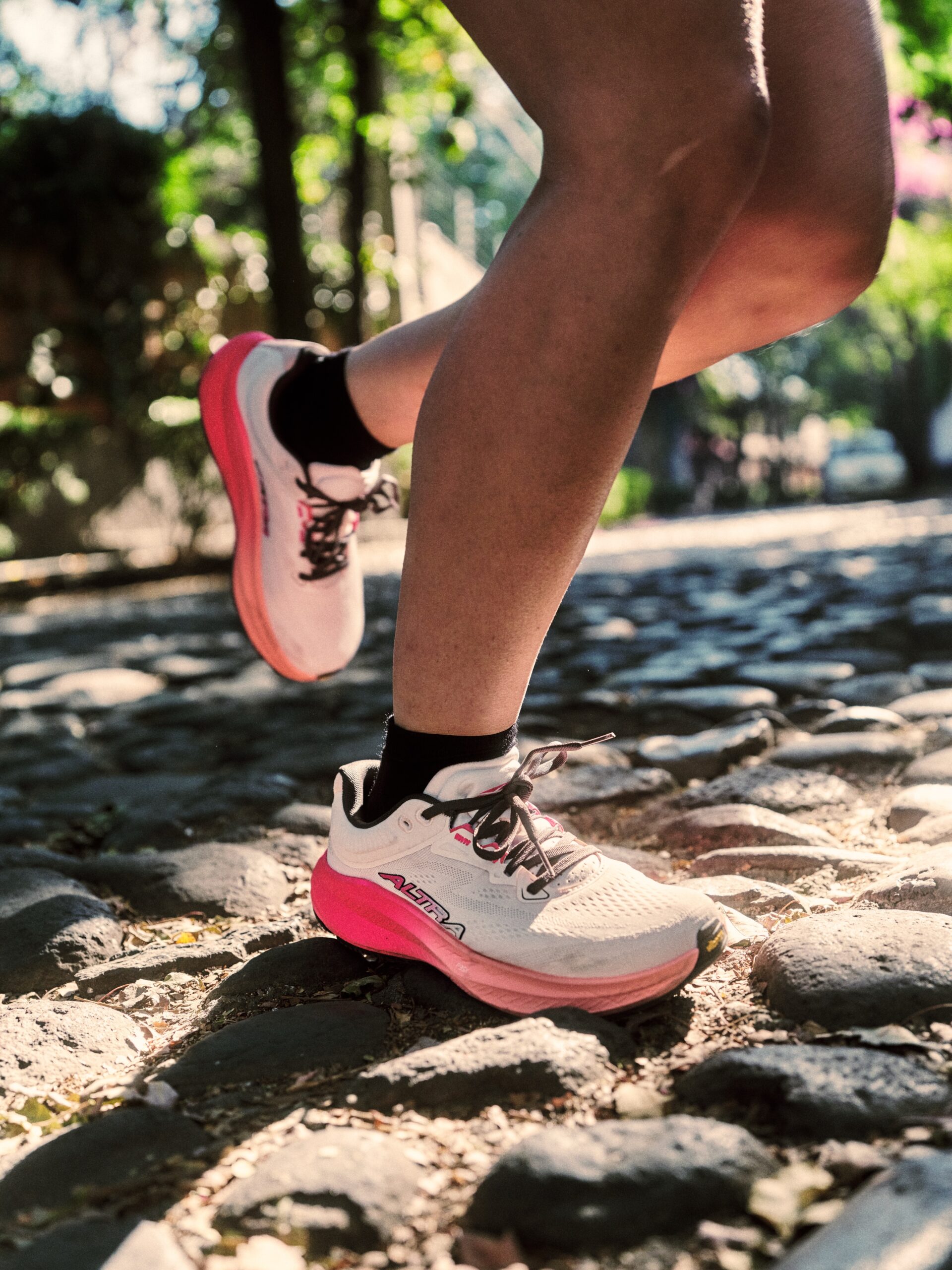
hill.camp does not test products first-hand. This comparison is a structured synthesis of 10 independent sources covering both shoes — specialist field tests, retailer panels, verified owner feedback and manufacturer specifications — assembled with AI assistance and edited before publication. Sources are selected and verified by runners who follow this equipment closely. Very few reviewers test both models in the same conditions, so cross-reading the two bodies of testing is the only honest way to compare them — and it lets us flag where sources contradict each other instead of smoothing it over.
Altra shipped both of these in the same summer, and the contrast between them says more about the brand than either shoe does alone. The Torin 9 got a brand-new dual-density midsole and the first Vibram outsole Altra has ever put on a road shoe. The Escalante 5, arriving after two and a half years of silence, got a new sockliner and some extra rubber. Same company, same season, wildly different levels of investment — and the result is two zero-drop trainers that are far less interchangeable than the shared FootShape toe box suggests.
Torin 9 vs Escalante 5: Specs Side by Side
| Spec | Altra Torin 9 | Altra Escalante 5 |
|---|---|---|
| Price | $160 | $140 |
| Weight (men’s) | ~269–278 g / 9.8 oz | ~275 g / 9.7 oz |
| Weight (women’s) | ~228 g / 8.0 oz | ~221 g / 7.6 oz |
| Stack height | 28 mm / 28 mm | 24 mm / 24 mm |
| Drop | 0 mm | 0 mm |
| Midsole | P35X dual-density (new) | Altra EGO / CMEVA (unchanged) |
| Outsole | Vibram XS Run AW | Altra rubber, increased coverage |
| Upper | Engineered mesh, non-gusseted tongue | Engineered knit, chenille-lined tongue |
| Widths | Standard + wide (D / 2E) | Standard only |
| Best for | Daily miles, long runs, walking, light gravel | Up to ~10 miles, speedwork, gym, walking |
The Four Millimetres That Change Everything
On paper the gap is small: 28 mm against 24 mm, both flat. In practice it separates the two shoes more decisively than any other single spec, because it lands right at the boundary where a zero-drop shoe stops feeling minimal.
At 24 mm, the Escalante 5 is genuinely low. Testers consistently place its comfortable ceiling around eight to ten miles, after which the thin platform starts making demands on your legs. It is enough foam to keep the road from being punishing, and not much more. That is the design intent, not a shortcoming — but it caps the shoe’s range.
At 28 mm, the Torin 9 never reads as minimalist. Testers describe it as protective without disconnecting them from the ground, and it handles marathon-block mileage at easy to moderate pace without complaint. That is the practical difference: the Escalante is a shoe for specific runs, the Torin is a shoe for most of your week.
The consequence for anyone new to zero-drop is significant. Both shoes will stretch your Achilles and load your calves in ways a conventional trainer does not, and both demand the same gradual four-to-eight-week transition. But doing that adjustment on 28 mm of dual-density foam is materially kinder than doing it on 24 mm of EVA. If you are making the switch, the Torin is the better classroom.
New Foam Against Old Foam
This is the least ambiguous difference between the two shoes, and it is worth being blunt about.
The Escalante 5 runs on Altra EGO — a compression-moulded EVA, unchanged from the Escalante 4, and old technology by any current standard. Altra’s representatives have said customers explicitly asked for it to stay, which is a legitimate reason and also an admission. The ride is firm, controlled and connected, with modest genuine energy return and no trampoline effect whatsoever. Reviewers have called it dated, and that reads as accurate rather than unkind.
The Torin 9 runs on P35X, an entirely new dual-density construction with a firmer outer carrier around a softer core. It produces more cushioning and more energy return than EGO — though how much more is genuinely contested. One independent tester found real forefoot pop, comparing it to a supercritical super-trainer with less foam underneath. A retail test panel landed the opposite way: firm, not much return, and argued that was the point. Both readings are defensible. P35X is clearly livelier than EGO and clearly less lively than a modern PEBA or TPEE foam.
The more important claim is durability. Previous Torins had a documented habit of going flat after a couple of hundred miles, and P35X exists specifically to fix that. Whether it does is unknowable this early — but it is at least an attempt at the problem. The Escalante’s EGO has a long track record and no such ambition.
Vibram Against House Rubber
Both shoes improved their outsoles this generation, and one improved considerably more than the other.
The Escalante 5 adds meaningfully more rubber coverage than the 4, addressing a real complaint — the previous version wore through fast in high-friction zones. Grip on wet road has been reported as reliable and early wear as minimal. It is a sensible fix to a known weakness.
The Torin 9 goes considerably further with Vibram XS Run AW, a road-specific compound derived from approach-shoe rubber, in thin-cut zones across almost the whole outsole. Altra claims 8.5% better traction than the Torin 8; one independent reviewer called it the grippiest road-specific outsole he has tested on any zero-drop shoe. It held on asphalt, concrete, wet pavement, groomed paths and packed dirt.
Two honest caveats. First, some testers found the Torin’s grip excessive on clean dry tarmac — more traction means more contact, and you pay for security you may not need. Second, neither shoe is a trail shoe. The Torin’s Vibram makes it more capable on gravel and light dirt, but it has no lugs and will not hold on technical ground. For that, our guide to the best trail running shoes in 2026 is the right starting point.
Fit: Same Philosophy, Different Problems
Both use Altra’s Standard FootShape last — the middle of the brand’s three widths, still broader through the forefoot than most competitors’ wide options. Both run true to size. Beyond that they fail in different directions, and the specifics matter more than the similarity.
The Escalante’s problem is vertical. It is wide but shallow. Owner reports repeatedly describe insufficient height in the toe box, pressure across the top of the big toe, and real difficulty fitting aftermarket insoles because the added thickness eats space that is not there. Several long-term wearers describe a shoe that measures wide and feels tight for exactly this reason. Press coverage largely misses it. It is also slim through the midfoot and heel, so runners who are broad throughout may feel arch pressure on longer efforts — and there is no wide version to escape into.
The Torin’s problem is the tongue. Altra removed the gusset on the 9, presenting it as an upgrade — an adjustable, elevated, molded tongue rather than one fused into the upper. Several testers loved it; one named it his favourite feature of the shoe. But two independent sources report the sides folding over and rubbing, forcing mid-run readjustment, and both attribute it specifically to high-instep and high-volume feet. Two unconnected reports converging on the same fault in the same foot type is worth taking seriously.
The Torin does offer one clear structural advantage: it comes in a wide width (D for women, 2E for men). The Escalante does not. If you are wide through the midfoot as well as the forefoot, that alone may decide this.
One more Torin win: the redesigned heel. The Torin 8’s high heel tab dug into the Achilles for some runners, and the 9’s lower-profile rounded collar fixes it, with fewer hot spots in warm weather as a bonus.
Speed, Distance and What Each Shoe Is Actually For
Here the two diverge cleanly, and the difference is not the one the spec sheet implies.
The Escalante is the quicker shoe despite weighing roughly the same. Its low stack and exceptional forefoot flexibility — InnerFlex grooves, minimal structure — make it genuinely responsive at pace, and one specialist retailer categorises it outright as a speed shoe rather than a daily trainer. It suits shorter, faster efforts, gym work and walking. What it does not do is distance.
The Torin is the mileage shoe. Testers describe it as blocky and less agile than rockered competitors — the honest cost of a wide, flat, stable platform — and it is not the shoe for intervals. But it absorbs volume, and testers who ran it across recovery runs, tempo sessions and hill work found it capable across all of them without excelling at any. It is also the better walking shoe of the two, with more foam under prolonged load.
Neither is a racing shoe. Neither has a plate, a rocker, or meaningful propulsion. If that is what you want, you are in the wrong part of the catalogue entirely.
Which One Should You Buy?
Choose the Torin 9 if you are new to zero-drop and want the most forgiving entry Altra makes. Choose it if you need one shoe to carry most of your weekly mileage, including long runs. Choose it if you are wide through the midfoot and need the wide width. Choose it if outsole durability has burned you on previous Altras. And choose it if you want the newer, better-engineered shoe — because on foam, rubber and heel design, that is unambiguously what it is.
Choose the Escalante 5 if you already know you like minimal shoes and want maximum ground feel. Choose it if your runs are short and often fast, or if you want something light for gym work and walking. Choose it if you have worn Escalantes before and simply need a fresh pair — the 5 is the best-built version yet. And choose it if $20 matters, though that is the weakest reason on this list.
If the flat platform itself is what worries you, neither is the answer. Altra’s Experience line runs a 4 mm drop as a genuine halfway house, and the Mount to Coast R1 offers firm, ground-connected cushioning on a conventional 8 mm platform.
Our Take
For most runners, most of the time, the Torin 9 is the better buy — and the $20 gap is not close to being the deciding factor. It has newer foam, a substantially better outsole, more cushioning, a fixed heel, and a wide option the Escalante lacks. If you are choosing between them without a specific reason to prefer minimalism, take the Torin.
That said, the Escalante is not the loser here so much as the more specialised tool. There is a real constituency for a light, flexible, genuinely low shoe with a wide forefoot, and almost nobody else builds one. If that is what you want, the Torin’s extra 4 mm and firmer chassis will feel like exactly the wrong direction. The Escalante’s problem is not that it is worse — it is that Altra has left it running on 2017 technology while investing everywhere else.
Our practical advice applies to both: try them on, and check the dimension that will actually catch you out. For the Escalante that is toe box height. For the Torin it is whether your instep gets along with that tongue. Neither is a spec you can look up. You can see both models on the official Altra Running website.
Frequently Asked Questions
Which is better for beginners to zero-drop?
The Torin 9, clearly. Its 28 mm stack and dual-density P35X foam make it substantially more forgiving than the Escalante’s 24 mm of EVA, and it never feels minimalist. Both still require the same gradual transition — one or two easy runs a week alongside your existing shoes, building over four to eight weeks — but the Torin makes that adjustment considerably less punishing on the calves and Achilles.
Is the Torin 9 worth $20 more than the Escalante 5?
Yes, and it is not a close call. For that $20 you get an entirely new midsole compound, a Vibram outsole, 4 mm more cushioning, a redesigned heel, and the option of a wide width. The Escalante 5’s changes this generation amounted to a new sockliner, more rubber coverage and a revised tongue. On components alone the Torin is the better value even at the higher price.
Which is better for wide feet?
Both use Altra’s Standard FootShape last, so forefoot width is comparable and both are wider than most brands’ wide options. The Torin 9 wins for two reasons: it comes in a genuine wide width (D for women, 2E for men) where the Escalante does not, and the Escalante has a documented shallowness problem in the toe box that affects high-volume feet regardless of width. If your feet are broad throughout, the Torin is the safer choice.
Which one is faster?
The Escalante 5, despite the two weighing almost the same. Its lower stack and exceptional forefoot flexibility make it more responsive at pace, and it suits shorter fast efforts well — one retailer categorises it as a speed shoe rather than a daily trainer. The Torin is described by testers as blocky and less agile by comparison. Neither, though, is a racing shoe: no plate, no rocker, modest propulsion in both.
Can either handle long runs and marathon training?
The Torin 9 can. It has the cushioning and expected durability for high-mileage weeks at easy to moderate pace, and P35X is designed specifically to hold its character over distance. The Escalante 5 tops out around eight to ten miles for most testers before the low stack becomes a factor. Well-conditioned runners with an established zero-drop history will manage more, but it is not what the shoe is built for.
Can you use either on trails?
Light trails and gravel only, and the Torin 9 is the better of the two thanks to its Vibram compound — testers reported good traction and push-off on packed dirt. Both lack lugs entirely and will not hold on loose or technical ground. Treat them as road shoes that tolerate a detour, not as road-to-trail hybrids.
Should I own both?
They complement each other reasonably well if you already run in zero-drop: the Torin for volume, long runs and recovery, the Escalante for shorter and faster sessions. But this is a narrow rotation with a lot of overlap, and most runners would be better served pairing the Torin with something that actually offers propulsion for workout days rather than with a second flat, plateless shoe.