hill.camp does not conduct first-hand product testing. This Tracksmith Eliot Runner review is a synthesis of independent field tests, specialist press articles, and verified consumer feedback gathered from multiple sources. All technical data and performance observations are drawn from those sources and attributed accordingly.
There is a version of running apparel — and running footwear — that takes itself seriously without taking itself too seriously. That understands a Tuesday morning run deserves the same considered aesthetic as a weekend race. That believes the shoes you lace up matter not just for what they do, but for what they say. The Tracksmith Eliot Runner is that shoe made physical: a daily trainer that looks like it was designed in a prep school common room, built from materials that belong in a carbon race shoe, and priced at a level that demands honest justification. This Tracksmith Eliot Runner review draws on a wide range of independent testers to deliver that justification — or the absence of it.
The Eliot Runner launched in December 2022 as Tracksmith’s first-ever running shoe — a significant moment for a brand that had built its entire reputation on apparel. Everything about the shoe’s design, materials, and presentation is consistent with the Tracksmith brand story: deliberate, refined, and unapologetically expensive. Whether the performance matches the promise is what this Tracksmith Eliot Runner review sets out to establish.
Tracksmith Eliot Runner — Quick Specs
| Price | $198 / €208 |
| Weight | 261g / 9.2oz (men’s US9) — 227g / 8oz (women’s US7) |
| Stack height | 33.5mm heel / 24.5mm forefoot |
| Drop | 9mm |
| Midsole | Dual-density Pebax — firmer base layer + 10mm supercritical Pebax sockliner |
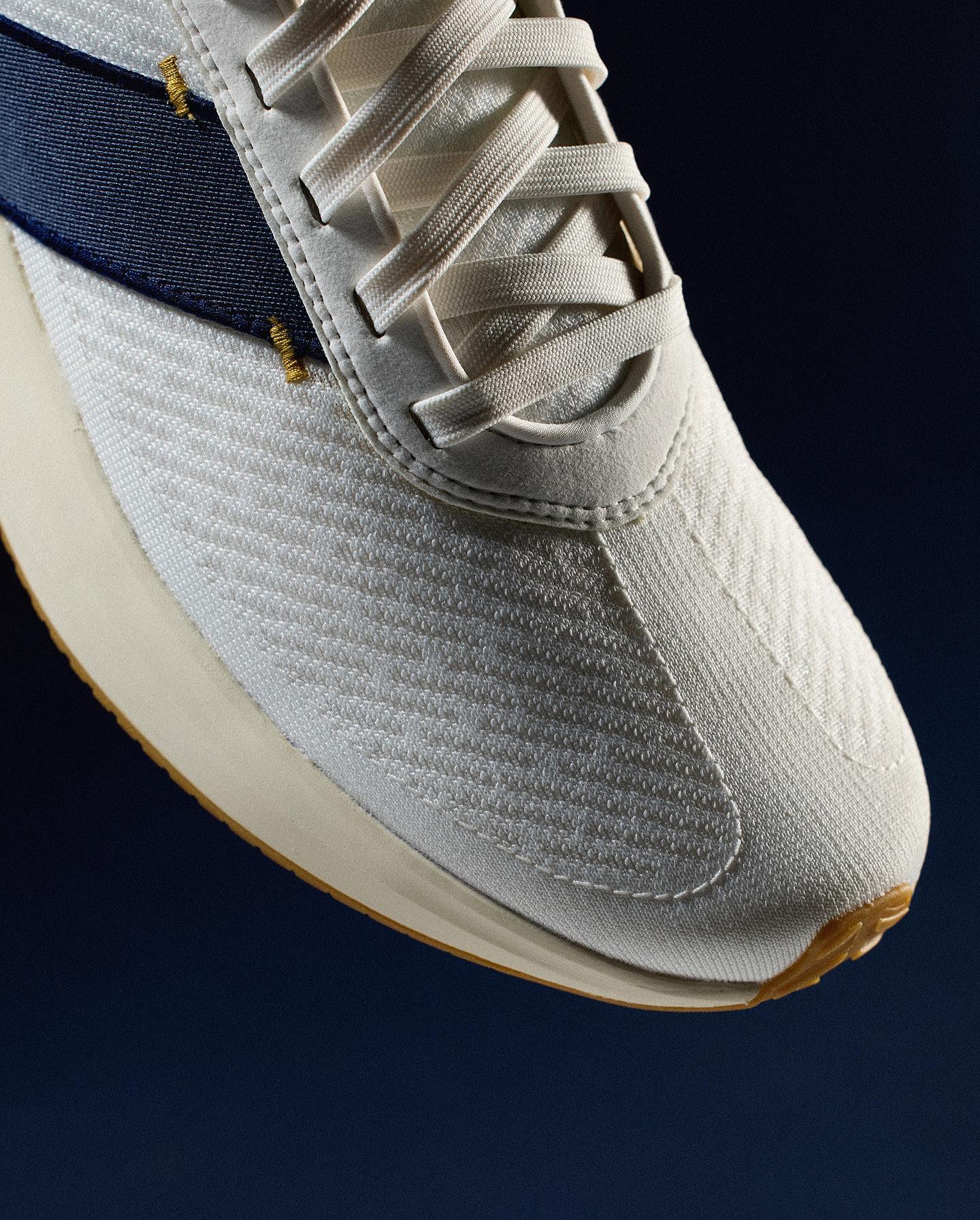
| Upper | Engineered mesh, microsuede collar and eyestay, woven sash |
| Outsole | Full-coverage gum rubber |
| Release | December 2022 |
| Category | Daily trainer / lifestyle crossover |
First Impressions: An Unboxing Unlike Any Other in Running
Every Tracksmith Eliot Runner review worth reading begins before the shoe is on your foot — because the unboxing experience is genuinely unlike anything else in the daily trainer category. The shoe arrives in a navy box adorned with Tracksmith’s familiar red and white stripe and the leaping hare logo. Inside that sits a matte navy shoebox. Under the lid, a pastoral sepia-toned image of a rolling road and a gold foil Tracksmith logo. Vanilla-coloured tissue paper crinkles with illustrations matching the embroidered hare from the apparel line. And beneath that, finally, the shoe itself — along with hidden Easter eggs including a poem printed on the underside of the removable insole.
Believe in the Run’s Thomas Neuberger, who has reviewed hundreds of running shoes, noted he had never previously written about a shoe’s packaging — until the Eliot Runner. That says something. Tracksmith has understood from the beginning that the running shoe is not just a performance tool; it is an object, an artefact, an experience. The Eliot Runner delivers on all three counts before a single step has been taken.
Visually, the shoe sits at the intersection of vintage collegiate running and modern menswear — evoking the Nike Killshot, the Adidas Stan Smith, the classic tennis shoe as reimagined for a runner who also wears chinos on the weekend. The ivory/navy colourway is the signature expression, though the range has expanded to seven colourways since launch. The gold stitching on the side and the embroidered Tracksmith hare on the insole are the kind of details that reward close attention. This is, quite simply, a beautiful shoe.
Upper: Refined, Structured, and Slightly Sneaker-Like
The Tracksmith Eliot Runner upper is built from an engineered mesh of moderate thickness — structured without being rigid, breathable without being flimsy. The collar and eyestay are lined with microsuede, and a woven sash runs across the midfoot, providing both the brand’s visual signature and a genuine lockdown function when the laces are tightened. The insole is stitched with a gold Tracksmith logo on navy — a detail that multiple reviewers describe as making them feel, in the words of Believe in the Run, « quite royal. »
The inner construction features a partial bootie that wraps the tongue and front of the shoe, contributing to fit comfort and keeping the tongue in place during runs. Multiple Tracksmith Eliot Runner reviewers describe step-in comfort as immediate and impressive — the thick Pebax sockliner creates a cushioned, almost luxurious first sensation underfoot.
Several consistent criticisms emerge across independent Tracksmith Eliot Runner reviews, however. The heel collar sits lower than most daily trainers — a consequence, reviewers suggest, of the 10mm sockliner elevating the foot higher than the collar was originally designed to accommodate. This can result in a slightly insecure heel feel for some runners, particularly during faster efforts. Lacing all the way to the top eyelet is recommended as a partial solution. The laces themselves are thick and old-school in character — visually appropriate, practically functional, but not ideal for runners who like a heel-lock lacing technique, as the lace length is limiting.
The upper’s visual resemblance to a premium sneaker — noted by virtually every Tracksmith Eliot Runner reviewer — cuts both ways. It makes the shoe strikingly versatile for off-run wear: casual, travel, even light hiking. It also means the white colourway shows dirt immediately and requires post-run cleaning to maintain its appearance. For those who prefer their running shoes to look like running shoes, the Eliot Runner’s refined aesthetic may take adjustment.
One sizing note appears consistently across Tracksmith Eliot Runner reviews and warrants clear emphasis: sizing is variable between pairs. Some testers found their normal size to run long by a full size; others found it snug in the midfoot and toe box. Doctors of Running’s Nathan Brown tested two pairs in different colourways and found them to fit quite differently. Tracksmith’s 30-day / 100-mile return policy exists partly to address this — take advantage of it.
Midsole: Dual-Density Pebax, Firmly Calibrated
The Tracksmith Eliot Runner midsole is the shoe’s most technically distinctive feature — and the source of its most divided opinion. The construction is dual-density: a firmer standard Pebax base layer in the midsole, topped by a removable 10mm sockliner made from supercritical Pebax. The combination delivers a total stack of 33.5mm at the heel and 24.5mm at the forefoot, with a 9mm drop.
The critical point — emphasised in the Doctors of Running Tracksmith Eliot Runner review with admirable technical clarity — is that not all Pebax is the same. The foam’s properties depend entirely on how it is processed: compliance (how much it compresses under load) and resilience (how completely it returns to its original form) vary significantly between applications. The Pebax in the Eliot Runner is considerably firmer and less compliant than the supercritical foam found in race shoes like the Nike Vaporfly or Saucony Endorphin Pro. Runners expecting a bouncy, explosive, racing-shoe sensation will be disappointed. Those who approach the shoe as a quality daily trainer with responsive Pebax — rather than a race-day foam in training-shoe clothing — will find the ride well-calibrated and genuinely enjoyable.
The ride character that emerges from this construction is consistent across Tracksmith Eliot Runner reviews: balanced, moderately cushioned, responsive without being aggressive, and firmly grounded. The shoe rewards a calm, controlled cadence — it does not rock you forward or propel you through transitions. The forefoot is flat and flexible rather than rockered, providing good ground feel and natural propulsion at everyday training paces. At faster speeds — intervals and sustained tempo efforts — the Pebax responds adequately, but the shoe lacks the propulsive snap of dedicated uptempo trainers.
Meta Endurance’s Tim describes it this way: not the best daily trainer, not the best endurance shoe, not the best tempo shoe — but if forced to pick one shoe for all three purposes, this would be it. That is an honest and useful summary of the Eliot Runner’s performance identity: a genuinely versatile trainer that excels at nothing specific while handling everything competently. The sweet spot is runs of three to ten miles at easy to moderate pace. For longer efforts above eight miles, most Tracksmith Eliot Runner reviewers prefer a softer, more cushioned platform.
Outsole: Gum Rubber, Full Coverage, Built to Last
The Eliot Runner outsole is full-coverage gum rubber — covering approximately 90% of the midsole surface, one of the highest coverage ratios in the daily trainer category. Every Tracksmith Eliot Runner review that addresses the outsole notes the same things: excellent grip on road and light trail surfaces, reliable traction in wet conditions, and durability that substantially exceeds most trainers at this price point. After 150 miles of running use combined with months of casual wear, testers report the outsole holding up well with only localised wear appearing at the lateral heel.
The gum rubber also contributes to the shoe’s versatility off-road. Multiple reviewers report taking the Eliot Runner on bark trails, light gravel, mountain paths, and beach surfaces without issue. For a shoe marketed primarily as a road trainer, this breadth of surface capability is a genuine bonus. The trade-off — a slightly damped, « slappy » feel at the forefoot for midfoot strikers on hard surfaces — is noted by some testers, though it does not appear to be a universal experience.
The $198 Question: Is the Tracksmith Eliot Runner Worth It?
Every Tracksmith Eliot Runner review eventually arrives at this question, and none of them answer it the same way — because the answer depends on what you are buying. If you are optimising purely for performance per dollar, the answer is no. At $198, the Eliot Runner is $40–70 more expensive than directly comparable daily trainers from Saucony, Nike, ASICS, and New Balance. Those shoes match or exceed it for cushioning, energy return, and fit consistency.
But that framing misses the point of the Eliot Runner, as Believe in the Run’s Robbe Reddinger articulates with characteristic directness: « That’s not what you’re paying for in this shoe, anyway. » What you are paying for is premium Pebax foam in a daily trainer (a material typically reserved for racing shoes), exceptional build quality and material finishing, an unboxing experience with no peer in the category, a shoe that transitions seamlessly from morning run to afternoon errands, and membership — implicitly — in the Tracksmith Running Class.
Run Oregon’s Matt Rasmussen, who has taken the Eliot Runner on multiple holidays as his sole travel shoe, describes it as perhaps the best crossover running-and-casual shoe on the market for that purpose. RunToTheFinish’s Amanda Brooks notes the 30-day/100-mile return policy as a meaningful commitment from a brand that knows its shoe will need to be worn to be understood. These are the practical arguments for the Eliot Runner’s price. The aesthetic argument — that it is, quite simply, the best-looking daily trainer money can buy — stands on its own.
The Eliot Runner sits alongside the Eliot Racer as part of a small but considered Tracksmith footwear range that brings the same philosophy to shoes that the brand has always applied to kit: fewer pieces, better materials, longer life, stronger identity. For runners who already wear Tracksmith apparel, the Eliot Runner is a natural extension of that commitment. For runners encountering the brand through footwear for the first time, it is as good an introduction as exists.
Who Should Buy the Tracksmith Eliot Runner?
Based on the full synthesis of Tracksmith Eliot Runner reviews consulted for this article, the shoe is best suited to a specific runner profile. You should seriously consider the Eliot Runner if you want a daily trainer that doubles convincingly as casual footwear; if you run three to ten miles at easy to moderate pace several times per week; if you appreciate premium materials and considered design and are willing to pay for them; and if the Tracksmith aesthetic — understated, collegiate, quietly serious — resonates with how you see yourself as a runner.
You should look elsewhere if you need maximum cushioning for long efforts above ten miles; if you have a wide foot or need a generous toe box; if you prioritise energy return and propulsion over feel and ground contact; or if the price point is simply incompatible with your running budget, however understandable that is.
Our Take
The Tracksmith Eliot Runner is not a revolution in daily training footwear. It is not trying to be. What it is — and what it succeeds at being — is the most considered, most beautifully finished, most aesthetically coherent daily trainer available at any price. The dual-density Pebax platform delivers a ride that is genuinely enjoyable across a wide range of everyday training paces. The full-coverage gum rubber outsole provides durability and versatility that justify the investment over hundreds of miles. And the whole package — from the navy box to the gold-stitched insole — reflects a brand that takes running as seriously as it takes craft.
Sort out your sizing carefully, keep the laces long enough for a heel lock, and accept that the white colourway will need cleaning. Do those things, and the Tracksmith Eliot Runner will reward you with one of the most distinctive and satisfying daily training experiences available — on the run, and everywhere after it.
Explore the full Tracksmith footwear range, including the Eliot Runner, at tracksmith.com.
Tracksmith Eliot Runner — Frequently Asked Questions
Is the Tracksmith Eliot Runner good for daily training?
Yes, within a specific range. The Eliot Runner performs well for easy to moderate efforts of three to ten miles. Its dual-density Pebax platform — a firmer base layer topped by a 10mm supercritical Pebax sockliner — delivers a balanced, responsive ride that handles most everyday training paces comfortably. It is less well-suited to runs above eight to ten miles, where a softer, higher-cushioned platform becomes preferable, and it lacks the propulsive snap of dedicated uptempo trainers for interval work.
How does the Tracksmith Eliot Runner fit?
Sizing on the Eliot Runner has been inconsistent across production batches — a recurring observation in multiple independent Tracksmith Eliot Runner reviews. Some runners find their normal size runs long by a full size; others find the midfoot and toe box snug. The toe box tends toward narrow to medium width, making the shoe less suitable for wider feet. Tracksmith’s 30-day / 100-mile return policy is specifically designed to address this uncertainty — use it. When the fit is right, the upper wraps the foot well with good lockdown and no hot spots.
Can the Tracksmith Eliot Runner be worn as a casual shoe?
Absolutely — and this is one of the Eliot Runner’s strongest practical arguments. Multiple reviewers describe it as the best running-to-casual crossover shoe currently available. Its sneaker-inspired silhouette, muted colourways, and premium materials make it equally at home with chinos, shorts, or casual trousers as with running kit. Several reviewers travel exclusively with the Eliot Runner as their sole footwear, using it for both runs and daily sightseeing. The ivory/navy colourway does require cleaning after muddy runs to maintain its appearance.
Is the Tracksmith Eliot Runner worth $198?
It depends on what you value. On pure performance-per-dollar terms, comparable daily trainers from mainstream brands cost $40–70 less and match or exceed the Eliot Runner’s running performance. The premium reflects Tracksmith’s use of Pebax foam (unusual in daily trainers), small-batch manufacturing, premium materials throughout, and the brand’s design philosophy. For runners who value aesthetics, build quality, and off-run versatility — and who already identify with the Tracksmith brand — the price is justifiable. For runners optimising purely for training performance, it is harder to defend.
How does the Tracksmith Eliot Runner compare to the Eliot Racer?
The two shoes share aesthetic DNA — the same restrained colourways, the woven sash, the premium materials — but serve very different purposes. The Eliot Racer is a full carbon-plated super shoe with a 38mm stack and race-day ambitions, priced at $280. The Eliot Runner is a daily trainer with a 33.5mm stack, a firmer and more traditional ride character, and a stronger case for casual crossover use. The Runner is the shoe you train in day after day; the Racer is the shoe you reach for on race morning.