hill.camp does not conduct first-hand product testing. This article is a synthesis of independent field tests, specialist press, and verified consumer feedback gathered from multiple sources.
Some brands enter a market. Others create one. GU Energy belongs firmly to the second category. In 1993, in Berkeley, California, a biochemist mixed up a homemade energy formula for his ultrarunner daughter. The result — a dense, easy-to-swallow paste formulated for rapid absorption — would become the world’s first energy gel. Thirty years later, GU remains one of the global reference points in endurance sports nutrition.
But reputation alone is no longer enough. The sports nutrition market has exploded. Brands like Maurten, Näak, and Overstims are disrupting the space. Prices have climbed. So have athlete expectations. So in 2026, is GU Energy still a safe bet — or simply a brand coasting on its own history? Here is our Gu Energy review.
A Californian story born on the trails
It starts with Bill Vaughan, a biochemist and father of an ultra runner. In 1993, he formulated an energy concentrate in his kitchen, designed to replace bars that were hard to chew and drinks that were too bulky to carry. The gel — peanut-butter consistency, 100-calorie payload — was a revolution in format as much as in formula.
GU Energy Labs set up in Berkeley and built its reputation within the North American trail and triathlon communities. The brand was acquired in 2020 by Reinhold Schmieding, founder of Arthrex, but has kept its Californian roots and its founding philosophy: products designed by and for serious endurance athletes.
Today, the range covers three main segments: energy gels (Energy Gel and Roctane), drinks (Hydration Drink Tabs and Roctane Energy Drink Mix), and chewable gummies (Energy Chews). A complete proposition, built to cover every effort format.
GU gels: the core of the brand
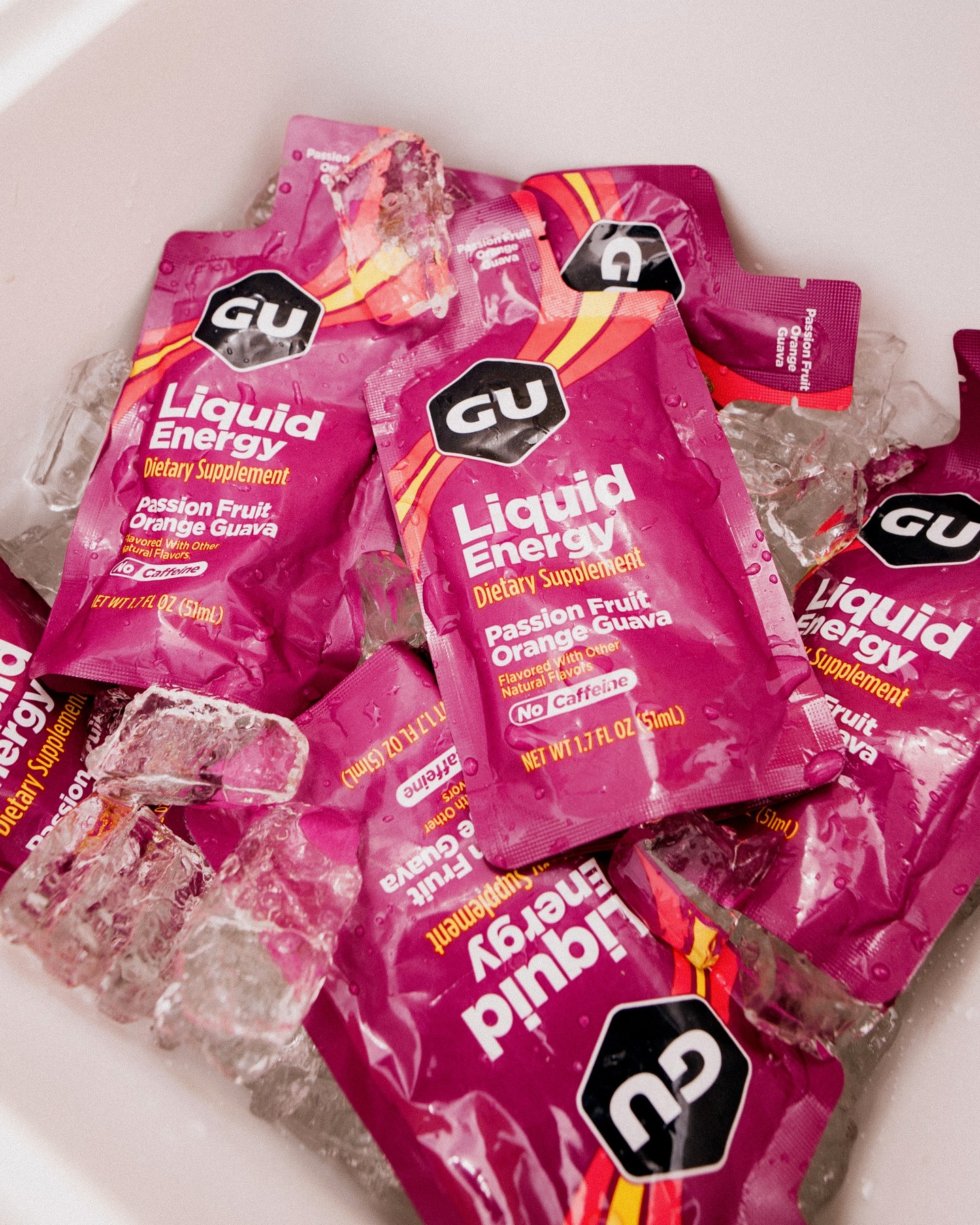
The GU Energy Gel remains the flagship product. Each 32 g packet delivers 100 kcal, with a mixed carbohydrate profile (maltodextrin + fructose) that supports progressive absorption. The formula systematically includes amino acids (leucine, valine, isoleucine), electrolytes, and antioxidants (vitamins C and E). Sodium sits at 40–55 mg per gel — modest, but coherent for a short-format fuelling hit.
What has distinguished GU since the beginning is the attention paid to flavour. Over twenty options are available, including several with no equivalent in competing ranges: salted caramel, chocolate peanut butter, salted watermelon. The texture is thick — more so than SIS or Maurten — which can put off sensitive stomachs but works well for lower-intensity efforts or cold conditions.
The Roctane line steps things up. Designed for long efforts — ultra, Ironman, multi-hour gravel rides — it doubles the BCAA dose, adds taurine and optional caffeine, and increases electrolyte density. Sports dietitian Nicolas Aubineau’s March 2026 comparative review of 46 energy products recognises Roctane gels as a solid solution for ultra-endurance, particularly for their BCAA content — an ingredient that is often absent from competing formulas.
The optional caffeine (40 mg in selected gels) is a genuine asset: it allows athletes to build a modulated race-day strategy without relying on a single stimulant source throughout the effort.
The drinks: two very different logics
GU offers two drink formats, each responding to a distinct need.
The Hydration Drink Tabs are effervescent tablets dissolved in 500 mL of water — one tablet per bottle. Ultra-compact in format, they fit in a vest pocket or race belt. Their purpose is hydration and electrolyte replenishment (sodium, potassium), not caloric intake. For runners who prefer to drink light and take their calories via gels or solids, it is a practical and well-conceived solution. The taste is subtle and refreshing — which is not always the case with classic isotonic drinks.
The Roctane Energy Drink Mix, on the other hand, is a fully caloric drink: up to 240 kcal per 500 mL bottle, with BCAAs, complete electrolytes, and optional caffeine. It is designed for very long efforts where swallowing gels every 30 minutes becomes difficult. Its weak point: the price per kg is high, and the sweetness can become oppressive after several hours. French alternatives such as Apurna or Mulebar offer very well-dosed formulas at more competitive price points on this segment.
Energy Chews: the solid-food alternative
GU Energy Chews are an original proposition in a market dominated by gels and bars. They are chewable gummies — four per 30 g packet, around 90 kcal — that incorporate the same active ingredients as the gels (electrolytes, amino acids, optional caffeine). The texture is closer to a firm fruit paste that melts in the mouth.
The benefits are twofold. First, the act of chewing stimulates the salivary glands and can aid digestion during prolonged efforts. Second, they are a genuine alternative for runners who hit gel fatigue after several hours on course. On an ultra or a very long gravel ride, varying fuel formats is a strategy widely recommended by sports nutritionists. The Chews fit that logic precisely.
Our guide to trail running nutrition and hydration covers in depth the importance of diversifying energy sources to avoid flavour fatigue — the Chews answer exactly that need.
What GU does well — and what it gets wrong
GU has built its reputation on three solid foundations: flavour diversity, systematic BCAA inclusion in the Roctane line, and the practicality of its formats. For a runner looking to build a complete nutritional strategy with a single brand — short-effort gel, electrolyte drink, caloric drink, solid food — GU covers the full spectrum.
But there are blind spots. The sodium content per gel (40–55 mg) remains low relative to sports nutrition guidelines, which recommend a minimum of 300 mg of sodium per hour of effort. GU expects that shortfall to be covered by the drink or tabs — but that requires a level of dietary discipline that many runners simply do not apply in practice. The thick gel texture is another dividing factor: effective in moderate conditions, it can become hard to swallow in heat or at high intensity.
On pricing, GU sits at the higher end of the market. An Energy Gel costs around €2.20, a Roctane around €3.20, a tube of 12 electrolyte tabs around €9. Against well-dosed alternatives available at similar or lower price points, the value equation does not always favour the American brand.
A further criticism: transparency on ingredient dosing is not always exemplary. While macros are clearly stated, certain micronutrients (taurine, amino acids) are not always precisely quantified on packaging — making rigorous comparison with more transparent brands more difficult than it should be.
GU Energy vs the competition in 2026
The endurance nutrition market has never been more competitive. Maurten has set a new benchmark with its hydrogel technology and minimalist ingredient list. Näak is pushing insect protein and a more natural composition. French brands like Apurna and Mulebar are consistently topping quality-to-price comparatives from independent specialists.
Within this context, GU remains relevant for several distinct profiles. The ultrarunner chasing BCAAs: the Roctane line is one of the rare ranges to integrate a serious amino acid dose directly into the gels, which can make a real difference over a 24-hour effort. The runner who needs flavour variety: with over twenty options, GU offers a palette that few brands can match — on a long ultra, gustatory diversity is a genuine mental asset. The triathlete or long-distance cyclist: the compact tab format works perfectly in bike bottles and on-the-move refuelling, where powder-based drinks are cumbersome.
For those thinking carefully about hydration management during effort, the Tabs deserve a place in any serious strategy. And for runners looking for the right footwear to pair with a dialled-in nutrition plan, our guide to the best trail running shoes of 2026 covers every terrain and distance.
For runners targeting half marathon to marathon distances and prioritising value, European alternatives will often outperform GU on pure nutritional quality at an equivalent or lower cost.
Our verdict
GU Energy is not a brand coasting on its legacy. The range is coherent, the formulas are serious, and the Roctane line remains a reference point for ultra-endurance nutrition. But the brand has aged in a market that has matured around it. Dosing transparency could be better. The value proposition is being challenged by newer competitors. And the thick gel texture is a genuine selection criterion — one that must be tested in training, not discovered on race day.
Our recommendation: if you are racing efforts longer than six hours and want a complete single-brand system with integrated BCAAs and enough flavour variety to go the distance, GU Energy earns its place in your race-day toolkit. For shorter efforts, compare the local alternatives first — you may be surprised by what you find.
What is the difference between a GU Energy Gel and a GU Roctane Gel?
The Energy Gel is the standard format: 100 kcal, basic amino acids, light electrolytes. The Roctane is designed for long, intense efforts: it doubles the BCAA dose, adds taurine, increases electrolyte density, and always includes an optional caffeine version. It costs more (around €3.20 vs €2.20) but is well justified for ultra-endurance contexts.
Are GU Energy gels gluten-free?
Yes. The entire GU Energy range is certified gluten-free, making it a viable option for runners with coeliac disease or gluten intolerance.
How often should you take a GU gel during a race?
The standard recommendation is one gel every 45 minutes to one hour, taken with around 150–200 mL of water. On very long efforts, alternating between gels, Chews, and caloric drinks helps avoid flavour fatigue and supports better fluid management throughout the race.
Do GU Hydration Tabs replace a classic energy drink?
No. The Hydration Drink Tabs are electrolyte drinks, not energy drinks: they replace mineral losses but do not provide meaningful calories. They should be paired with gels or solid food to cover energy needs during effort.
Is GU Energy worth the price compared to French brands?
On pure nutritional quality, brands like Apurna, Mulebar, and Baouw offer very well-dosed formulas at comparable or lower prices. GU justifies itself primarily through flavour diversity, the BCAA content of its Roctane line, and international availability — a real advantage for athletes who travel frequently for races.
For the full picture on fuelling your long efforts, read our complete guide to trail running nutrition and hydration. And explore the full GU range on the official GU Energy website.