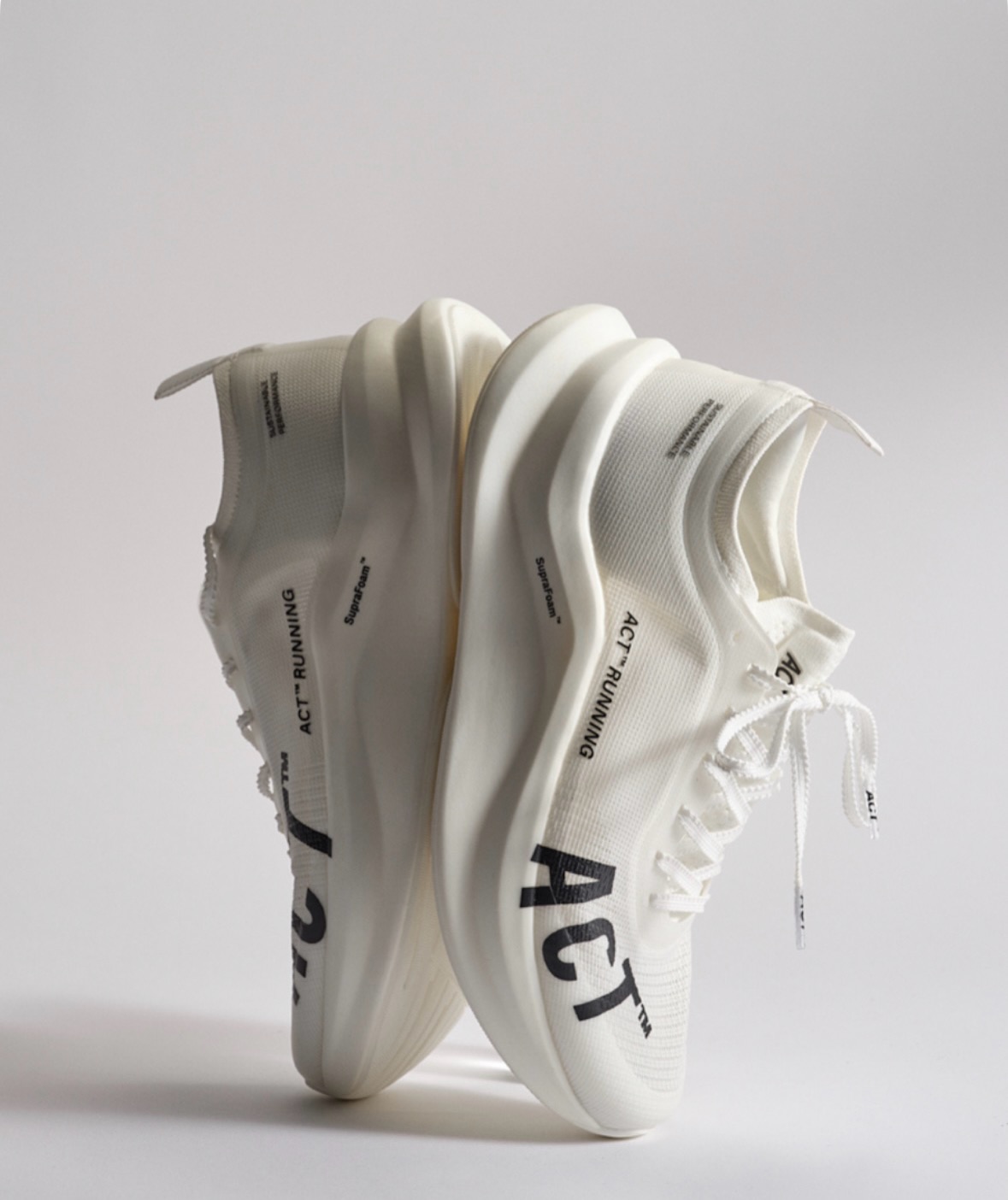
hill.camp does not test products first-hand. This review is a structured synthesis of 3 independent sources — specialist running-gear field tests, both written and video, from reviewers who put real miles on the shoe — assembled with AI assistance and edited before publication. All sources were fully accessible at the time of writing.
| Official name | C.1 (also written C1 by some retailers and reviewers) |
| Weight | 243g / 8.6oz (US M8.5) to 270g / 9.5oz (US M10), scaling with size; 225g / 8oz (US W7.5) |
| Stack height | Listed as 34mm heel / 30mm forefoot; one tester measured 37mm / 33mm on his own pair |
| Drop | 4mm (multiple testers describe the ride as feeling closer to 4–6mm) |
| Best for | Daily training, with enough range for moderate tempo work |
| Key materials | SupraFoam midsole (EVA/PEBA/TPEE blend, nitrogen-infused), BioFlite bootie-construction upper, sawtooth laces with Lace Lock eyelets |
| Outsole | Described as a durable rubber compound by two testers; a third identifies it specifically as a CPU (polyurethane) compound |
| Carbon footprint | 3.62kg CO2 — about 14% below a conventional running shoe, per the brand’s own figures |
| Price | $202–207 (US) / €150 (EU) |
The Pitch: Two Materials Worth Actually Explaining
This Act C1 review starts where the brand’s own pitch does. The C.1 is Act Running’s first running shoe, and it leans on two proprietary materials rather than borrowed off-the-shelf components. SupraFoam is a nitrogen-infused supercritical foam — an EVA/PEBA/TPEE blend, per one tester who broke down the compound — produced without toxic finishing agents, solvents, or water, and reportedly without residual carbon-gas emissions at the end of production. BioFlite, the upper, traces back to the same castor bean-oil chemistry the brand uses across its BioFlex and BioPerf apparel lines: a renewable feedstock that grows on marginal land without competing with food crops. The brand’s reported carbon output for the shoe — 3.62kg of CO2, roughly 14% below a conventional running shoe — is a specific number rather than a vague claim, and it’s stamped directly onto the heel of the shoe itself, not just buried in marketing copy.
Sizing and Fit: A Narrow Toe Box That Splits Opinion
All three testers agree on the shape: narrow through the toe box, with a bootie-style knit tongue and no traditional overlapping tongue construction. Where they diverge is on how much that matters. One tester found the toe box tight enough, paired with a comparatively loose heel, that it took 18 to 20 miles for the upper to relax and feel right. A second tester — sizing true to length — had no real complaints beyond a bit of bunching near the eyelets, caused by a semi-rigid lining meant to lock the Lace Lock system in place; he suggests a squared-off eyelet construction would fix it. A third tester, sizing a half-size up per the brand’s own on-site recommendation, found the fit close to ideal: voluminous enough in the toe box without feeling sloppy, and forgiving enough for both narrower and moderately wider feet. The throughline: try the C.1 with the brand’s suggested half-size-up guidance in mind, and expect the upper to need a handful of runs to fully settle.
The Ride: Firmer Than the Spec Sheet Suggests, But Adaptable
Descriptions of the ride vary more by running style than by disagreement. One tester found the ground feel firmer and harder than expected out of the box, only smoothing out after real mileage. A second, framing the C.1 against category peers like the Adidas Evo SL and Saucony Endorphin Speed, described the geometry and rocker as suited to moderate zone-3 efforts rather than true easy running or all-out speed work, while still being comfortable enough to slow down in in when needed. A third — running everything from recovery paces to sub-8:00 efforts in the same pair — echoed the brand’s own on-site description of the foam almost word for word: soft impact absorption with controlled rebound, better suited to distance and moderate paces than a high-rebound race feel. Across all three accounts, the SupraFoam midsole reads as dense and absorptive rather than bouncy — a deliberate choice, not an accident of the bio-based compound, and one that held up better than sustainability-focused foams typically have.
Where the Details Diverge
This is where the three tests genuinely disagree, and it’s worth surfacing rather than picking a side. One tester’s pair measured 37mm/33mm at the heel and forefoot — three millimeters over the brand’s listed 34mm/30mm spec — which is a large enough gap to matter for anyone shoe-shopping by stack height alone. On the outsole, two testers describe simple durable rubber with no unusual wear after 30-plus miles; the third identifies the compound specifically as a CPU (cast polyurethane) outsole, the same category of material Mount to Coast uses on its R1 and H1 models, and ties it directly to Act’s durability and lifecycle goals. And on the small hardware — laces, tongue, pull tab — reactions split hardest: one tester had a sawtooth lace come undone mid-run and called the tongue and pull tab flimsy; the other two reported no lacing failures and were, if anything, positive about the bootie tongue and heel lockdown, with one flagging only that the material felt thin (likely a sustainability trade-off) without it causing actual lace bite or discomfort.
The Price Problem
At $202–207 in the US, depending on the source, the C.1 sits well above the $150–160 range of the daily-trainer/supercritical-foam category it’s most often compared to — the Evo SL and Endorphin Speed/Azura, specifically — without the plate or dual-density construction that usually justifies a jump into true « super trainer » pricing (Superblast, Megablast, and similar). One tester pegged a fairer price closer to $170 for a debut shoe from an unproven brand. The European price of €150 makes the US figure look worse still on a straight conversion. All three testers raised the price unprompted, which is a stronger signal than any one of them raising it alone — this is the C.1’s most consistent criticism across otherwise varied reviews.
How It Stacks Up
The C.1 invites comparison whether Act wants it or not: the name and the minimal, Helvetica-adjacent branding echo Mount to Coast’s own C1 closely enough that testers raise it independently of each other. On the road, the two ride differently — Mount to Coast’s version runs firmer and more energetic thanks to a rubberized EVA heel, while Act’s C.1 leans softer and more purely absorptive. Against category peers like the Evo SL and Endorphin Speed, the C.1 gives up some outright pop in exchange for a more distance-friendly, controlled ride. Testers also brought up a dual-layer PEBA shoe (lighter and bouncier, but with a worse-fitting upper) and the On Cloudmonster 3 Hyper (a taller, firmer-riding shoe despite a similar nominal drop) as useful reference points, and one tester name-checked Hylo as the other bio-based running shoe brand worth watching alongside Act as the category matures.
Our Take
Three independent testers landed in a similar place: the C.1 is a genuinely strong debut shoe with a real, well-explained sustainability case, undercut mainly by its price and by inconsistent quality control on small components. The SupraFoam midsole outperforms what bio-based foams have historically delivered, the BioFlite upper’s sourcing claims hold up, and the carbon numbers are specific rather than vague. But the measured-vs-listed stack height gap, the split experience with the laces and tongue, and a price that sits above its closest performance peers are all real friction points a first-time buyer should go in expecting. Worth trying if the sustainability story matters to you and you’re comfortable with a shoe that rewards moderate, controlled paces over speed work; less compelling as a pure value play against established daily trainers at $150–160.
FAQ
Is it called the Act C1 or the C.1?
Act’s own site lists the shoe as the C.1, with a period, which some reviewers believe is a deliberate distinction from Mount to Coast’s similarly named C1. Both spellings circulate in reviews and retail listings.
Does the Act C.1 run true to size?
Reports vary. The brand recommends sizing up a full size from your everyday shoe, and testers who followed that guidance found a comfortable, well-shaped fit; one tester sizing at his normal length found the toe box tight enough to need a genuine break-in period. Following the brand’s own sizing recommendation appears to be the safer starting point.
Is the listed stack height accurate?
Not necessarily. The C.1 is listed at 34mm heel / 30mm forefoot, but one tester who measured his own pair got 37mm / 33mm — a notable three-millimeter gap. Multiple testers independently described the ride as feeling like a slightly higher, softer drop than the spec sheet suggests.
Is the Act C.1 worth the price?
At $202–207 in the US, it’s priced above the daily-trainer/supercritical-foam category it competes with most directly, without the plate or dual-density midsole that usually justifies that jump. All three independent testers flagged the price as the shoe’s main weakness, even while praising the materials and ride.
Full specs, colorways, and current availability for the C.1 are on the brand’s own site at act-running.com.