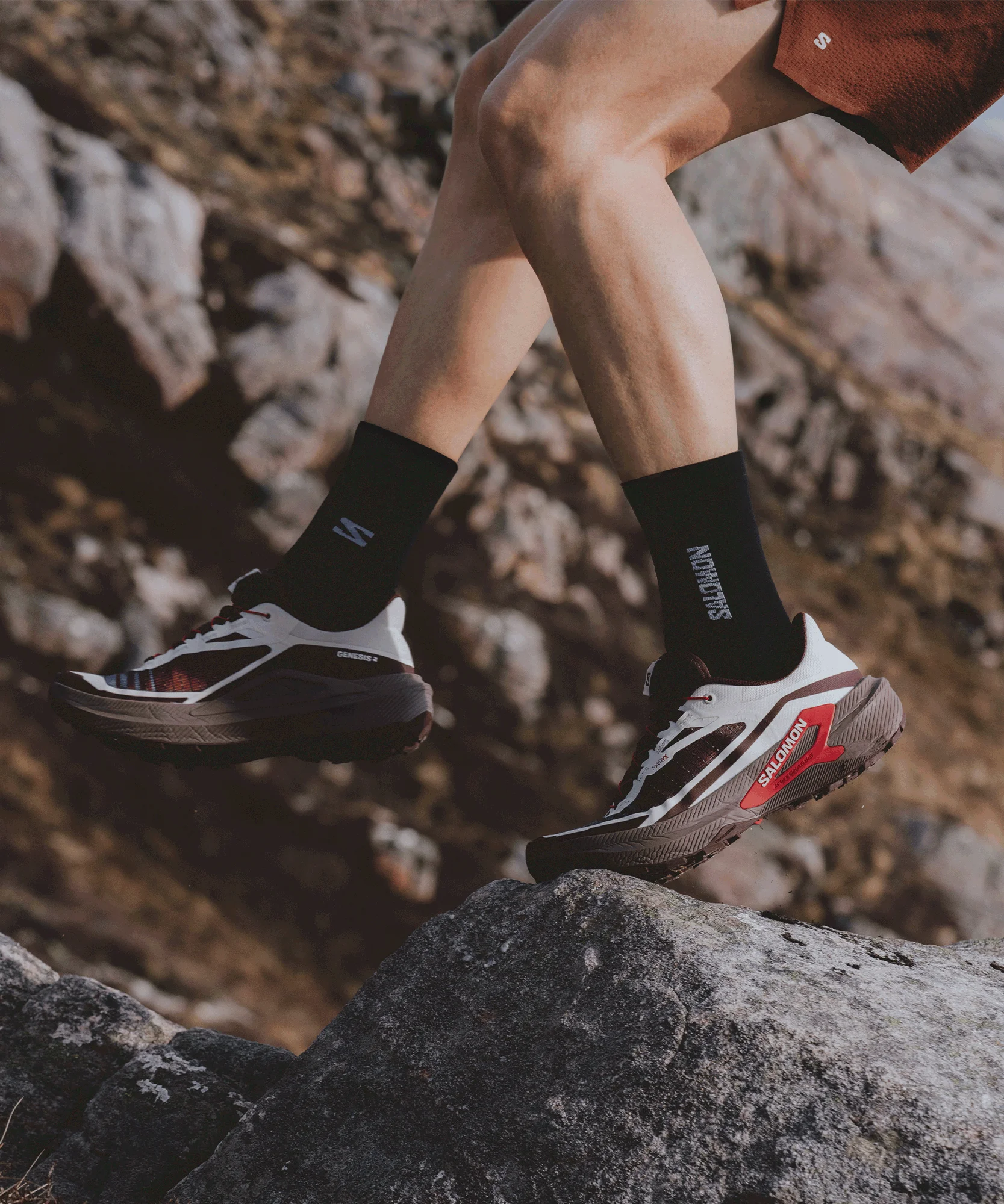
hill.camp does not test products first-hand. This review is a structured synthesis of seven independent sources — a multi-tester field test run by a French mountain retailer, multi-tester long-form reviews from the US trail running press, a 150-mile long-term gear test, a specialist blogger’s review and an owner review from a French gear forum — assembled with AI assistance and edited before publication. Three of the seven cover the S/Lab Genesis 2 sibling rather than the standard shoe; we use them only where we compare the two. Where sources disagree, we say so.
Every few weeks another trail shoe launches with a taller stack, a fancier foam and a carbon plate somewhere inside it. The Salomon Genesis 2 does none of that. It is an 8 mm drop, moderately cushioned, plateless mountain shoe with an EVA midsole and a $150 price tag, and almost every tester in this Salomon Genesis 2 review pool described it in some version of the same words: it knows exactly what it is. Whether that makes it the smartest buy of the season or a shoe that has quietly been overtaken depends on where you run — and on a handful of points where our sources flatly disagree.
Quick Specs
| Price | $150 / €150 |
| Release | 1 August 2026 |
| Weight | 264–312 g per shoe depending on size and source (see below) |
| Stack height | 34 mm heel / 26 mm forefoot (one source lists 33.5 / 25.5 mm) |
| Drop | 8 mm (unchanged from v1) |
| Midsole | optiFOAM EVA blend, no plate |
| Stability | Revised activeCHASSIS, now integrated into the midsole |
| Upper | Matryx woven polyamide with aramid (Kevlar) fibres, endoFit inner sleeve |
| Outsole | All Terrain Contagrip, ~4 mm lugs |
| Lacing | Quicklace with tongue garage |
| Best for | Technical trails, mountain training, short to long days on rough ground |
Where the Genesis 2 Sits in Salomon’s Line-Up
The Genesis family sits in the middle of Salomon’s trail range: below the S/Lab racing tier, above the entry-level models, and off to the technical side of the softer, maximal Ultra Glide 4. Salomon launched the Genesis 2 on 1 August 2026, a few weeks before UTMB week in Chamonix — a timing the French retailer in our pool read as a clear statement that this is meant to be a mountain shoe first. If you want the longer story of how a ski-edge workshop in Annecy ended up defining trail running, our Salomon brand history covers it.
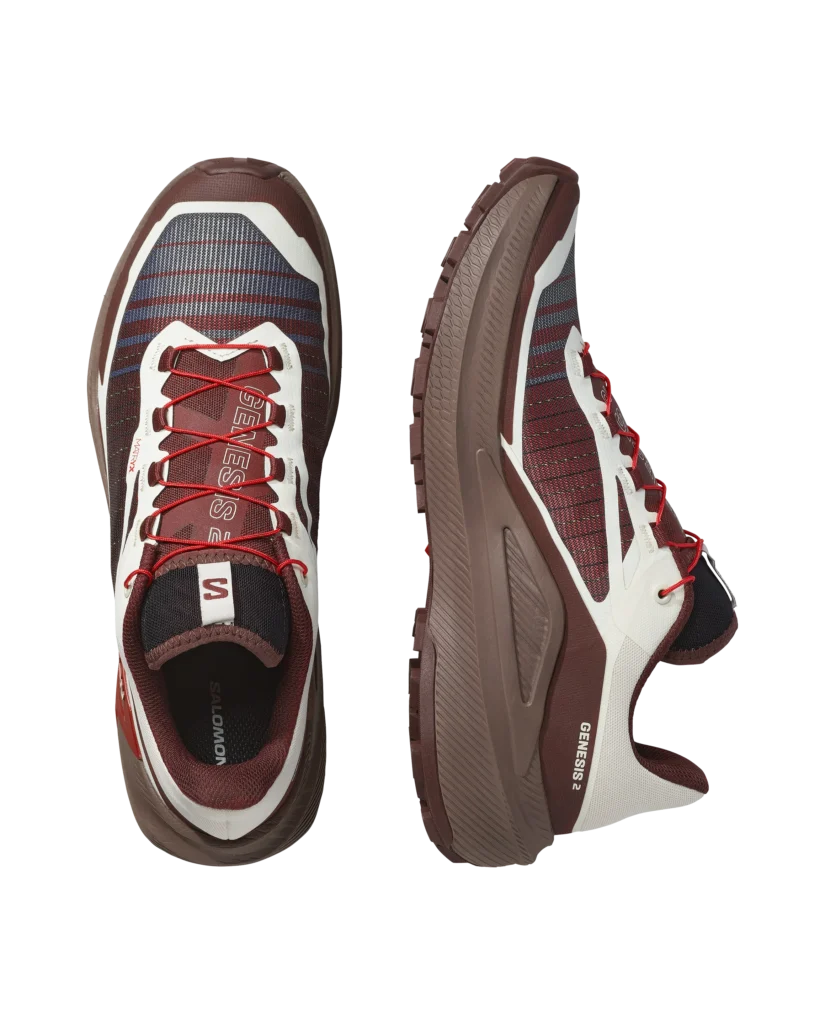
The price matters more than it used to. With premium trail shoes now routinely sitting at $200 and beyond, several US reviewers singled out the $150 tag as the Genesis 2’s most important feature. One Believe in the Run tester admitted she assumed the price was a typo. That framing is worth keeping in mind through the rest of this review: many of the shoe’s limitations are the limitations of a $150 shoe, and its testers judged it accordingly.
What Changed From the Original Genesis
Salomon did not start from a blank page. The changes are incremental, and the testers who knew the first version well all described the Genesis 2 as a refinement rather than a reinvention:
- Platform: RoadTrailRun measured the heel at 93 mm wide versus 90 mm on v1, with the midfoot and forefoot unchanged. Testers felt it as a more planted landing.
- Toe box: slightly more volume up front, according to most US testers (more on why one source disagrees below).
- activeCHASSIS: no longer a bolted-on external piece. RoadTrailRun describes the lateral side as glued in and the medial side molded into the midsole.
- Outsole: a reworked All Terrain Contagrip lug pattern, with broader, more widely spaced lugs mixing chevrons and square blocks.
- Weight: up 21 g in a US 10, per RoadTrailRun’s side-by-side measurement.
That weight gain is the one change nobody celebrated, but nobody called it a dealbreaker either. The prevailing view is that the extra grams bought the stability and durability gains. Which brings us to the weight itself — because our sources cannot agree on it.
How Much Does It Actually Weigh?
Salomon’s spec sheet, as reported by RoadTrailRun, gives 9.6 oz (about 272 g) for a men’s shoe. Real-world numbers spread out around that. Believe in the Run lists 264 g for a US M9. The French retailer quotes 281 g without naming a size. Better Trail weighed a US 9 pair at 1 lb 5.1 oz — roughly 299 g per shoe, against a listed 1 lb 4 oz. RoadTrailRun’s US 10 sample came in at 312 g. Size explains part of the gap, but not all of it: two US 9 measurements sit about 35 g apart. Plan on a shoe in the high-200s for a men’s 9 and treat any single figure with caution.
Traction: All-Terrain, With One Asterisk
Grip is where the strongest praise lands. The retailer’s staff pushed the Genesis 2 through a race at XTrail Courchevel, across wet grassy slopes and rocky ravine descents, and their verdict was blunt: it grips. The same group took it onto the sandstone at Fontainebleau and into rooty forest trails around Chambéry, and came back reporting confident traction both dry and greasy. Believe in the Run’s testers liked it on loose rock and some mud, and Better Trail’s reviewer used it on fourth-class scrambling without complaint.
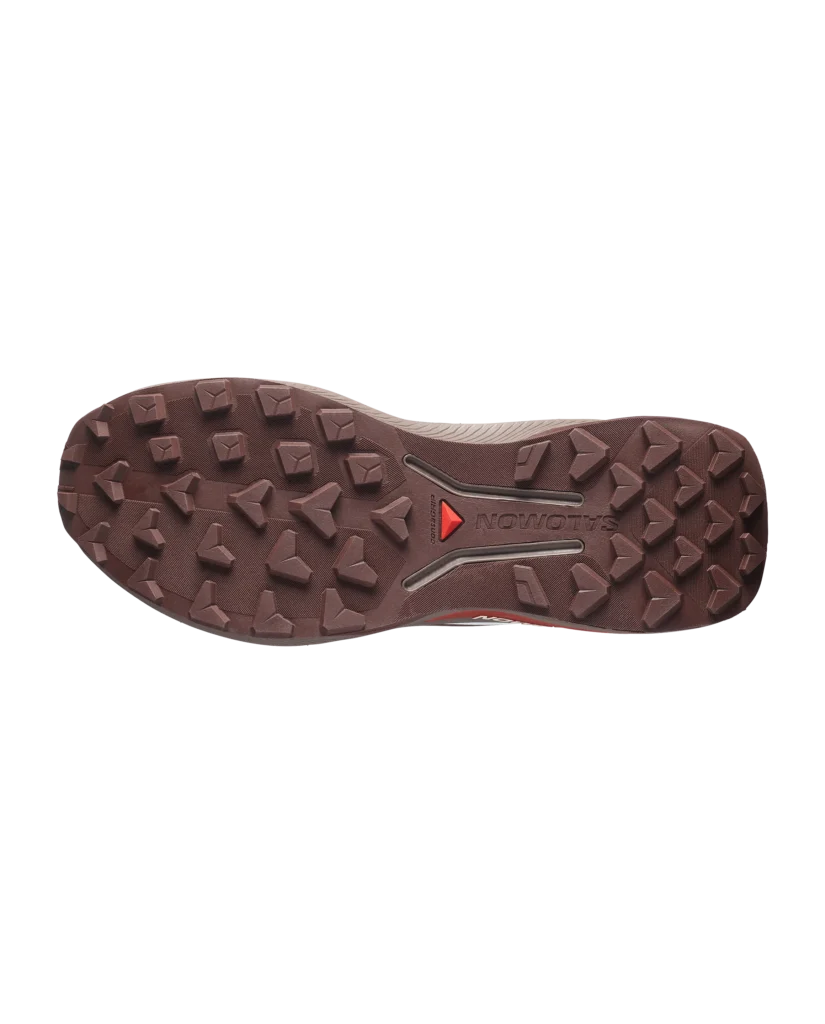
The asterisk is bare rock. Better Trail — the most measured voice in the pool — noted that the Contagrip compound sits at the firm, durable end of the spectrum and lacks the stickiness of a premium Vibram Megagrip on stone. That is the classic trade-off between rubber that lasts and rubber that clings; our explainer on why so many trail shoes use the same yellow Vibram sole goes into why brands make that call. RoadTrailRun’s Jeff Valliere added a second caveat: running straight down the fall line on loose gravel and grass at Breckenridge, he would have liked deeper, sharper lugs, even if the shoe rarely slipped unexpectedly.
So: excellent on mixed, muddy, rooty mountain terrain; good but not class-leading on wet slabs; and, by design, not a mud-specialist with 5 mm-plus lugs. That last point matters if you are comparing it against a Speedcross — our Speedgoat vs Speedcross face-off explains where deep-lug shoes still make sense.
Stability: The One Point Nobody Disputes
If there is a consensus in this review, it is here. Better Trail gave stability its only 5/5 score, reporting zero ankle rolls across talus and loose rock in Idaho’s Sawtooth Mountains and Washington’s Alpine Lakes Wilderness. The retailer’s four testers were unanimous that the shoe stays predictable when the ground deforms underfoot, limiting both forward-back and lateral movement on descents. RoadTrailRun found the integrated chassis helpful not only on technical ground but late in long runs, when form gets sloppy.
Interestingly, the stability does not come from a wide, barge-like base. Better Trail contrasted it with the Brooks Cascadia’s broad platform and found the Genesis 2 quicker and more precise for foot placement. One Believe in the Run tester summed up the feel as stability that works from inside the midsole rather than through bulky overlays. The result, in the retailer’s words, is a shoe that tries to make each footstrike safer rather than each stride more spectacular.
Cushioning and Protection: Where Testers Split
Everyone agrees the optiFOAM midsole is firm. They disagree on what that means for distance and protection, and these disagreements are real enough that we would rather lay them out than average them away.
Is It a Long-Distance Shoe?
Better Trail says no: the Genesis 2 is not built for ultras, and its reviewer would reach for something more cushioned — the Nike ACG Zegama Trail or the S/Lab Genesis 2 — for anything beyond a long day out. Fatigue built up over high miles on sharp terrain. RoadTrailRun takes the opposite position, calling the cushioning appropriate for outings of almost any duration. The French retailer sits in between but with the most concrete data: one tester covered 55 km in the mountains without discomfort, another did 36 km with 2,600 m of climbing in a day.
Our reading: the Genesis 2 can go long if your feet and legs are used to firm, moderate-stack shoes. If you are coming from something like the Hoka Mafate 5, it will feel spartan by hour four.
Underfoot Protection
Here the split is sharper. RoadTrailRun scored rock protection 9/10 and the retailer praised the toe bumper on rocky passages. But Believe in the Run’s John Calabrese — a habitual ultrarunner — said he could feel debris poking through even on fire roads, and warned runners with tender feet. Better Trail independently flagged the absence of a rock plate and the 26 mm forefoot as sources of fatigue on sharp terrain. Note that the praise mostly concerns the toe cap and the overall feel on technical ground; the criticism concerns direct underfoot penetration on long, sharp sections. Both can be true at once.
On the Road
The retailer’s Lyon tester found it less pleasant than the original Genesis on asphalt — firmer, and with an outsole that clearly wants dirt. Calabrese, by contrast, did not mind short road links to reach trailheads. Nobody suggested it as a road-to-trail hybrid, and Salomon has its gravel models for that job.
Responsiveness and Break-In
Opinions on energy return range from neutral to lively. Better Trail scored it 3/5 but admitted the shoe had more life than expected for a basic EVA, helped by a fair amount of rocker. RoadTrailRun called it lively and responsive. Within the retailer’s own team, one tester found it punchy on climbs and relaunches, another found it simply neutral — neither heavy nor springy. One detail only Better Trail reported: the shoe felt stiff and almost hiking-boot-like for the first 10–15 miles before loosening up considerably. If your first runs disappoint, give it time.
Fit: Narrow, or Finally Roomier?
This is the most confusing point in the source pool. RoadTrailRun found the v2 toe box notably wider than v1 and better suited to longer days and foot swell. Believe in the Run agreed it is more accommodating than before while staying secure. Better Trail called the fit wider than typical Salomon, though its tester felt snug and low-volume on the first run. Yet the French retailer’s conclusion lists a fairly narrow forefoot as a drawback.
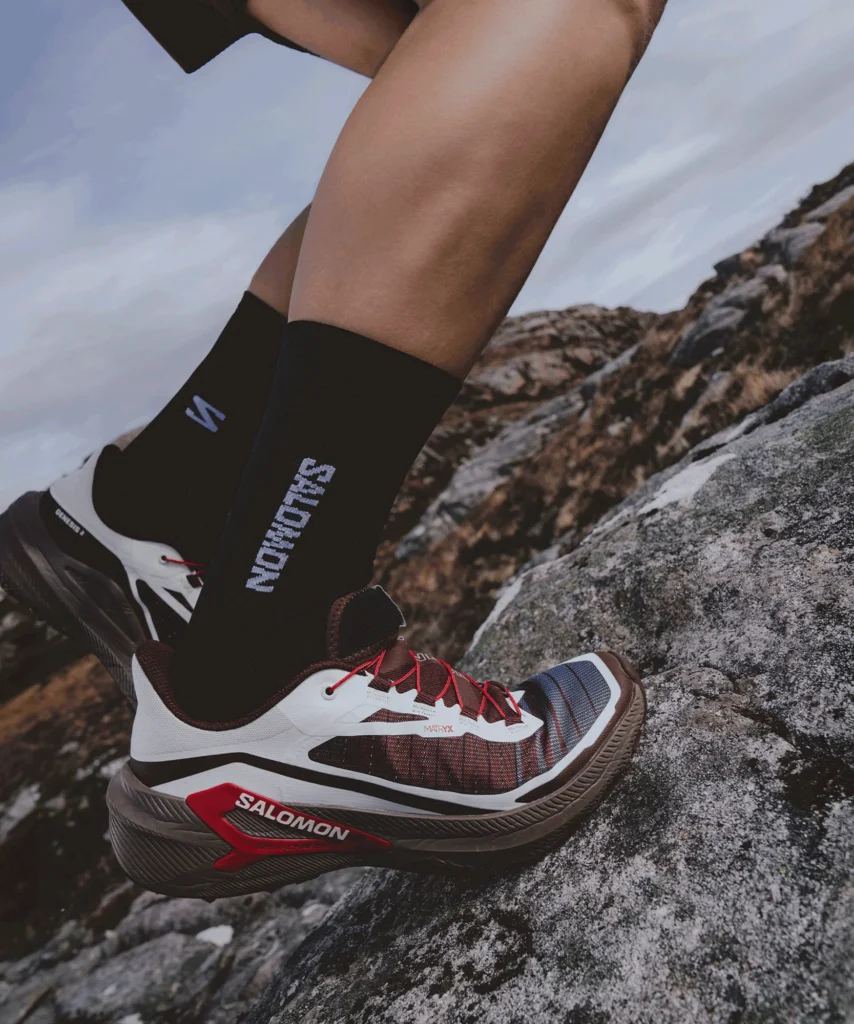
The most plausible explanation is reference point: the US testers compare it against the first Genesis and other Salomons, while the French testers compare it against the wider market. « Wider for a Salomon » is not the same as « wide ». A RoadTrailRun reader also reports that a Wide version exists, which we could not confirm against Salomon’s own range at the time of writing. On sizing, most testers found it true to size; Believe in the Run’s Renee Krusemark recommends going by EU sizing and found she had more length than she wanted, with heel lockdown below what she expects for nimble technical running — the only heel complaint in the pool, against Better Trail’s and RoadTrailRun’s excellent heel hold.
If you have broad feet, try it on. Our guide on how to choose trail running shoes by distance, terrain and runner profile covers what to check in store.
The Quicklace Question
Salomon’s one-pull lacing remains polarising, and the Genesis 2 adds a specific concern. Two of Believe in the Run’s three testers reported laces that looked frayed — one straight out of the box. Neither expected a failure mid-race, but on a shoe sold on durability it is not a great look. Better Trail found the cord did not slide smoothly through every eyelet and occasionally needed manual tweaking. The retailer’s testers liked the system but stressed that it must be properly tensioned before technical descents: too loose and the foot shifts, and one tester wished she could lock the foot down harder on the steepest ground. RoadTrailRun, meanwhile, had no complaints at all.
Our take: if you already know you dislike Quicklace, nothing here will change your mind. If you like it, spend a few seconds dialling it in at the trailhead and keep an eye on lace wear.
Upper, Breathability and Durability
The Matryx upper — a tight weave of polyamide and aramid fibres — is the Genesis 2’s other headline strength. Durability reports are consistent across very different mileages: little to no wear after about 50 rough miles (RoadTrailRun), minimal outsole wear and an upper that looks close to new after 150 miles (Better Trail), and very few signs of wear after around 200 km (the retailer). Better Trail’s prediction is that the EVA midsole will pack out before the outsole or upper are anywhere near finished — a fair expectation for this foam, but one nobody has yet confirmed.
Breathability is more nuanced. The retailer’s testers found the upper airy in summer and noted that after running in rain at Courchevel it did not stay waterlogged and dried quickly. RoadTrailRun described the material as somewhat thick and not particularly airy, but never overheating, even at 27–33°C. Better Trail rated it as breathable as the Cascadia or The North Face Vectiv Enduris. The consensus: not a mesh-like sauna-proof upper, but far from stuffy given how tough it is.
Genesis 2 vs S/Lab Genesis 2: Is the Extra $50 Worth It?
The S/Lab Genesis carries a lot of history. As Trail Runner magazine reminds readers, Courtney Dauwalter won Western States, Hardrock and UTMB in 2023 in the original S/Lab Genesis — an unusually broad demonstration of one shoe’s range. The S/Lab Genesis 2 ($200 / €200) shares the name and the activeCHASSIS concept with the standard model, but several key elements differ:
- Geometry: 31 / 25 mm stack and a 6 mm drop, versus 34 / 26 mm and 8 mm on the Genesis 2.
- Midsole: a dual-density optiFOAM² build with a springier TPU-based compound in the forefoot. Testers consistently found it more responsive than plain EVA.
- Upper: Matryx Micro with coated aramid fibres, plus an integrated gaiter-style collar and profeelFILM underfoot protection.
- Outsole: 4.5 mm lugs, and a wider platform Salomon credits with 23% more ground contact.
Testers love it — Alastair Dixon called it his favourite technical trail shoe, refined, and a French forum owner felt the extra cushioning made it a genuine technical ultra shoe. Fit is again disputed: Trail Runner found the toe box quite roomy and the shoe running slightly large, while the forum reviewer and Alastair describe a precise fit for narrow to medium feet. Wet rock remains the historic question mark for the S/Lab line, and none of these sources could yet confirm whether the new lug geometry fixes it.
One more detail worth knowing: Salomon deliberately keeps its S/Lab trail racers plateless. Trail Runner points to a small, brand-funded 2024 study by two Salomon researchers suggesting carbon plates gave no metabolic benefit on flat trails and cost around 2% more energy uphill. A brand-funded study is not the last word, but it fits the wider debate in our analysis of whether carbon plate trail shoes actually work off-road.
So who should pay the extra $50? Trail Runner’s view — that most intermediate and advanced runners would feel the upgrade — is reasonable. Better Trail’s reviewer would also choose the S/Lab for longer efforts. But if you value durability, an 8 mm drop and a forgiving daily trainer over racing pop, the standard Genesis 2 is the more rational purchase. Believe in the Run’s Renee Krusemark adds a practical tip: the first-generation S/Lab Genesis has been discounted to the same $150, and she would pick it for a bit more padding.
How It Stacks Up Against Its Rivals
RoadTrailRun’s comparisons place it clearly. The La Sportiva Prodigio 2 is about 21 g lighter, more responsive and grips better — though one RoadTrailRun reader reported poor wet-rock grip on its red FriXion rubber, and found the Genesis more nimble in rocky alpine sections (if the brand interests you, see our La Sportiva brand profile). The Saucony Peregrine 16 is slightly lighter, $5 cheaper and a touch grippier in loose conditions. The Salomon Ultra Glide 4 is the plusher choice for long, less technical days.
Better Trail adds two useful benchmarks. The Topo MTN Racer 4 sits even closer to the ground with a wider toe box and Vibram rubber, but the Genesis 2 is the more forgiving one-shoe solution. The North Face Vectiv Enduris 4 brings a nitrogen-infused TPU midsole and a plate for more pop, at a higher price. For runners wanting more cushion and a softer ride in a technical package, the Nike ACG Zegama Trail is the comparison Better Trail itself reached for. And if you want broader options, our roundup of the best trail running shoes in 2026 covers the field.
Our Take
The Salomon Genesis 2 is the trail shoe for people who are tired of trail shoes trying to be road super-shoes. Its stability is the best-documented quality in our source pool, its traction is excellent on everything except slick bare rock, and its Matryx upper looks set to outlast most rivals. At $150, that combination is hard to find.
It is not without compromises. The firm EVA ride divides testers on long distances, underfoot protection draws criticism from two independent sources, the fit is only « wide » by Salomon standards, and Quicklace durability raised eyebrows at Believe in the Run. It also gained weight. None of these is a dealbreaker; all of them are worth weighing against how and where you run.
Buy it if you run rough, rooty, rocky mountain trails, value control over bounce, and want one durable shoe for training, long days and hiking. Look elsewhere if you want max cushioning for ultras, have genuinely wide feet, or spend much of your time on smooth gravel and pavement — or stretch to the S/Lab Genesis 2 if you want the same philosophy with a livelier ride.
FAQ
Is the Salomon Genesis 2 good for technical trails?
Yes — it is the terrain every source agrees it handles best. Stability on descents, off-camber ground and talus is its strongest point, and its grip is excellent on mud, roots and loose rock.
Can I use the Genesis 2 for ultras?
Testers disagree. One tester ran 55 km in the mountains without discomfort and RoadTrailRun considers it fine for almost any duration, while Better Trail says it is not built for ultras and would choose something more cushioned for anything beyond a long day. If you are used to firm, moderate-stack shoes, it can go long.
Does the Salomon Genesis 2 fit true to size?
Most testers found it true to size. The toe box is roomier than the first Genesis, but one French source still describes the forefoot as fairly narrow. One US tester recommends going by EU sizing.
What is the difference between the Genesis and the Genesis 2?
A slightly wider heel platform, more toe box volume, an activeCHASSIS integrated into the midsole, a redesigned Contagrip lug pattern and a small weight gain (about 21 g in a US 10). The stack height and 8 mm drop are unchanged.
Should I buy the Genesis 2 or the S/Lab Genesis 2?
The S/Lab Genesis 2 ($200) has a lower 6 mm drop, a more responsive TPU-based forefoot foam, an integrated gaiter and 4.5 mm lugs. It suits faster and longer efforts. The standard Genesis 2 ($150) is the more durable, forgiving and affordable daily trainer.
Is the Genesis 2 good on the road?
Only for short links between trails. Its firm cushioning and aggressive outsole make it less pleasant on asphalt than the original Genesis, according to one tester.
Is there a waterproof version?
Yes, French retailers list a Genesis 2 GORE-TEX alongside the standard model.
How durable is the Salomon Genesis 2?
Very, based on current testing. Sources report minimal wear after 50 miles, 150 miles and around 200 km respectively. The EVA midsole is expected to be the first component to fade.
The Genesis 2 is available now from specialist retailers and directly from Salomon’s trail running range. For context on the brand behind it, read our Salomon brand story, and if you are still weighing alternatives, compare it with the NNormal Tomir 02, another durability-first trail shoe built for long mountain days.