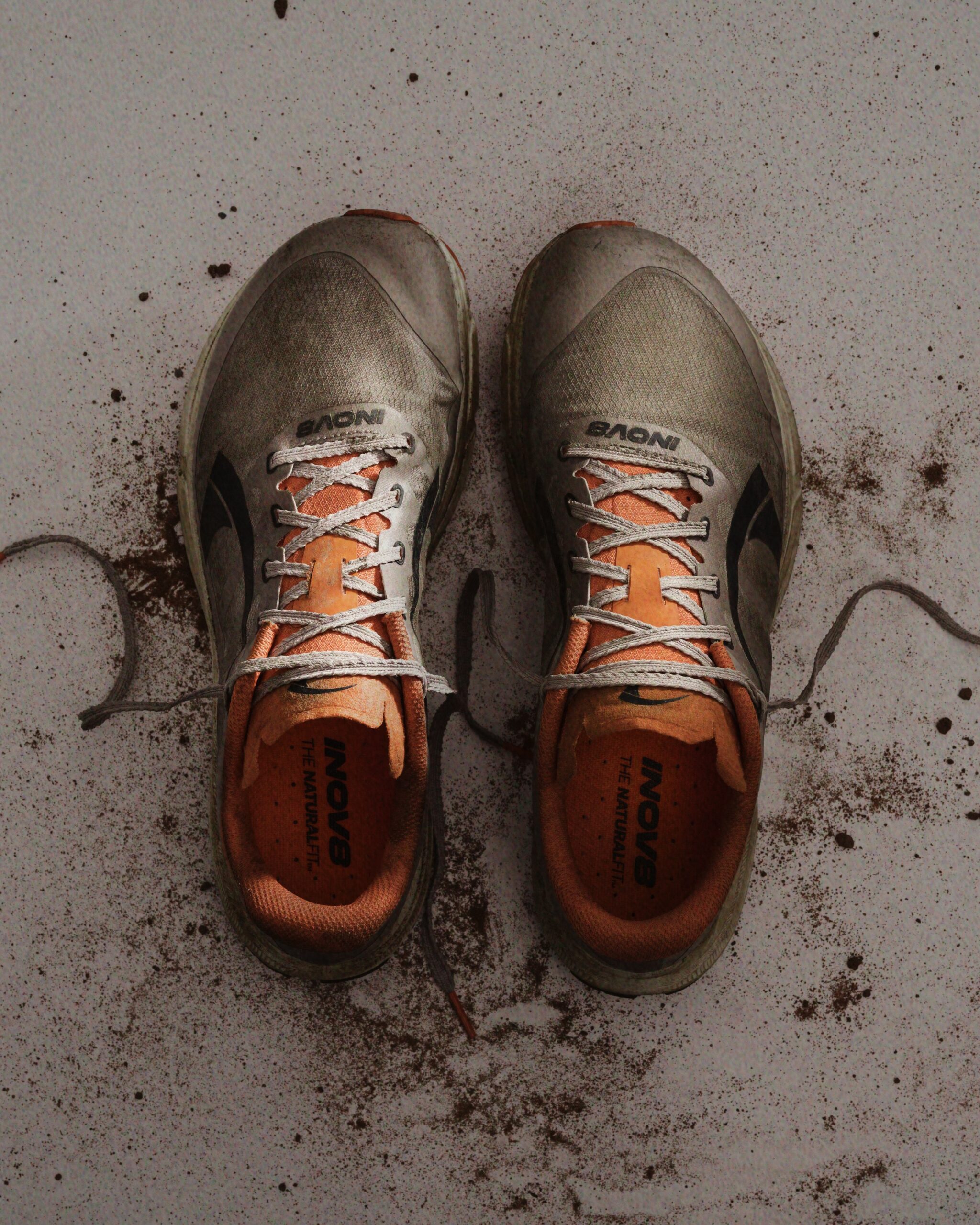
hill.camp does not test products first-hand. This review is a structured synthesis of eight independent sources — multi-tester and long-form reviews from the US, UK and French trail running press, a physical therapists’ evaluation, a 140-mile ultra-runner test, a UK retailer’s early impressions and a French analysis site — assembled with AI assistance and edited before publication. A ninth source, a lab test of the standard Trailfly v2, is used only for range context. Where sources disagree, we say so.
For decades, Inov-8 built its reputation on the wet, steep fells of the English Lake District: low, firm shoes with aggressive lugs that kept you close to the rock and locked onto mud. The Trailfly Pro is something else entirely. It puts 26 mm of new supercritical TPEE foam under the heel, keeps the shoe at around 228 g in a reference size, and skips the carbon plate that almost every rival now carries. Several testers in this Inov-8 Trailfly Pro review pool called it the brand’s best trail shoe to date. Others found it unstable, fragile and too roomy. Both camps have a point — and which one you belong to depends almost entirely on your feet and your terrain.
Quick Specs
| Price | €170 / £165 / $195 |
| Release | Late August 2026 (UK), September–October 2026 (US and rest of world) |
| Claimed weight | 228 g (reference size around EU 42.5 / US M9) |
| Measured weight | 224–272 g depending on size and source (see below) |
| Stack height | 34 mm heel / 28 mm forefoot (26 / 20 mm midsole + 4 mm footbed + 4 mm lugs) |
| Drop | 6 mm |
| Midsole | POWERFLOW ELITE nitrogen-infused supercritical TPEE, BOOMERANG LITE TPEE footbed |
| Plate | None (no carbon plate, no rock plate) |
| Outsole | Graphene-infused G-GRIP, 4 mm bidirectional chevron lugs, split into flex zones (METAFLEX) |
| Upper | Single-layer ripstop polyester, 3D-printed overlays, offset heel collar |
| Fit | NATURALFIT: standard heel and midfoot, wide forefoot, one width only |
| Best for | Fast runs on hard-packed to moderately technical trails, road-to-trail routes, 50K racing |
A Break With Inov-8’s Own Tradition
Several reviewers framed the Trailfly Pro as a turning point. Runner’s World UK’s Rick Pearson argued that recent Inov-8 models — the Trailfly Max, Speed and Zero — had felt like variations on a theme, and that the Pro is the first genuinely new idea in years. Believe in the Run’s Taylor Bodin was blunter: the brand had tried a bit of everything with mixed success, and this is the first Inov-8 he had genuinely enjoyed running in for years. RunUltra’s Harry Firth, a Lake District runner, saw it as a return to the brand’s old strength — the do-it-all shoe you pull from the cupboard for anything the British hills throw at you.
The positioning is specific. According to RoadTrailRun’s John Tribbia, Inov-8 told the trade that the shoe was developed for 50K racing with events like OCC at UTMB in mind, and Runner’s World UK confirms it debuted on athletes’ feet in Chamonix. In the range, it sits between the Trailfly Speed V2 — which, per French analysis site RunMorph, has roughly half the stack and a flexible rock plate — and the heavier Trailfly Max, which Runner’s World UK puts at 291 g against the Pro’s claimed 228 g.
How Much Does It Really Weigh?
Inov-8’s 228 g headline is real — but only for a small size. RoadTrailRun weighed 230 g in a US M9 and 236.5 g in a US M10. Doctors of Running confirms 228 g in a men’s 9.5, and Believe in the Run lists 7.9 oz. RunUltra’s UK 9.5 pair came in at 247 g. At the top of the range, Courir Mieux’s Cyril Forestier weighed 272 g in an EU 45.5. RunMorph, building on that figure, points out that most product pages and comparison sites simply copy the 228 g number regardless of size. Our reading: expect something in the 230–250 g range for a typical men’s size and closer to 270 g in large sizes. That is still exceptionally light for a shoe with this stack, and Firth notes his NNormal Tomir 2 weighs around 301 g in the same size.
The Midsole: Bounce Without Bulk
On the foam, there is near-unanimity. POWERFLOW ELITE is a nitrogen-infused supercritical TPEE, and Inov-8 claims it is the most energetic foam the brand has made. Testers broadly agree. Tribbia described a quick rebound rather than a slow sink — cushioned and protective, but firm and lively through its compression, absorbing repeated rock impacts while letting you feel what you stand on. Doctors of Running’s David Salas compared the ride to a lower-stack shoe with softer foam: you feel the platform deform, then a gentle bounce back. Forestier noticed the TPEE character from the very first strides, and Bodin summed it up as smooth and nimble.
Remember that only 26 mm of the 34 mm heel stack is actual midsole; the rest is a 4 mm TPEE footbed and 4 mm of lugs. That explains why so many testers stress ground feel despite the headline stack. Salas could feel rocks underfoot on technical sections — never painfully, but noticeably — and Forestier felt the ground quickly with only 20 mm of forefoot foam.
Rocker or No Rocker?
Here our sources diverge. RoadTrailRun reports a defined geometry — heel flare starting at 20% of the shoe’s length and a forefoot rocker at 60% — and found transitions smooth even on flat roads. Runner’s World UK and RunUltra both describe a subtle, non-aggressive rocker that works naturally with the foot. Forestier, however, found the shoe essentially flat, with no rocker he could perceive either at rest or on the run, and RunMorph repeats that view. The most likely explanation: the rocker exists but is mild enough that runners coming from heavily rockered max-cushion shoes will not notice it. Do not buy this shoe expecting the rolling sensation of a Hoka.
Stability: The Great Divide
This is where the Trailfly Pro splits its testers most sharply, and it matters more than any other point in this review.
On the positive side, Tribbia found platform stability better than expected for a neutral shoe at this stack. He deliberately ran angled rock slabs, loose scree edges and exposed roots and never felt the shoe escaping sideways. A UK retailer’s tester found it secure and fast on the descents of Anglesey. Doctors of Running gave stability a B — fine over rocks thanks to grip and lockdown, but more neutral than other Inov-8s because of the softer foam.
On the other side, Forestier describes a shoe that twists enormously, both lengthwise and across, with a completely soft heel counter and flex grooves that let forefoot and rearfoot rotate independently. After 60 km, he felt his stabilising muscles working far harder than usual and was clearly uncomfortable as soon as the terrain turned technical. Bodin found the back half squirrelly at times and wanted more structure underfoot for power transfer, concluding that only a strong-footed runner will fully harness the shoe. Firth, on technical Lakeland descents, felt his foot pushing the upper around rather than the upper holding his foot, and became more hesitant than in his usual shoes.
The pattern is consistent once you look at who said what. Runners on hard-packed, rolling or moderately technical trails rarely complained. Those who pushed the shoe hard on steep, off-camber, rocky terrain mostly did. And every source that discussed it agreed the Trailfly Pro asks your feet and ankles to do the stabilising work. That is a deliberate design choice, not a defect — but it rules the shoe out for many runners. If you want structure on technical mountain ground, something like the Salomon Genesis 2 sits at the opposite end of that spectrum.
Fit: Generous Up Front, and Confusing on Size
Inov-8’s NATURALFIT last holds the heel and midfoot while opening up at the toes. Everyone agrees on the shape: Tribbia found the toe box anatomical and accommodating, Bodin described a broader forefoot that let his toes splay, and Salas found normal width at the heel and midfoot with a wider forefoot. The offset heel collar, cut higher on the inside to follow the ankle bones, drew curiosity more than strong opinion; Firth admitted he did not notice much difference.
The downside is for narrow feet. Forestier, who has slim feet, had too much room up front and linked that excess volume to a lack of precision. Firth felt the same on loose technical ground and hoped for a narrower Precision version. According to Forestier, the shoe exists in one width only.
Sizing is genuinely contradictory. Forestier went a full size down (EU 45.5 instead of his usual 46.5) and says the shoe runs large; RunMorph repeats that advice. Bodin, on the other hand, went up half a size, as he does with other Inov-8 models, and called it absolutely the right move. Salas found it true to size. With three different answers from experienced testers, the only safe advice is to try it on before buying.
Two smaller details: the tongue has no gusset, which Bodin would happily trade a few grams to fix, and the notched laces split opinion — Tribbia called them his favourite type, while Runner’s World UK found them a little cheap for a premium shoe. Salas and Forestier’s complaints about the toe guard also deserve a mention: Salas felt it rub on descents, while Forestier and Tribbia note there is essentially no protective toe bumper at all.
Traction: Sticky Rubber, Debatable Lugs
The graphene-infused G-GRIP compound drew strong reviews. Tribbia found it exceptionally sticky and noted that the split outsole let his foot wrap over rocks rather than slip off them. Firth was impressed enough to say it is getting close to Vibram confidence on wet rock — high praise, given how dominant Vibram’s rubber has become, as we explain in our guide to Vibram Megagrip. Salas called it reliable on technical sections, and Forestier found it good on damp surfaces.
The lug layout is the weak point. Tribbia found the chevrons tightly packed, losing bite in loose, deep scree compared with older, more widely spaced Inov-8 patterns. Bodin went further: on softer ground, sand and loose dirt, the lugs simply did not dig in, which he attributes to too many or too broad lugs. Every source agrees on one thing — this is not a mud shoe. Runner’s World UK and the retailer both state plainly that the 4 mm lugs are made for firmer trails, not British winter bogs.
Durability: Two Red Flags
Runner’s World UK claims outsole durability is excellent thanks to the graphene. Our other sources tell a more complicated story.
- Courir Mieux (France): at around 40 km, a strip of lugs began to come unstuck on one shoe, exactly at one of the rubber-free METAFLEX flex grooves, after a run with a technical section where the shoe was twisting heavily. Forestier links the two and advises keeping the shoe away from rocky, abrasive mountain terrain.
- RunUltra (UK): at around 70 miles, the right shoe began to separate where the upper meets the midsole, including the front lip of the outsole. Inov-8 told Firth it was the first such case they had seen and sent a replacement pair. He suspects an isolated gluing issue.
- RoadTrailRun (US): minor micro-wear and early chewing on the lug edges after several runs on abrasive Colorado rock, though still durable overall so far.
- Believe in the Run: initial worries about the outsole faded once a surface film wore off.
The upper looks much more robust. Bodin found the ripstop remarkably durable, and Firth’s pair still looked fresh after 140 miles of Lakeland fastpacking, fell racing and Pennine Way miles. Two separate failures on two continents within the first 100 km is not proof of a systemic problem — but it is enough that we would not recommend the Trailfly Pro to anyone whose main terrain is sharp, abrasive rock.
Breathability and Wet Weather
Another small contradiction. Tribbia found the single-layer ripstop less breathable than he hoped on warm, muggy days. Salas found the upper breathable and comfortable. Firth, running a full rain day in the Lakes, reports that it held little water, drained well and dried quickly. The fair summary: it handles wet conditions well, but may run slightly warm in humid heat.
How Far Can You Take It?
Opinions spread widely. Doctors of Running sees it as a sub-ultra and daily training shoe, saying ultras would require a lot of experience with moderate-stack shoes. RunMorph puts the reasonable ceiling at around 50–60 km for a foot used to minimalism. At the other end, Rick Pearson ran a 35-mile day along the Vanguard Way in it, and Firth would happily take it towards 100 km as long as the route was not predominantly highly technical. After eight hours on his feet, his midsole had not bottomed out and he had no blisters.
Road sections are where the shoe surprised almost everyone. Runner’s World UK called it Inov-8’s best road-to-trail attempt to date, and both Firth and the retailer found transitions onto tarmac seamless. Tribbia’s testing included 10% pavement with no complaints.
How It Compares
Several testers and readers immediately reached for the Norda 005, with its near-identical stack. Bodin thinks the Trailfly Pro brings Inov-8’s identity to a similar package without quite matching Norda — though, as one Believe in the Run reader noted, the Norda costs around 50% more. Our Norda 005 review covers that shoe in depth.
Tribbia’s comparisons are useful. The Adidas Terrex Agravic Speed 2 is a little lower and firmer with a much narrower, race-day fit. The Hoka Zinal 3 is slightly lower and lighter, with deeper 5 mm lugs that bite better in loose dirt, but Inov-8’s rubber is more predictable on slick rock. The La Sportiva Prodigio 2 shares the same stack and drop but is more structured and protective; the Trailfly Pro is springier and lighter.
RunMorph compares it with the NNormal Kjerag 02 (€190) and the Salomon S/Lab Pulsar 4 (€220): the Trailfly Pro is the cheapest and lightest of the three, while the others use tougher, fuller-coverage rubber. See our NNormal Kjerag 02 review for that alternative. Firth found his NNormal Tomir 02 more stable and supportive when things got fast and technical, but heavier and less lively underfoot.
One note on plates: Inov-8 deliberately left it out, and Tribbia found that the plateless forefoot made the shoe runnable on any gradient, even if your foot has to work harder on steep climbs. That fits the wider debate in our analysis of whether carbon plates actually help off-road.
Our Take
The Inov-8 Trailfly Pro is the most interesting shoe the brand has made in years. Its POWERFLOW ELITE foam is genuinely lively, its weight is remarkable for the cushioning it offers, its rubber is sticky, and it moves between road, trail and fell with rare ease. For a runner with strong feet and a wide forefoot, chasing pace on hard-packed or moderately technical trails, it may well be one of the most fun shoes of 2026.
But it is a niche shoe dressed up as a do-it-all. It offers almost no built-in stability, splits testers on sizing, comes in one roomy width, has no rock plate, struggles in soft and loose ground, and has already produced two early durability failures. None of that makes it a bad shoe. It makes it a shoe you should buy deliberately, not on the strength of its headline weight.
Buy it if you have wide or high-volume feet, you are comfortable in flexible, low-structure shoes, and your running is mostly fast, hard-packed or mixed road-to-trail terrain up to around 50K. Look elsewhere if you need support on technical mountain ground, have narrow feet, run in deep mud, or mostly run on sharp, abrasive rock. For more options across that spectrum, see our best trail running shoes of 2026.
FAQ
How much does the Inov-8 Trailfly Pro weigh?
Inov-8 claims 228 g, which matches independent measurements in a men’s US 9 to 9.5. Larger sizes are heavier: testers measured 236.5 g in a US 10, 247 g in a UK 9.5 and 272 g in an EU 45.5.
Does the Trailfly Pro run large or small?
Testers disagree. One French tester went a full size down, a US tester went half a size up, and another found it true to size. Try it on before buying if you can.
Is the Trailfly Pro stable on technical terrain?
It depends on your feet. The shoe has no plate, a soft heel counter and a very flexible sole, so your feet and ankles do the stabilising. Some testers found it secure on rocky ground; others found it twisted too much on steep, off-camber terrain.
Is the Trailfly Pro good for wide feet?
Yes. Its NATURALFIT last has a noticeably wide forefoot. Runners with narrow feet reported too much room, and the shoe comes in a single width.
Can I use the Trailfly Pro in mud?
Not really. Its 4 mm, tightly packed lugs are designed for firm trails, rock and grass. Several testers found it lacked bite in soft ground, sand and loose scree.
Is the Trailfly Pro durable?
The ripstop upper has held up well. The outsole is less certain: one tester had a lug strip come unstuck at around 40 km and another had the upper start to separate from the midsole at around 70 miles. Inov-8 described the second case as a first.
Can I run an ultra in the Trailfly Pro?
Inov-8 designed it with 50K racing in mind. Some testers would take it towards 100 km on non-technical routes, while others limit it to sub-ultra distances unless you are very used to moderate-stack, low-structure shoes.
Does the Trailfly Pro have a carbon plate?
No. It has neither a carbon plate nor a rock plate. Its energy return comes from the supercritical TPEE midsole and its low weight.
The Trailfly Pro is available from specialist retailers and directly from Inov-8. If you are weighing it against a premium alternative with a similar stack, our Norda 055 vs 005 comparison is a good next read.