hill.camp does not test products first-hand. This review is a structured synthesis of eighteen independent sources — multi-tester long-form reviews from the US trail running press, field tests from UK, French and Spanish outlets, a 792km retailer wear test, and long-term owner feedback from a retailer panel and a Reddit thread — assembled with AI assistance and edited before publication. Sources are selected and verified by runners who follow this equipment closely. That process surfaced real disagreements on this shoe, including a spec sheet that has changed since launch and a sharp split over how it behaves on technical ground, which we’ve flagged openly below rather than smoothing over.
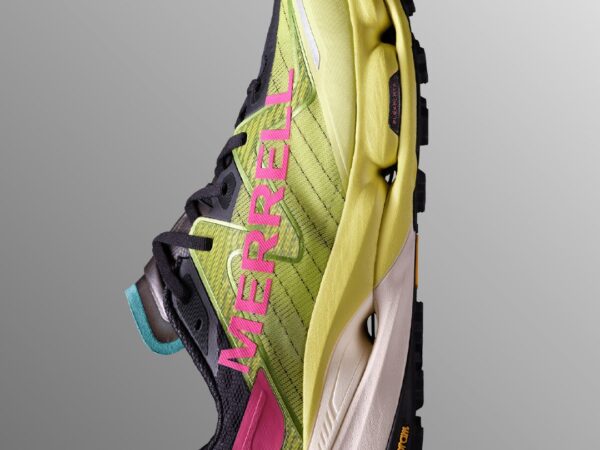
For years, Merrell‘s trail running line had a hole in the middle of it. There were fast, low mountain racers in the MTL Skyfire 2 and Long Sky 2, and there was the do-everything Agility Peak 5, but nothing for runners who wanted a proper max-cushion shoe for very long days. The Merrell MTL Adapt Matryx fills that gap, and it does it loudly: a huge, translucent, grooved midsole, a Kevlar-reinforced Matryx upper and Vibram Megagrip underneath, launched at $180 / €200 and now listed at $190 in the US. This Merrell MTL Adapt Matryx review brings together eighteen independent sources, including one pair followed for almost 800km, to work out what that stack actually delivers. The short version: it looks like a marshmallow, runs noticeably firmer than it looks, lasts a very long time, and divides testers most sharply exactly where its name makes a promise — adapting to rough ground.
| Spec | Detail |
|---|---|
| Price | $190 (launched at $180) / £170 / €200 — widely discounted in Europe since |
| Weight | 300g claimed at launch (men’s US 9) — 284g to 350g measured independently depending on size (see below) |
| Stack height | 36mm heel / 30mm forefoot at launch — independent measurements range from 40mm to around 50mm at the heel; Merrell’s US page now lists 42mm / 34mm |
| Drop | 6mm at launch — 8mm on Merrell’s current US product page |
| Upper | Matryx (Kevlar and high-tenacity polyamide), gusseted tongue, padded collar, mesh lining, 3D-printed and TPU overlays |
| Midsole | Dual-density FloatPro: supercritical nitrogen-infused core inside a firmer EVA carrier, FLEXconnect flex grooves, no rock plate |
| Outsole | Vibram Megagrip, 4mm lugs (three sources report up to 5mm) |
| Width | Single (medium) width |
| Release | Spring 2025; a 45th Anniversary colourway joined the range in 2026 |
| Best for | Long training runs and ultras on runnable to moderately technical trail |
What Merrell Actually Built
Leave the Road & Run’s Luke Merrett sums up the brief neatly: take what worked in the Agility Peak 5, add the Matryx upper from the Long Sky 2, give it more foam and a wider toe box, and aim it squarely at ultra distances. Merrell itself pitches the shoe at 50 miles and beyond, and Countryfile quotes a target range of 50–160km. Courir Mieux, in France, describes it as the maximalist model Merrell’s line had been missing, positioned against the Salomon Ultra Glide and S/Lab Ultra Glide, while Run’ix frames it as the long, comfortable end of a three-shoe Merrell rotation alongside the Skyfire 2 and Long Sky 2.
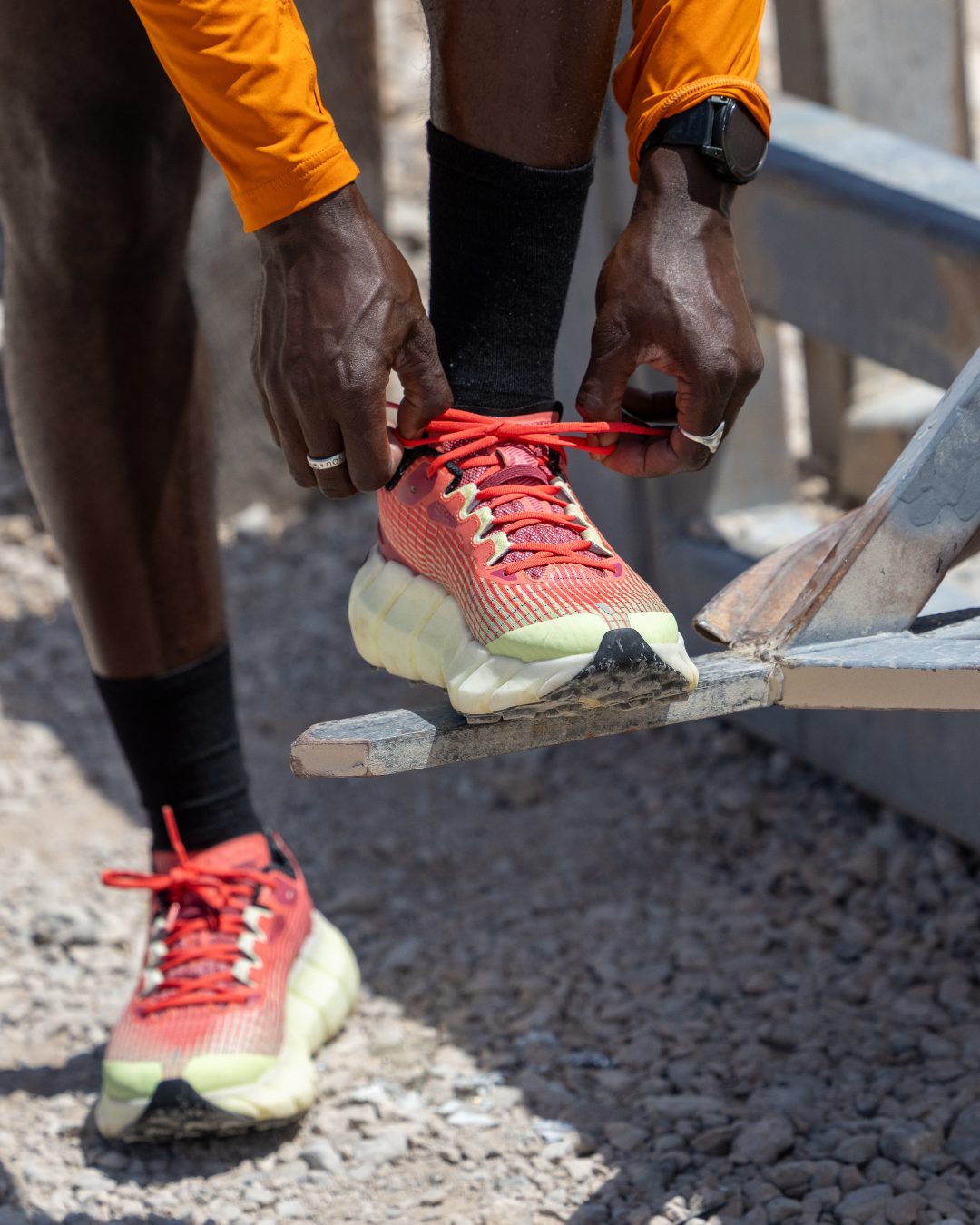
The midsole is the headline. Merrell’s team explained to WearTesters and Road Trail Run that the FloatPro foam here is really two foams: a springy, nitrogen-infused supercritical core wrapped in a thinner, denser EVA shell that protects it and adds stability. That shell is what you see and squeeze in the shop, which is why almost every tester says the shoe feels firmer in the hand than on the run. Journal du Trail’s Vincent Gaudin notes that Merrell says little about the exact compound, and found it firm and dense under the thumb. Cut into the sidewalls are the FLEXconnect grooves that give the shoe its caterpillar look and its name — segmented, « podular » sections that, in Believe in the Run’s description, are meant to let a high-stack midsole flex and adapt over uneven ground instead of behaving like one rigid slab. Unlike the Agility Peak 5, there’s no rock plate.
The Spec Sheet Has Moved
Before the ride, a warning about the numbers. At launch, Merrell listed a 36mm heel, 30mm forefoot and 6mm drop, and that’s what most of our sources report. Measurements tell a different story. Road Trail Run’s Mike Postaski felt that figure was too low and measured 42mm at the heel and 36mm at the forefoot, including insole and outsole; Runnea quotes the same 42/36mm. RunMag lists a 50mm heel and Journal du Trail says the stack comes close to 50mm. Mercidistillery, a Grenoble retailer that ran one pair for 792km, measured 40mm at the heel with the insole removed — on compressed foam and worn heel lugs, which it points out will lower the figure.
Mercidistillery’s explanation is the most useful: sources simply aren’t measuring the same thing, and whether you count the lugs and the insole changes the result by several millimetres. Then comes the twist. Merrell’s own US product page now lists a 42mm / 34mm stack and an 8mm drop, alongside a weight of 420g per shoe. The stack figure is close to the independent measurements and probably reflects a switch to total stack. The drop change is harder to explain — every tester we reviewed reports 6mm, European retailers still list 6mm, and REI in the US still lists 6mm, although Journal du Trail felt the pronounced forefoot rocker made it ride like a higher-drop shoe. The 420g weight is almost certainly an error: independent scales put the shoe at 284g for a men’s UK 7 (Countryfile), 288–294g around US 8.5–9.5 (Road Trail Run, WearTesters, Runnea), 290–303g in EU 42–43 (Courir Mieux, Pacing Trail, Alpine Mag, RunMag, Journal du Trail), 318g for a US 9 (Alastair Running), 332g for a US 11 (Believe in the Run) and 350g for an EU 46.5 (Courir Mieux). If drop matters to you, check the pair in your hands.
Ride and Cushioning: Firmer Than It Looks
If there’s one point of near-total agreement, it’s this: the Adapt is not a soft shoe. Road Trail Run’s Mike Postaski says flatly that it’s firmer than its looks suggest and warns anyone after a big squishy ride to look elsewhere; his co-tester Renee Krusemark calls the midsole firm but not uncomfortable. Run Oregon describes « controlled cushion » rather than marshmallow, Courir Mieux a dense, intermediate cushioning that never feels harsh after hours on foot but never loses contact with the ground, and Runnea’s David Picorel a foam that is neither too soft nor too hard. The Reddit owner, around 800km into his pair, agrees it’s firm for a max shoe, and an REI reviewer found it a little hard on concrete. Journal du Trail is the harshest, finding plenty of cushioning but not much softness. At the other end, Countryfile praises the midsole’s rebound and plushness over long, slow miles, and Pacing Trail calls it generous without being mushy.
What the cushioning does well is last. Mercidistillery found it still clearly present beyond 700km and particularly welcome on descents at the end of long runs, and Runnea’s tester finished a four-hour, 30km-plus outing with feet that felt fresher than in lighter shoes. Break-in varies: WearTesters’ Sam Lohse only felt the supercritical core come alive after about 80km (50 miles), Believe in the Run noticed a slight softening, and Leave the Road & Run found the shoe constrictive at the start of every run until a few kilometres in, even after 100km of use. Mercidistillery, by contrast, needed no break-in at all.
Ground feel is a pleasant surprise for several testers. Courir Mieux’s Cyril Forestier expected a vague, filtered ride from a 36mm stack and instead found the shoe still transmits information from the ground, even on rocky trails — something he says the Salomon Ultra Glide 3 and ASICS Trabuco Max 4 had lost. Alastair Running and WearTesters describe the same thing. Mercidistillery draws the opposite conclusion from the same protection: you barely feel stones at all, which it warns can tempt you into going faster than the terrain deserves.
The Rocker: Nobody Feels the Same Shoe
Few details split our sources as widely. Courir Mieux credits a double rocker, front and rear, with a natural rolling « culbuto » effect that keeps the shoe lively even when the stride shortens late in a long run — for him, the geometry matters more than the foam. Mercidistillery also felt a clear forward push at first, but found it faded after about 100km, which it counts as a drawback. RunMag describes a very pronounced forefoot rocker that can feel destabilising unless you land on your forefoot, and Journal du Trail goes further, calling the forward tipping effect too marked and almost unpleasant, particularly for midfoot strikers. On the other side, Alpine Mag found less rocker than in the Hoka Speedgoat, Believe in the Run says Merrell doesn’t really build in a full rocker, and Road Trail Run describes a shoe that stays solid under the midfoot and flexes up front at the ball of the foot.
Responsiveness is equally contested. WearTesters found a little pop, the Reddit owner rates the foam as livelier than the Agility Peak 5’s, and Courir Mieux calls the overall package fluid and energetic. RunMag found it hard to accelerate even on the forefoot, and Run’ix, Pacing Trail, Countryfile, Runnea and Journal du Trail all say it lacks the snap for speed work or short races. Most agree it simply isn’t built for that.
Stability on Technical Terrain: The Real Split
This is the question the shoe’s name invites, and it’s where our sources disagree most.
On one side, a large group found it far more stable than its stack suggests. Courir Mieux ran 55km and 3,500m of climbing in Belledonne, through scree fields and technical singletrack in the rain, and noted no side-to-side wobble even on off-camber ground. He credits a semi-rigid heel counter and an outsole that flares slightly beyond the midsole to widen the base. Believe in the Run’s Taylor Bodin calls it probably the most stable of its max-cushion peers, and Road Trail Run measured a broad 90mm heel, 85mm midfoot and 110mm forefoot. Alpine Mag found reliable lateral hold on camber and more stability than the Speedgoat, Pacing Trail never felt the tipping sensation of other maximalist shoes despite ankles prone to rolling, and Runnea didn’t turn an ankle once in 25km on rocky tracks. Run’ix was « bluffé », Leave the Road & Run found the grooves made it more nimble than expected, and the Reddit owner found it much more secure than the Agility Peak 5 on broken ground.
On the other side, several detailed reports draw a clear limit. Journal du Trail found the footprint relatively narrow, especially at the heel, and describes a shoe that feels stable right up until it tips on a camber — « piégeuse » (treacherous) on descents. RunMag’s tester, running from flat Burgundy tracks to technical Haute-Savoie trails, had a few genuine scares on steep descents, with the foot pivoting sharply on stony ground; he also found the footprint only moderate. Mercidistillery, after 792km, advises against flat-out descents through rocks and roots, while finding it faultless on soft, easy ground. Countryfile wanted a nimbler shoe for the most technical terrain, Alastair Running found it a touch blocky on tight singletrack, and two REI owners report either repeated ankle rolls on rocky Colorado terrain or an upper that got sloppier as runs went on.
Our reading: two things seem to decide which camp a runner lands in. The first is fit — most testers who struggled also reported heel movement or a loose upper. The second is descent style: the Adapt appears most at home when you place your feet deliberately on long, steady descents, and least comfortable when you attack steep, loose rock at speed. Testers even disagree on whether the platform is wide or narrow, which suggests heel shape and foot strike matter a great deal. If your races are steep and rocky, try before you buy.
Fit: The Heel, the Toe Box and Those Laces
The heel is the most consistent complaint. Believe in the Run’s two testers both struggled to lock it down, Renee Krusemark had slippage on climbs and descents, RunToTheFinish’s tester rubbed a spot on her heel every run until she taped it, Journal du Trail felt the heel move slightly and had to work on the lacing, and Alastair Running and Run Oregon warn narrow heels to try first. But the picture isn’t uniform: Courir Mieux, despite a slim foot, never needed the extra heel-lock eyelet he uses on almost every shoe, and WearTesters, Countryfile, Pacing Trail and Leave the Road & Run all found the hold secure, some with heel-lock lacing.
The toe box produces an even stranger disagreement. WearTesters and RunToTheFinish call it wide-foot friendly, Mercidistillery says it suits medium to wide feet, and Pacing Trail found it balanced, with no black toenails after hours of descending. Courir Mieux, though, describes the fit as normal to slim. Leave the Road & Run explains part of the gap: the toe box looks wider than the Agility Peak 5’s but feels more constrictive, because it’s very shallow — and with a stiff toe bumper, that caused big-toe rubbing. The Reddit owner independently reports the same shallow depth and a snug hold. On sizing, most sources say true to size, but the Reddit owner finds it about a quarter size short of the Agility Peak 5 and Mercidistillery’s tester went up a full size for ultra use, which meant lacing right to the top to keep the heel in place. Pacing Trail suggests going up if you’re between sizes.
The laces are criticised almost everywhere. Courir Mieux, Mercidistillery, Leave the Road & Run, Believe in the Run and several REI owners found them too short to use the top eyelet comfortably. Courir Mieux adds that their rough texture prevents loosening but makes them hard to adjust, while Leave the Road & Run and Countryfile had the opposite problem, with laces slipping undone on long runs. Sources don’t even agree on their shape: Courir Mieux describes flat laces, Journal du Trail round, tubular ones. Several testers say swapping them transforms the fit — one REI owner who initially blamed the upper changed his verdict entirely after 320km and new laces.
Durability: The 792km Answer
Durability is the Adapt’s strongest card, and unusually, we have real long-term data. Mercidistillery bought its pair at full retail price and logged 792km, including several runs of over three hours and the 103km, 4,000m Ultra Trail des 2 Roches in a little over 18 hours. The Matryx upper showed no problems at all. The 4mm lugs were down to 2–3mm on less-used areas and around 2mm at the forefoot, with the outer heel worn smooth — a good result at that distance, in its view. It notes that the cut-out outsole multiplies rubber edges that wear faster, and that resoling isn’t possible. It calculates €0.25 per kilometre so far and expects to reach 1,000km.
The rest of the evidence points the same way. The Reddit owner reports no wear on the upper after roughly 800km, and an REI owner found almost no change in midsole, grip or upper after 320km. Courir Mieux saw only superficial scuffs after 120–140km of rocky terrain, and Pacing Trail no tears on stony ground. Road Trail Run, Believe in the Run and WearTesters also saw a Merrell-sponsored athlete’s pair at around 1,300km (800 miles) at a trade event — a data point rather than independent proof.
The trade-off is heat, though not everyone feels it. Road Trail Run, Alastair Running, Alpine Mag, Run Oregon and Run’ix all flag limited breathability. The Reddit owner explains why: the gusseted tongue is attached along the inside of the upper, creating a double layer, and he wouldn’t take it to a 100-miler for that reason. Pacing Trail, however, found it breathable enough on summer runs, and Countryfile, RunMag and Leave the Road & Run had no real complaints. Countryfile adds one cosmetic note: the white midsole stains easily.
Traction: Close to Unanimous
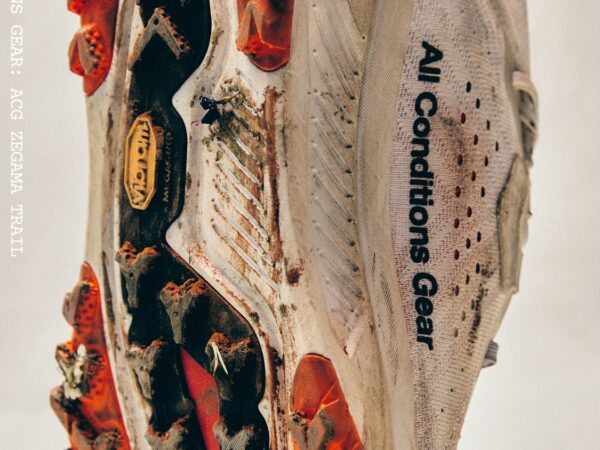
The Vibram Megagrip outsole gets top marks almost everywhere, and Journal du Trail calls it the shoe’s single biggest strength. Courir Mieux’s rainy 55km in Belledonne brought no worrying slips on wet rock, and he credits a heel lug pattern that curls slightly up the back for biting hard when braking on steep descents. He’d initially wanted 5mm lugs, but the 4mm pattern — star-shaped lugs from the Agility Peak 5 and V-shaped chevrons pointing one way for climbing and the other for braking — changed his mind. Both Road Trail Run testers gave traction a 10, and Run’ix, RunMag, Pacing Trail, Alpine Mag, Believe in the Run, Alastair Running and Countryfile all praise it on wet rock and mixed ground. If you want to know why this rubber appears on so many premium shoes, our Vibram Megagrip guide explains the compound family.
Mud is where opinions part. Run’ix found grip in mud extraordinary and said it cleared easily, and Pacing Trail agrees. Runnea found the 4mm lugs less effective in deep, soft mud, the Reddit owner found the wide outsole cakes up in clay, and WearTesters and an Oregon-based REI owner would prefer 5mm lugs for muddy descents. Mercidistillery didn’t test in heavy rain and would point muddy-course runners elsewhere. Lug depth itself is disputed: Merrell and most sources say 4mm, while Run’ix, RunMag and Pacing Trail report up to 5mm.
Weight: Heavy on Paper, Lighter on Foot
At roughly 290–330g in most sizes, the Adapt is heavy by general standards, and Road Trail Run, Run’ix, Runnea, Countryfile and Leave the Road & Run list weight as a drawback. Alastair Running puts it about 10% above the average for cushioned all-mountain shoes. But within its category it’s typical: Courir Mieux finds it within a few grams of the Salomon Ultra Glide 3, ASICS Trabuco Max 4 and Amplux 2, only slightly heavier than the Agility Peak 5 and 20g lighter than the Lowa Fortux, and Believe in the Run weighed it level with the Brooks Caldera 8, Nike Zegama 2 and Speedland GS:PDX. Several testers also say it feels lighter than it is — Alpine Mag, RunMag and Believe in the Run were all surprised on first steps.
How Far Can You Take It?
Merrell says 50 miles and up, and the most enthusiastic sources agree. Courir Mieux would choose it for a mountainous 100km or 100 miles, a technical ultra with lots of climbing, or even an ambitious UTMB — but not for the SaintéLyon, the Templiers or a fast 50K, where he’d want something lighter and livelier. Mercidistillery’s tester finished a 103km ultra in it on rolling vineyard terrain that suited it perfectly. Pacing Trail and Alpine Mag see its sweet spot beyond 40–50km, Runnea from 20km upwards at easy paces, and one REI owner calls it his pick for anything over 100km. Road Trail Run and RunToTheFinish also see it as a race option for anyone who finds carbon plates too stiff — a question we explored in our guide to whether carbon plate trail shoes actually work off-road.
Others are more cautious. RunMag would keep it to runs of 40–50km on non-technical ground, Journal du Trail to long distances on not-too-technical terrain, and the Reddit owner wouldn’t take it to 100 miles because of heat rather than cushioning. Notice the tension: Courir Mieux sees it as a technical mountain ultra shoe, while RunMag and Journal du Trail see technical ground as exactly its limit.
A note on independence: Courir Mieux has a partnership with Merrell, including a discount code, so we’ve relied on it mainly for its measurements and specific observations. Mercidistillery sells the shoe, although it bought its test pair at full price. Road Trail Run, WearTesters and Run Oregon disclose receiving free samples, and most other outlets earn affiliate commissions or run price comparators. The 800-mile pair cited by three US outlets belongs to a Merrell-sponsored athlete. We gave extra weight to long-term owner and retailer wear tests. We couldn’t access a paid video review from Relance, whose author also writes for Journal du Trail, and we set aside a further review whose listed specifications don’t match this shoe at all.
Merrell MTL Adapt Matryx vs the Competition
The comparisons are revealing because they don’t agree. Journal du Trail finds the Hoka Stinson 7 wider and more reassuring on camber, the Brooks Caldera 8 more consistent and more stable, and the ASICS Trabuco Max 4 more versatile — and thinks the Adapt falls short of all three. Road Trail Run and Believe in the Run reach almost the opposite conclusion: the Caldera is softer and bouncier but less stable than the Adapt, which Believe in the Run rates smoother and steadier than the Caldera 8, Stinson 7 and Speedland’s GS series — our Speedland GS:BLK review covers the latest of those. Pacing Trail sits in between: the Trabuco Max 4 is more versatile on runnable ground but weaker on technical, muddy descents, and the Caldera 8 is as comfortable but less grippy in the wet. RunMag suggests the Trabuco Max 4, On Cloudultra 3 or Caldera 8 as more complete options at the price.
Against Hoka, Road Trail Run and WearTesters see the Mafate Speed 4 as the closest rival, softer underfoot but less controlled on technical ground, while Pacing Trail finds the Hoka Mafate 5 more cushioned but less agile on narrow trails. On the Speedgoat, Alpine Mag finds the Adapt more stable with less rocker, Runnea calls it a more comfortable, more protective take on the Speedgoat or Altra Olympus, and Alastair Running goes as far as calling it what the Speedgoat should be by now — for more on that shoe, see our Speedgoat vs Speedcross and Norda 001 vs Speedgoat comparisons. Courir Mieux prefers it to the Salomon Ultra Glide 3 for precision, and Road Trail Run to the Nike Zegama 2 for stability. Among La Sportiva‘s shoes, the Reddit owner calls the Prodigio Max almost the same shoe but with a much roomier toe box.
Within Merrell’s own range, the Agility Peak 5 comparison splits testers. Road Trail Run and the Reddit owner prefer the Adapt for its flex and security; Leave the Road & Run recommends the Agility Peak for technical terrain and higher-volume forefeet; Pacing Trail prefers the lighter Agility Peak for 20–40km trails, and Courir Mieux ranks both shoes in his personal top, calling the Agility Peak the more versatile of the two. The line has since moved on to the Agility Peak 6. For technical racing, Alastair Running and Pacing Trail point to the MTL Long Sky 2, and runners who want Merrell’s carbon-plated racer should read our Merrell MTL SpeedARC Peak review. Our best trail running shoes of 2026 guide puts all of this in a wider context.
Our Take
The Merrell MTL Adapt Matryx is best understood as the opposite of what it looks like. The bulbous, translucent midsole promises softness; what you get is a firm, controlled max-cushion shoe with one of the best outsoles available and an upper that, on the evidence of two independent 800km reports, may outlast almost anything else in its category. For long training days and ultras on runnable or moderately technical trail, the balance of our eighteen sources is clearly positive, and several testers rank it among the best ultra shoes they’ve run in. The flaws are real, though. The laces are poor, the heel doesn’t suit every foot, the toe box is wider than it is deep, and the upper can run warm. Above all, testers genuinely disagree about stability on steep, rocky descents and about whether its rocker helps or hinders — so this is not a shoe to buy blind for aggressive technical racing. Add a spec sheet that now disagrees with itself. Buy it if you want one durable, protective shoe for big mileage, prefer firm cushioning to squish and tend to descend with control rather than abandon — then budget for new laces, and look out for the substantial discounts now common in Europe. If your heel is narrow, your forefoot is high-volume or your races are hot, steep and loose, try it on first or look at the rivals above.
Merrell MTL Adapt Matryx Review: Frequently Asked Questions
Does the Merrell MTL Adapt Matryx run true to size?
Most testers found the length true to size. One long-term owner finds it about a quarter size shorter than the Agility Peak 5, and one retailer tester went up a full size for ultra use, which meant lacing right to the top to keep the heel secure. If you’re between sizes and planning long races, going up is the more common advice.
Is the MTL Adapt Matryx good for wide feet?
Often yes, but not always. Several sources describe a roomy toe box suited to medium and wide feet, while one French tester found the fit normal to slim, and two others found the toe box shallow. Runners with high-volume rather than simply wide forefeet may feel constricted. It comes in a single width.
Is the MTL Adapt Matryx stable on technical terrain?
It depends on who you ask. Many testers, including one who ran 55km of scree and singletrack in Belledonne, found it remarkably stable for its height. Others found it unpredictable on steep, rocky, off-camber descents, citing a relatively narrow heel footprint or heel movement. It appears most at home on long, controlled descents rather than fast, loose ones.
What is the real drop of the MTL Adapt Matryx?
Merrell listed 6mm at launch, and every tester and European retailer we checked reports that figure. Merrell’s current US product page, however, lists 8mm with a revised 42mm / 34mm stack. We couldn’t confirm whether later production changed, so check the pair or ask the retailer if drop matters to you.
How long does the MTL Adapt Matryx last?
A long time. One retailer’s pair reached 792km with an intact upper, lugs worn from 4mm to around 2–3mm and cushioning still present, and was expected to reach 1,000km. A Reddit owner reports no upper wear after about 800km. The cut-out outsole is the part most likely to go first.
MTL Adapt Matryx or Agility Peak 5: which should I choose?
Choose the Adapt for durability, protection and long days over 40km; choose the Agility Peak for a lighter, more versatile shoe for 20–40km, technical terrain or higher-volume feet. Sources are split on which is more stable. The Agility Peak line has since been updated to the Agility Peak 6.
This Merrell MTL Adapt Matryx review is a starting point rather than the final word — for current colourways, sizing and the latest specifications, head to the official Merrell MTL Adapt Matryx page.