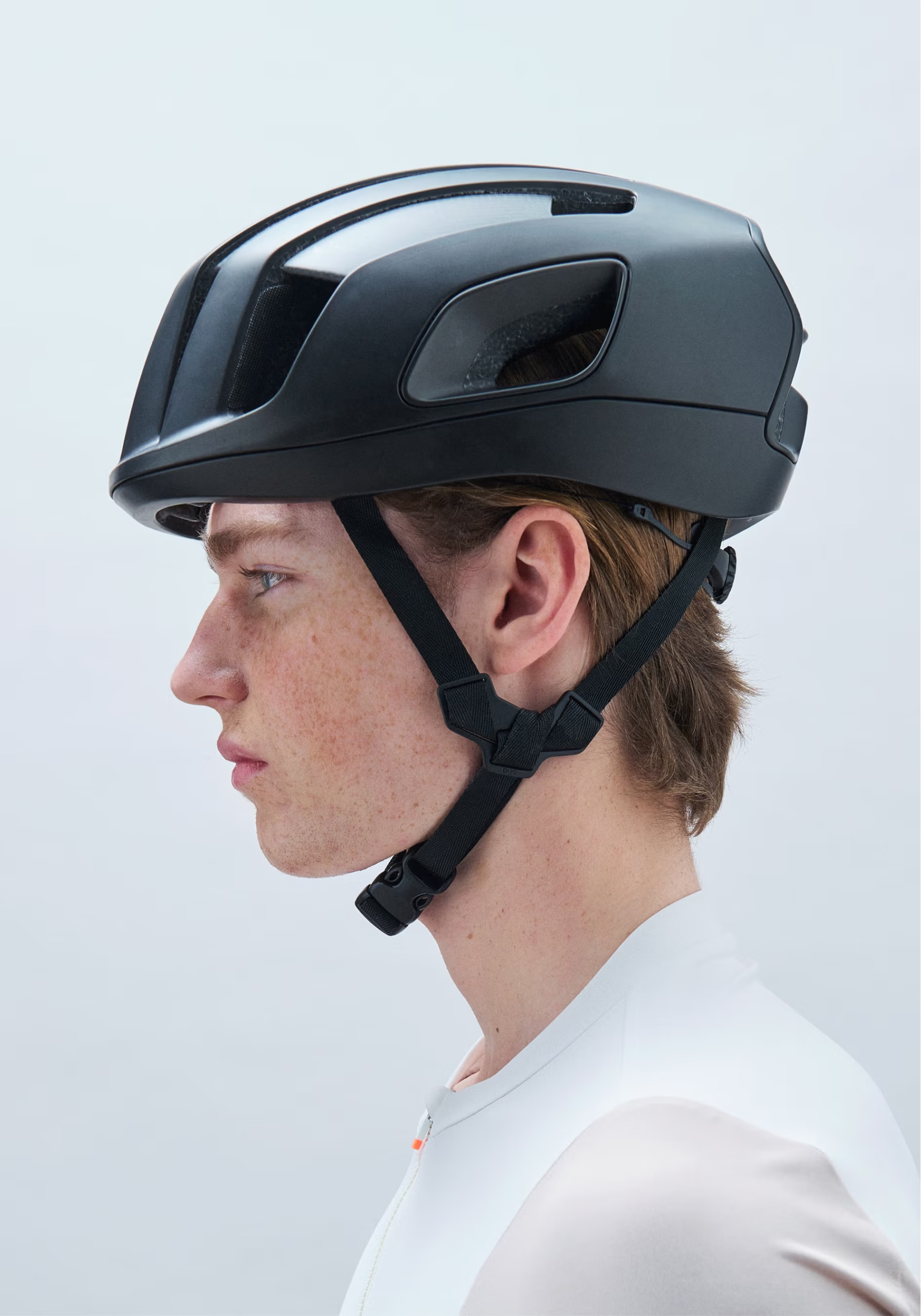
Search for the « best gravel bike helmet » and you’ll find a small industry of buying guides, each with its own winner, its own testing methodology, and — more often than not — a helmet that was never actually designed for gravel in the first place. That’s not a knock on any of them. It’s just the honest state of the category: gravel riding sits in a gap between road and mountain biking, and helmet brands have only recently started building lids specifically for it.
We went through ten independent sources — lab-backed buying guides, long-term owner reviews, and an unfiltered Reddit thread from actual gravel riders — to see where the real consensus sits. The short version: most of what gets marketed as a « gravel helmet » is a well-ventilated road helmet with better marketing. A handful of models, though, are genuinely built around gravel’s specific demands — slower speeds, longer days, rougher surfaces, and gear you actually want to carry on your head. We’ve organized our picks around both realities, weighted by protection, ventilation, and price, so you can pick the category that matches how you actually ride.
Quick Specs: Best Gravel Bike Helmets at a Glance
| Category | Helmet | Price | Weight | Rotational Protection |
|---|---|---|---|---|
| Best Overall | Giro Aries Spherical | $300 / £220–290 | ~280–305g | MIPS Spherical |
| Best for Hot-Weather Ventilation | Specialized S-Works Prevail 3 | $300 / £250 | ~260–320g | MIPS Air Node |
| Best Value | Lazer Tonic KinetiCore | $80 / £53–60 | 240–260g | KinetiCore |
| Best Gravel-Specific Design | POC Amidal | Premium tier | ~353g | MIPS Air Node |
| Best for Gravel Racing | Specialized S-Works Evade 3/4 | $250–330 / £250–275 | ~276–327g | MIPS Air Node |
| Best Budget Aero | Van Rysel RCR-F / RCR MIPS | £79.99–89.99 | 290–345g | MIPS Air Node (MIPS model) |
| Best Safety Score | POC Cytal | $360 / £360 | ~271–305g | MIPS Air Node |
This list is built from a synthesis of independent field tests, lab data, and rider feedback rather than our own hands-on testing — you can read how we approached it in the methodology note near the bottom. Prices and weights vary slightly between sources depending on region and helmet size; we’ve listed the ranges we found rather than picking a single number to look more precise than it is.
Best Overall: Giro Aries Spherical
The Aries Spherical is the closest thing this category has to a consensus pick. It shows up at or near the top of six of the ten sources we reviewed, and for good reason: it balances safety, ventilation, and comfort without leaning hard into any single trait. Its MIPS Spherical system uses a ball-and-socket shell design rather than a separate slip-plane liner, which lets it manage rotational impact forces while keeping the big, open vents that make it one of the more breathable helmets in this price range.
Notably, nobody in our source set recommends the Aries specifically for gravel — it’s a road helmet that happens to work exceptionally well off-road too, at slower gravel speeds and on longer days in the saddle. If you want one helmet for road, gravel, and everything in between, this is the one that keeps coming up.
Best for Hot-Weather Ventilation: Specialized S-Works Prevail 3
If you ride gravel in genuine heat — and gravel routes, with their slower average speeds, generate less cooling airflow than a fast road ride — ventilation stops being a nice-to-have. The Prevail 3 is built around three wide central airflow channels supported by slim carbon struts instead of foam bridges, which opens up more of the shell to open air than almost anything else on this list.
The tradeoff is coverage: with that much of the shell given over to venting, there’s less foam between your skull and the road than on a more conservative design. It’s a fair trade for hot, slow gravel days, less so for technical singletrack where you might come off at an angle.
Best Value: Lazer Tonic KinetiCore
Three separate buying guides in our source set — covering road, gravel, and general cycling audiences — land on the Tonic KinetiCore as the best budget pick, and it’s not close. At around $80 / £53–60, it undercuts most of this list by a factor of three or four while still using Lazer’s KinetiCore rotational protection, which relies on crumple-zone foam blocks built into the shell rather than an added slip-plane liner.
Worth flagging: the Tonic originally scored 5 stars in Virginia Tech’s independent testing, then dropped to 3 stars after Virginia Tech recalibrated its rating scale to reflect how much safer helmets have gotten across the board. That’s a shift in the scale, not the helmet — but it’s a good reminder to check when a rating was published, not just what it says.
If you want to go even cheaper, the community consensus points elsewhere. On the r/gravelcycling thread we reviewed, the Specialized Align II MIPS comes up repeatedly as the pick that beats far more expensive helmets in Virginia Tech’s own testing for a quarter of the price — a genuinely useful data point that the professional buying guides don’t emphasize as much.
Best Gravel-Specific Design: POC Amidal
This is the category where « gravel helmet » actually means something. The Amidal was designed around what long gravel and bikepacking days actually require: a reinforced rear structure built to accept a Knog helmet light without crushing the foam, a ladder-style attachment system for other light brands, an eyeglass « garage » with high-friction material to keep sunglasses stashed securely in the vents, and padding specifically tuned for comfort over very long distances rather than peak-speed efficiency.
It also considers aerodynamics via CFD modeling — not to chase watts, but to keep air moving efficiently through the shell and out the rear exhaust ports even at gravel’s more modest speeds. The one real gap: POC hasn’t submitted it for Virginia Tech testing, which is frustrating given that the MIPS Air Node system and reinforced rear structure would likely score well.
If the Amidal’s styling or price isn’t a fit, the Smith Network MIPS is the closest alternative — it independently won « best gravel helmet » from two separate American outlets in our source set, largely on the strength of its removable fabric visor and honeycomb-structured Koroyd padding, at roughly half the price.
Best for Gravel Racing: Specialized S-Works Evade 3/4
For riders chasing a finish-line clock rather than a sunset, the Evade strikes the best balance we found between aerodynamic performance and real-world livability. It isn’t the single fastest helmet in wind-tunnel testing — that title tends to go to more extreme aero shapes — but it consistently lands within a watt or two of the fastest option while offering meaningfully better ventilation, easier adjustability, and a shape that doesn’t look out of place off the bike.
It’s also been proven specifically in gravel racing conditions, including multi-hour events like Unbound and the Gralloch, which matters more for this category than pure wind-tunnel numbers gathered at road-racing speeds.
Best Budget Aero: Van Rysel RCR-F / RCR MIPS
Decathlon’s performance sub-brand punches well above its price point here. In wind-tunnel testing, the RCR-F has saved real watts against a baseline helmet and finished only a couple of watts behind helmets costing four times as much — a result borne out by WorldTour race wins, not just marketing copy. It’s since gained an optional MIPS liner, which is worth the modest upcharge given how close the RCR MIPS still sits to premium competitors on price.
The catch is finish quality: expect some peeling stickers and a less refined feel than the helmets it’s benchmarked against. For racers on a budget, that’s an easy trade.
Best Safety Score: POC Cytal
If Virginia Tech’s independent impact testing is your primary decision criterion, the Cytal is the strongest performer among road-style helmets that also work well for gravel. It’s routinely cited as one of the highest-scoring road helmets Virginia Tech has ever tested, helped by a dual-density EPS liner working alongside MIPS Air Node.
Ventilation is excellent too, with large front vents and deep internal channels — though that same open design makes it a poor choice for cold-weather riding, and at $360 / £360 it’s one of the most expensive options on this list.
Also Worth a Look
A few models didn’t win a category outright but deserve a mention. The Sweet Protection Fluxer MIPS is a genuinely versatile road-and-gravel helmet with excellent ventilation and a moderate price (~$200 / £179) — a sensible middle ground if none of the picks above quite fit your budget. The MET Allroad MIPS (£72.99) is the clearest budget-friendly, gravel-specific option we found, with a removable visor built in from the start rather than bolted on as an afterthought. And the POC Procen Air is worth knowing about if pure speed is the only metric that matters to you — it’s reportedly the fastest helmet tested across multiple independent wind-tunnel sessions, including a win at Unbound, but it ships without MIPS or any independent safety rating, which is a real gap for a helmet in this price bracket.
Do You Actually Need a Gravel-Specific Helmet?
Here’s the honest answer buried in most of these buying guides, and stated outright by more than one gravel rider we read: probably not. A gravel road is still a road — smoother than singletrack, generally more predictable than mountain bike terrain — and a well-fitted road helmet with modern rotational protection covers the vast majority of gravel riding just fine. That’s why the Giro Aries Spherical, a road helmet through and through, tops so many « best gravel helmet » lists in the first place.
Where a genuinely gravel-focused design like the POC Amidal or Smith Network earns its keep is in the details road helmets don’t bother with: mounting points that survive a multi-day bikepacking trip, a visor for sun and mud spray on rougher tracks, and comfort tuned for six-hour days rather than a two-hour club ride. If you’re riding smooth gravel roads at a decent pace, buy for fit and ventilation. If you’re bikepacking, racing ultra-distance gravel, or spending real time on technical, rougher terrain, the extra-purpose-built features start to matter.
Our Take
If you only take one helmet away from this guide, make it the Giro Aries Spherical — it’s the pick with the broadest support across independent testers, and it will serve you equally well on tarmac and gravel. If you’re building a dedicated gravel or bikepacking setup and want a helmet designed around that use case specifically, look at the POC Amidal or the more affordable Smith Network MIPS. And if budget is the deciding factor, the Lazer Tonic KinetiCore remains the safe, well-reviewed choice — just don’t discount the Specialized Align II if you want to go even cheaper without giving up much in Virginia Tech’s testing.
Whichever direction you go, fit still beats every spec on this page. Every source we reviewed said some version of the same thing: the safest helmet is the one that fits your head correctly and that you’ll actually wear on every ride, not the one with the best lab score sitting unused in a drawer because it never felt right.
FAQ
Do I need a gravel-specific helmet, or will a road helmet work?
For most gravel riding, a well-fitted road helmet with modern rotational protection works fine. Gravel-specific designs earn their keep mainly for bikepacking, ultra-distance racing, or consistently rough, technical terrain — situations where light mounts, visors, and all-day comfort start to matter more than aerodynamics.
What does MIPS actually do, and do I need it?
MIPS (Multi-Directional Impact Protection System) adds a low-friction layer inside the helmet that lets the shell shift slightly relative to your head on an angled impact, reducing the rotational forces linked to concussion. It’s become close to a baseline expectation rather than a premium extra — competing systems like Lazer’s KinetiCore, Smith’s Koroyd, and Trek’s WaveCel aim to solve the same problem through different mechanisms.
What is a Virginia Tech helmet rating?
Virginia Tech runs independent, standardized impact testing on bike helmets and assigns a star rating based on how well each one reduces the forces linked to concussion. It’s become the closest thing the industry has to an independent benchmark, though not every helmet gets submitted for testing, and the rating scale has been recalibrated over time as helmets have gotten safer overall.
Should I prioritize aerodynamics or ventilation for gravel?
Gravel speeds are generally lower than road speeds, which reduces the airflow a helmet naturally gets and makes ventilation more valuable for comfort. Unless you’re specifically training or racing for speed, a well-ventilated helmet will likely serve you better on long, slower gravel days than a dedicated aero shape.
When should I replace my gravel bike helmet?
Replace it immediately after any impact, even if you can’t see visible damage — the foam liner is designed to absorb energy by crushing or cracking, and that protection doesn’t reset. Absent a crash, most manufacturers recommend replacing a helmet every three to five years as UV exposure, heat, and sweat gradually degrade the foam.
Whatever you land on, buy from a retailer that lets you try before committing — head shapes vary enough between brands that sizing charts alone won’t guarantee a safe fit. You can check current colorways and sizing directly on Giro’s official site and POC’s official site before you buy.