We have used both products discussed here on our own rides. The analysis itself is built from both manufacturers’ published labels and four outside sources — an independent sports dietitian’s comparison, two buyer’s guides sponsored by competing electrolyte brands (flagged where relevant), and a consumer-magazine investigation — assembled with AI assistance and edited before publication.
Walk into any French pharmacy in July and a tube of Hydratis will be sitting by the till, in fourteen flavours, at around ten euros. Walk into Decathlon and a tube of plain lemon electrolyte tabs costs seven. Both promise to fix your hydration. Both fizz in a bottle. And if you buy hydration tablets the way most of us do — by price, by habit, or by whatever is closest to the checkout — you would never guess that the cheaper tube puts more than twice as much salt in your bottle.
That gap is the whole story of this guide. Hydration tablets are not interchangeable, and the number that matters most is rarely the one on the front of the packaging. Here is how to read the label, what Hydratis and Decathlon’s tabs actually deliver per bottle, and when you need either of them at all.
Quick Specs: Hydratis vs Decathlon, per sport bottle
All values below are for one 500 ml bottle prepared at each brand’s recommended sport dose: two tablets for Hydratis, one for Decathlon.
| Hydratis | Decathlon electrolyte tabs | |
|---|---|---|
| Tube price | €9.90 / 20 tablets | €6.99 / 20 tablets |
| Tablets per 500 ml (sport) | 2 | 1 |
| Cost per bottle | ≈ €0.99 | ≈ €0.35 |
| Sodium | 116 mg | 250 mg |
| Potassium | 300 mg | 100 mg |
| Magnesium | 65 mg (citrate) | 56 mg (oxide) |
| Calcium | None | 40 mg |
| Chloride | 180 mg | Not declared |
| Sugar | Small amount of dextrose (see below) | 0 g (≈1.4 g sorbitol) |
| Sweetener | Sucralose | Stevia |
| Vitamins | None (adds zinc, manganese) | B1, B2, B6, C |
| Where to buy | Pharmacies, online | Decathlon stores and site |
What a hydration tablet is actually for
When you sweat, you lose water and minerals — mostly sodium and chloride, with smaller and more variable amounts of potassium, magnesium and calcium. Drink only plain water over a long, hot effort and you replace the water but not the salt. In mild cases that just means you absorb and retain fluid less efficiently. In extreme cases — big volumes of plain water over many hours — blood sodium can fall far enough to become dangerous, a condition known as exercise-associated hyponatremia.
A hydration tablet is simply a compact way to put some of that salt back into your bottle, usually with a flavour that makes you drink more willingly. That flavour effect is real and documented: people tend to drink more when the drink tastes good. It is also, frankly, the main thing a tablet does for someone sitting at a desk.
Which brings us to the marketing. The French consumer magazine whose investigation we reviewed argues that tablet brands lean heavily on the idea that most of us are chronically under-hydrated — a claim it says needs serious qualifying. Hydratis’s own website headlines the figure that 78% of French people don’t drink enough. Even the sponsored guides we read concede the point: for a healthy person eating normally, outside of heat, sport or travel, water and food cover electrolyte needs perfectly well. Tablets earn their place when sweat losses go up — long rides, hot runs, summer days in the mountains — not as a daily wellness ritual.
Sodium first: the one number that decides it
Every serious source we reviewed agrees on one thing: for exercise, sodium is the priority. It is the mineral you lose most of in sweat, and it is what helps your body hold on to the fluid you drink rather than passing it straight through.
How much do you lose? It varies enormously. Sweat sodium concentration differs several-fold from one athlete to the next, and sweat rate itself can range from half a litre to well over two litres an hour depending on heat, intensity and the individual. A salty sweater riding hard in summer can lose more than a gram of sodium an hour. Nobody is going to replace all of that from a bottle, and nobody needs to — but it tells you that a few dozen milligrams is a rounding error.
The independent dietitian whose comparison we used sets a practical floor of at least 300 mg of sodium per hour of effort. Assume you drink roughly one 500 ml bottle an hour, and the arithmetic becomes simple:
- Decathlon tabs: 250 mg per bottle — just under the floor, close enough that a salty snack or a second bottle in the heat gets you there.
- Hydratis: 116 mg per bottle, even at the two-tablet sport dose — well under half the floor. The coconut flavour is the exception, at around 170 mg per bottle, but still short.
This is where the two sponsored guides become unexpectedly useful. One is paid for by Nutripure, the other by Nutri&Co, and each predictably crowns its sponsor. But both independently land on the same verdict for Hydratis: pleasant to drink, too low in sodium for real exercise. When rival commercial interests agree on a weakness, it is probably real.
Hydratis: a pharmacy product built for everyday sipping
Hydratis launched in 2020 and is now stocked in more than 11,000 French pharmacies. Its pitch is broad — daily wellbeing, heat, travel, skin, sport — and its formula reflects that breadth more than a sporting brief.
Per tablet, the manufacturer lists 58 mg of sodium, 150 mg of potassium, 90 mg of chloride and 32.5 mg of magnesium, plus small amounts of zinc and manganese. It is a potassium-led profile: two and a half times more potassium than sodium. That makes sense for a general hydration drink, but it is the inverse of what sweat takes out of you.
The oral rehydration claim
Hydratis says its tablets are inspired by oral rehydration solutions (ORS) — the sodium-and-glucose mixtures that transformed the treatment of diarrhoeal dehydration worldwide. The principle is sound: glucose and sodium absorbed together pull water across the gut wall. But the effect depends on concentration. The WHO’s reduced-osmolarity ORS contains around 1,700 mg of sodium per litre. Hydratis at its sport dose works out to roughly 230 mg per litre. « Inspired by » is doing a lot of work in that sentence.
Sugar: small, and the label doesn’t quite add up
Dextrose is the first ingredient, and the per-100 g panel shows about 50% sugar. How much ends up in a tablet is less clear than it should be. One of the sponsored guides reads the label as 1.8 g of sugar per two-tablet dose; working from the per-100 g figures and the per-tablet mineral values gives closer to 1.3 g per tablet. We could not reconcile the two, and Hydratis’s own page doesn’t state sugar per tablet. Either way, it is a small amount: enough to sweeten and to support the ORS story, nowhere near enough to fuel a ride.
The tablets also contain sucralose and, in most flavours, polyethylene glycol as an anti-caking agent. Neither is a safety concern at these doses, but if you prefer to avoid synthetic sweeteners, it is worth knowing.
The real cost per bottle
At €9.90 for 20 tablets, Hydratis looks like €0.50 a dose — and that is the figure you will see quoted when the dose is one tablet in a 250 ml glass. For sport, the brand’s own recommendation is two tablets per 500 ml bottle, which makes it about €0.99 a bottle. Both numbers are correct; only one is relevant on a bike. The daily maximum is five tablets, which caps you at two and a half bottles’ worth.
The independent dietitian is blunter than we would be: he criticises the absence of calcium and B vitamins, ranks Hydratis near the bottom of his panel on sodium, and takes issue with the brand promoting its tablets as a hangover remedy while also positioning them for sport. Where Hydratis genuinely wins is availability, choice of flavours — including a neutral one — and the simple fact that people who struggle to drink plain water may drink more of it.
Decathlon’s electrolyte tabs: more salt for a third of the price
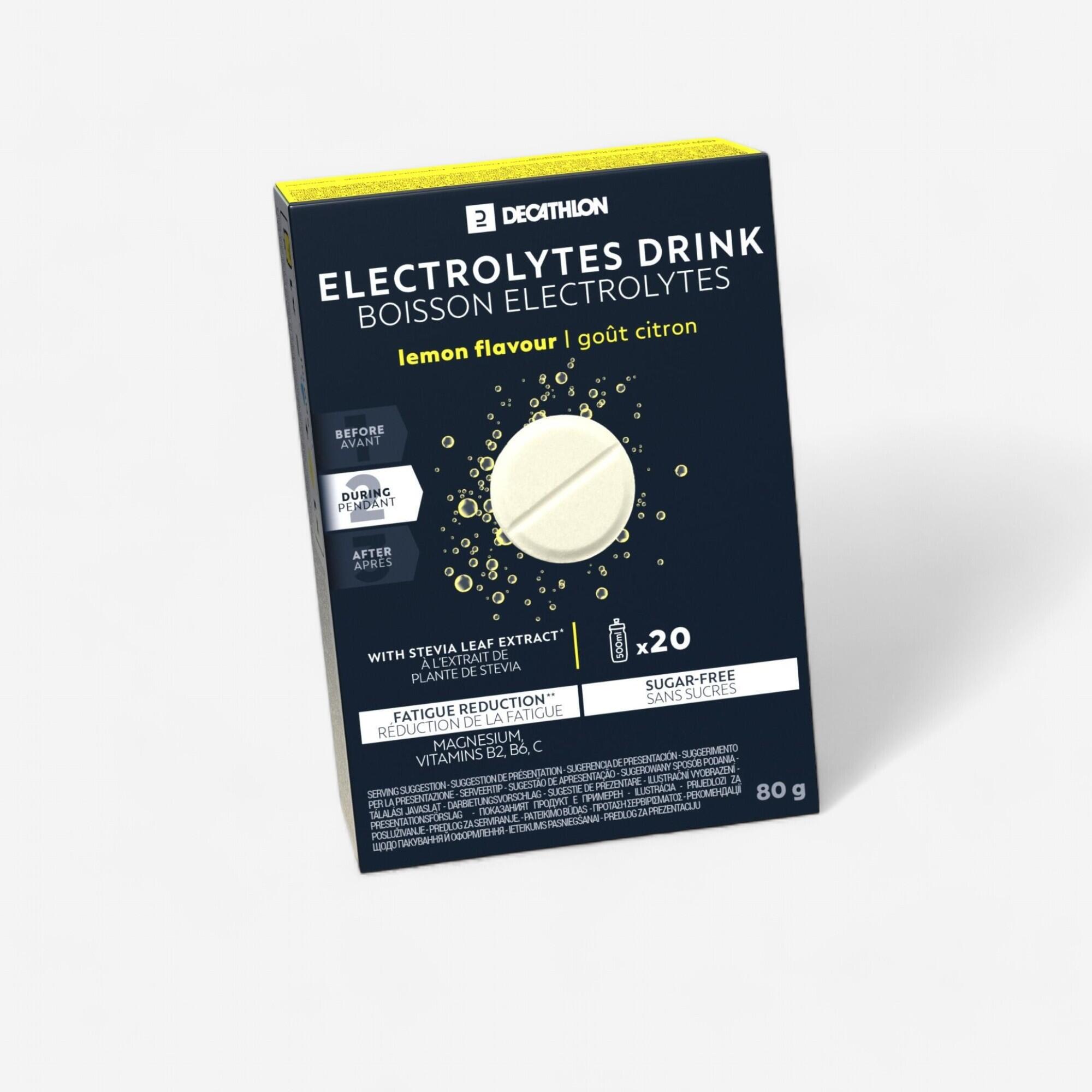
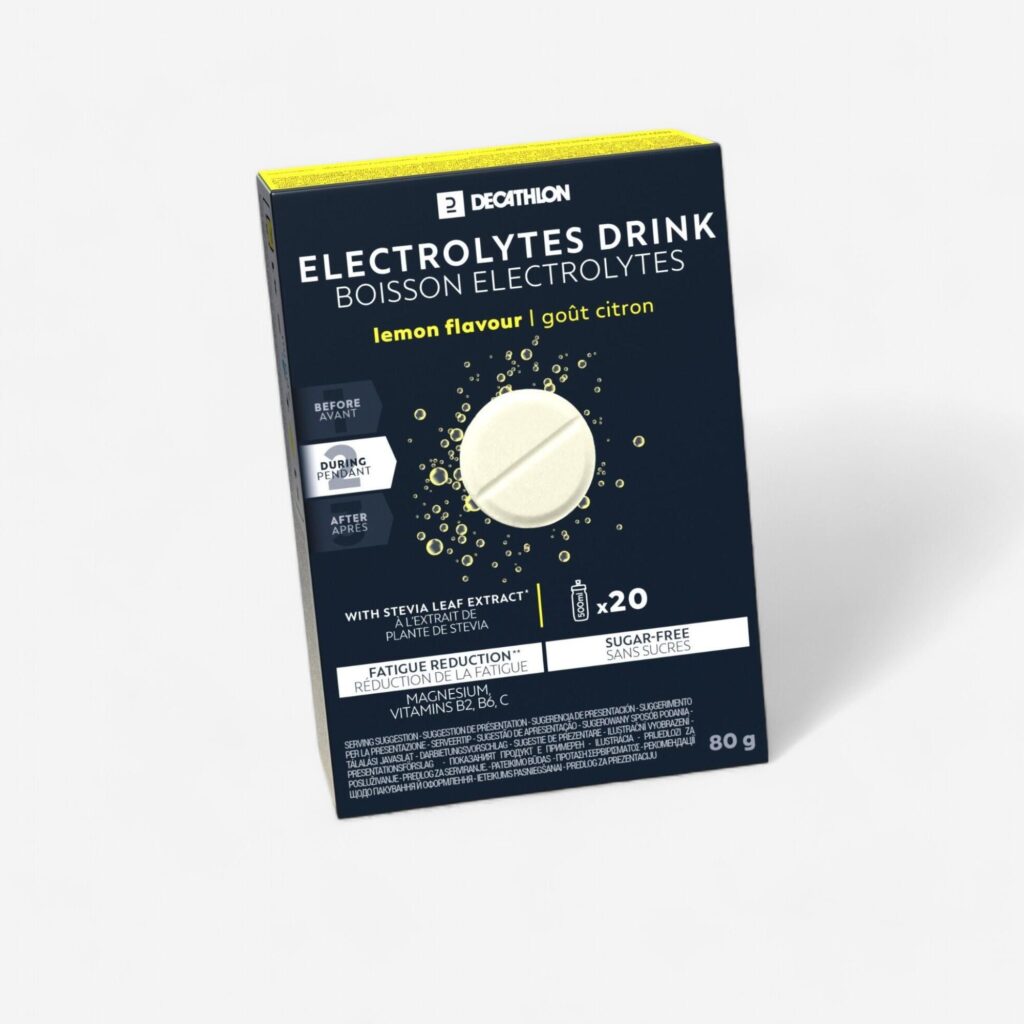
Decathlon’s sugar-free effervescent tabs — formerly sold under the Aptonia name — are designed, by the brand’s account, by triathletes for sessions and races under three hours. One 4 g tablet makes one 500 ml bottle, and it carries a score line so you can split it for the narrower neck of a soft flask.
Per tablet you get 250 mg of sodium, 100 mg of potassium, 56 mg of magnesium and 40 mg of calcium, plus vitamins C, B1, B2 and B6 at 30% of reference intakes. That is a sodium-led profile, which is what you want when the goal is replacing sweat. At €6.99 for 20, it costs around €0.35 a bottle. The independent dietitian ranked these tabs second-best value in his twelve-product panel, while noting they are a touch light on sodium and clearly light on potassium and calcium.
The product is not without quirks:
- Sorbitol. The bulking agent is a polyol, and most of the 1.4 g of « carbohydrate » per tablet is likely sorbitol. Polyols can upset sensitive stomachs at high doses. At one tablet per bottle you would need to drink a lot of bottles to get there, but if your gut is fragile on long days, it’s a variable to rule out.
- Magnesium oxide. A cheap, less readily absorbed form of magnesium than the citrates used by Hydratis and pricier brands.
- Muddled labelling. Decathlon’s product page announces « 2 electrolytes: sodium and magnesium » a few lines above an ingredient list that also includes potassium and calcium.
- A dated physiology claim. The page says the electrolytes help clear lactic acid, described as a waste product behind heavy legs. That view of lactate has been out of date for years, and electrolyte tablets do not flush it from your muscles. Buy them for the sodium, not the lactate story.
One practical tip straight from Decathlon: the tabs stay slightly fizzy, so leave your bottle valve open for a moment after dropping one in. Otherwise you will get a spray in the face on your first sip.
Neither of them is fuel
This is the most common misunderstanding about hydration tablets. Decathlon’s tabs contain 7 kcal per bottle. Hydratis contains a gram or two of sugar. On a ride or run longer than about an hour to ninety minutes, your body needs carbohydrate — typically tens of grams an hour — and no tablet comes close.
So the right way to think about tablets on a long day is as one layer of a strategy: salt in the bottle, carbohydrate from gels, bars, chews or real food. If you want the fuelling side of that equation, our trail running nutrition and hydration guide covers before, during and after, and our look at GU Energy explains how the modern energy gel came to be. The alternative is an energy drink mix that combines carbohydrate and electrolytes in the same bottle — which is the route many riders prefer on very long efforts.
How to read any hydration tablet label
The two products in this guide are only examples. The method works for any tube on any shelf:
- Bring everything back to one bottle. Brands publish values per 100 g, per tablet, per two tablets or — like Hydratis — per five tablets. Find the sport dose and the volume it goes into, then calculate per 500 ml.
- Read the sodium line first. Aim for roughly 250–500 mg per bottle for exercise, more if you sweat heavily or it’s hot. Under 150 mg, you are mostly buying flavour.
- Then potassium and magnesium. Useful, but secondary during the effort itself. A formula with more potassium than sodium is designed for everyday sipping, not sweat replacement.
- Decide on sugar versus sweetener. Sugar-free suits short efforts and daily use. A little glucose helps absorption. A lot of sugar turns the product into a sports drink — fine on long efforts, if you account for it.
- Check for polyols. Sorbitol, maltitol and friends can cause digestive trouble in large amounts.
- Calculate the price per bottle, not per tube. A tube that looks cheap can be expensive if the sport dose is two tablets.
- Be wary of health claims that go beyond hydration. Skin, hangovers, lactic acid — the further a claim drifts from « replaces sweat losses », the less weight it deserves.
Using hydration tablets on the bike and on the trail
On a gravel ride, the simplest system is one tablet per bottle and a spare tube in the jersey pocket, refilling at fountains or cafés. How many bottles you carry — and whether a pack makes more sense — is covered in our gravel hydration guide. Trail runners using soft flasks will appreciate the Decathlon tabs’ score line; if you’re still choosing a vest to carry them in, start with how to choose a trail running hydration pack, and if you’re curious about who actually makes most of the flasks on the market, read our piece on HydraPak.
A few rules of thumb, whichever tube you buy:
- Under an hour in mild weather: water is fine. Tablets are optional.
- One to three hours, or any hot day: a sodium-led tablet in every bottle makes sense.
- Multi-day trips and ultras: combine tablets with salty food, and don’t rely on a low-sodium product. Our first bikepacking trip guide and ultra-trail preparation guide cover the bigger planning picture.
- Don’t overdrink. Drinking far beyond thirst over many hours is the main driver of hyponatremia, with or without tablets.
- Respect daily limits. Hydratis caps use at five tablets a day; check the label of whatever you use.
- Talk to a doctor first if you have kidney or heart disease, high blood pressure, take diuretics or other medication affecting mineral balance, or are pregnant. Potassium-rich formulas in particular are not for fragile kidneys.
Our Take
If you ride or run for more than an hour and want a tablet to put salt back in your bottle, Decathlon’s electrolyte tabs do the job better than Hydratis for roughly a third of the cost per bottle. They are not perfect — magnesium oxide, sorbitol, and a product page that needs a physiology update — but they put a meaningful dose of sodium in every bottle, and that is the point.
Hydratis is a well-made, pleasant product that is honest about being sugared and broadly targeted. It suits people who simply want to drink more water during a heatwave, on a plane or at the office. For sport, its low sodium and two-tablet dose make it the expensive way to get not quite enough. Buy it if you love the flavours. Don’t buy it because it’s in the pharmacy and costs more, and therefore must be better.
Whatever you choose, the habit worth building is reading one line on the label — sodium per bottle — before anything else.
FAQ
Do I need hydration tablets for a one-hour ride or run?
Usually not. In mild conditions, water is enough for an hour. Tablets become useful beyond that, in heat, or if you are a heavy, salty sweater.
How many tablets should I use per bottle?
Follow the brand’s sport dose: one Decathlon tab per 500 ml, two Hydratis tablets per 500 ml. Then check what that gives you in sodium, because the dose alone doesn’t tell you whether it’s enough.
Are hydration tablets with sugar better?
A small amount of glucose can help fluid absorption, but the sugar in tablets like Hydratis is far too little to fuel exercise. For long efforts, you need a separate carbohydrate source or a proper energy drink mix.
Can hydration tablets prevent cramps?
Not reliably. Cramps have several causes, including fatigue and intensity, and electrolyte loss is only one possible factor. Brands often hint at cramp prevention, but the evidence doesn’t support treating a tablet as a cramp cure.
Is Hydratis an oral rehydration solution?
No. It is a food supplement inspired by the ORS principle, but at its sport dose it contains only a fraction of the sodium found in a WHO-standard oral rehydration solution. For dehydration caused by illness, use a pharmacy ORS and seek medical advice.
Can I drink hydration tablets every day?
Within the label’s daily limit, generally yes for healthy adults, but it is rarely necessary if you eat normally and aren’t sweating heavily. If you have a kidney, heart or blood-pressure condition, ask a doctor first.
Full compositions, flavours and stockists are on the official Hydratis site and on Decathlon’s electrolyte tabs product page.