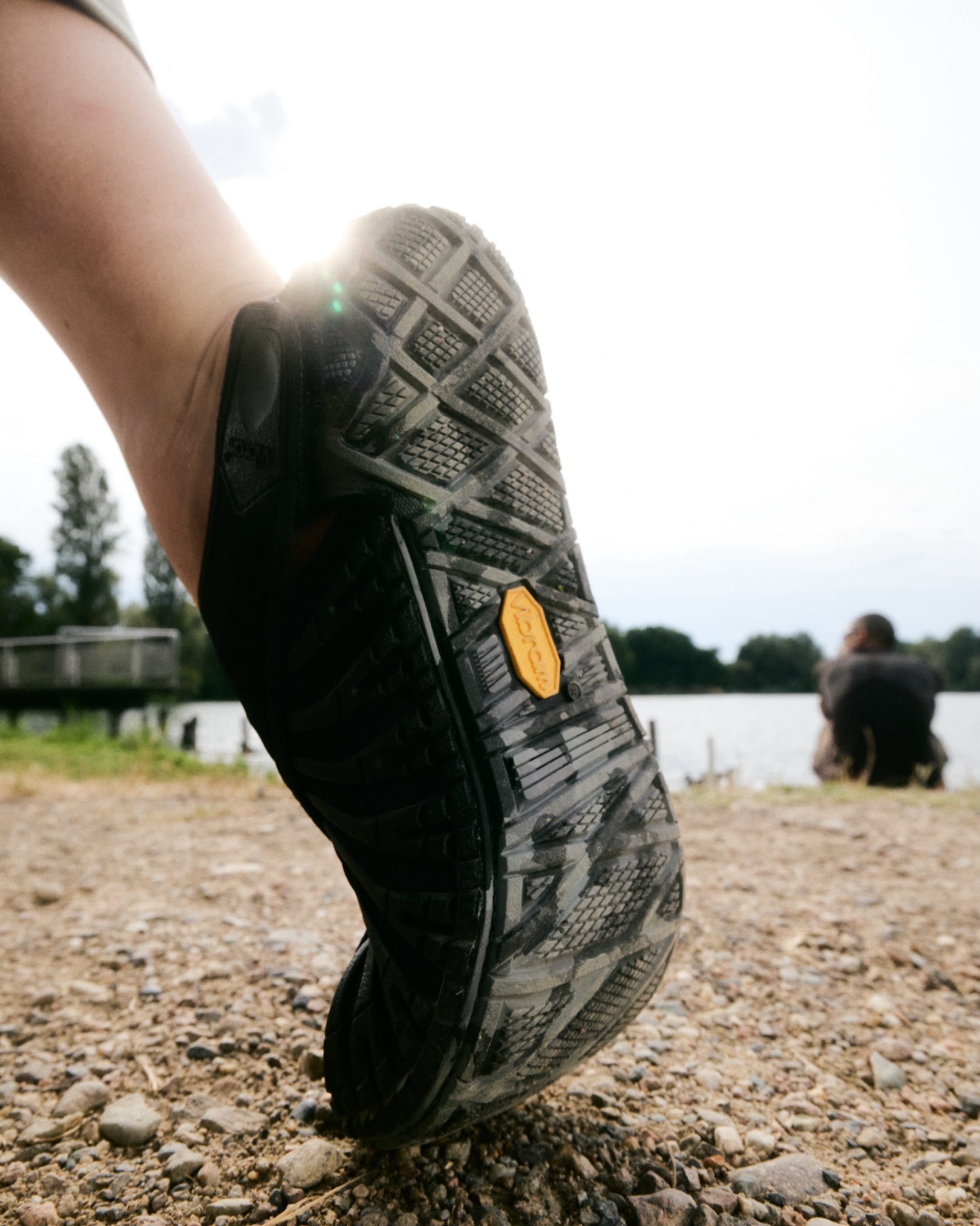
Flip over almost any serious trail shoe released in the last five years and there’s a decent chance you’ll find a small yellow octagon stamped into the rubber. Norda, NNormal, Hoka, Altra, Mount to Coast — brands that agree on almost nothing else in terms of geometry, drop, or cushioning philosophy all converge on the same outsole supplier. That supplier is Vibram, and its Megagrip family of compounds has become close to a default setting for anyone building a shoe meant to survive wet rock, loose scree, or a hundred miles of mixed terrain.
According to Monocle, the Italian manufacturer produces more than 40 million soles a year and counts Nike, Arc’teryx and the sandal specialist Suicoke among its clients, alongside the outdoor and running brands most readers here already know. That scale is worth pausing on: Vibram isn’t a boutique rubber lab supplying a handful of niche brands. It is, in practical terms, infrastructure — the kind of component that shapes what a shoe can do before a single designer has drawn a lug pattern.
So what’s actually inside that yellow logo, and does the marketing match what independent testers find on the ground? Here’s what we could verify.
From a Mountaineering Tragedy to 40 Million Soles a Year
Vibram’s origin story is one of the more sobering ones in outdoor gear. In 1935, Italian mountaineer Vitale Bramani led a climb in the Alps that ended with six of his companions dead — their leather, hobnailed boots offered no real grip on wet, icy rock, and the group was caught out by a storm during the descent. Bramani, convinced that footwear had failed his friends as much as the weather had, spent the following two years developing a vulcanized rubber lug sole. Backed by Leopoldo Pirelli, he launched it in 1937 under the name Vibram, and the first pattern — the deep-lugged Carrarmato, Italian for « tank tread » — is still produced today in only slightly modified form.
The brand’s credibility was cemented in 1954, when the Italian expedition that made the first ascent of K2 climbed in boots fitted with Vibram soles. From there the company expanded steadily into hiking, work, and military footwear through the second half of the 20th century, opened a dedicated testing facility in Albizzate in 1991, and eventually built the version of itself we recognize now: the outsole supplier of choice for outdoor performance brands, and, more recently, an unlikely presence in fashion, with collaborations spanning Balenciaga to Hoka. Fellow Italian mountain brand La Sportiva, born in the Dolomites a decade before Vibram itself, has been one of the closest long-term partners in that history, building its approach and alpine footwear around Vibram rubber for decades.
The Compound Family, Decoded
« Vibram » isn’t a single rubber recipe — it’s a portfolio of compounds, each tuned for a different job. For runners and hikers, four names come up regularly, plus a fifth aimed at a completely different market.
Vibram Megagrip
The workhorse of the range. Megagrip is built for balance: strong traction on both wet and dry surfaces, decent durability, and enough flexibility to adapt to uneven ground. It’s the compound you’ll find across the widest range of trail, hiking, and even gravel-adjacent shoes, precisely because it doesn’t specialize — it’s the safe, competent default.
Vibram Megagrip Elite
A newer, race-focused variant, fine-tuned specifically for competitive trail running rather than everyday hiking. Vibram positions it around durability under race-day intensity — vertical kilometers, technical climbs, hundred-mile efforts — with the same wet/dry grip profile as standard Megagrip but reworked for performance footwear rather than all-round use.
Vibram Litebase
Not a different rubber so much as a different construction: Litebase reduces the sole’s thickness by around 50%, cutting its weight by up to 30%, while claiming to preserve Megagrip-level grip and durability. This is the technology behind some of the lightest, most minimal-feeling trail shoes on the market — it shows up heavily across NNormal’s Kjerag and Tomir lines, and on several Norda models.
Vibram Traction Lug
A geometry-first approach: rather than changing the rubber, Traction Lug redesigns the shape of the studs themselves, claiming up to 25% more traction and a 50% larger contact surface depending on terrain. NNormal uses it on the Tomir, often paired with Litebase for the underlying rubber.
Vibram XS Trek Evo
Aimed at wet, mixed-use terrain rather than pure trail — think multisport, watersports, and shoes that need to transition between rock, mud, and boat decks without marking indoor floors. Less relevant to dedicated trail runners, more relevant to approach shoes and hybrid outdoor footwear.
There’s also a sixth compound worth a mention purely for context: Vibram Megagrip Pro, which Vibram markets for safety and work boots — construction, oil and gas, utilities. It shares the Megagrip name and the wet/dry/rock grip profile, but it’s built for steel-toe work boots, not running shoes, so it sits outside what matters for most hill.camp readers.
| Compound | Built for | Trade-off |
|---|---|---|
| Megagrip | All-round trail, hiking | Jack of all trades, master of none |
| Megagrip Elite | Competitive trail racing | Tuned for race intensity over long-term daily wear |
| Litebase | Lightweight race and fastpacking shoes | Thinner sole, less protection on sharp terrain |
| Traction Lug | Technical, loose or steep terrain | Aggressive lugs feel harsh on hardpack or road sections |
| XS Trek Evo | Wet, mixed multisport use | Not optimized for pure trail running grip |
What Independent Testers Actually Say
Here’s where the marketing needs a reality check. Trek & Mountain‘s deep dive into sole rubber makes a point that’s easy to miss in brand copy: grip and durability pull in opposite directions, and no compound escapes that trade-off entirely. The outlet found that Vibram Megagrip, mounted on the Scarpa Crux, gripped impressively on rock during field testing — but developed a reputation for wearing out relatively quickly under regular use. The same piece rates « standard issue Vibram » as a strong compromise between grip and longevity for all-round hiking and running use, while noting that Salomon’s own Contragrip compound tends to perform fine in the dry but can get slippery on wet, smooth rock — a useful reminder that Vibram isn’t automatically superior to every in-house alternative, just a very reliable, well-tested one.
That nuance matters. Vibram’s own product pages naturally lead with the upside — traction, durability, confidence — but independent field testing suggests the honest framing is closer to: very good, well-engineered, and consistent across a huge range of conditions, without being flawless or wear-proof on every model it touches.
On the Trail: Who’s Actually Running on Vibram
The compound family shows up across a wide swath of the shoes we’ve covered here. Norda’s 005 and its siblings lean on Vibram’s Litebase construction to keep weight down without giving up grip on technical terrain. NNormal builds its entire outsole strategy around Vibram, pairing Litebase with Traction Lug geometry across the Kjerag, Tomir, and Cadí. On the road-to-trail side, Altra’s Torin 9 brought Vibram rubber to a shoe that’s mostly built for pavement — a fairly rare crossover. And Mount to Coast paired Vibram with a Kevlar upper on its debut trail shoe, the T1.
Beyond hill.camp’s own coverage, Vibram lists the Hoka Speedgoat 6, the Scarpa Spin Infinity GTX, and the Nike Zegama 2 as current Megagrip-equipped models — a useful reminder of just how far the compound spreads across brands that otherwise compete directly against each other.
The Brands That Say No
Not everyone licenses Vibram, and that’s worth noting for balance. Salomon has built its Contragrip compounds in-house for years, betting on its own rubber science rather than an external supplier — with, per Trek & Mountain‘s testing, a real weakness on wet, polished rock compared to Vibram’s stickier options. Some Altra and Hoka models also ship with proprietary or co-developed rubber rather than Vibram, generally to hit a specific price point or weight target that Vibram’s compounds don’t serve as well. Neither choice is automatically wrong — it’s a genuine trade-off between an in-house compound tuned exactly to one brand’s needs, and Vibram’s broader, heavily tested track record across dozens of brands and millions of pairs.
What’s clear is that Vibram’s ubiquity isn’t accidental marketing — it’s the result of nine decades of rubber R&D, a genuinely wide compound lineup built for different jobs, and enough independent field testing to back up most of what’s printed on the box. For the full breakdown of every compound and where each is used, Vibram’s own technology pages are worth a look.