hill.camp does not test products first-hand. This guide is a structured synthesis of seventeen sources — independent binding tests, season-long and single-day reviews from the snowboard and outdoor press, a coach’s on-snow trial, two critical demo-day reports, owner discussions, trade-press previews, the system’s launch announcement, and brand and retailer information (flagged as such where it appears) — assembled with AI assistance and edited before publication. Several sources have a commercial interest in FASE; we say so where it matters.
FASE bindings arrived for the 2025/26 season with an unusually modest promise. They do not ask you to buy new boots, they do not lock you in with a pedal and a lever, and they do not pretend you will never touch a ratchet again. FASE is a two-strap binding with three changes: a highback that opens and closes itself, an ankle strap that never fully comes apart, and a toe strap you set once and leave alone. You still crank one strap. You just stop wrestling with the other one.
That modesty has made FASE the fastest-growing idea in bindings. In its second season, the system is offered by four brands across eleven models, and Bataleon told retailers that demand for its FASE bindings was outpacing inventory. It has also made FASE divisive: one camp says it is the first quick-entry design that rides exactly like a normal binding, the other that it is a normal binding with more parts to freeze. This guide explains how FASE works, what testers actually found, and how the 2026/27 models differ. If you want the wider picture of quick-entry systems first, start with our guide to fast-entry bindings.
Quick Specs
| What it is | A licensed « ingredient » system built into two-strap bindings, not a binding brand |
| Key parts | AutoBack self-closing highback, FastStrap ankle strap, Locked-In toe strap |
| Entry | Semi-automatic: step in from behind, then ratchet the ankle strap |
| Boots | Regular snowboard boots; no special sole or cleats |
| Claimed added weight | 40 g per binding (manufacturer figure) |
| Brands (2026/27) | Jones, Rome, Bataleon, ThirtyTwo |
| US price range | About $280 to $490 |
| Warranty | Lifetime on the FASE mechanism; brand warranty on the rest of the binding |
| Launched | 2025/26 season, after seven years of development |
How FASE Works
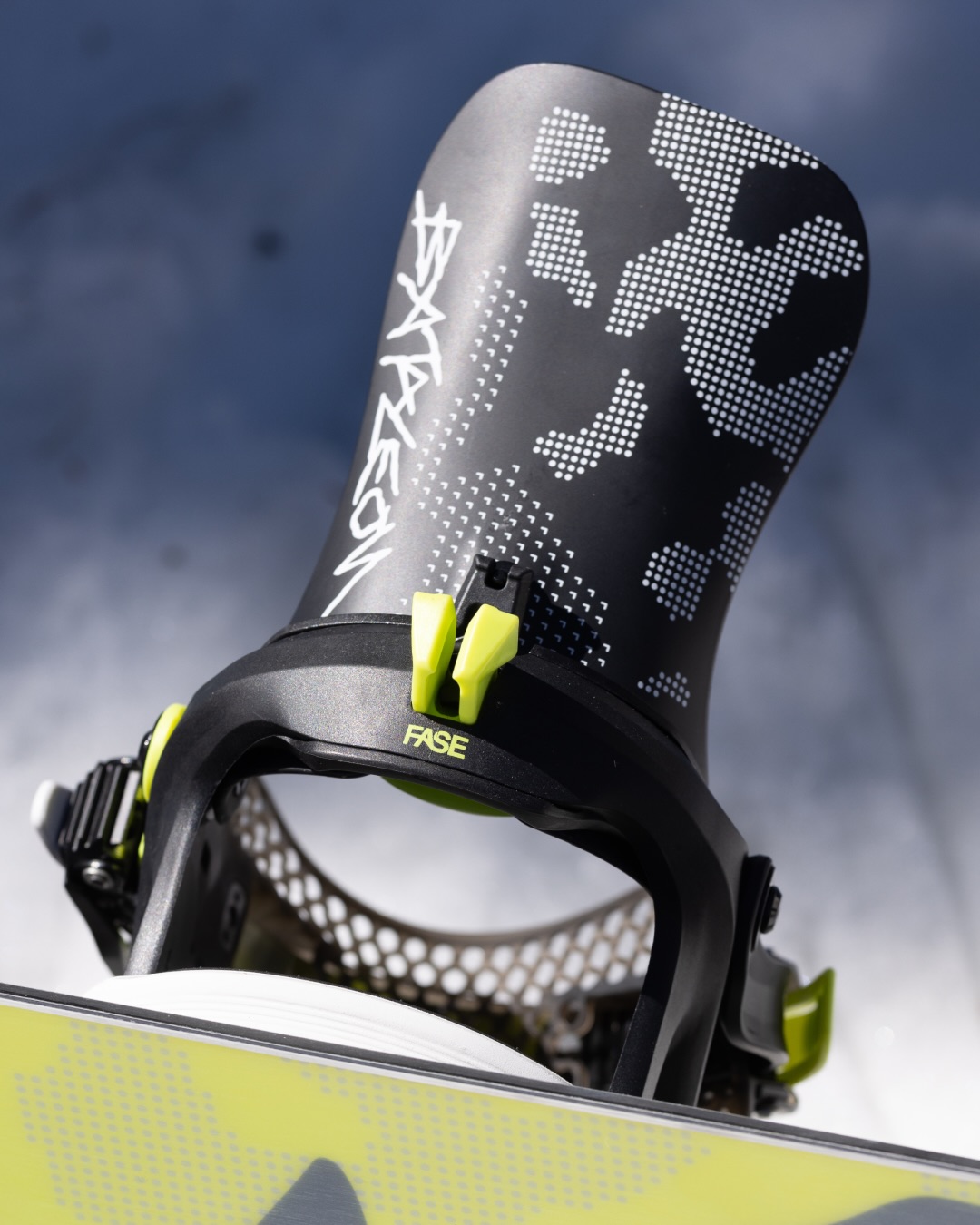
Every FASE binding shares the same three components. Everything else, from baseplate to straps to flex, is up to the brand, which is why a Jones Mercury FASE and a ThirtyTwo Basin FASE ride nothing alike.
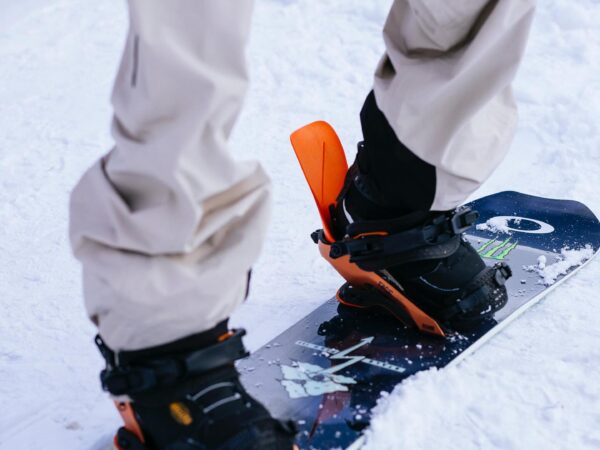
- AutoBack. The highback can recline far back, leaving the rear of the binding open. A small pressure-sensitive pedal in the heelcup acts like a trap: when your heel presses down on it, the highback snaps up and locks behind your boot. When you loosen the ankle strap and lift your heel, it releases again. The highback also folds flat for chairlifts and storage.
- FastStrap. The ankle strap uses a longer ladder that never fully leaves its buckle. Instead of two loose halves, you get a wide loop to slide your boot through, then cinch it with one hand.
- Locked-In Toe Strap. An auto-locking buckle and a toothed ladder are meant to hold the toe strap at your chosen tension all day. You set it once, at home, and your boot slides under it on every entry.
In practice, getting in looks like putting on a slipper. Recline the highback, slide your toe forward until it meets the toe strap, step down on the heel pedal, and ratchet the ankle strap. Getting out means releasing the ankle strap and lifting the heel. One tester notes a small technique point that takes a few runs to learn: the exit works best when you drive the knee forward rather than pulling straight up. And if anything goes wrong, you can always open both straps and use FASE as a normal binding, which Jones states explicitly on its own FASE page.
Where FASE Came From
FASE was announced as a patented system co-invented by David Partridge and JF Pelchat, a figure from snowboarding’s early Wildcat crew, and developed over seven years before launch. It sits inside the Nidecker group, the Swiss family company whose stable includes Jones, Bataleon, Rome and ThirtyTwo, and whose own Nidecker-branded bindings use the separate, fully automatic Supermatic. Interviewed by Snowboarder, Henry and Xavier Nidecker explained the thinking: Burton’s Step On was ingenious, but snowboarding’s core resisted it because it changed too much. FASE was designed to feel familiar.
The first four models, all launched for 2025/26, were FASE versions of existing favourites: the Bataleon Blaster, Rome Katana and Jones Mercury, plus ThirtyTwo’s first-ever binding, the T32M. A long list of pros rides them, including Jeremy Jones, Victor de Le Rue, Ståle Sandbech, Scott Stevens, Pat Fava and Tor Lundström; one blog reports that de Le Rue won the opening Freeride World Tour stop of 2025 on Mercury FASE bindings.
Does It Ride Like a Normal Binding?
This is the one point on which almost every source agrees. Snowboarder’s Josh Sullivan, who rode two FASE models for most of a season across the East Coast and Colorado, called it a regular binding, only easier, and found no adjustment period. The Inertia rode the Jones Mercury FASE for a full season and named it its favourite of the FASE bindings. A Swedish coach who borrowed a Mercury FASE on a choppy Cervinia run felt no difference from the conventional bindings he knows. Outside’s Lisa Jhung went further, arguing that the fixed toe strap gives her more consistent control than ordinary straps, because there is one less strap to get wrong.
The most useful comparison comes from The Good Ride, which rode the Bataleon Blaster AW FASE alongside the Union Atlas Step On. Its reviewer found that Step On releases the heel much faster, but that FASE holds noticeably better on hard heelside carves, much better, in his view, than both Step On and the Nidecker Supermatic. That is the core of the FASE argument: you trade a little entry speed for a fully strapped-in feel. Sullivan even lost a toe-strap screw at Palisades and rode three hours without a toe strap; the binding still worked as a binding.
How Much Faster Is It, Really?
Here the sources range widely, and the spread is worth seeing whole:
- The Good Ride: about as fast as Step On to get into, once learned.
- The Swedish coach: insanely quick, and easier to get into than Burton’s three-point Step On system.
- Snowboarder: nominally easier, perhaps 20 per cent, and most noticeable when strapping in at an awkward spot such as a sidecountry traverse or the top of a hiked jump line.
- A Utah rider on Reddit who tested the Katana FASE for two days with two friends: maybe half a second faster per entry, and not worth the extra moving parts to them.
- Board of the World, testing three models at two cold demo days: not faster at all, because frozen buckles slowed every adjustment.
Two things explain most of the gap. First, practice: several testers describe the step-in motion as unnatural at first and smooth after a few runs. Second, setup: FASE only saves time if the toe strap is already at the right tension, which is why every brand and retailer says to dial it in at home. Our reading is that FASE is clearly faster than a normal binding once it is set up and learned, but not as fast or hands-free as Step On or the Supermatic, because you always finish by ratcheting the ankle strap.
The Known Problems
No source reports a safety failure, but a consistent list of quirks emerges across testers and owners.
Cold and frozen buckles
The most widely shared criticism comes from Board of the World’s Steve Weber, who tried three FASE models at two demo events, one in 7°F cold at Stratton and one at an indoor slope where the bindings had sat on the snow all morning. The sliding FastStrap buckle froze on the Bataleon Blaster and the extra inner adjustment buckle froze on the Katana, so he could not dial in the fit and felt he might fall out. Weber is candid that demo conditions are not typical: buyers set up their bindings warm, at home.
Others report nothing of the kind. A Reddit owner rode all four launch models from January to spring, in sub-zero and slushy conditions, with zero ratchet problems; a Jones and ThirtyTwo team rider says a ladder broke on the first-generation version and that FASE has since switched to a softer plastic that does not freeze. Temperature also seems to work the other way indoors: the Swedish coach found the ratchet sluggish in a warm room and smooth on the mountain, and was told the plastics soften indoors and add friction. Expect home try-ons to feel grippier than the real thing.
The reclined highback
Once you step out, the AutoBack lies far back, opening through closer to 160 degrees than the usual 90. Weber kept kicking it while skating to the lift and had to fold it over by hand or foot. Owners reply that you should fold any highback down before the chairlift anyway, and one measured the folded highback at less than four centimetres beyond the heel loop. A Japanese-lift detail from another owner is worth noting: where chairs load low, everyone folds the highback, and doing so means forcing the plastic lever out of the mechanism, which he suspects is the most likely wear point.
Less adjustability
The FASE mechanism does not allow highback rotation, so the Katana FASE loses a feature the standard Katana has. The Good Ride also found forward lean adjustment limited on the Blaster FASE, while The Inertia rated the Mercury FASE’s adjustability strong overall, with adjustable highback lean, and only slightly behind Union’s Atlas Pro. If you rotate your highbacks to match your stance angles, this matters.
Snow, screws and boot heels
- Snow in the binding. The Good Ride found snow hard to clear from the footbed on powder days, especially with gloves. Outside’s Lisa Jhung found the opposite: snow under her boot was simply pushed out or melted, unlike the step-in system she rode in the 1990s.
- Toe-strap screws. Two independent testers lost one: Sullivan’s fell out at Palisades, and one of The Inertia’s testers sheared one on the first ride. Both were easily replaced, but it is worth checking hardware before your first day.
- Boot compatibility. Jones calls FASE compatible with all standard snowboard boots, while Rome’s own page says most. The difference shows up at the heel. Weber found the rubber heel of his boots catching on the release lever when stepping out; a ThirtyTwo rep told him the brand’s new boots wrap the heel in plastic to make exit smoother. Outside’s boot testers found the lipped backstay of the Nidecker Altai catching in FASE bindings when unstrapping. Our best snowboard boots of 2026/27 notes which boots are built with quick-entry bindings in mind.
- Long-term durability. The Good Ride, which liked the Blaster FASE enough to keep it, still lists longevity under constant step-in use as an open question. The lifetime warranty on the mechanism, which covers the pedal, spring, axle and forward-lean hitch, is the system’s answer.
Weight: 40 Grams on Paper
The FASE mechanism itself is claimed to weigh just 40 g, and brand material quotes 870 g for a medium Mercury FASE. Independent scales give a less flattering picture of the bindings as a whole: The Inertia lists the Mercury FASE at 900 g, Snowboarding Profiles measured a Katana AW FASE at 1,100 g against a men’s average of about 938 g, and The Good Ride weighed the Katana FASE at 2 lb 7 oz (about 1,105 g) and the Blaster FASE at 2 lb 5 oz (about 1,050 g). The added weight of the system is small, but several FASE bindings are built on heavy-duty aluminium chassis and are not light to begin with. They are still far lighter than a Supermatic, which The Good Ride weighed at 2.8 lb, or about 1,270 g.
Who FASE Is For, and Who It Is Not For
FASE makes most sense for riders who like strap bindings and want them faster: people lapping short lifts, strapping in on traverses or at the top of hike-to features, parents helping kids, and anyone who wants to keep their current boots. Because each FASE binding is a different chassis, it covers every style, from the soft Basin and Nebula to the carbon Zenith.
Riders with limited mobility are where sources disagree. Weber argues that the Supermatic is the better choice for them, since FASE still requires bending down to ratchet the ankle strap. The Swedish coach points out that one strap means much less time bent over, and Sullivan recommends either FASE or Step On for riders whose backs or knees make strapping in difficult. A Reddit rider with use of only one hand explained why FASE appeals to him: no loose straps to line up with a fist or forearm. Our view is that FASE helps if your problem is fiddling, but not if your problem is bending; for the second case, look at fully hands-free systems, starting with our FASE vs Supermatic comparison.
For complete beginners, the binding matters more than the system. An Australian retailer argues that less lift-top chaos helps new riders, while Snowboarding Profiles warns that a stiff model like the Katana FASE is too much binding for a beginner. Pick a soft FASE model or a soft traditional binding.
The 2026/27 FASE Range
FASE has expanded from four models to eleven for its second season. Every brand has added a cheaper, softer option, Rome and Bataleon on a new one-piece « MonoFrame » chassis, while Jones, Rome and ThirtyTwo have added carbon flagships.
| Binding | Character | Flex (as rated) | US price | Status |
|---|---|---|---|---|
| ThirtyTwo Basin FASE | Soft, damp, playful park and resort | Soft | $279.95 | New |
| Jones Nebula FASE | Cushioned, forgiving, creative riding | 4/10 | $299.95 | New |
| Bataleon Ghost FASE | Budget all-mountain and park, MonoFrame chassis | 5/10 | $299.95 | New |
| Rome Volt FASE (men’s and women’s) | Freestyle, MonoFrame chassis | 5–6/10 | $329.95 | New |
| ThirtyTwo T32M FASE | Freestyle all-mountain | Mid (7/10 in one guide) | $329.95–349.95 | Carry-over |
| Jones Mercury FASE | Stiff all-mountain freeride | 8/10 | $370–390 | Carry-over |
| Bataleon Blaster AW FASE | Surfy all-mountain, aluminium AsymWrap chassis | 6/10 | $379.95 | Carry-over (colours only) |
| ThirtyTwo T32M XLT Carbon FASE | Stiff, responsive all-mountain and freeride, carbon highback | 8/10 | $399.95 | New |
| Rome Katana AW FASE (men’s and women’s) | Versatile all-mountain, highly adjustable straps | 6–8/10 | $409.95–429.95 | Women’s version new |
| Rome Katana AW FASE Pro | Carbon-infused Katana | 7–9/10 | $449.95 | New |
| Jones Zenith Carbon FASE | Carbon-injected, expert freeride | Stiff | $489.95 | New |
Prices are US list prices from brand and retailer listings; some vary by colourway or limited edition. Pro and collaboration versions also exist, including Bataleon’s Blaster Pro with Tor Lundström, ThirtyTwo T32M editions for Scott Stevens and Pat Fava, and a Basin made with Public Snowboards.
Jones Mercury FASE: the freeride benchmark
The best-tested FASE binding. The Inertia’s season-long test made it the favourite of the launch models: stiff and performance-oriented, with an asymmetric highback, a responsive baseplate and comfortable, hotspot-free straps. Its testers found the entry angle can be awkward on steep slopes or when sitting, and suggest using it as a normal two-strap binding in those moments. Outside’s Lisa Jhung and the Swedish coach both liked it. For 2026/27 Jones adds the softer Nebula FASE and the carbon Zenith FASE, neither of which has yet been tested by our independent sources.
Rome Katana AW FASE: the all-rounder
Board of the World’s Weber, despite his problems, rated the Katana FASE the best of the three models he tried, describing it as a high-end, damp, comfortable all-mountain binding. Snowboarding Profiles scored it 89.5/100, felt the flex at around 7/10, and found it stiffer and better at carving than the Blaster FASE, though not quite as nimble at low speed. Its reviewer found the entry not yet smooth after limited use and the ratchets less smooth releasing than tightening. It is one of the heaviest FASE bindings, and it gives up the standard Katana’s highback rotation. A carbon-infused Katana AW FASE Pro joins the range for 2026/27.
Bataleon Blaster AW FASE: the surfy option
Here the sources split hardest. The Good Ride liked it so much it asked to keep it as its reference quick-entry binding, praising its flex underfoot, near-excellent shock absorption, canted footbed and stiffer, better-holding straps than the Katana’s, and found it highly recommendable. Weber, whose buckles froze, found it felt like an entry-level binding with weak damping. A Reddit owner of all four launch models replied that the Blaster shares the Katana’s baseplate and was his favourite, closest in feel to the Union Ultra. Weber’s own conclusion was that a fair test was impossible in those conditions. The 2027 version is unchanged apart from colours. Bataleon’s new, cheaper Ghost FASE sits below it.
ThirtyTwo T32M, Basin and T32M XLT Carbon FASE: from park to freeride
ThirtyTwo’s first binding is the most park-oriented of the launch four. Weber found the T32M FASE worked as intended, describing it as light, mid-flexing and reminiscent of a Union Strata, though still a little clunky with its straps. Snowboarder’s Sullivan rode the Scott Stevens edition for much of his season. For 2026/27 the range grows in both directions: the softer, cheaper Basin FASE below it, and the T32M XLT Carbon FASE above it, ThirtyTwo’s most responsive binding, pairing a stiff carbon-fibre highback with a nylon and glass-fibre baseplate for advanced and expert riders. None of our independent sources has ridden either new model yet. Because ThirtyTwo also builds boots, it is the one brand that designs both halves of the connection, adapting its boot heels to FASE.
Setting Up FASE Bindings
- Do it at home, warm. Brands, retailers and critical reviewers agree: fine-tuning cold buckles on the hill is where FASE gets frustrating.
- Set the toe strap first. Position it over the toe box so your boot slides under and stops against it, at the tension you want for the whole day.
- Size the ankle strap loop. Too tight and entry gets hard; too loose and you lose response.
- Test your boots in the binding. Step in and out several times and watch the heel: a rubber heel cup or a lipped backstay can catch on the release lever.
- Check the hardware. Given two reports of lost toe-strap screws, tighten every screw before your first day and after the first few sessions.
- Fold the highback before the chairlift. It protects the mechanism and keeps it out of the way when skating.
How Far to Trust the Sources
FASE has attracted unusually partisan coverage. Whitelines’ deep dive is enthusiastic, built around team-rider quotes and shop links, and calls the system worth the hype on the strength of its test team’s season. One blog review reads largely like the brand’s own launch material, quoting R&D and team-rider feedback rather than its own riding. An Australian retailer’s review is generic. On the other side, the Reddit thread that spread Weber’s critical review was started by an account other users accused of a running grudge against FASE, and the official FASE account replied in the thread. We have given most weight to sources that rode the bindings themselves and say how: The Good Ride, The Inertia, Snowboarding Profiles, Snowboarder, Outside, the Swedish coach and Weber’s honest account of two bad demo days.
Our Take
FASE is the most conservative of the quick-entry systems, and that is its strength. It rides like the strap binding it is built on, works with the boots you already own, and holds better on hard heelside turns than the strapless or fully automatic alternatives. In exchange, it is only part of the way to hands-free: you still bend down once per foot, it loses a little adjustability, and it adds moving parts whose long-term durability is not yet proven.
If you already ride straps and like them, FASE is the easiest quick-entry system to adopt, and the choice comes down to the binding rather than the system: the Jones Mercury FASE for stiff all-mountain and freeride riding, the Rome Katana AW FASE for versatility, the Bataleon Blaster AW FASE for a surfier, damper feel, and the ThirtyTwo T32M or the new budget models for park and resort laps. Set it up at home, check your boot heels, and give yourself a few runs to learn the motion. If you want to stop bending over altogether, compare the fully automatic options in our Burton Step On vs Nidecker Supermatic comparison and our look at CLEW’s hybrid binding.
FAQ
What are FASE bindings?
FASE (Fast Entry System) is a mechanism built into two-strap snowboard bindings from Jones, Rome, Bataleon and ThirtyTwo. A self-closing highback, an ankle strap that stays connected and a pre-set toe strap let you step in from behind and tighten a single ratchet.
Do FASE bindings need special boots?
No. They work with regular snowboard boots. Some boot heels and backstays can catch on the release lever, so try your boots in the binding before buying.
Are FASE bindings hands-free?
Not completely. The highback closes by itself and the toe strap stays set, but you still ratchet the ankle strap by hand. Burton Step On and the Nidecker Supermatic are the fully hands-free alternatives.
Do FASE bindings freeze?
One reviewer had buckles freeze at two cold demo events, while several season-long owners report no problems. A team rider reports that first-generation straps were updated with a softer plastic, and brands recommend setting the bindings up at home rather than on the hill.
How much do FASE bindings weigh?
The mechanism adds a claimed 40 g. Complete bindings measured by independent testers range from about 900 g for a Jones Mercury FASE to about 1,100 g for a Rome Katana AW FASE, per binding.
Can you rotate the highback on FASE bindings?
No. The FASE mechanism does not allow highback rotation, and some testers found forward lean adjustment limited on some models.
Which FASE binding is best?
It depends on your riding. Testers’ favourites are the Jones Mercury FASE for stiff, all-mountain freeride, the Rome Katana AW FASE as a versatile all-rounder and the Bataleon Blaster AW FASE for a softer, surfier feel. For park riding or a lower budget, look at the ThirtyTwo T32M and Basin, the Bataleon Ghost, the Rome Volt and the Jones Nebula.
The system’s own explanations and demo-shop locators are on the brands’ sites: see Jones’s FASE guide and Rome’s FASE page. If you can, demo a pair on snow before you buy.