hill.camp does not test products first-hand. This guide is a structured synthesis of 12 sources — nine buyer’s guides from the specialist snowboard press, outdoor magazines and retailers in the US, the UK, France and Austria, a retailer’s preview of the 2026/27 ranges, a launch report and an owner thread on wide-foot fit — assembled with AI assistance and edited before publication. Very few of these testers rode the same boots in the same conditions, several guides mix this season’s models with carry-overs from earlier winters, and a boot that suits one foot can be wrong for the next. Treat the shortlist as a map of where the guides agree, not as a ranking.
Search for the best snowboard boots of 2026/27 and you will find nine confident lists that barely overlap. Between them, the guides we read recommend around sixty different models. A French retailer’s top ten shares a single boot with the top ten of a US outdoor magazine. One British title fills three of its eight winning slots with a single Austrian brand that the four American guides never mention. Everybody agrees that fit matters more than any feature, and then everybody picks different boots.
So we counted. Which models keep turning up when testers who do not share an employer, a continent or a foot shape go looking for the same thing? Where do they contradict each other on flex, sizing and price? And which heavily promoted new boots has nobody in our file actually ridden? If you want the principles first, our guide to choosing snowboard boots covers fit, flex and lacing. This article is about the models.
Quick Picks
| Use | Boot | Flex (as rated) | Lacing | US price | Guides listing it |
|---|---|---|---|---|---|
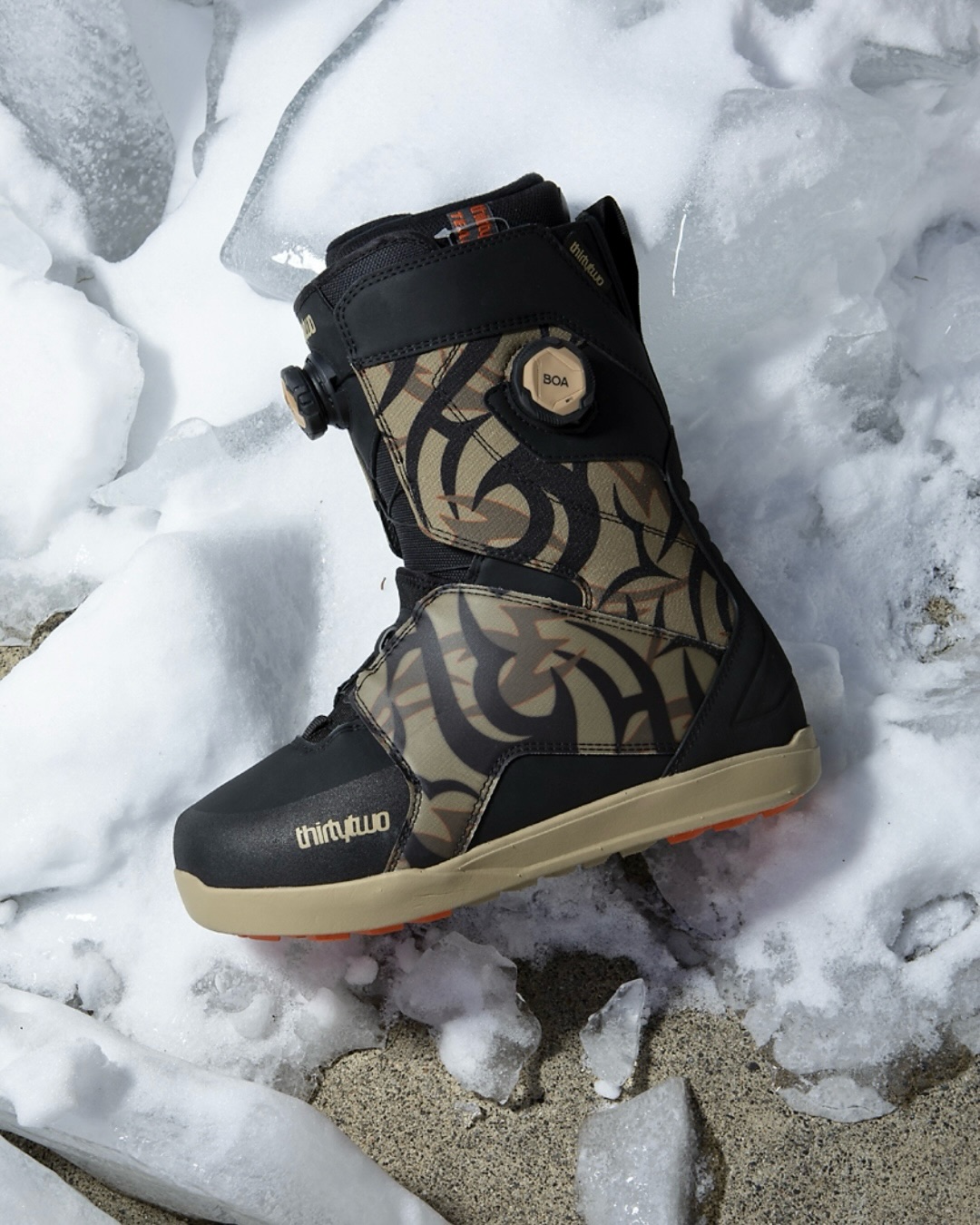
| All-mountain, most riders | ThirtyTwo Lashed Double BOA | Medium, 6/10 | Dual BOA | $400 | 5 of 9 (Lashed family) |
| All-mountain, alternative | Nitro Team BOA | Mid-stiff | Dual BOA | $460 | 3 of 9 (Team family) |
| Value | Nidecker Altai | Medium | Dual BOA | $320 | 3 of 9 |
| Beginners | Burton Moto BOA | Soft, 3/10 | Single BOA | $249–280 | 3 of 9 |
| Stiff, hard charging | Nidecker Kita | Stiff, 8–9/10 | Dual BOA | $480 | 5 of 9 |
| Supportive workhorse | K2 Maysis | Medium-stiff, 7/10 | Dual BOA with liner harness | $380 | 3 of 9 |
| Premium, built to last | Union Reset Pro | Stiff, 7–8/10 | Dual BOA | $650 | 2 of 9 |
| Step On, all-mountain | Burton Highshot X Step On | Medium-stiff, 6–7/10 | Dual BOA | $549 | 5 of 9 (Highshot X family) |
| Step On, comfort | Burton Waverange X Step On | Soft to medium, 3–6/10 | Dual BOA | $530 | 5 of 9 (Waverange family) |
| Wide feet | Salomon Dialogue Dual BOA | Medium, 4–6/10 | Dual BOA | $430 | 3 of 9 |
| Maximum adjustability | Head PSI Triple BOA | Disputed, see below | Triple BOA | $459 | 3 of 9 |
| Splitboarding | K2 Waive | Mid-stiff, walk mode | Lace + BOA | $590–600 | 2 of 9 |
Prices are the US figures quoted by the guides or current retail listings; where two guides quote different prices for the same boot, both are shown. « Family » means the count includes close variants such as lace versions, pro models or Step On editions.
How the Shortlist Was Built
Nine of our twelve sources are buyer’s guides with named picks. Two are large field tests: Outside, whose 32 testers rode 38 pairs across the Rockies, the Wasatch and the Sierra, and GearJunkie, where three testers rode 14 pairs over the past year. Three are smaller editorial tests (The Inertia, Whitelines, Mountain Weekly News), one is a single instructor’s long-term list (The Snow Chasers), one is a descriptive magazine guide (Snowboard International), and two are retailer selections (Glisshop in France, Blue Tomato in Austria).
We counted how many of those nine guides list each model, then read what each one says about it, including the complaints. A boot earned a place on the shortlist by appearing in at least three guides, or in two when both tested it and no better-supported rival exists for that use. Counting has an obvious weakness: guides copy the market’s bestsellers, and a boot that five outlets list is not five times better than one that a single careful tester loved. That is why the reservations get as much room below as the praise.
All-Mountain: ThirtyTwo Lashed Double BOA
No boot family shows up more often. Outside names the Lashed Double BOA its best all-mountain freestyle boot and its women’s all-mountain favourite. The Snow Chasers calls it the best freestyle-leaning all-mountain option. Blue Tomato lists it as a long-running classic, Mountain Weekly News picks the lace version, and GearJunkie gives its top strap-binding award to the Zeb Powell edition of the Lashed XLT with a 9/10 score.
What they describe is consistent: a medium flex that carves and holds a line but still lets you tweak a grab, a cushioned liner that moulds quickly, and good heel hold. The criticisms are consistent too. The Snow Chasers’ instructor says ThirtyTwo boots soften faster than stiffer rivals if you ride a lot. Outside’s testers had to retighten the BOA through the day, noticed some fraying at the eyelets, found the build bulky, and one developed a pressure point from this year’s restructured liner heel. A wide-footed Reddit rider found the Lashed too padded, with numbness after half an hour. It also needs a short break-in before it settles to a true medium.
One muddle to be aware of: GearJunkie describes the XLT Powell edition as medium-soft and park-oriented, while retailers sell the XLT as the stiffer version of the Lashed. If you are buying the XLT for extra support, flex it in a shop first.
Also consider: the Nitro Team BOA ($460), Outside’s best all-mountain boot outright, praised for comfort out of the box, heel hold and a Vibram outsole that copes with scrambling; testers found the fit snug and suggest going up half a size. The speed-lace Team Pro MK TLS appears in two more guides. And the Burton Ruler BOA ($329), The Snow Chasers’ pick for most riders and a Glisshop top-ten entry: easy to fit, quick to break in, available in wide, but with a basic liner and a flex that softens under heavy use.
Value: Nidecker Altai
Outside’s best-value pick at $320, Blue Tomato’s description of it as Nidecker’s bestseller, and a place in Glisshop’s top ten for the wide version make the Altai the clearest budget consensus with dual BOA. Outside’s testers rated it among the most comfortable boots in the whole test, including one with a history of foot pain who rode it without a professional fitting.
The same testers supply the caveats. The stock insoles are flimsy and one instructor replaced them immediately. Several worried about how long the lightweight foam outsole will last compared with rubber. A couple had to size up half a size. And there is a compatibility catch that retailer copy does not mention: Blue Tomato says the outsole is optimised for speed-entry bindings like the Supermatic, but Outside found the lipped backstay catches in FASE bindings when unstrapping. Blue Tomato also describes a new outsole with more grip for 2027, so the durability concern may apply to the version Outside rode rather than the one now on shelves.
Beginners: Burton Moto BOA
Three guides, the same verdict. The Snow Chasers’ instructor has put many new riders into the Moto and names it the best beginner boot. The Inertia calls it the best budget boot and one of the lightest it tested. Glisshop opens its top ten with it. It is soft (3/10), comfortable immediately and closes with one dial.
Nobody pretends it is more than that. The liner is thin and basic, the single BOA cannot tighten the foot and the cuff separately, and both testing guides expect improving riders to outgrow it within a season or two. The guides also disagree on what it costs: $249 in one, $280 in another.
Also consider: the Ride Octave ($350), The Inertia’s beginner pick, a 5/10 dual-BOA boot with an Intuition liner that leaves more room to progress, though testers doubted its durability. For riders who prefer laces and a skate-shoe feel, the Vans Hi-Standard OG ($199) is The Snow Chasers’ value pick and opens Mountain Weekly News’s list; both say it folds under heavier riders and at speed.
Stiff and Fast: Nidecker Kita
Five of nine guides list the Kita, which makes it the most widely recommended stiff boot of the season. Whitelines’ tester named it his favourite of everything he tried. The Inertia struggled to find a fault and noted that it undercuts most premium rivals. Mountain Weekly News toured in it and rates it among the best soft boots it has used for splitboarding. GearJunkie tested the new women’s version on frozen steeps and scored it 8.4/10.
There is a generation trap here. Blue Tomato reports that the Kita has been completely reworked for 2026/27, with a BOA-driven wrap strap around the shin, a new injected tongue, a new liner and a new Vibram outsole. GearJunkie rode that version. Whitelines marks the boot as unchanged and, like The Inertia and Mountain Weekly News, describes the earlier design with its external heel lock. The praise for fit, traction and power is shared across both generations, but check which one a discounted pair is.
All five agree on who should not buy it. Rated between 8 and 9 out of 10 depending on the source, it is too much boot for park riders, lighter riders and intermediates, and GearJunkie adds that the wrap strap is one more step every morning.
Also consider: the Ride Lasso Pro ($429–460), The Snow Chasers’ choice for aggressive riders, with heel hold praised everywhere. GearJunkie’s tester found its single shell dial pulls unevenly, over-tightening the cuff while the forefoot stays loose, then migrating during the day.
Supportive Workhorse: K2 Maysis
The Maysis is the boot the testers themselves ride. It is The Snow Chasers’ author’s current daily boot and his pick for advanced riders; The Inertia calls it a value all-rounder and notes that resorts use it in rental fleets, a fair sign of durability; Mountain Weekly News picks it for heel hold. The reason is the BOA-tightened harness around the liner, which every source credits with locking the heel without cutting circulation, plus an Intuition liner that breaks in quickly. At about $380 it is also one of the cheapest boots here with that level of support.
Against it: it is heavy and bulky, the upper cuff can loosen during hard riding, and The Inertia warns that it is easy to over-tighten. A Reddit rider who tried the wide version got burning pain from the straps over the instep and sent it back.
Premium: Union Reset Pro
Only two guides list the Reset Pro, but both tested it at length and both rank it at or near the top. The Inertia makes it the best boot overall; Whitelines includes it among its eight winners. Union’s argument is longevity: a shell made largely of Pebax with few seams, meant to hold its flex for 100 days or more. Whitelines’ tester reported very little change in flex after half a season, with only slight packing-out of the liner, and The Inertia needed just a day or two to break it in, unusual for a boot this stiff. Our own Union Reset Pro review covers the construction and the 2026/27 changes in detail, and our Union brand profile explains how a binding company came to build boots.
The reservations are price and warmth. Whitelines found the low-volume shell colder in low temperatures. On price, The Inertia’s guide shows $550 in its heading and $650 in its text; Union’s own site and current retail listings say $649.95, so $650 is the figure to plan on. The boot is in its second season, with a new Vibram midsole and outsole. One UK retailer’s listing also warns against heat-moulding it, which is worth confirming with the shop before anyone puts it in an oven. For 2026/27 Union adds a slightly softer Reset, which Blue Tomato lists as an insider tip; none of our testers has ridden it.
Step On Boots
Burton’s strapless system needs its own boots, and for 2026/27 the guides concentrate on two redesigned families. The Inertia points out that the Highshot and Waverange lines are the first Burton boots designed from the ground up around Step On.
The Highshot X Step On ($549) is the all-mountain choice. The Snow Chasers’ instructor, a long-time sceptic, says it changed his mind: more supportive than he expected and far more direct than earlier Step On boots, though too direct for freestyle. He rode it in Union’s Atlas Step On bindings, which he prefers to Burton’s originals. Snowboard International notes that it inherits the internal ankle hammock from the top model. That top model, the triple-BOA Highshot X Pro Step On ($730), earns GearJunkie’s highest score of the year, 9.4/10, for heel hold and response, with early creasing at the ankle and the price as the drawbacks.
The Waverange X Step On ($530) is the comfort choice, The Inertia’s best Step On boot and one of the most comfortable boots it has tested, soft to medium and suited to cruising. Here the guides split sharply over the top version. Whitelines approves of the Waverange X Pro. Outside lists it too, at $730, and calls it ridiculously priced: its expert testers found the flex too forgiving, cranked the dials for more response until their ankles hurt, and mostly missed their straps. Outside’s test team states that it strongly prefers traditional boots and recommends Step On mainly to instructors, parents, beginners and riders who struggle to bend down.
Whether the system suits you is a bigger question than which boot to pick. We cover it in Burton Step On vs Nidecker Supermatic.
Wide Feet
This is where the guides help least and owners help most. The Inertia names the Salomon Dialogue Dual BOA ($430) its best wide-fit boot because even the standard version felt broad in the forefoot, and a dedicated wide exists. Mountain Weekly News says the opposite of the standard boot: not for wide feet unless you buy the Wide. Glisshop lists it for medium-width feet. Try both versions. Glisshop’s wide pick is the Nidecker Altai Wide, and The Snow Chasers recommends the Burton Ruler Wide.
The Reddit thread in our file, written by riders with feet around 275 mm long and 110 mm wide, adds things no guide mentions. One commenter claims that many « wide » boots simply use a thinner liner in a standard shell, and that the only boots that truly fit him are ThirtyTwo’s Bode Merrill pro models. Another settled on the Ride Lasso Pro Wide after rejecting the Maysis Wide. A Step On rider found the regular Burton Ion painful and the Ion Wide right. The thread’s most useful observation is about sizing: manufacturers are inconsistent, even between models in their own range, and one rider ended up a full size apart between two brands in the same shop.
The European Picks: Deeluxe
Read only American guides and you would not know Deeluxe exists. Read the European ones and it is everywhere: three of Whitelines’ eight winners, four of Snowboard International’s nine boots, two of Blue Tomato’s picks. The Aeris Pro (7/10, hybrid lacing, about €450) appears in all three, described as a boot for fast, freestyle-minded riding across the whole mountain; Whitelines’ tester normally rides softer boots and still found the flex progressive rather than plank-like. The softer DNA Pro (5/10, about €380) won the same tester’s highest praise for heel hold, with two notes: it rides stiffer than its rating and runs big enough that he went down half a size.
The lack of American coverage looks like a matter of distribution and test fleets rather than a judgement on the boots. For riders in Europe, where Deeluxe is easy to try on, it belongs on the list.
Maximum Adjustability: Head PSI Triple BOA
Three guides pick out the PSI ($459) for the same feature: a third BOA dial built into the liner, which Outside considers the best integration of its kind and GearJunkie credits with virtually eliminating heel lift. Both praise the slim, snag-free shell.
Then they describe two different boots. Snowboard International lists the flex as 9/10. GearJunkie calls it a stout 8/10, too rigid for casual cruising or park. Outside’s testers found a natural, medium flex they stopped noticing, and suggest that committed freeriders may want something stiffer. All three do agree on fit: the low-volume shape suits average and narrow feet, and Outside warns riders with wide feet or high arches away from it.
Splitboarding: K2 Waive
Outside and The Inertia both name the Waive ($590–600) their splitboard boot, and The Inertia says nothing has displaced it in a couple of seasons. Releasing the upper BOA frees the calf for the skin track, the Vibram sole has a heel welt for semi-automatic crampons, and both guides rate the descent as highly as the climb. The cost is price, several steps to tighten, and a walk mode that Outside reminds readers is still well short of a hardboot’s.
New for 2026/27 and Not Yet Tested: K2 Theory
The K2 Theory is the most visible launch of the season. It appears in Glisshop’s top ten and Snowboard International’s guide, evo’s range preview calls it the biggest addition to K2’s line, and Snowboard International ran a separate launch report. The idea is a three-panel wrap around the foot, tightened by dual H5 BOA dials, intended to hold securely with fewer pressure points.
What our file does not contain is a single written on-snow verdict. Every description traces back to K2’s launch material, and evo’s writers say plainly that they are looking forward to trying it. Even the flex is unsettled: 7/10 according to Snowboard International, « intermediate » in Glisshop’s text and « stiff » in the same page’s table. It may turn out to be excellent. For now it is a promising boot with no independent evidence behind it, and it is not on our shortlist for that reason.
Flex Numbers Do Not Travel
The Head PSI is the most striking case, but the same thing happens all over these guides. Bataleon rates the Salsa 6/10; Outside’s testers would call it 8 or 8.5 and rename it a stiff boot, while Mountain Weekly News describes the same model as mellow. The Inertia lists the Nitro Team Pro MK at 8–9/10 in its specs and as a medium flex in its text. GearJunkie found the Head Raker, rated 7, rides like a 5. Whitelines’ tester thinks the Deeluxe DNA Pro is stiffer than its 5.
Flex ratings are set by each brand against its own range, and testers of different weights feel them differently. Use them to compare boots within one brand. Across brands, the only reliable test is to put the boot on and flex forward.
What Is Changing in Boot Design
Three trends run through this season’s guides. The first is BOA’s H5 dial, which turns both ways so tension can be released click by click instead of popped open; it appears on boots from Nidecker, K2, ThirtyTwo, Bataleon and Head, and one Reddit shopper counted it as a real advantage. The second is the third dial: triple BOA on the Burton Highshot X Pro and Waverange X Pro and on the Head PSI, in each case to control heel hold separately from shell tension. GearJunkie calls it the new top tier; Outside’s experience with the Waverange X Pro shows that more dials do not rescue a flex that is wrong for the rider.
The third is that boots are now shaped around quick-entry bindings. Nidecker tunes its soles and heels for the Supermatic, ThirtyTwo adapts its heels for FASE, and Deeluxe and Bataleon advertise similar optimisation. As the Altai example shows, a boot built for one system is not automatically friendly to another, so check your boot and binding together. Our quick-entry bindings guide explains the systems.
What the Guides Agree On About Buying
- Buy boots before bindings and board. Outside and GearJunkie both say it: boot size and footprint decide binding size and board width.
- Replace the insole. Outside, GearJunkie and The Snow Chasers independently describe stock footbeds as poor, on expensive boots as well as cheap ones.
- Do not trust size advice across brands. Outside’s testers went up half a size in the Nitro Team and the Altai; Whitelines’ tester went down half a size in the Deeluxe DNA Pro; The Snow Chasers warns against sizing up at all, and GearJunkie says to take the smaller size if you are between two. All of them can be right for the boot they were wearing.
- Dual BOA has become the default. Nine of our twelve quick picks use it. Single-dial boots draw the same complaint wherever they appear: you cannot tighten the cuff without squeezing the foot. Laces survive mainly in freestyle boots and hybrids.
- Try them on in a shop. Every guide ends with this, including the ones written by online retailers.
How Far to Trust the Sources
Most of these guides earn affiliate commission, and say so. Two are written by retailers about boots they sell; Blue Tomato describes its list as personal favourites, and Glisshop’s top ten gives no testing detail. Snowboard International’s guide contains no tester verdicts and reads close to the brands’ own descriptions. evo’s preview is explicit that most of what it describes has not been ridden yet.
The guides are also less independent of one another than nine mastheads suggest. GearJunkie and The Inertia belong to the same media group. Outside’s test director also writes for Whitelines and has contributed testing to GearJunkie. Burton accounts for five of The Snow Chasers’ ten picks, and Deeluxe, Nidecker and Bataleon for six of Whitelines’ eight winners, which says as much about which boots each tester had access to as about the boots.
Dates need care as well. Whitelines’ 2026-2027 page carries a 2024 publication date and marks all eight winners as not new this season. Mountain Weekly News’s 2026 guide dates from December 2025 and covers the previous winter’s models. The Inertia’s text still introduces the Union Reset Pro as new this season. Older verdicts are not worthless, since many boots change little from year to year, but where a model was redesigned, as the Kita was, they describe a different product.
Our Take
If you ride the whole resort and want one boot, start by trying the ThirtyTwo Lashed Double BOA, the Nitro Team BOA and the Burton Ruler BOA, and buy whichever fits. They are the three mid-flex boots with the broadest support, and the differences in last shape between them matter more than the differences in features. On a tighter budget, the Nidecker Altai gives up little except outsole durability, and a first-season rider will be well served by the Burton Moto BOA.
If you ride fast and often, the choice is between the K2 Maysis for dependable support at a fair price, the Nidecker Kita for more power, and the Union Reset Pro if you put in enough days for its durability to pay back the extra $170 to $270. The Reset Pro is the most interesting boot on this list and also the one whose central claim, a flex that lasts for seasons, needs more than half a winter of evidence.
For Step On riders the Highshot X is the safer buy and the Waverange X the more comfortable one; in both lines the $730 Pro versions are hard to justify unless heel hold has been a persistent problem for you. And if a guide tells you a boot new this winter is the best of the year, check whether anyone has ridden it.
FAQ
What are the best snowboard boots for 2026/27?
There is no single answer, because fit decides everything. The models recommended by the most guides are the ThirtyTwo Lashed Double BOA for all-mountain riding, the Nidecker Kita for stiff, fast riding, the Nidecker Altai for value and the Burton Moto BOA for beginners.
Which snowboard boots are best for beginners?
A soft, forgiving boot. Three guides pick the Burton Moto BOA. The Ride Octave costs more but has a medium flex and dual BOA, so it takes longer to outgrow.
Which snowboard boots suit wide feet?
Look at dedicated wide versions: Salomon Dialogue Wide, Nidecker Altai Wide, Burton Ruler Wide, Ride Lasso Pro Wide and ThirtyTwo Lashed Wide. Owners report that width and sizing vary a lot between brands, so measure your feet and try several.
Are Step On boots as good as regular boots?
Testers disagree. GearJunkie gave a Step On boot its highest score of the year, and an instructor at The Snow Chasers was won over by the Highshot X. Outside’s test team strongly prefers traditional boots and recommends Step On mainly for convenience.
Is BOA better than laces?
Dual BOA is faster and easier to adjust during the day, and most testers now prefer it. Laces give finer control zone by zone and are simpler to repair in the backcountry. Single BOA is the weakest option because it cannot separate the foot from the cuff.
How long do snowboard boots last?
Softer boots lose their flex first. Several testers notice softening by mid-season when riding most days, and GearJunkie says warmth begins to fade after 50 to 100 days as the liner packs out. Riders who go out a few weeks a year should get several seasons from a well-made pair.
Should I size up or down in snowboard boots?
Neither by default. Your toes should touch the end when standing and pull back slightly when you bend your knees. Liners pack out, so a boot that feels roomy when new will get loose. Sizing differs by brand and even by model.
Current ranges, size charts and stockists are on the brands’ own sites: Burton, Nidecker, Union and K2. For the companies behind the boots, read our Burton brand history and our Deeluxe profile.