hill.camp does not test products first-hand. This comparison is a structured synthesis of fifteen sources — two long-running independent binding tests from a reviewer who weighed both systems, a snowboard coach’s multi-day field comparison, a second independent weight measurement, a European gear test, a magazine roundup, three retailer guides, an affiliate comparison site, two trade-press previews, two long owner threads and both manufacturers’ own published specs (flagged as such where they appear) — assembled with AI assistance and edited before publication. Very few reviewers ride both systems in the same conditions: only two of our sources did, and neither has yet tested Burton’s redesigned 2026/27 baseplates. Read the verdicts below as a synthesis, not a lab duel.
The Burton Step On vs Nidecker Supermatic debate is usually framed as a race to the bottom of the chairlift ramp. It is really a choice between two different sacrifices. Burton removes the straps altogether and asks you to buy into a boot ecosystem. Nidecker keeps the straps, lets you keep your boots, and asks you to carry roughly a pound of extra hardware on each foot. Both get you riding in seconds on a groomed, flat lift exit. Both get awkward the moment the snow turns deep or the slope turns steep. Almost everything else about them is different.
If you want the wider landscape first — CLEW, FASE and the rest — our guide to quick-entry snowboard bindings covers it. This article is about the two systems most riders end up choosing between.
Quick Specs
| Burton Step On | Nidecker Supermatic | |
|---|---|---|
| Principle | Strapless: two toe cleats and one heel cleat on the boot lock into the binding | Two-strap binding with a reclining highback and heel pedal that closes it as you step in |
| Boots | Step On boots only (Burton, DC, Nitro) | Regular snowboard boots; Nidecker itself says « virtually any » |
| 2026/27 range and US price | Step On Re:Flex $279.95 · Cartel X $349.95 · Genesis $399.95 · Step On X $479.95 | OG $429.95 · LT $479.95 · Carbon $569.95 |
| Measured weight, one binding | About 1.8 lb / 0.8 kg (Step On Re:Flex) | About 2.8 lb / 1.27 kg (original Supermatic, size M) |
| Manual strap-in possible | No | Yes, the ratchets still work |
| Release | Lever beside the heel, lift the heel out | Lever on the highback, slide the foot back |
| Highback rotation | Very limited | None |
| Mounting | Re:Flex: 4×4, 2×4 and Channel · EST: Channel only | 4×4 and Channel |
| Other brands using the system | Bindings from Union, Nitro and Flux | None (the related FASE system is a separate, semi-automatic design) |
| Best for | Resort riders who like Burton-pattern boots and want the lightest, most direct set-up | Riders who love their current boots and want a strap feel with a manual fallback |
Prices are the manufacturers’ US list prices for the 2026/27 season. The weights come from The Good Ride’s own scales, not from the brands.
Two Answers to the Same Annoyance
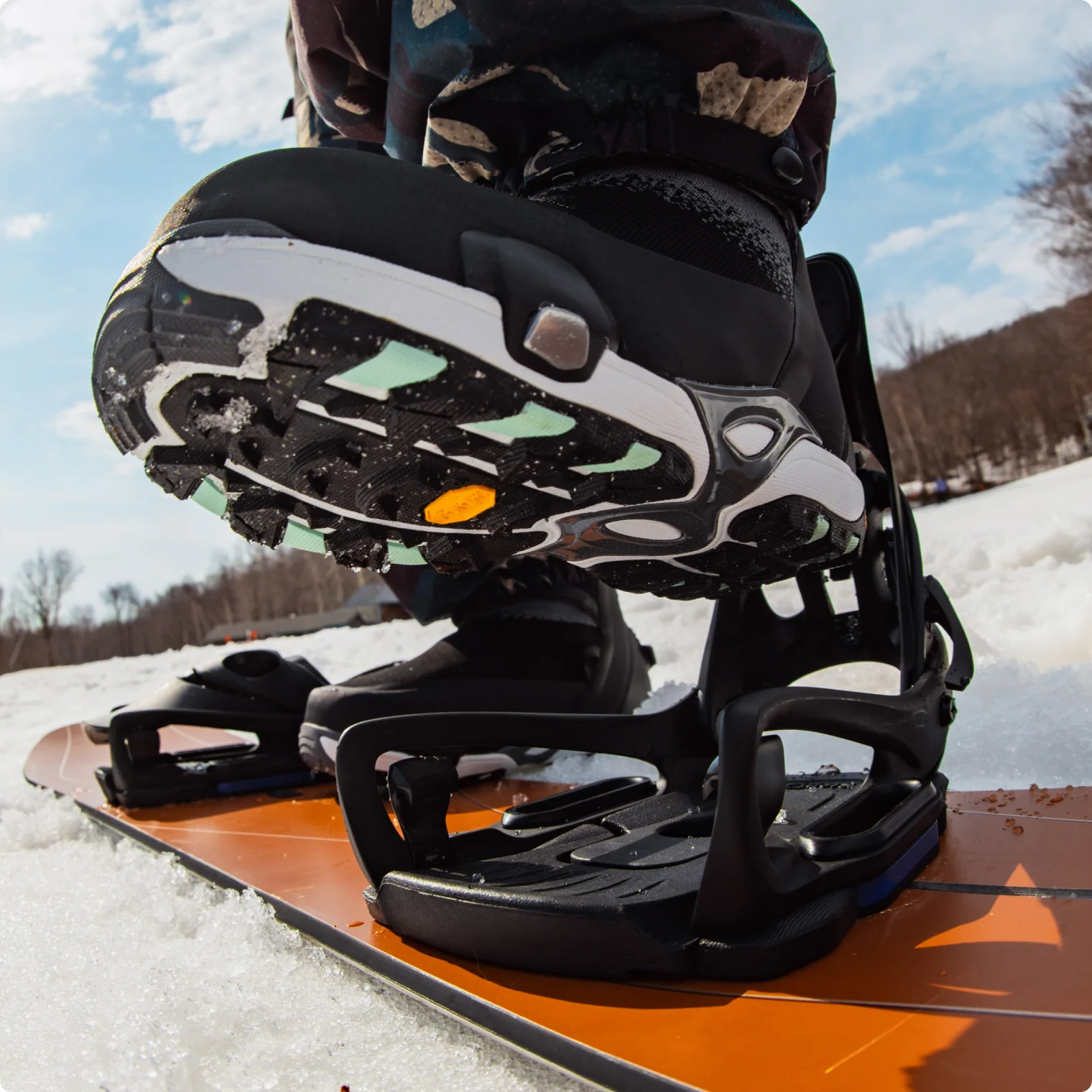
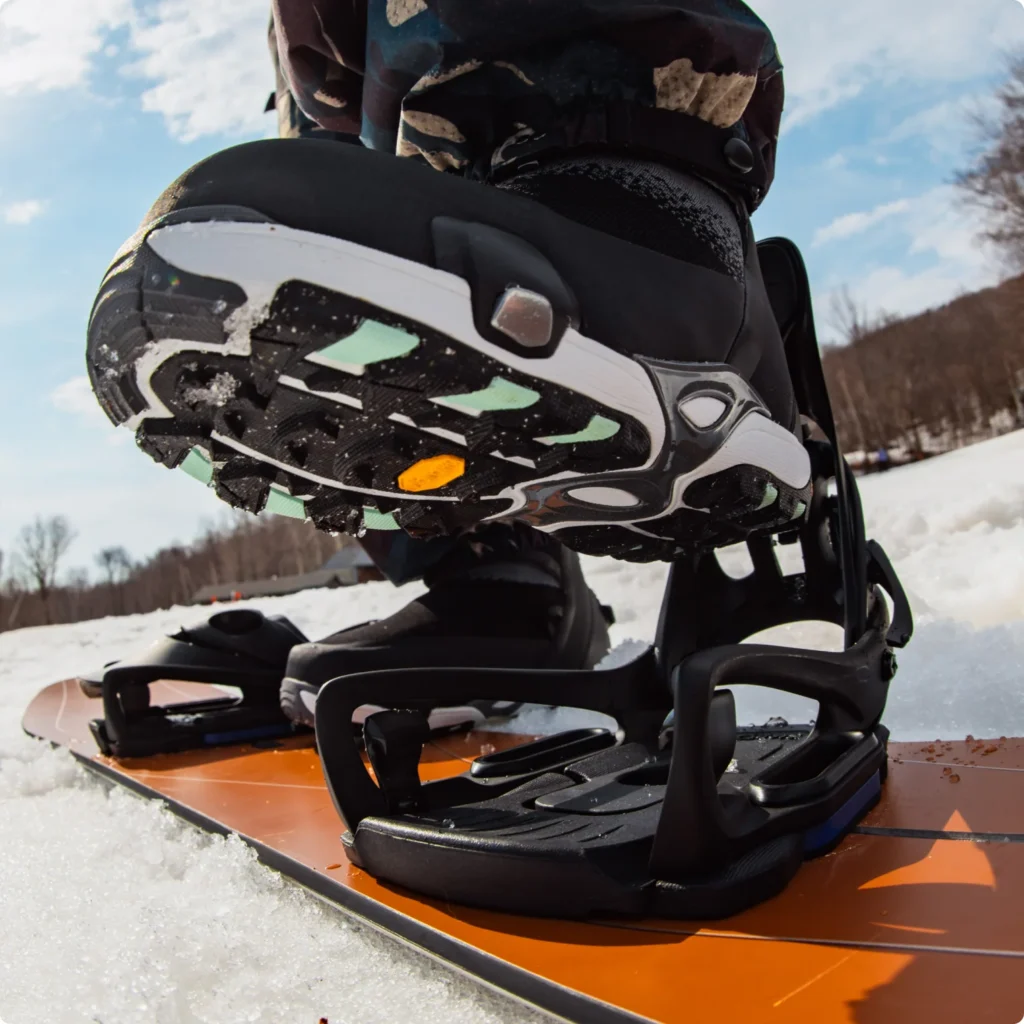
Step On, launched in 2017, is the more radical idea. There is no ankle strap and no toe strap. The boot carries two cleats at the toe and one at the heel, and the binding grabs all three. Because nothing wraps over the foot, the boot shell does the job that straps normally do. That is the source of both its best quality (a very direct, symmetrical response) and its most common complaints (fit and boot stiffness matter more than usual). Burton has since licensed the interface: DC and Nitro make compatible boots, and Union, Nitro and Flux make compatible bindings.
The Supermatic is an evolution of Flow’s rear-entry bindings, which Nidecker owns. The highback reclines, you slide your boot in from behind, and stepping on a heel pedal flips the highback up and locks it. The straps stay set at your chosen tension, and the ratchets still open if you want to strap in the traditional way. Several owners in our sources describe it in exactly those terms: a Flow binding, improved, with top entry and proper hybrid straps.
Both ranges changed for 2026/27. Burton told the trade press it has redesigned the Step On Re:Flex baseplates and heelcups, added a « Heel Grabber » to the Step On X to tighten the heel connection, and lowered its entry prices; its own listings show the base Step On dropping from $319.95 to $279.95. Nidecker has given the LT and Carbon Supermatic a new baseplate with rockered corners, intended to let the board flex more naturally, while the OG carries over with new colours. None of our independent testers has ridden the new Burton parts yet, so treat those claims as the manufacturer’s.
Weight
This is the one category with hard numbers, and it is not close. The Good Ride’s James Biesty weighed the Supermatic at 2.8 lb per binding in a medium and called it the heaviest binding he has tried; most bindings he has weighed fall between 1.8 and 2.2 lb. He measured the Step On Re:Flex at 1.8 lb. A second independent reviewer weighed the Step On Genesis EST at 700 g against an average of 935 g for men’s bindings, which matches what one older Reddit rider reported: Step Ons are lighter than normal strap bindings, Supermatics heavier.
Supermatic fans, and at least one retailer in our sources, argue that Step On boots are heavier and that it evens out. The Good Ride tested that claim directly and rejected it. A Photon Step On Wide boot weighed 2.2 lb against 2.1 lb for the regular Photon Wide. His per-foot totals put a Step On set-up at 3.8 lb and the same boot family in a Supermatic at 4.9 lb. One caveat on his arithmetic: the two Step On figures he lists add up to 4.0 lb, not 3.8. Either way the gap is around a pound per foot.
Does it matter? Retailer copy says you will not notice it while riding, and several owners agree. Others notice it exactly where you would expect: hanging from the front foot on a chairlift. One rider in his fifties with past knee and ankle surgery chose Step On for that reason alone.
The Carbon Supermatic muddies things further. Nidecker describes it as built from super lightweight materials, and a forum owner in 2024 was waiting for it specifically to save weight. A Powderguide tester who weighed the range in 2026 found the Carbon version 400 to 600 g heavier than the OG and LT, and said so with some surprise. Meanwhile a Whitelines tester describes the new LT baseplate as lighter still. We have no measured figure for the 2026/27 LT, so the only safe statement is that no Supermatic is light, and that the most expensive one should not be bought for its weight.
Edge: Step On, by a wide and measured margin.
Getting In
On firm, groomed snow at the top of a lift, both systems do what they promise. The Good Ride found the Supermatic just as fast in and out as Step On, and far quicker than a traditional Flow. Owners on small hills, where you strap in dozens of times a day, are the happiest people in every thread we read; one reported finishing a session noticeably less tired simply because he no longer bent over at each lap.
Leave those conditions and the picture changes for both. Step On needs two clicks at the heel. In soft snow the board sinks as you push down, the second click is hard to hear, and you can ride off on one click without knowing it. Experienced owners have a routine for this: make a weighted heelside turn straight away, or give a small hop. SnowboardProCamp’s Kevin, a coach who bought a Step On set-up himself and rode each system for two to three full days at Kirkwood and Palisades, found that routine to be more effort than ratcheting two straps. Burton’s own Step On page states that the system works great in powder. The Good Ride lists entry in steep or deep snow among its negatives.
The Supermatic has the same weakness and one extra risk. If the heel pedal does not latch fully, the highback can drop open. Kevin had it happen twice on toeside turns; a long-term forum owner was thrown once in powder for the same reason and now starts every run on his heel edge to give the mechanism a second chance to lock. Snow and ice in the mechanism come up repeatedly too, from a Reddit owner who says the low connection point clogs more easily than Step On, to a retailer’s own customer review mentioning ice jams.
What the Supermatic has, and Step On does not, is a way out. In deep snow or on a narrow, steep stance you can ignore the pedal, open the ratchets and strap in like it is 2015. Whitelines, both retailers and several owners treat this as the decisive practical difference, and it is hard to disagree.
Edge: even on groomers; Supermatic when conditions get difficult, because it can fall back to manual straps.
Getting Out
Exit is the part the marketing skips. With Step On you reach for a lever beside your heel and lift your heel at the same moment. The Good Ride calls stepping out awkward and notes that Burton’s sturdier toe hooks, introduced in 2022 and 2024, take slightly more effort to leave. Some owners move the lever to the inside of the binding to make the reach easier. One Step On owner pointed out that he now has to stop completely on flat ground to get his back foot out, where he used to unstrap while gliding to the lift.
With the Supermatic you push a lever on the highback and slide your foot back. Kevin found this the harder of the two, particularly once snow had packed around the lever on a steep run. Owners who have set their straps correctly report no such trouble, and several say they are out before friends with straps have sat down.
There is a point here for anyone buying a step-in for mobility reasons, which is a real and growing group: older riders, riders with back or knee problems, a rider who returned to the sport after a spinal injury thanks to Step On. Both systems remove the bend at the top of the run. Both still require a reach to the heel at the bottom, and that reach is longer than the one to a strap buckle. Try the release movement in a shop before you buy.
Edge: none. Neither is easier to leave than a pair of straps, and our sources disagree on which is worse.
Hold and Fit
The Supermatic rides like a two-strap binding, with one condition that owners learn quickly: the straps cannot be cranked tight. Setup guides tell you to leave about a finger’s width of slack in the ankle strap so the boot can pass, and riders who ignore this struggle to get in and out. Kevin put the usable tension at roughly 85 per cent of what he would run on straps. A forum regular explains why it never feels clamped: the hybrid strap spreads pressure across the foot. One former Flow rider left the system for precisely that reason. You can tighten the ratchets by hand for a serious run, but then you have a heavy strap binding.
Step On has no slack to set, and no tension to add either. What you get is what the boot gives you. Opinions on play at the heel are split. One experienced owner describes a small amount of movement between heel cleat and boot, comparable to backing an ankle strap off two clicks; another insists it is rock solid once the second click is engaged. A three-season owner reports play increasing as the footbed compresses with age. Burton’s new Heel Grabber on the Step On X is aimed at exactly this, which suggests the complaint is not imaginary.
Because the boot is the structure, boot choice matters more with Step On. The Good Ride felt the softer Ruler’s tongue fold in uneven terrain and preferred the stiffer Photon and Ion, both of which accept an optional ankle strap. One forum member went further and worried about ankle injuries without a strap to limit forward flex; others replied that six years of widespread use had produced no such pattern, and none of our sources offers evidence either way. Our guide to choosing snowboard boots explains flex ratings if you are weighing a softer model.
Edge: Supermatic for riders who want to feel straps over the foot; neither matches a traditional binding for a fully locked-in run.
Response and Board Feel
Here the two systems have opposite characters. Step On is the sharper tool. The Good Ride describes its response as very fast and unusually even between toe and heel, close to hard-boot directness with a stiff boot, and too twitchy for his taste on mellow, easy-turning boards. He rates its shock absorption and underfoot board feel above most quick-entry rivals, with the reservation that freedom of movement is limited because the boot is locked to the highback.
The Supermatic surprised the same tester by riding better than its spec sheet. He found plenty of response, even pressure thanks to the hybrid straps, and a highback with a pleasant twist. His criticism is underfoot: the baseplate has little flex, boards feel deader and are harder to butter, and heel-side shock absorption trails Step On. Nidecker’s rockered baseplate corners on the 2026/27 LT and Carbon are a direct answer to that; the OG keeps the older plate. Whitelines’ testers were happier, calling the OG responsive and well damped and rating the LT as very hard to beat among step-in designs.
Kevin’s overall judgement is the most sceptical in our file: both ride well, both deliver somewhere around 85 to 90 per cent of what he gets from straps, and he would still recommend traditional bindings. Owners who ride forty or more days a year on Step On, and one with 70 to 80 days on Supermatics in all conditions, would tell him he is wrong. That disagreement is the honest state of the evidence.
Stiffness ratings for the Supermatic are a mess, incidentally. Whitelines gives the OG 6/10 and the LT 8/10, one retailer quotes 7/10 for the family, The Good Ride rates the original medium-soft, and a long-term owner calls it pretty stiff. Go by the model hierarchy (OG, then LT, then Carbon) rather than any single number.
Edge: Step On for carving precision and underfoot feel; Supermatic for a more familiar, forgiving ride.
Adjustability
Neither system rewards tinkerers. The Good Ride rates binding adjustability as poor on both. On the Step On Re:Flex the disc offers only two boot-centring positions, highback rotation is minimal and forward lean is restricted; Kevin found that setting forward lean at the third notch stopped him getting the second heel click and had to back it off to two, which he considered a real limitation for aggressive heelside carving. On the Supermatic the highback cannot be rotated at all, though forward lean is adjustable, and boot centring depends on turning the discs if you sit at the edge of a size range.
Edge: draw. If you rotate highbacks or run a lot of forward lean, look at traditional bindings or a FASE model.
Boots, Compatibility and the Real Price
Step On ties the binding to the boot. That has three consequences. First, the system only works if a Step On boot fits your foot; the choice is wider than it was now that DC and Nitro make them, but it is still a fraction of the boot market. Forum owners note that Burton’s « wide » Step On boots are not wider at the cleats, since the toe hooks sit at a fixed width, and pinky-toe pressure points are a recurring topic. Second, you cannot swap freely: Step On boots are not suited to Supermatics according to one retailer, and one comparison site claims the heel cleat rules out every other binding, which we could not confirm. Third, forget your boots on a trip and a rental shop may not be able to help.
The Supermatic’s headline promise is that it works with any boot. Retailers repeat that wording; Nidecker’s own site says « virtually any », and the qualifier is earned. A Reddit rider who has owned both systems found the Supermatic awkward to enter and lock with one of his boots and perfect with another, and blamed the toe shape. Check your own boots in the binding before buying. A retailer’s customer also noticed scuffing on older boots after a week, and Nidecker reinforces the spine of its own boots for the entry roller.
On price, the binding tags mislead. The base Step On is now $150 cheaper than the OG Supermatic, but it needs Step On boots. If your boots are finished anyway, Step On is the cheaper route in. If you own boots you like, the Supermatic saves you a boot purchase and is cheaper overall. Used base Step Ons also turn up regularly at low prices, according to Reddit buyers.
Edge: Supermatic for freedom of boot choice; Step On on entry price if you are buying boots regardless.
Beginners
Our sources contradict each other here, and the split follows experience. Kevin, who teaches, argues that neither system suits first-week riders: beginners strap in sitting down, the Supermatic cannot be entered sitting on your heels because the highback has to recline, and getting two clicks on a Step On while seated is harder than closing two straps. Owners replied that seated Step On entry is easy if you hold the board, and one bought them for a true beginner friend so he could stay standing. A retailer lists the Supermatic’s entry as something that takes practice, while a comparison site argues its manual fallback solves the beginner problem. Our reading: both work for beginners on gentle, groomed terrain, and the Supermatic is the safer buy for a beginner who will also meet steeps and soft snow, because the straps are still there.
How Far to Trust the Sources
Several of the pages that rank for this comparison have a stake in the answer. The Whitelines roundup of the best quick-entry bindings is marked as sponsored, and all nine of its picks are either Supermatics or FASE bindings; Whitelines itself notes that FASE came out of the same Nidecker brand group. Step On is named in the introduction and absent from the list. That does not make its tester notes wrong, but the selection is not a neutral ranking. The two retailer guides sell the products they describe, and one of them concludes that the Supermatic is worth it with a flat « 100% yes ».
One affiliate comparison site declares the Supermatic the winner on versatility while stating that only two brands make step-in bindings, which is contradicted by CLEW, by FASE and by the licensed Step On bindings from Union, Nitro and Flux. We have used it only where other sources support it. The Good Ride earns affiliate commission too, but publishes its own measurements, lists flaws for both systems and had one binding on loan and bought the other. Kevin paid for his Step On set-up. Forum and Reddit owners are sincere and self-selected: people who kept a binding tend to like it.
Head-to-Head Summary
| Criterion | Advantage | Why |
|---|---|---|
| Weight | Step On | About a pound lighter per binding on independent scales |
| Entry on groomers | Even | Both take seconds once set up |
| Entry in powder and on steeps | Supermatic | Both struggle; only the Supermatic can be strapped manually |
| Exit | None | Both need a reach to the heel; sources split |
| Strap feel and hold | Supermatic | Real straps, though they must run slightly loose |
| Response and edge-to-edge speed | Step On | Direct boot-to-binding connection |
| Underfoot flex and damping | Step On | Supermatic baseplate criticised as dead; new LT and Carbon plate untested |
| Adjustability | Draw | Poor on both |
| Boot choice | Supermatic | Regular boots, with a fit check advised |
| Entry price | Depends | Step On if you need boots anyway; Supermatic if you keep yours |
Our Take
Choose Burton Step On if a Burton, DC or Nitro Step On boot fits your foot well, if you ride mostly resort and groomed terrain, and if you care about weight and a sharp, direct response. It is the lighter, cleaner and more refined system, the base model is now the cheapest way into hands-free entry, and the riders who get on with it rarely go back. Buy the stiffer boots, learn to check for the second click, and accept that deep days will cost you a few awkward moments.
Choose the Nidecker Supermatic if you already own boots you would not give up, if you want something that still feels and works like a strap binding, or if your riding regularly takes you into powder and onto steeps where a manual fallback is worth having. Budget for the weight, spend the time on strap setup, and test your boots in the binding first. Of the three models, the LT with its new baseplate is the one our sources point to; the Carbon is hard to justify.
And choose neither if what you value most is a fully cranked, fully adjustable connection for demanding terrain. The coach in our sources finished his test recommending traditional straps, and the semi-automatic FASE bindings now sit between the two worlds with almost no weight penalty. Our piece on CLEW’s hybrid binding covers another alternative, and if you are curious about the brands building around Burton’s interface, Union’s first boot is reviewed in our Union Reset Pro article.
FAQ
Which is lighter, Burton Step On or Nidecker Supermatic?
Step On. Independent measurements put the Step On Re:Flex at about 1.8 lb per binding and the original Supermatic at about 2.8 lb. Step On boots weigh roughly the same as regular boots, so the difference does not even out.
Do Nidecker Supermatic bindings work with any boots?
With most regular snowboard boots, yes, and Nidecker’s own wording is « virtually any ». At least one owner found entry difficult with a particular boot shape, so try your boots in the binding before buying. Burton Step On boots are not the intended match.
Which boots work with Burton Step On bindings?
Only boots built with the Step On cleats. Burton makes the widest range, and DC and Nitro make licensed Step On boots. Regular snowboard boots will not connect.
Are step-in bindings good in powder?
Both systems are harder to enter in deep, soft snow because the board sinks when you push down to engage the mechanism. The Supermatic can be strapped in manually with its ratchets in those conditions. Step On cannot, so owners rely on a hop or an early heelside turn to confirm the heel is locked.
Can you tighten Supermatic straps like normal bindings?
You can, using the ratchets, but for hands-free entry the straps need a little slack, roughly a finger’s width at the ankle strap. Run them fully tight and you will have to strap in and out manually.
Which is better for beginners?
Sources disagree. Both are easy on flat, groomed terrain. The Supermatic gives a beginner the option of strapping in normally on steeper or softer ground, which makes it the more forgiving choice of the two.
What changed for 2026/27?
Burton redesigned its Step On Re:Flex baseplates and heelcups, added a Heel Grabber to the Step On X and cut the price of the base model. Nidecker fitted a new baseplate to the LT and Carbon Supermatic and left the OG unchanged apart from colours.
Both systems are sold through specialist snowboard shops and directly by the brands: see Burton’s Step On page and Nidecker’s Supermatic technology page for current models and size charts. For the story behind the company that started it all, read our Burton brand history.