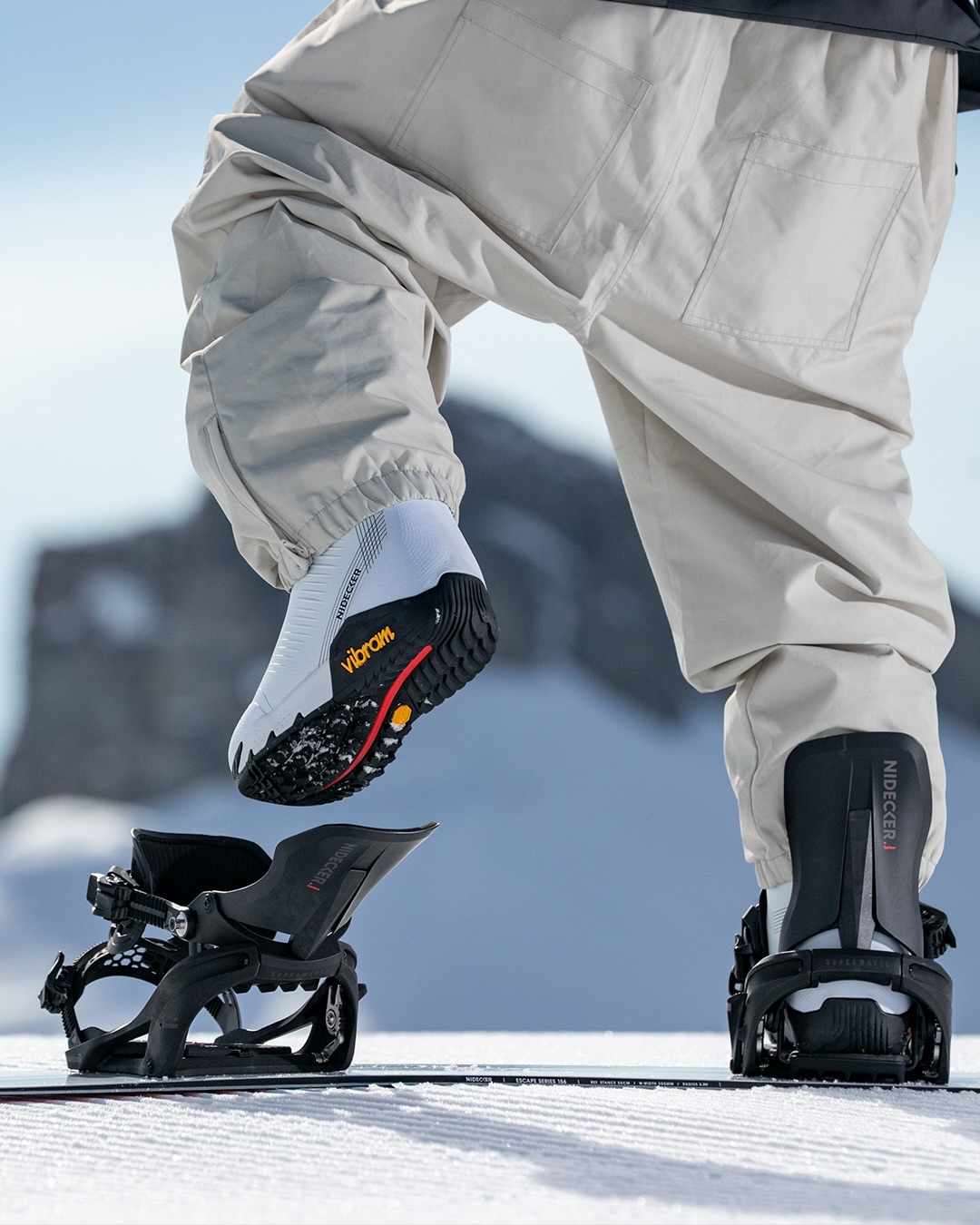
hill.camp does not test products first-hand. This comparison is a structured synthesis of nine sources — three long owner discussions, four retailer guides, a sponsored magazine roundup and an affiliate review site — plus independent weight measurements and test findings already cited in our FASE guide and our Step On vs Supermatic comparison, assembled with AI assistance and edited before publication. Very few reviewers ride both systems in the same conditions: only a handful of our sources did, mostly owners and shop staff, and no independent lab has tested them side by side. Several sources have a commercial interest; we say so where it matters.
FASE vs Supermatic is an unusual rivalry, because both systems come from the same house. The Nidecker group, the Swiss family company behind Nidecker, Jones, Rome, Bataleon and ThirtyTwo, sells the fully automatic Supermatic under its own name and the semi-automatic FASE through its sister brands. Both work with the boots you already own. Both keep two straps. The difference is how much they do for you. The Supermatic closes itself and locks you in when you stomp on a heel pedal; FASE closes the highback for you and leaves you to ratchet the ankle strap.
That single extra step shapes everything else: weight, feel, adjustability, price and the kind of rider each system suits. If you are new to the topic, our guide to FASE bindings explains the system in detail, our Burton Step On vs Nidecker Supermatic comparison covers the Supermatic against its strapless rival, and our overview of quick snowboard bindings sets out the whole landscape.
Quick Specs
| FASE | Supermatic | |
|---|---|---|
| Principle | Semi-automatic: self-closing highback, then ratchet the ankle strap | Fully automatic: heel pedal flips up the highback and locks the binding |
| Straps | Separate toe and ankle straps; toe strap set once | Joined hybrid toe-and-ankle strap, set once |
| Boots | Regular snowboard boots (not Step On) | Regular snowboard boots (not Step On) |
| Exit | Release the ankle ratchet, lift the heel | Push the release lever, slide the foot back |
| Manual strap-in | Yes | Yes |
| Highback rotation | No | No |
| Measured weight, one binding | About 900 to 1,105 g depending on model | About 1,270 g (original Supermatic, size M) |
| Brands (2026/27) | Jones, Rome, Bataleon, ThirtyTwo | Nidecker, Salomon, Bent Metal |
| US price range | About $280 to $490 (eleven models) | About $430 to $570 |
| Best for | Strap-binding riders who want faster entry without changing their feel | Riders who want the most hands-off entry their current boots allow |
Weights come from independent testers’ scales, cited in our earlier articles, not from the brands. Prices are US list prices from brand and retailer listings for 2026/27.
One Family, Two Philosophies
The Supermatic descends from Flow’s rear-entry bindings, which Nidecker owns. The highback reclines, you slide your boot in from behind, and stepping on a heel pedal flips the highback up and locks it with a steel mechanism. The toe and ankle straps form one connected cradle, set at your chosen tension. A release lever on the inside of the highback lets you out. Nidecker sells three versions, the OG, LT and Carbon, and now licenses the system to Salomon, whose XA Supermatic arrived for 2025/26, and to Bent Metal, with its Lightning Supermatic.
FASE is the newer and more conservative idea. Its three parts are a highback that reclines and snaps upright when your heel presses a pedal, an ankle strap whose extended ladder never leaves the buckle, and a toe strap that locks at a pre-set tension. You step in, the highback closes, and you crank one ratchet. Everything else, from baseplate to flex, is up to each brand. One retailer in our sources sums up the split neatly: the Supermatic is an automatic binding, FASE a semi-automatic one.
The official FASE account, which took part in two of the owner discussions we read, put its own position plainly: FASE is a system added to a two-strap binding, and in terms of riding performance comparing it with a Supermatic is like comparing a Supermatic with any standard binding. That is the brand’s claim, but most independent riders in our sources describe the difference in similar terms.
Getting In
This is where the Supermatic earns its price. The affiliate site in our sources, which rode a Supermatic LT, a Bataleon FASE binding and a Union Step On on snow, found the Supermatic’s highback folds back the furthest of the three, giving the biggest opening, and rated it the easiest to get into: hook up, stomp down, and you are fully locked. A Norwegian retailer that tested all three systems calls the Supermatic the most automated and the fastest in practice. An owner who tried both on carpet found the Supermatic entry easier and FASE in need of a little more finesse with alignment.
FASE’s opening is the tightest of the quick-entry systems, according to both the affiliate reviewer and the Norwegian shop, and its entry is described as quick but a moment slower, because you finish by ratcheting the ankle strap. How much slower is disputed:
- A rider with back problems who has ridden all three systems argues that FASE is now comparable in speed to Step On and the Supermatic, so time is no longer the deciding factor.
- An owner on a hill with very short runs planned to return a newly ordered pair of FASE bindings for Supermatics because they were not as quick.
- A UK retailer found the Supermatic easier to ride straight off the chairlift, while conceding that this could be a matter of practice.
One condition applies to the Supermatic’s speed: the straps must be set so the boot can pass. Several owners say they spent time dialling strap tension to get the three clicks of the lock without blocking the mechanism, and one learned that stepping in is a skill, needing a firm, well-aligned stomp of the heel. A coach in one thread watched a beginner struggle with Supermatics even on flat ground, and could not get his own boot in without loosening the straps. A US retailer adds that some riders size up for the smoothest entry and exit.
Edge: Supermatic, for the most automatic entry of any system that works with regular boots.
Getting Out
Exit reverses the result. The owner who compared both on carpet found FASE clearly easier to leave: open the ankle strap until it hits its stop and pull your foot out. The Supermatic’s push-down lever followed by a lift of the foot felt odd to him. The affiliate reviewer also rated FASE the easiest of the three to exit, and a rider who owns Supermatic, Step On and ThirtyTwo FASE bindings found the FASE exit more reliable than the Supermatic’s.
The harshest verdict in our file comes from one Reddit user who claims Supermatics work well only about 20 per cent of the time and that FASE is more reliable in and out. Other owners describe the opposite experience: one used Supermatics for a year across backcountry, carving, park and halfpipe without a problem, another rode them on small hills and on epic powder days at Mount Baker. Read that 20 per cent figure as one frustrated owner’s experience, not as data.
Edge: FASE, by a majority of the riders who tried both.
Strap Tension and Hold
The Supermatic’s automatic entry comes with a trade-off on tension. Because the boot has to slide under straps that stay closed, many riders run them a little looser than they would on a standard binding, and the UK retailer notes that anyone who likes their straps very tight will find getting in and out tricky. One contributor sums the Supermatic up as set and forget: you fine-tune it once to your boot, but lose the on-the-fly pressure adjustment of a ratchet. Nidecker’s own FAQ says the opposite, that the Supermatic is designed to work with your normal strap tension. Owners’ experience suggests the truth lies between the two and depends on your boot.
FASE keeps the ankle strap fully adjustable at every entry, and that is its main riding argument. Independent testers cited in our FASE guide found the system holds noticeably better on hard heelside carves than both the Supermatic and Step On. An owner who carves aggressively reads the trade-off the same way, and one Reddit contributor summarises FASE as a locked-in, responsive feel suited to high speeds.
Edge: FASE, for riders who want to set tension run by run.
Weight
Every source agrees the Supermatic is the heavier system; they disagree on how much it matters. Independent scales put the original Supermatic at about 1,270 g per binding in a medium. FASE bindings measured by independent testers range from about 900 g for a Jones Mercury FASE to about 1,105 g for a Rome Katana FASE. On those figures, the gap is roughly 170 to 370 g per binding, depending on the FASE model.
Perceptions vary widely around those numbers:
- A rider who has two friends on the same board, one with FASE and one with Supermatics, says the Supermatics look much heavier and bulkier.
- Another who inspected a pair in a shop found them heavy, with a large heel profile and hard plastic underneath, and ruled them out on the spot.
- A long-time owner says the weight is not noticeable once the bindings are mounted.
- The affiliate reviewer found the Supermatic LT and the Bataleon FASE binding roughly similar on snow, with FASE only slightly lighter.
The weight of the FASE mechanism itself is also contested. The brand says it adds only a few grams, a UK retailer says FASE bindings weigh the same as a conventional two-strap, and the brands’ own figure is 40 g. Independent scales show that several FASE bindings are heavier than average anyway, because they are built on heavy-duty chassis. Two owners also note that FASE bindings have a larger heel profile than ordinary bindings, though smaller than the Supermatic’s. Whitelines, in its sponsored roundup, says the new LT baseplate is lighter still; we have no measured figure for the 2026/27 LT.
Edge: FASE, on measured weight.
Flex and Ride Feel
On feel, the consensus is clear: FASE rides most like a traditional two-strap binding. Three retailers say so, the affiliate reviewer found the same, and so did the rider who owns both. FASE bindings use the brands’ regular baseplates, so board feel is not lost in a bulky chassis, as the UK shop puts it. One former Supermatic rider described the board feel as horrible; another sceptic said the Supermatic’s hard plastic underside, without bushings, looks like a binding from twenty years ago. Supermatic owners largely disagree, and Whitelines’ tester found the OG responsive and well damped.
Stiffness is where the sources contradict each other most directly. The UK retailer says every Supermatic model is stiff and that there is no soft option. Whitelines rates the OG at 6/10 and the LT at 8/10, and one Supermatic Carbon owner calls his super stiff. Yet the rider who compared a Supermatic OG with a Jones Mercury FASE on carpet found the Supermatic much softer and the FASE much stiffer, and a rider who owns three quick-entry systems calls the Supermatic soft to ride and pairs it with extra-stiff boots. Some of the gap is simply that the Mercury is one of the stiffer FASE bindings. Go by the model hierarchy, OG then LT then Carbon, and try a pair if you can.
FASE has a clear advantage in range. Because it is built into eleven different bindings from four brands, it spans everything from the soft ThirtyTwo Basin and Jones Nebula to the carbon Jones Zenith. Retailers in Norway and the US both single it out as the better quick-entry choice for park and freestyle riders. The Supermatic family, including the Salomon and Bent Metal versions, sits in the medium to stiff range.
Edge: FASE, for a traditional feel and a much wider choice of flex.
Adjustability
Neither system lets you rotate the highback; Nidecker states this for the Supermatic, and FASE’s mechanism does not allow it either. Beyond that, FASE keeps more of a normal binding’s settings. One owner points out that FASE bindings can (depending on the model) keep full highback height and heelcup length adjustment, which the Supermatic lacks, and another describes FASE as the most adjustable of the quick-entry systems, while still a little short of the full range available on traditional bindings. Our FASE guide notes that some testers found forward lean limited on certain FASE models.
Edge: FASE.
Durability and Reliability
The Supermatic’s weight buys a reputation for toughness. Its lock uses steel parts, which an owner credits for both the weight and the durability, and which the affiliate reviewer, the Norwegian shop and the US retailer all describe as robust or bombproof. The cost is complexity: every source ranks it the most mechanically complex quick-entry system that works with regular boots.
FASE adds fewer parts. Its official account says there is only one additional moving part, the heel lever, a simple pin-and-spring mechanism, and that the FASE parts carry a lifetime warranty. Owners have been more cautious. One rider worried about the highback lever’s durability before launch, another declined to buy any new technology in its first production year, and the Norwegian retailer warns that the first generation could have teething problems with strap and lever details. Our FASE guide records some of those: frozen buckles at cold demo days, lost toe-strap screws, and a team rider reporting a switch to a softer plastic after first-generation ladders broke.
Both systems pick up snow. An owner notes that after riding deep snow you will need to clear the Supermatic mechanism before stepping back in, much as with a normal binding, and a retailer adds that there is no clear evidence that any quick-entry system has an advantage in powder. The Supermatic, like FASE, can be strapped in manually when the snow is deep.
Edge: Supermatic for a proven, sturdy mechanism; FASE’s long-term record is still being written.
Bending Down and Mobility
For riders with back or knee problems, the sources disagree sharply. The rider with back problems who tried all three systems says that if you cannot bend, your options are the Supermatic or Step On. One owner rules out FASE for exactly that reason. The official FASE account argues the opposite: FASE needs the shortest reach of all, since the ankle ratchet sits on top of the foot, while the Supermatic and Step On release levers sit beside or behind the heel. One Supermatic owner was surprised to find its release lever needed as much bending as his old straps; another rider replied that the Supermatic means three to five seconds bent over, against twenty to thirty for a fiddly strap.
Our reading: the Supermatic removes the bend at the top of the run, FASE shortens it, and both still need a reach at the bottom. If bending is the problem, the Supermatic is the safer choice; if fiddling is the problem, either will help.
Price and Models
| Binding | System | Flex (as rated) | US price |
|---|---|---|---|
| ThirtyTwo Basin FASE | FASE | Soft | $279.95 |
| Jones Nebula FASE / Bataleon Ghost FASE | FASE | 4/10 / 5/10 | $299.95 |
| Rome Volt FASE / ThirtyTwo T32M FASE | FASE | 5–6/10 / mid | $329.95–349.95 |
| Jones Mercury FASE / Bataleon Blaster AW FASE | FASE | 8/10 / 6/10 | $370–390 |
| ThirtyTwo T32M XLT Carbon FASE | FASE | 8/10 | $399.95 |
| Rome Katana AW FASE / Katana AW FASE Pro | FASE | 6–8/10 / 7–9/10 | $409.95–449.95 |
| Nidecker OG Supermatic | Supermatic | 6/10 | $429.95 |
| Nidecker LT Supermatic | Supermatic | 8/10 | $479.95 |
| Salomon XA Supermatic | Supermatic | Stiff (retailer rating) | $479.95 |
| Bent Metal Lightning Supermatic | Supermatic | Stiff side | About $480 |
| Jones Zenith Carbon FASE | FASE | Stiff | $489.95 |
| Nidecker Carbon Supermatic | Supermatic | Stiffest Supermatic | $569.95 |
The cheapest Supermatic costs more than most FASE bindings, and the Supermatic range starts where FASE’s upper-middle range sits. Flex ratings come from the brands, Whitelines and retailers, and do not translate exactly from one brand to another. The Bent Metal price is the 2025/26 launch price reported by the trade press. Street prices are already well below list: one owner in our sources saw a FASE binding drop from €400 to €300 in a one-day sale.
Edge: FASE, by around $150 at entry level.
Who Should Choose Which
The sources converge on a simple split, which one contributor put in three lines: casual riders who care about their old boots go Supermatic, performance riders who want fast entry go FASE (Step On being the third option for casual riders who care about weight).
- Choose the Supermatic if you want the least effort per lap: short lifts and lots of strap-ins, a ski-patrol or teaching job where you step in and out constantly, or a back that makes bending difficult. The owner who tried both on carpet recommends it specifically for small hills.
- Choose FASE if you already like strap bindings and want them faster without changing how they ride: aggressive carvers, park and freestyle riders, anyone who wants a soft flex, a lower price, or full ankle-strap tension on every run. The same carpet tester recommends it for longer, more serious runs.
- Consider neither if you want the simplest, lightest, most repairable set-up, or you swap between boot systems. Several sources still recommend traditional bindings for those riders.
Whatever you choose, test your own boots in the binding. Both systems claim near-universal compatibility, but boot heels, toe shapes and lipped backstays can catch, as our best snowboard boots of 2026/27 and our guide to choosing snowboard boots explain.
How Far to Trust the Sources
No independent publication in our file rode both systems back to back under controlled conditions. The three owner discussions are the most direct evidence, but they date from FASE’s launch period, and the official FASE account took part in two of them, promoting its system. Whitelines’ roundup is sponsored and lists a ThirtyTwo T32M FASE price ($549.95) that does not match brand and retailer listings. Four sources are retailers that sell both systems. The affiliate site earns commission on sales, calls the system « Phase » throughout and gives few details of its test; one retailer guide describes FASE as Bataleon’s own technology, which it is not. We have used these sources for points where they agree with others and flagged them where they stand alone.
Our Take
The Supermatic and FASE are not really competitors so much as two points on the same scale, and the Nidecker group clearly designed them that way. The Supermatic goes as far towards hands-free as a regular boot allows: the biggest opening, a self-locking steel mechanism and no ratchet to touch at the top of the run. You pay for it with weight, a higher price, a narrower flex range and straps that many owners run a little looser than they would like.
FASE stops one step earlier, and gains almost everything else: a binding that rides like the two-strap model it is built on, easier exit, more adjustment, lighter weight, a choice of eleven models and lower prices. If you ride many short laps or struggle to bend, the Nidecker OG or LT Supermatic is the better tool. If you ride straps today and want them faster, start with a FASE model matched to your style, using our FASE guide to pick one. If you want to drop straps altogether, look at our Step On vs Supermatic comparison, and at CLEW’s hybrid binding.
FAQ
What is the difference between FASE and Supermatic bindings?
The Supermatic is fully automatic: a heel pedal flips up the highback and locks the binding with your straps already set. FASE is semi-automatic: the highback closes by itself, but you ratchet the ankle strap by hand. Both work with regular snowboard boots.
Which is faster, FASE or Supermatic?
Most sources find the Supermatic faster and easier to get into, thanks to its bigger opening and automatic lock. Several riders who tried both found FASE easier to get out of.
Is the Supermatic heavier than FASE?
Yes. Independent scales put the original Supermatic at about 1,270 g per binding, against roughly 900 to 1,105 g for the FASE bindings that have been weighed. How much that matters on snow is a matter of opinion.
Are FASE and Supermatic made by the same company?
Both come from the Nidecker group. The Supermatic is sold by Nidecker and licensed to Salomon and Bent Metal; FASE is used by the group’s sister brands Jones, Rome, Bataleon and ThirtyTwo.
Which is better if I have back problems?
The Supermatic, in most riders’ view, since it locks without a ratchet at the top of the run. FASE still requires bending once per foot, though the reach to the ankle ratchet is short. Both require a reach to release at the bottom.
Which is better for park riding?
FASE. It feels closest to a traditional two-strap binding and comes in soft, freestyle-oriented models, while the Supermatic range runs from medium to stiff.
Both brands explain their systems and list dealers on their own sites: see Nidecker’s binding range, including the Supermatic, and Jones’s guide to FASE. If you can, demo both on snow before you buy.