You’ve seen the little yellow badge. It’s tucked at the back of half the helmets on any bike shop wall, quietly implying that this one is somehow safer than the one next to it. A MIPS bike helmet is built around a specific claim: that it protects against a type of impact standard foam doesn’t handle well. But what is MIPS actually doing in there, and is it worth the extra money it usually adds to the price tag? We dug into how the system works, where it came from, and where its real limits are — because a yellow sticker isn’t a safety guarantee, and it shouldn’t be treated like one.
What MIPS Actually Stands For
MIPS stands for Multi-directional Impact Protection System. It’s not a helmet brand — it’s a Swedish company that licenses a specific safety mechanism to helmet manufacturers across cycling, skiing, snowboarding, equestrian sports, and beyond. MIPS doesn’t make helmets itself; it makes the layer that goes inside someone else’s.
The pitch is narrow and specific: standard helmet foam is built to absorb a straight-on hit. MIPS targets the kind of impact that straight-on testing doesn’t simulate well — a glancing, angled blow that twists the head on contact. That distinction matters more than the marketing badge suggests, and it’s worth understanding before you decide whether it’s worth paying for.
The Origin Story: A Neurosurgeon, a Researcher, and Twenty Years of Testing
MIPS didn’t come out of a helmet company’s R&D lab. It started in Sweden in 1995, when biomechanics researcher Peter Halldin, working at the Royal Institute of Technology, connected with Hans von Holst, a neurosurgeon who specialized in traumatic brain injuries. Their shared frustration was straightforward: helmet standards of the era were built almost entirely around straight-line impacts, while real-world falls are rarely that clean.
The pair filed their first patent in 1998 and had a working prototype by 2000. The company itself, Mips AB, was founded in 2001 — and its first market wasn’t cycling at all, it was equestrian helmets. Cycling didn’t get its own dedicated version, MIPS BPS (Bike Protection System), until 2010. Since then, the company reports having run more than 31,000 impact tests refining the concept, and it’s now licensed across most major helmet brands rather than sitting on the fringe.
Why Rotational Force Is the Injury Nobody Tests For
Picture a typical crash: you don’t land squarely on the crown of your head. You catch a curb, a root, a patch of gravel at an angle, and your head twists on impact. That twisting motion generates rotational force — and it’s a different injury mechanism entirely from a direct, linear hit.
Brain tissue doesn’t behave like a solid. It shears more like a gel or a dense fluid, which means that when the skull rotates suddenly, different regions of the brain can move at different speeds relative to each other. That relative motion stretches and strains tissue, and it’s strongly associated with concussions and diffuse injury — arguably more so than a straight impact that a rigid foam liner is already reasonably good at absorbing.
For decades, helmet certification standards were built almost entirely around linear drop tests — a helmet falling straight down onto a flat or angled anvil. Useful for skull fractures, much less representative of how most real crashes actually happen. That gap is the entire reason MIPS exists.
How the Layer Actually Works
Strip away the branding and the mechanism is fairly simple. A MIPS-equipped helmet has a low-friction plastic layer sitting between the rigid outer shell (and its EPS foam) and the padding that touches your head. That layer is loosely mounted, usually with small elastic anchors, so it can shift slightly — typically somewhere in the 10 to 15mm range — independently of the outer shell during an angled impact.
The idea is loosely modeled on how the brain already protects itself: it floats in cerebrospinal fluid inside the skull, which lets it absorb some rotational motion naturally. MIPS is essentially trying to give the helmet a second, smaller version of that same slip layer, so that on an oblique hit, the outer shell can rotate slightly against the head rather than transferring that full rotational energy directly into it.
Importantly, this is a secondary system, not a replacement for the foam. The EPS liner still does the primary job of crushing and absorbing a direct hit — it’s a one-use, sacrificial material that needs replacing after any real impact, MIPS or not. The slip layer only engages during angled loading, and it’s designed to be invisible in day-to-day use: no perceptible effect on fit, comfort, or airflow when you’re just riding.
MIPS Isn’t One Product — It’s a Family of Systems
« MIPS » on a spec sheet can mean a few different physical implementations, and manufacturers have pushed the technology in different directions as ventilation and weight complaints piled up over the years.
| System | What it is | What changed |
|---|---|---|
| MIPS BPS | The original cycling-specific version, launched 2010 | A distinct plastic slip liner mounted inside the shell — the version most associated with the classic yellow-anchor look |
| MIPS Air Node | An ultralight version built directly into the EPS foam structure | Integrated rather than added as a separate liner, aimed at cutting weight and preserving ventilation on MTB and road helmets |
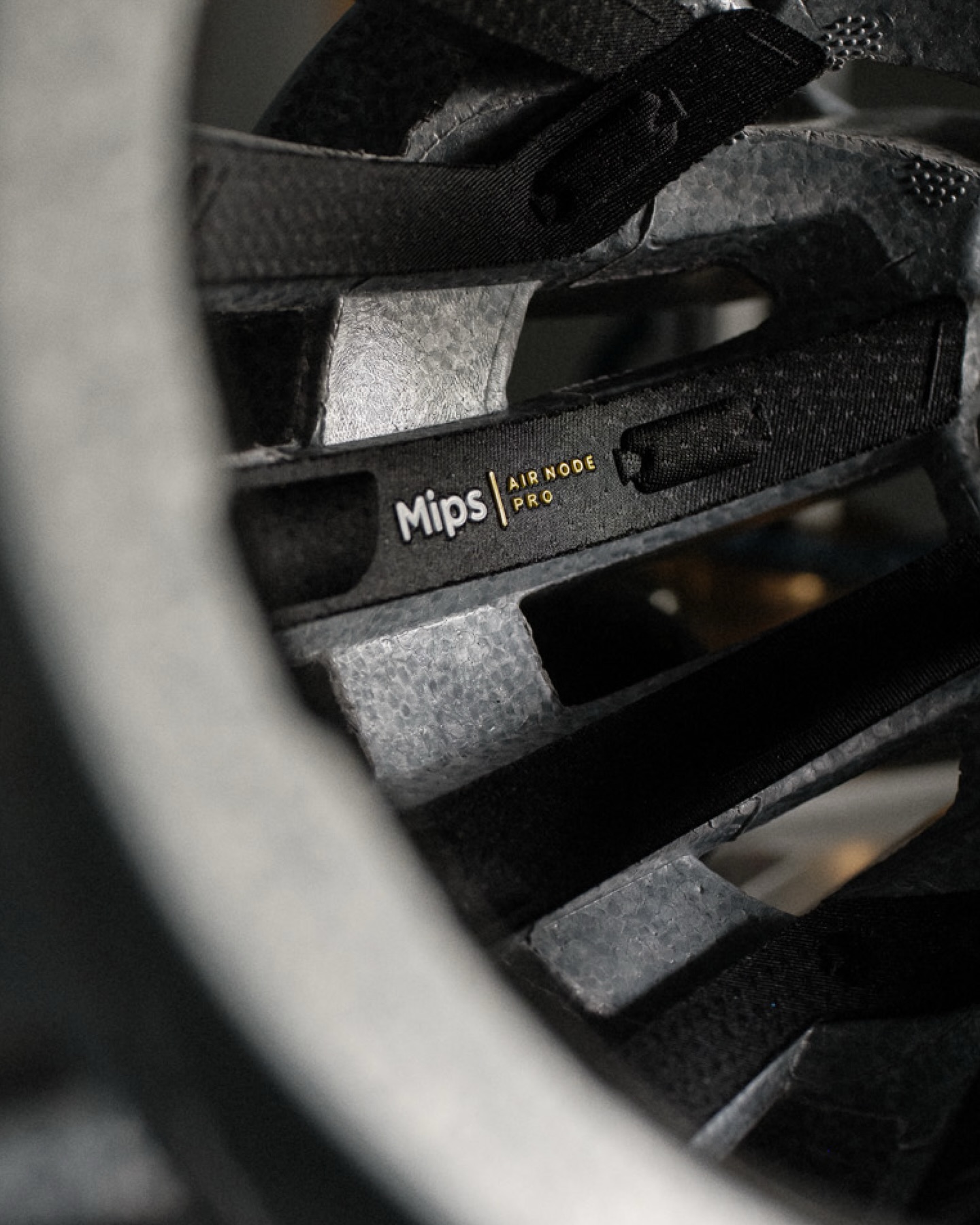
| MIPS Air Node Pro | A newer evolution of Air Node | Engineered specifically to avoid blocking airflow channels or moisture-wicking performance, since ventilation was the most common complaint about earlier systems |
The direction of travel is clear: each generation is chasing the same rotational protection with less added weight and less impact on breathability. If you’re comparing two MIPS helmets, it’s worth checking which generation is actually inside, since they’re not interchangeable in feel or performance.
Where You’ll Actually Find It
MIPS has spread well beyond road racing. It shows up across road, mountain bike, gravel, urban, and kids’ cycling helmets, and — outside of cycling entirely — in ski and snowboard helmets and equestrian headgear. If you’re shopping specifically for gravel riding, our gravel bike helmet buying guide breaks down which models handle rotational protection well without compromising the ventilation gravel riders actually need on long, hot days in the saddle.
The Trade-offs Nobody Puts on the Box
None of this makes MIPS a free upgrade, and hill.camp isn’t in the business of pretending brand technology is flawless. A few honest caveats:
- It costs more. At comparable spec levels, a MIPS version of a helmet typically runs 10 to 30 percent above the non-MIPS equivalent, largely due to added engineering and testing.
- It adds weight. Usually just a matter of grams, but it’s a real consideration if you’re chasing the lightest possible lid for racing.
- Ventilation can take a hit. Older or budget MIPS implementations sometimes restricted airflow more than a MIPS-free version of the same shell — a gap that Air Node and Air Node Pro were specifically built to close, though it hasn’t disappeared everywhere.
- It’s not a guarantee. MIPS reduces rotational force transmission; it doesn’t eliminate injury risk, and it’s no substitute for correct sizing, proper fit adjustment, or replacing a helmet after any real impact — MIPS-equipped or not.
How to Spot One in the Wild
Three reliable tells. First, the yellow MIPS badge, usually visible at the back or inside the shell. Second, on cycling helmets using the older BPS-style system, you can often see the loose plastic liner itself if you look inside — a thin layer held by small elastic tabs, slightly detached from the padding around it. Third, and most reliably: check the product listing. Retailers and brands consistently spell out which MIPS generation is inside, and it’s worth reading that line rather than assuming every yellow logo means the same hardware.
Our Take
MIPS is one of the rare pieces of helmet marketing that’s actually backed by a real, identifiable gap in older safety standards: rotational impact wasn’t being tested for, and now it largely is. That’s a genuine improvement, not just a sticker. But it’s also not magic, and it’s not the only variable that matters. A well-fitted, correctly sized non-MIPS helmet from a reputable brand will very likely protect you better than a badly fitted MIPS one. Use MIPS as a tiebreaker between two helmets you already like — not as the single deciding factor, and never as an excuse to skip proper fit and replacement discipline.
FAQ
Does MIPS make a helmet crash-test rated differently?
Not in terms of official certification. Helmets still need to pass the same regional safety standards (like CPSC or EN 1078) with or without MIPS. MIPS is an additional layer of rotational protection on top of that baseline, not a separate certification tier.
Is a MIPS helmet always safer than a non-MIPS helmet?
Not automatically. Fit, retention, and correct sizing all matter as much or more than the presence of a MIPS liner. A MIPS helmet that doesn’t fit properly won’t outperform a well-fitted helmet without it.
Do I need to replace a MIPS helmet after a crash?
Yes. The EPS foam that handles the primary impact absorption is a one-use material regardless of whether the helmet has MIPS. Any helmet involved in a real impact should be replaced, MIPS liner or not.
Are all MIPS systems the same?
No. MIPS BPS, Air Node, and Air Node Pro are distinct implementations with different weight and ventilation trade-offs. Check the specific system listed on a helmet’s spec sheet rather than assuming the yellow logo means identical hardware.
For the full technical rundown straight from the source, including their published test data, you can visit MIPS’ official site.