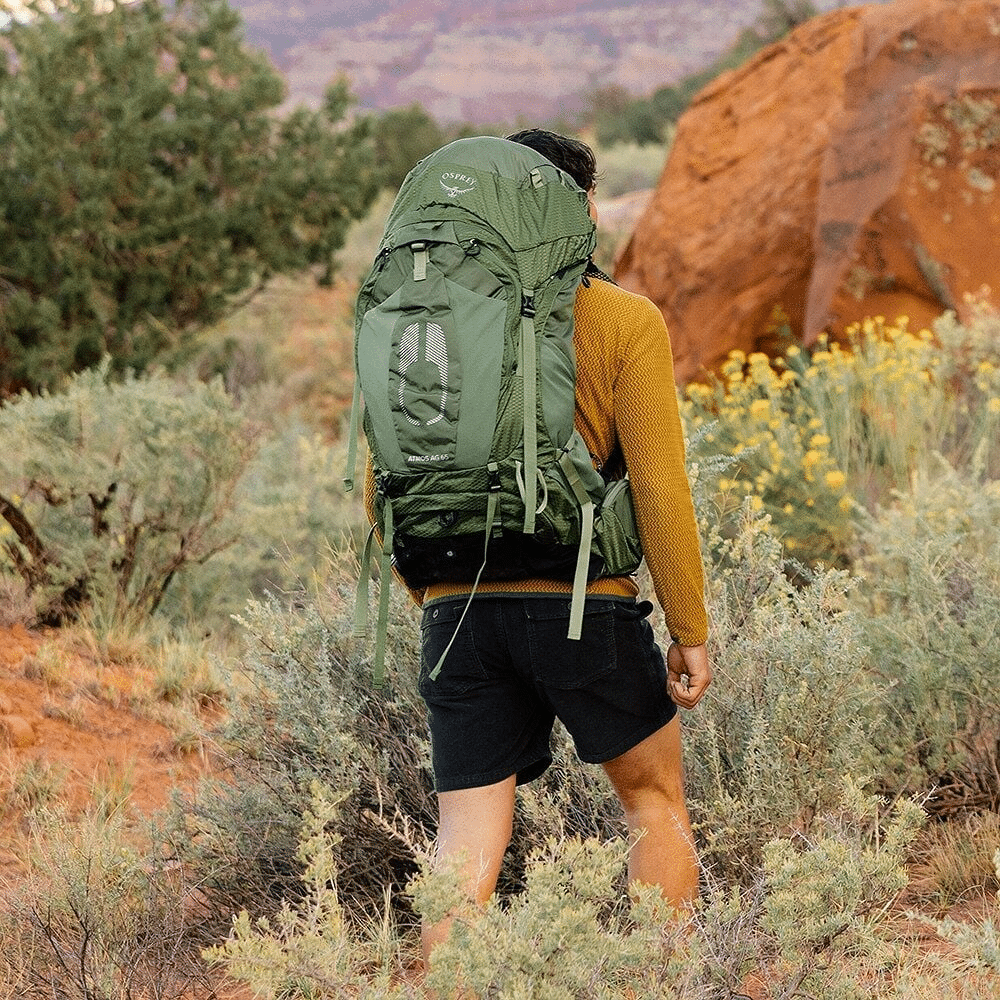
If you walk into any specialist outdoor shop in Europe and ask for a recommendation for a multi-day trekking backpack in the 50–65 litre range, the answer will almost certainly be one of these two. The Osprey Atmos AG and the Deuter Aircontact have dominated the mid-to-large trekking pack category for years, refining their respective ventilation and suspension systems across multiple generations while their competitors have struggled to match them on the fundamental question that matters most in a pack you will carry for eight hours a day: how does your back feel at the end of the day?
Both brands have deeper stories worth understanding — read our profiles on Osprey and Deuter for full context.
The Short Answer
The Osprey Atmos AG (Anti-Gravity) is the better ventilated pack. Its tensioned mesh back panel creates a gap between the pack and your spine that allows airflow throughout the carry, keeping your back measurably drier and cooler than any panel-contact system. For warm-weather trekking, high-output mountain routes, and anyone who runs hot, the Atmos AG’s breathability is a genuine competitive advantage.
The Deuter Aircontact carries heavier loads more efficiently. Its Contact system keeps the pack in contact with the back, transferring load directly to the hip belt without the energy loss that a tensioned-mesh system introduces when heavily loaded. For multi-week expeditions with full kit, the Aircontact’s load transfer is more effective and less fatiguing than the Atmos at maximum capacity.
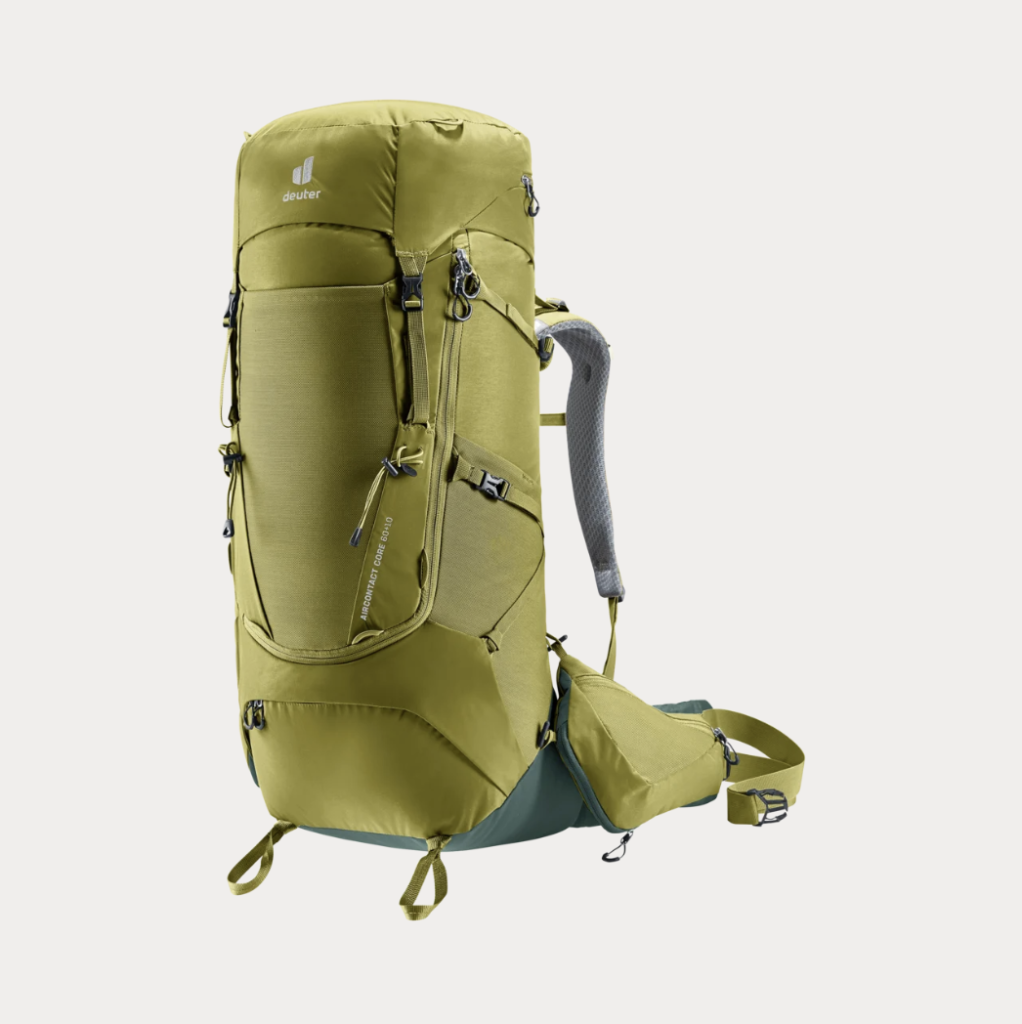
Specs Side by Side
| Spec | Osprey Atmos AG 65 | Deuter Aircontact Core 60+10 |
|---|---|---|
| Capacity | 65 L | 60+10 L |
| Weight | ~2.1 kg | ~2.3 kg |
| Back system | Anti-Gravity tensioned mesh | Aircontact panel-contact + Vari-Flex hip |
| Ventilation | Excellent (mesh gap) | Good (channelled foam contact) |
| Torso adjustment | FitOnTheFly adjustable | VariFlex adjustable |
| Hip belt | Integrated, non-removable | Vari-Flex, anatomic |
| Women’s version | Yes (Aura AG) | Yes (Aircontact Core 45+10 SL) |
| Rain cover included | Yes | Yes |
| Load range | Best to ~18 kg | Handles 20+ kg well |
| Price (approx.) | ~€285–320 | ~€250–290 |
The Back System: Where They Fundamentally Differ
Osprey’s Anti-Gravity system is the defining feature of the Atmos line. A tensioned trampoline-style mesh back panel holds the pack away from the spine, creating a channel of air between your back and the load. The mesh conforms to your back shape through its tension rather than through foam padding, producing a carry feel that is uniquely adaptive — the pack moves with your body in a way that rigid-panel systems do not replicate.
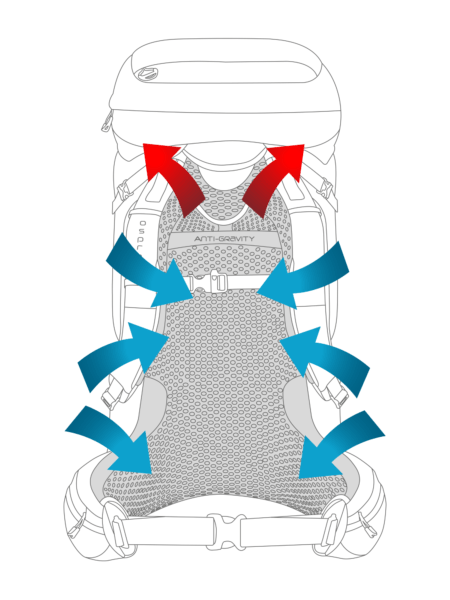
The trade-off appears under heavy load. When a tensioned mesh system is loaded significantly beyond its design range, the mesh deflects toward the back, reducing the airflow gap and partially negating the ventilation advantage. At lighter to moderate loads — say, up to 18kg — the Atmos AG performs as advertised. At heavier loads, the system becomes less effective at both ventilation and load transfer.
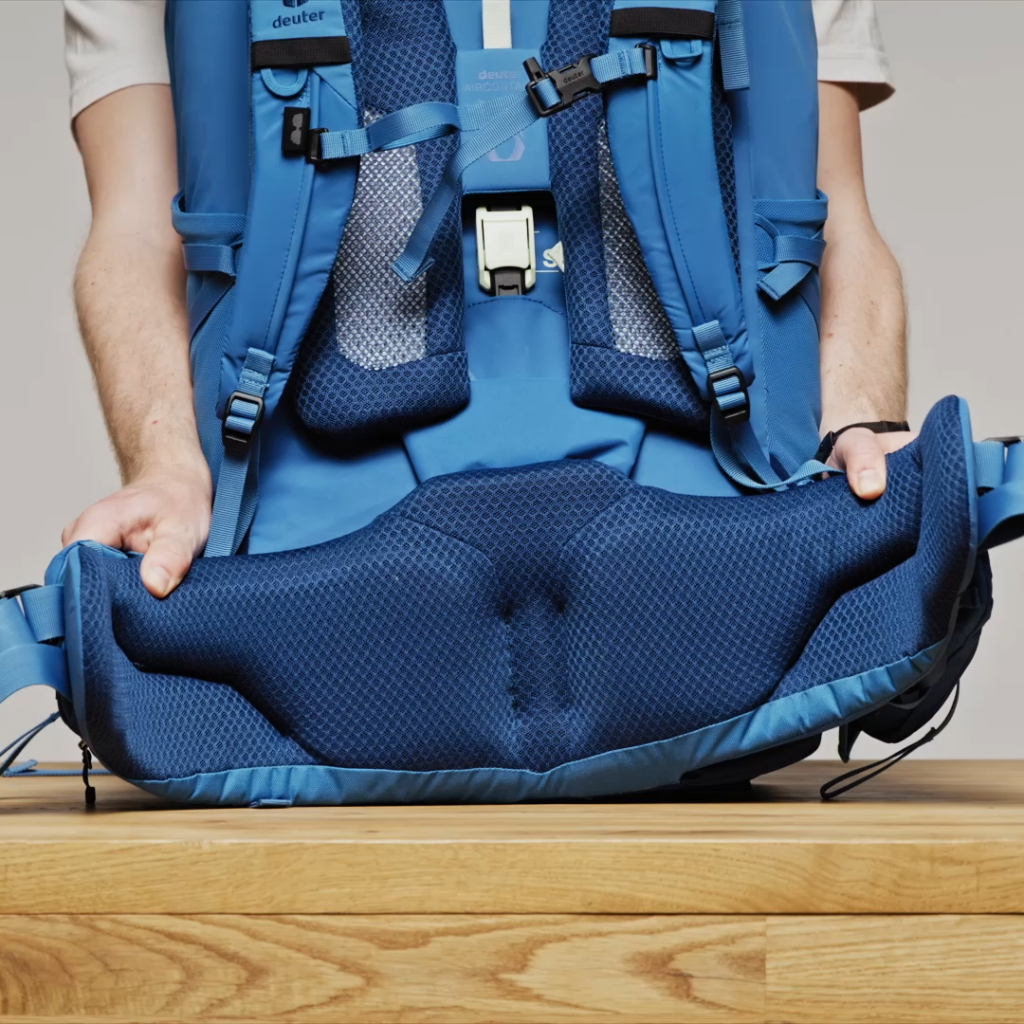
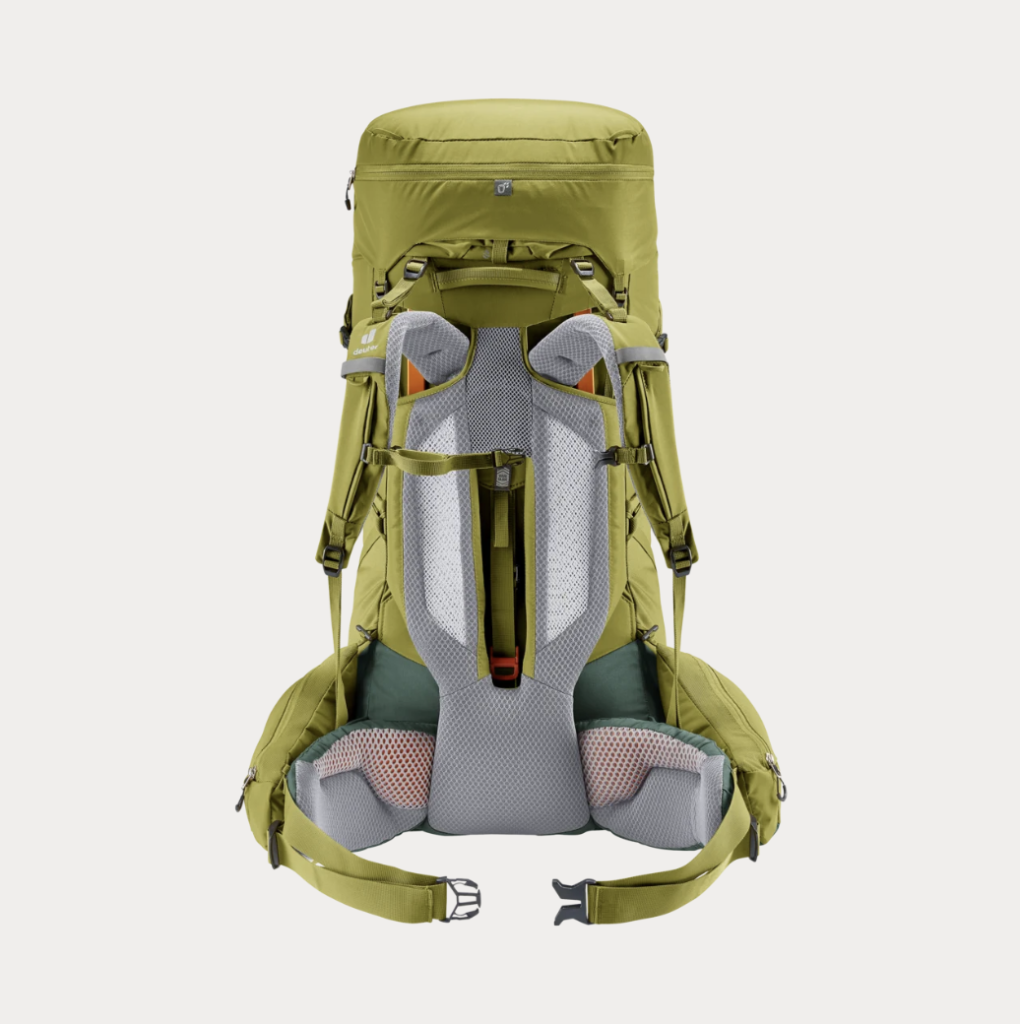
Deuter’s Aircontact system keeps the pack against the back through a shaped foam panel that channels air through grooves rather than holding it away from the body entirely. The result is less impressive breathability than the Atmos but superior load transfer at high weights, because the pack’s centre of gravity stays closer to the carrier’s body. The Vari-Flex hip belt system adds to this by allowing the belt to tilt with the hips through the gait cycle, reducing the rotational friction that rigid hip belts create on long carrying days. For multi-week treks with a full load of camping gear, food, and water, Deuter’s contact-system approach is more biomechanically efficient.
Organisation and Features
Both packs offer a comprehensive feature set appropriate to their price tier. Front U-shaped zip access to the main compartment, lid pocket organisation, hipbelt pockets, trekking pole attachment, ice axe carry, and side mesh bottle pockets are common to both. The Atmos AG has a slight advantage in pocket accessibility and the FitOnTheFly torso adjustment system, which can be adjusted on the fly with the pack on your back — a genuinely useful feature when you are between torso sizes or want to fine-tune the carry mid-route. The Deuter’s VariFlex torso adjustment requires pack removal to change.
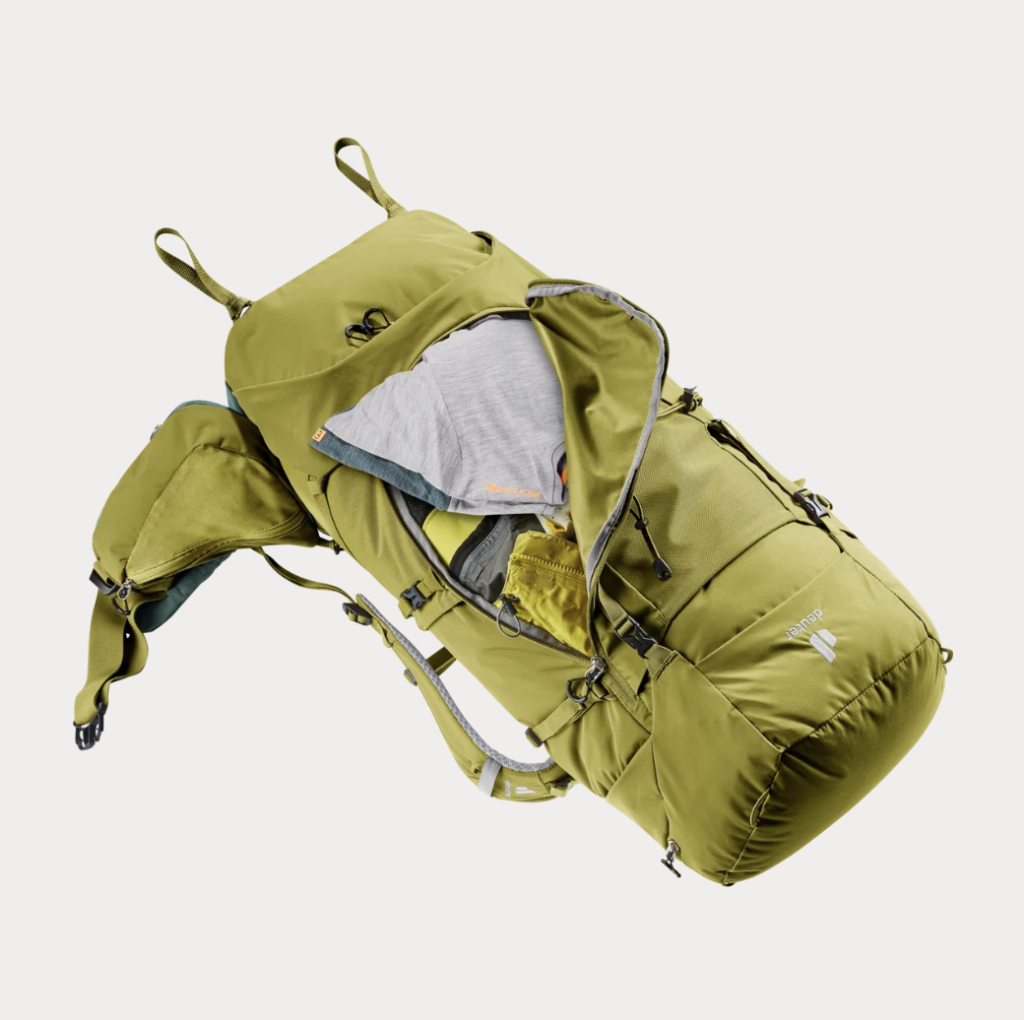
The Deuter Aircontact Core offers an expandable collar adding 10 litres of capacity when needed — useful for expeditions where load fluctuates significantly between the start and end of a multi-day section. The Osprey 65L is a fixed-capacity design without equivalent expansion.
Fit and the Women’s Question
Both brands offer genuinely women’s-specific versions — not simply shorter-torso equivalents of the men’s model but packs designed around different back-panel curvature, hip belt geometry, and shoulder strap spacing. The Osprey Aura AG and the Deuter Aircontact Core SL are proper women’s packs. This matters particularly for hip belt fit, where the difference between a pack designed for male and female pelvis geometry is significant over long carrying days.
Price
The Osprey Atmos AG typically costs slightly more than the Deuter Aircontact at comparable capacities, reflecting both the more complex Anti-Gravity suspension and Osprey’s premium positioning in the European market. The gap is usually €20–40 — not decisive, but worth noting if budget is a constraint. Both packs are durable enough to last a decade of serious use with normal care, which amortises the price difference significantly over the ownership period.
Verdict
Choose the Osprey Atmos AG if: you trek in warm conditions where back ventilation is a priority; your loads stay below 18kg; you want the most breathable suspension system available in a full-featured trekking pack; or you value on-the-fly torso adjustment. For summer alpine trekking, southern European mountain routes, and any context where sweating through your back panel is a significant discomfort, the Atmos AG is the more enjoyable carry.
Choose the Deuter Aircontact if: you regularly carry heavy loads (18kg+) on multi-day or multi-week expeditions; you trek in cooler conditions where back ventilation is less critical than load transfer efficiency; or the expandable collar’s extra 10 litres is useful for your packing style. The Aircontact is the more capable pack at the upper end of the weight range that most trekkers encounter.
For the step up to expedition-grade capacity, our Gregory Baltoro and Osprey Aether comparison covers the 70–80L tier. And for guidance on what to pack in a multi-day backpack, our sleeping bag guide covers one of the heaviest and most consequential items in any multi-day kit.
Explore the full Osprey trekking pack range on the Osprey official website, and the complete Deuter lineup on the Deuter official website.