hill.camp does not test products first-hand. This guide is a structured synthesis of 6 independent sources — specialist buyer’s guides, a UK grouptest, and verified owner testing — assembled with AI assistance and edited before publication. One relevant guide sits behind a paywall we couldn’t get past, so it isn’t reflected here. Very few of these testers rode the exact same bag on the exact same terrain, so where their verdicts diverge, we’ve flagged it rather than smoothed it over.
BIKEPACKING.com once asked nine of its most experienced editors and contributors to name their all-time favourite handlebar bag. With handlebar rolls, harnesses, top-loaders, cradle racks, and rando bags all in play, the panel could have splintered a dozen different ways. Instead it split cleanly into two camps: riders who build their whole system around a waterproof harness and drybag, and riders who won’t use anything but a rigid, top-opening bag they can dig through without unpacking it first. That divide runs straight through every other guide we cross-referenced for this piece, and it’s the first decision you actually need to make before you start comparing individual bags.
If you’re also sorting out the rest of your gravel bikepacking kit, we’ve already gone deep on the two biggest names in the space in our Apidura vs Ortlieb comparison — both show up again below.
| Category | Bag | Capacity | Waterproof? | Best For |
|---|---|---|---|---|
| Best harness system | Revelate Pronghorn (+ Stratex bag) | Varies with roll length | Yes | Long trips, off-bike versatility (seat, bear bag) |
| Best budget harness | Outer Shell Handlebar Harness | Pairs with any drybag | Depends on drybag | Mixing and matching bag sizes across bikes |
| Best top-loader (consensus pick) | Wizard Works Lil’ Presto Barrel Bag | ~3.4L | Weather-resistant, not fully | Riders who hate saggy bags |
| Best large bar bag | Restrap Bar Pack | 10L | Yes | Bulky, multi-day loads |
| Best large harness alternative | Ortlieb QR Handlebar Pack | 11L | Yes | Riders who want tool-free removal |
| Best value | Alpkit Gravel Bag 5L | 5L | Mostly (untaped seams) | Budget-conscious gravel day rides |
| Best for minimal loads | Rapha Bar Bag | 2L | Weather-resistant | Fair-weather rides, commuting |
Harness and roll systems: the waterproof multi-day choice
For genuinely long trips, harness-and-drybag setups dominate the recommendations. One BIKEPACKING.com contributor named the Revelate Pronghorn as his go-to, citing its durability since 2018, a fully waterproof Stratex bag long enough to swallow a tent and sleep system in one go, and the ability to strip it off the bike and use it as a camp seat or bear bag overnight. Another contributor has run a Revelate Harness since 2010 and made a similar point about versatility beyond just carrying gear — using it to lash a packraft to the bars.
Two contributors independently picked the Outer Shell Handlebar Harness, praising its low $60 price and simple Voile-strap construction, though one flagged that pairing it with a large-volume drybag on rough singletrack asks a lot of just two straps. Another tester’s pick, the Rockgeist BarJam, stood out for a different reason entirely: after 40 days on the Great Divide fighting a bag cradle that eventually broke, she valued a harness she never has to think about mid-trip more than any single feature. A fourth pick, the Rogue Panda Canelo Harness, takes the category furthest toward performance, using an ultralight carbon bar and a semi-rigid HDPE headtube plate to stabilise the load and keep the front end steady on technical terrain.
A separate bikepacking bags guide points to the Ortlieb QR Handlebar Pack as the large-volume alternative to a strapped harness: an 11-litre capacity with a tool-free bracket mount that clips on and off without a screwdriver. The trade-off, also noted there, is that it’s wide enough to be awkward on narrower drop bars and needs at least 44cm of bar width to make full use of its capacity.
Top-loaders: quick access, at the cost of full waterproofing
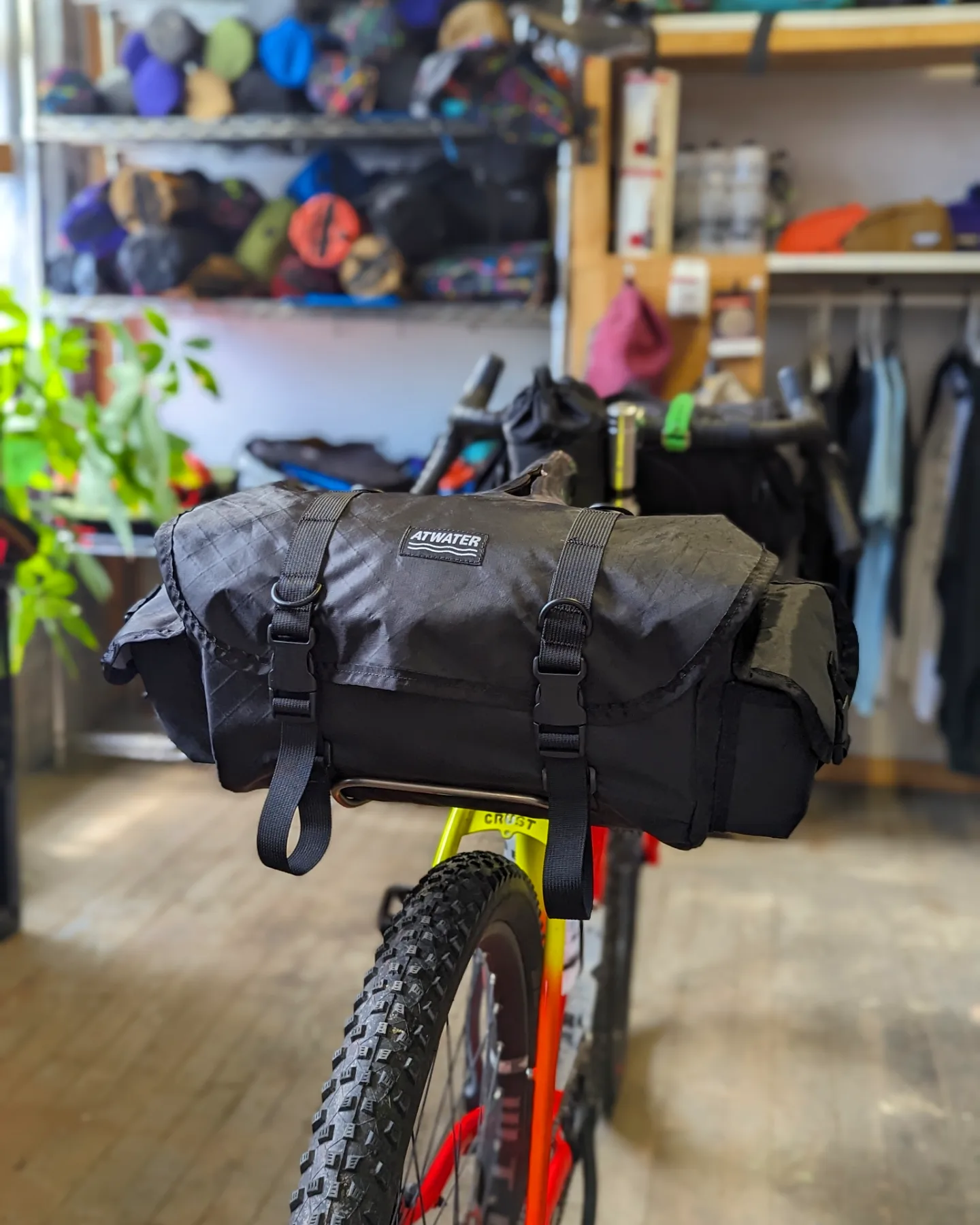
The other camp wants to open the bag once and see everything inside, without pulling gear out onto the ground first. One contributor’s picks — Road Runner’s Jumbo Jammer, the Tribulus Endover, and BXB’s Goldback — are all top-loaders for exactly that reason, though he’s explicit that none of them are fully waterproof, so he packs a separate drybag when rain is forecast. Another made the same trade-off consciously with the Atwater Marauder, valuing its cavernous main pocket, 20 modular attachment points, and usefulness for grocery runs over full weatherproofing.
One bag came up as a genuine favourite across three separate sources: the Wizard Works Lil’ Presto Barrel Bag. A BIKEPACKING.com contributor and a UK grouptest both singled it out, and for the same underlying reason — its plastic-sheet « hard shell » construction keeps the bag rigid even half-loaded, avoiding what one tester bluntly called « saggy bag syndrome » in the two rival bags tested alongside it. An independent BikeRadar review echoed the praise for handmade UK construction and rigidity, though it noted the bag still isn’t totally waterproof despite the reinforced build.
One guide’s top overall bar-bag pick, the Restrap Bar Pack, sits at the larger end of this category: a 10-litre roll-top with a smaller secondary Velcro compartment for on-the-go access, rated as the best of both worlds between full-capacity packing and quick reach-in convenience. On the racier end, another guide rates the Apidura Racing Handlebar Pack highly for its welded, zip-free Velcro-flap opening and genuinely waterproof laminate construction — a rarer combination in this category, since most fully waterproof designs use a roll-top rather than a flap.
The Rapha contradiction: two testers, two very different verdicts
The Rapha Bar Bag is where our sources genuinely disagree, on what appears to be the same core product. A UK-based independent tester bought one out of pocket — noting upfront that Rapha declined to supply a review sample, stating the brand doesn’t support independent reviews — and found the plastic mounting clips rattled annoyingly while riding, even when fully tightened, though they never actually worked loose. NYT Wirecutter tested what reads as the same or a closely related model and reached close to the opposite conclusion on that exact detail, rating its side-release buckles as the easiest to operate of any bag in a 28-bag test, thanks to a cam lock that keeps the webbing from loosening as you ride.
Both testers agree the bag is well-built and light on frills. Where they part ways is squarely on the mounting hardware — a reminder that strap and buckle tolerances can vary between production runs, and that « rattles but holds » and « doesn’t rattle at all » aren’t necessarily describing different products so much as different individual units.
The sagging problem, and how bags actually solve it
Across every source, the single most common complaint about handlebar bags isn’t waterproofing or capacity — it’s bags that go floppy once loaded and swing or sag against the front wheel. A UK grouptest found this with both the Rapha bag and the Restrap Cannister, neither of which has internal stiffening. A separate « also consider » verdict reached the same conclusion independently on the Restrap Canister (the same bag, different naming), flagging that it doesn’t hold its shape once loaded and isn’t as waterproof as its category rivals — a rare case of two unconnected testers landing on an identical weak point for the identical bag.
The fix, consistently, is internal rigidity: a plastic sheet or semi-rigid shell sandwiched into the fabric. NYT Wirecutter found this in its top three picks (Ornot, Almsthre, and the Swift Industries Catalyst all use a plastic insert), and it’s the same principle behind the Wizard Works Lil’ Presto’s « hard shell » design and the rigid construction praised on the Topeak Tubular Barbag. If a bag you’re considering doesn’t mention internal stiffening anywhere in its spec sheet, treat that as a real gap, not a minor detail — sag isn’t just cosmetic, it affects front-wheel clearance too.
Budget picks worth a look
A standalone review of the Alpkit Gravel Bag 5L found it punching well above its roughly £50 price point, with roll-top access, useful front bungee webbing for a wet jacket, and side pouches — genuinely comparable, in the reviewer’s assessment, to the pricier Restrap Bar Pack. The one recurring niggle was the main closure strap loosening slightly on rough terrain, needing an occasional retightening; Alpkit uses a locking lever clip on some of its other bags that would solve this, but not on the Gravel Bag.
NYT Wirecutter’s budget pick for everyday riding, the Chrome Industries Holman Handlebar Bag, uses cam-buckle straps rather than Velcro specifically to avoid the wear-out problem Velcro straps show over repeated daily use — a detail worth weighing if you’re commuting on gravel roads rather than bikepacking multi-day routes.
Fit and compatibility on a drop-bar gravel bike
Every source that addressed fit made the same core point: gravel bars are generally easier to work with than road bars, since they’re wider and flared, giving a bag more room to sit without fouling your levers or hoods. But one guide is specific that deeper bags can still rub the front tyre on smaller frame sizes once loaded and sagging, and that any strap-mounted system benefits from a strip of protective tape on both the bar and head tube to stop long-term wear. An older UK group test made a related point about Ortlieb’s wire-bracket mounting system specifically — while it delivered the lightest weight and the only lockable closure in that test, the wire had to be wound tightly around the bar and stem and wasn’t compatible with carbon handlebars, a limitation Ortlieb’s newer QR bracket system (covered above) was specifically designed to solve.
Our Take
The two-camps framing holds up: decide first whether you want a fully waterproof, expandable harness system for genuine multi-day trips, or a rigid top-loader you can dig through at a coffee stop, and the rest of the shortlist narrows itself considerably. For most gravel riders doing overnighters and weekend trips rather than continental crossings, the Wizard Works Lil’ Presto is the pick that keeps earning independent praise for the same reason across sources — it solves the sag problem properly without asking you to compromise on access. If you’re planning something longer with a full sleep system on the bars, a harness from Revelate, Rockgeist, or Apidura remains the safer, more waterproof bet, even if it means slightly slower packing at camp. You can see the full current Lil’ Presto range, including custom colourways, directly at Alpkit’s official site, which also carries the Gravel Bag 5L covered above.
Frequently Asked Questions
Should I get a harness or a top-loader bag for gravel bikepacking?
It depends on trip length and how often you need to access what’s inside. Harnesses paired with a drybag win on full waterproofing and raw capacity for multi-day loads like a tent and sleeping bag. Top-loaders win on convenience, letting you see and grab everything at once, but few are fully waterproof, so plan on packing a spare drybag for wet-weather items either way.
Will a handlebar bag fit on my gravel bike’s drop bars?
Almost certainly, and more easily than on a road bike, since gravel bars are typically wider and flared. Still check the gap between your brake levers and the front tyre before buying a large-capacity bag, and be aware that a bag can sag lower once loaded than it sits empty in a shop.
How do I stop my handlebar bag from sagging or swinging?
Look for internal rigidity — a plastic sheet, semi-rigid shell, or reinforced panel sewn into the bag — rather than relying on straps alone to hold its shape. A stabilising strap around the head tube also helps significantly, and it’s worth adding protective tape to both the handlebar and head tube contact points regardless of which bag you choose.
Do I need a fully waterproof handlebar bag?
Only you know how much rain your riding involves, but even testers who prefer non-waterproof top-loaders for their convenience routinely pack a separate dry bag inside when rain is forecast. If you’re carrying a sleeping bag or electronics and can’t guarantee dry weather, a genuinely waterproof harness-and-drybag system removes that risk entirely.