Carbon plate trail shoes arrived with a simple promise borrowed from the road: drop a stiff plate into a stack of bouncy foam, and run faster for free. On tarmac, that promise is backed by hard science. Off-road, it is one of the most genuinely contested questions in running gear right now — and the honest answer is far messier than either the marketing or the cynics will tell you. So let us actually work through it: what the plate does, what the research shows, where it helps on trail, where it hurts, and who should care. No hype, no blanket dismissal.
Where Carbon Plate Trail Shoes Came From
The story starts on the road in 2017, when Nike’s Vaporfly 4% launched and a 2018 study led by researcher Wouter Hoogkamer confirmed the headline: 18 trained runners saw an average 4% reduction in the energy cost of running. Every major brand scrambled to build its own plated racer, and the « super shoe » era began. But for years the plates stayed firmly on pavement, where the benefit was well documented and the surface was predictable.
Trail came late. The North Face Vectiv, in 2021, was the first trail shoe with a stiff, curved carbon plate in the midsole — and it drew mixed reviews, especially from runners on technical ground. Since then Hoka, Nike, Adidas, Saucony and a wave of boutique brands have all joined in. The question is whether the road magic actually survives the trip off-road.
What the Plate Actually Does (It’s Not What You Think)
Here is the single most important thing to understand, because it reframes the entire debate: the plate is not the spring. For years runners assumed the carbon plate was the magic ingredient, snapping them forward like a diving board. The research says otherwise. As Hoogkamer puts it, the plate’s role is actually secondary to the foam — it is the thick, explosive, trampoline-like foam that delivers the energy return. Studies even found that cutting slots in a plate didn’t significantly change a shoe’s running economy.
So what is the plate for? Three things, according to footwear biomechanist Martyn Shorten and others. First, it stabilises the soft, fragile modern foams that would otherwise be too unstable to run on. Second, it protects those foams from tearing — it prevents the shoe flexing so much that the lightweight foam breaks down prematurely. Third, it helps the foam compress as a single unit rather than in fragmented zones. Hoogkamer’s analogy is perfect: press your fingers into foam and you get five little dents; lay a playing card on top first and press, and you get one clean, uniform imprint. The plate and foam interact in ways researchers admit they don’t fully understand — but together they add up to more than the sum of their parts. Call it 1 + 1 = 3.
This matters enormously for trail, because it means a plate alone guarantees nothing. A plate in a thin, firm trail midsole — with none of the deep, soft foam that makes the system work — may do very little for propulsion. This is exactly what independent testers found with shoes like the Speedland SL:PDX, whose removable Carbitex plate functions less as a road-style spring and more as a tunable stone guard. Our Speedland SL:PDX review digs into that distinction in detail.
The Speed Problem: Why Pace Changes Everything
The plate-and-foam system has a catch that hits trail running hard: it works best at speed. As Shorten explains, the slower you run, the more the benefits diminish. On a flat road at marathon race pace, you are moving fast enough to load the system properly. On a trail — climbing steep grades, picking through rock, hiking the ups — you frequently are not.
This is where the most pointed research comes in. When Salomon set out to design its S/Lab Ultra race shoe, the team ran a study: 12 non-elite runners on a treadmill, two near-identical prototypes, the only difference being a carbon plate. They tested on the flat and on a 10% incline. The finding was that speed had a decisive role in whether the plate improved running economy — and their conclusion was that even elite trail runners wouldn’t sustain high enough speeds across an ultra to consistently benefit. In their uphill testing, Salomon’s scientists were surprised to measure a detrimental effect: adding the plate increased energy expenditure by around 2%. Salomon’s S/Lab Ultra shipped without a plate as a direct result.
That sounds like a knockout blow — but honesty cuts both ways. Hoogkamer, reviewing the Salomon study, pointed out real flaws: the prototype shoes didn’t help on flat ground either, which suggests the shoe itself, not plates in general, may have been the problem. « You can’t build a bad shoe and then say it doesn’t work, » he noted. The subtleties of how a plate is integrated and tested matter enormously. So the Salomon result is a genuine data point against plates in slow, uphill, ultra contexts — not proof that plates never work on trail.
The Stability Problem: When a Plate Becomes a Liability
Roads are flat, straight and predictable. Trails are none of those things — they are littered with rocks, roots and mud, and the landing surface changes step to step. A stiff plate that prescribes a smooth forward roll is an asset on pavement and a hazard on a root-strewn descent, where it can tip landings and bounce push-offs in unproductive, even dangerous, directions. Runners consistently describe plated trail shoes as feeling « tippy » or unstable on technical ground, and the taller the stack the worse it gets, because height and stability are direct trade-offs.
The runner community echoes this with one voice: plates shine on smooth, runnable, rolling terrain and become a hindrance on steep, technical, rocky trails — where many experienced runners prefer a low stack, no plate, and maybe a simple rock plate for protection. There is also a recurring complaint that stiff plated shoes are brutal on the calves when hiking steep climbs, precisely the terrain where the plate gives least back. As one runner put it, the shoes only help as far as your legs can run them; once the legs go, the plate does nothing.
How Brands Are Solving It
The smarter trail brands didn’t just transplant road plates — they rebuilt them. The core insight, from Carbitex founder Junus Khan, is that on trail a plate serves multiple possible purposes — protection, propulsion, stability — and the design has to follow the shoe’s intent: ultra or short, technical or smooth. A road plate is a rigid, scooped lever optimised for one thing. A trail plate often needs to flex laterally so the foot can still adapt to the ground.
Hence the design zoo you now see. Hoka’s Tecton X uses two parallel, independent plates acting like independent suspension — stiff heel-to-toe for propulsion, but adaptable side-to-side so you’re less likely to roll an ankle. We put that exact design head to head against a plateless rival in our Hoka Tecton X vs Norda 001 comparison, which shows how differently the two philosophies play out on real terrain. Hoka’s Mafate X uses a single H-shaped plate that forks at both ends, with a shallower curve, tuned for stability over long distances rather than speed. Adidas uses forked « energy rods » under the metatarsals that mimic the bones of the foot. The North Face stacks a stability plate above a full-length carbon plate. And Speedland’s Carbitex plate flexes asymmetrically and is fully removable, letting you decide per run. Biomechanically this makes sense: a forked or fingered plate with less stiffness in the frontal plane lets you adapt to terrain and reduces ankle-roll risk.
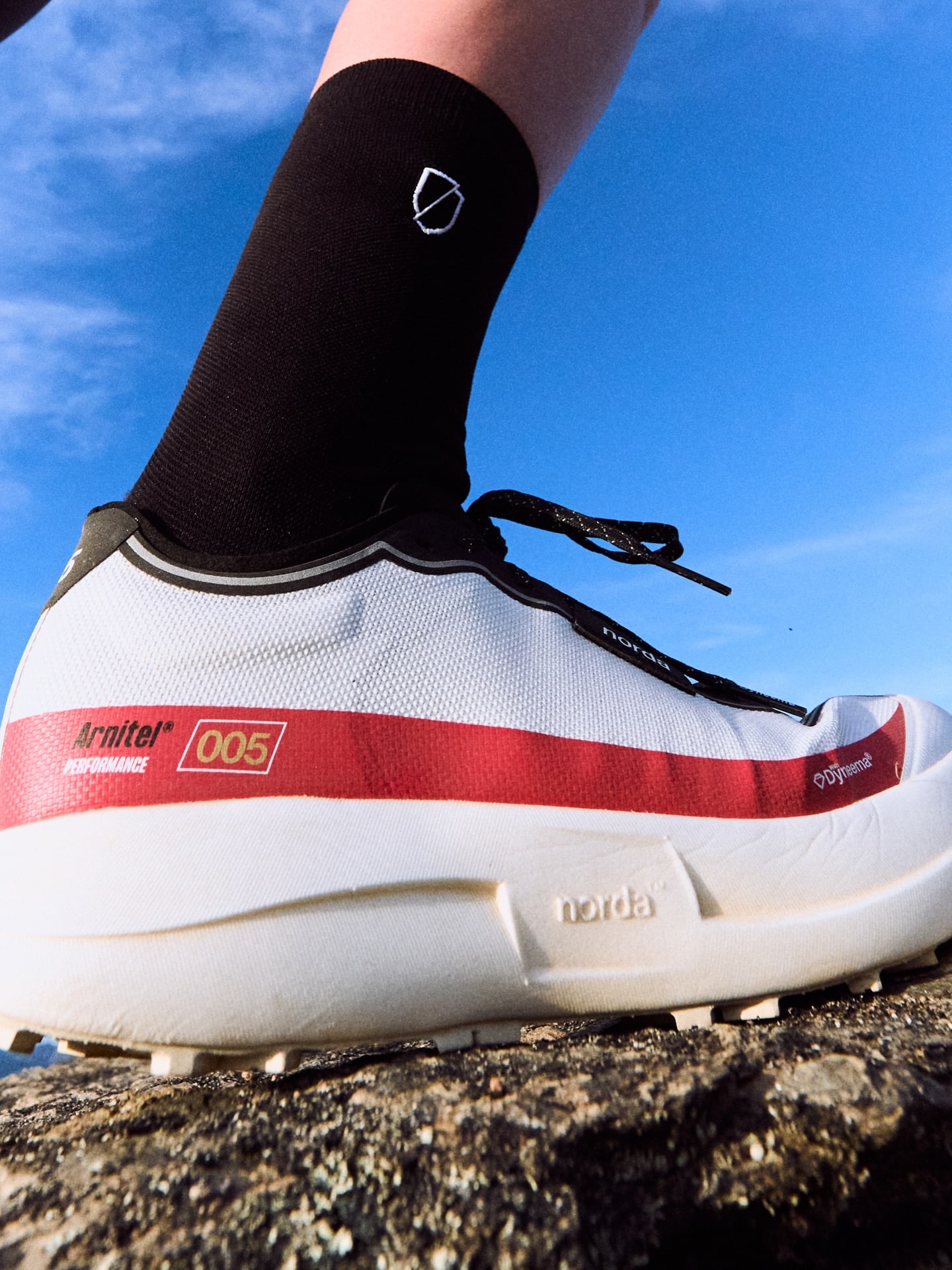
And then there’s the other camp entirely: brands that skip carbon. Salomon uses a thin, flexible TPU layer for « terrain filtering » — protection without rigidity. Norda’s 005 goes completely plateless, betting everything on a pure Arnitel TPEE foam that delivers its own energy return, and proving the point that you can build an elite-level trail racer with no plate at all. The plate-versus-no-plate philosophy is exactly the tension we explored in our Norda 005 vs Speedland SL:PDX comparison — two premium brands arriving at opposite answers.
The One Thing Everyone Agrees On: Protection
Amid all the disagreement, there is consensus on a single point: some kind of rigid barrier in the sole is genuinely useful on trail, because it stops sharp rocks from bruising your foot. After a brutal technical effort, plenty of runners want plate-level protection for anything long, regardless of energy return. But — and this is the crucial nuance from Shorten — that protection « doesn’t have to be a carbon fiber plate. It doesn’t have to be a curved plate. It doesn’t even have to be a plate at all — it could be a mesh that is still flexible but won’t let anything through. » In other words, if protection is what you’re after, you are paying a carbon premium for something a cheaper rock plate delivers just as well.
The Cost Question
Carbon plate trail shoes typically run $200–$300, against $100–$150 for most trail shoes. That premium buys the carbon itself plus the engineering to integrate it. The performance data, meanwhile, suggests the gains are real but narrow: roughly 2–3% improvement for elite athletes, concentrated on smooth terrain at fast paces. The average runner plodding at 8–10 minutes per mile is unlikely to see the same return — which makes the premium hard to justify on economy grounds alone. Cheaper nylon and fiberglass plates offer much of the stability and protection with more flexibility and durability, at lower cost, which is why you increasingly see them in mid-priced trail shoes. If you want a fuller framework for matching shoe tech to your running, our guide on how to choose the right trail running shoes covers stack, drop, lugs and terrain from the runner’s side.
So — Do They Actually Work Off-Road?
The most defensible answer, and the one the researchers themselves converge on, is this: it depends, and the variables are terrain and speed. Carbon plates unambiguously work on the road for fast runners on hard, straight surfaces. On trail, the picture is genuinely mixed — and Hoogkamer doubts we’ll ever be able to say plates are universally good or bad off-road. As he frames it, for some races they’ll be good and for some they’ll be bad, and both of those are true.
The practical rule that falls out of the science is clean. If you run smooth, rolling, runnable trails — the buffed singletrack and fire roads of California or Arizona — at a decent clip, a high-stack, well-cushioned, plated shoe can deliver comfort and a modest efficiency gain. If you run steep, rugged, technical mountain terrain, you probably want a lower stack, no plate or just a rock plate, and the ground feel and stability that plate-free designs provide. Speed and surface decide it, not the marketing.
Our Take
Carbon plate trail shoes are neither a scam nor a silver bullet — and anyone telling you they’re definitely one or the other is selling something. The plate is real engineering doing a real job, but that job on trail is mostly about stabilising foam, protecting it, and protecting your foot, not launching you forward like a road super shoe. The propulsion you’re paying a premium for only materialises when you’re moving fast on smooth ground, which describes some trail running and emphatically not all of it. For a fast runner racing flowy, rolling terrain, a good plated trail shoe is a legitimate, if expensive, edge. For someone grinding steep technical mountains, or running at a relaxed pace, the money is better spent on fit, cushioning, traction and a simple rock plate. The honest verdict is the unsatisfying one: the right answer is written by your terrain and your pace, not by the carbon. Buy the shoe that suits where you actually run.
Frequently Asked Questions
Do carbon plate trail shoes actually make you faster off-road?
Sometimes. The efficiency benefit is real but conditional: it shows up mainly at faster paces on smooth, runnable terrain, where studies suggest roughly a 2–3% gain for elite-level runners. On steep, technical or slow terrain, the benefit shrinks or disappears, and one Salomon study even measured a small energy penalty uphill. For most recreational runners on mixed trails, the speed gain is modest at best.
Is it the carbon plate or the foam that makes super shoes work?
Primarily the foam. Researchers now believe the thick, responsive foam provides most of the energy return, while the plate’s main jobs are stabilising that foam, protecting it from tearing, and helping it compress uniformly. The two work together — the system is greater than the sum of its parts — but a plate alone, without good foam, does relatively little for propulsion.
Are carbon plates bad on technical trails?
They can be. A stiff plate prescribes a smooth forward roll, which is great on flat ground but can feel unstable or « tippy » on rocks, roots and uneven terrain, and taller stacks make this worse. Many experienced technical runners prefer a low stack with no plate, or just a rock plate for protection. Trail-specific plates with forked or flexible designs reduce this problem but don’t eliminate it.
Do I need a carbon plate for protection from rocks?
No. Protection is the one benefit nearly everyone agrees on, but experts are clear that it doesn’t require carbon — a flexible rock plate or even a puncture-resistant mesh does the same job for far less money. If underfoot protection is your goal rather than propulsion, you don’t need to pay the carbon premium.
Are carbon plate trail shoes worth the money?
For elite and fast sub-elite runners racing smooth, rolling terrain, the 2–3% efficiency edge can justify the $200–$300 price. For average-paced runners and those on technical ground, the marginal benefit rarely justifies the premium, and cheaper nylon or fiberglass-plated shoes offer much of the stability and protection at lower cost. As always on trail, terrain and pace should drive the decision.
Which trail brands skip carbon plates entirely?
Several premium brands deliberately avoid carbon. Salomon uses a flexible TPU « terrain filtering » layer instead, and Norda’s 005 is fully plateless, relying on a pure Arnitel TPEE foam for energy return. Both prove that a top-tier trail racer can be built without a plate, prioritising ground feel, stability and adaptability over a rigid lever.