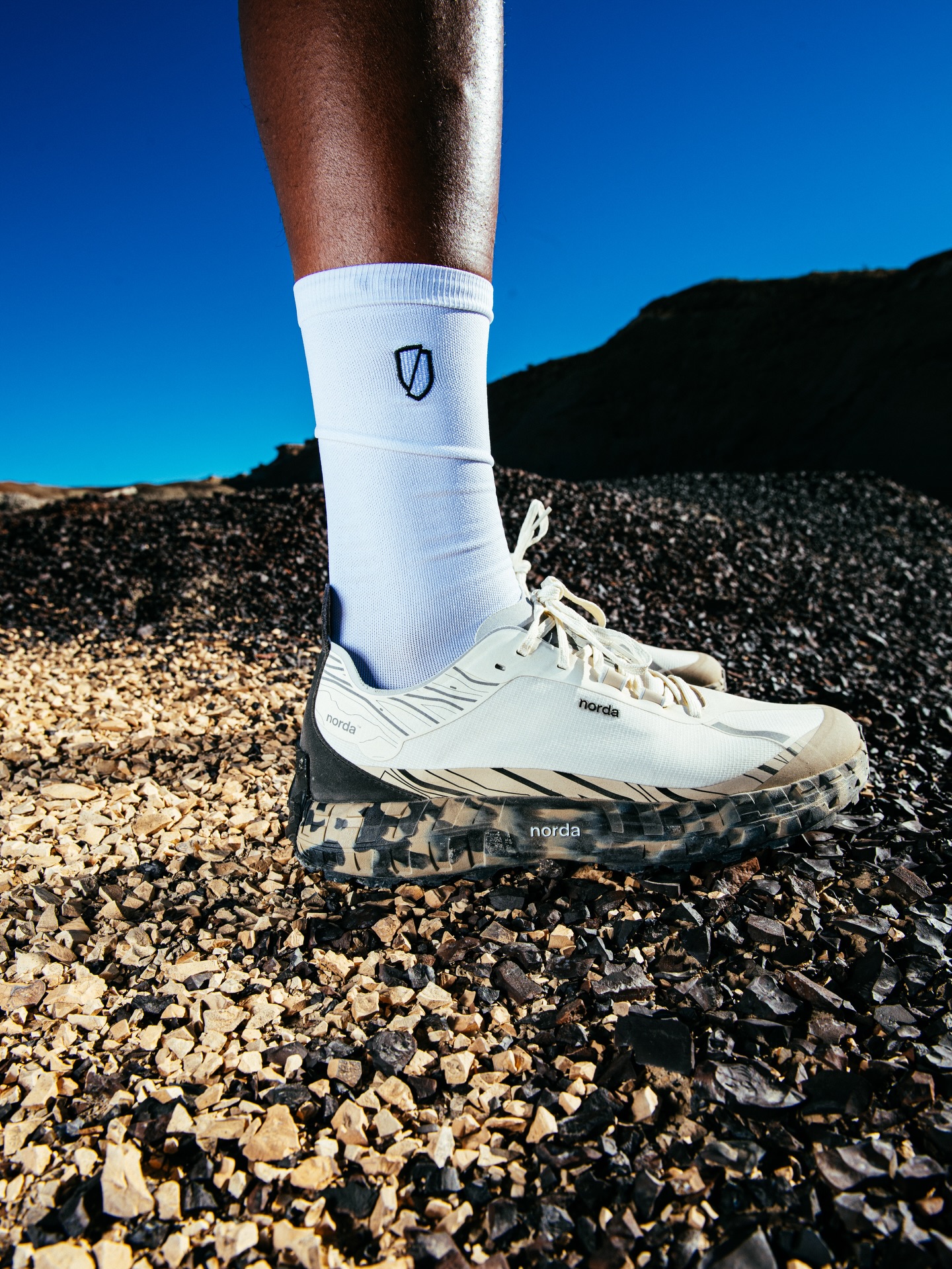
hill.camp does not conduct first-hand product testing. This Hoka Tecton X vs Norda 001 comparison is a synthesis of independent field tests, specialist press articles, and verified consumer feedback gathered from multiple sources. All technical data and performance observations are drawn from those sources and attributed accordingly.
If you want to understand the two great arguments happening in premium trail footwear right now, you could do worse than lace up these two shoes back to back. The Hoka Tecton X 3 is the carbon-plated, maximally cushioned super shoe — two parallel plates, 40 millimetres of bouncy PEBA, a built-in gaiter, the shoe a Hoka designer wore to win UTMB. The Norda 001 is its philosophical opposite: no plate, a moderate 26-millimetre stack, a near-indestructible Dyneema upper, and a bet that materials and durability matter more than mechanical propulsion. One shoe adds everything the road super-shoe era invented. The other refuses almost all of it. Neither is confused about what it is — which is exactly what makes the comparison worth having.
Hoka Tecton X vs Norda 001: Specs at a Glance
| Spec | Hoka Tecton X 3 | Norda 001 |
|---|---|---|
| Weight (US M9) | ~265 g | ~298 g |
| Stack (heel / forefoot) | 40 / 35 mm | 26 / 21 mm |
| Drop | 5 mm | 5 mm |
| Plate | Twin parallel carbon plates + winglets | None |
| Midsole | Dual-layer PEBA | Vibram SLE (EVA compound) |
| Upper | Matryx textile + knit gaiter | Seamless Bio-Dyneema |
| Outsole | Vibram Megagrip Litebase, 4 mm lugs | Vibram Megagrip Litebase, 5 mm lugs |
| Best for | Fast ultras on buffed / moderate trail | Durable all-round technical trail |
| Price | $275 | $285 |
One note before we go further, in the interest of honesty. Norda now sells two versions of this shoe: the original 001, with its Vibram SLE midsole, and the newer 001A, which swaps in an Arnitel TPEE foam borrowed from the Norda 005 for a bouncier, slightly lighter ride at the same geometry. This comparison centres on the 001 as most people search for and buy it, but nearly everything here applies to both — and where the 001A changes the maths, we say so. Our full Norda 001A review covers that version in depth.
Two Shoes, Two Opposite Bets
The Tecton X 3 is Hoka doing what Hoka does best: maximal cushioning, engineered to stay stable and fast. It is a race shoe, built around a development prototype Jim Walmsley wore to win UTMB in 2023 and Western States in 2024, and refined by Hoka designer Vincent Bouillard, who then won UTMB in it himself in 2024. Everything about it is oriented toward moving quickly and comfortably when you are deep into an ultra and your legs are shot.
The Norda 001 comes from the opposite instinct. When the Montreal brand launched it in 2021, the pitch was not propulsion — it was permanence. A seamless Bio-Dyneema upper billed as the strongest fibre in footwear, a hand-bonded build, a lifespan measured at 600 to 700 miles when most trail shoes are cooked by 300 to 400. It is low to the ground, precise, and deliberately free of gimmicks. Where the Tecton chases the super-shoe formula, the 001 quietly questions whether trail runners need it at all. That exact question is the subject of our guide on whether carbon plate trail shoes actually work off-road — and these two shoes are the cleanest illustration of both sides.
Cushioning and Ride: Maximal Bounce vs Ground Feel
This is the widest gap between the two, and it starts with stack height: 40 millimetres at the heel on the Tecton, 26 on the Norda. That is not a subtle difference — it is two entirely different relationships with the ground.
The Tecton X 3’s dual-layer PEBA midsole, with the twin carbon plates sandwiched between, delivers a soft, bouncy, forward-driving ride that testers consistently describe as fun and fast. Independent lab testing measured energy return around 70%, which is world-class for a trail shoe. The plates are tuned for propulsion first, with newly added winglets that broaden the base and calm the wobble that taller stacks invite. The result is a shoe that carries you when you are tired and makes long, runnable descents genuinely enjoyable — a road-super-shoe sensation adapted, as far as physics allows, to the dirt.
The Norda 001 offers almost the reverse. Its Vibram SLE midsole is a firmer EVA-based compound, and reviewers are candid that there is no « pop » out of the box — the reward is ground feel, precision, and control rather than bounce. You feel the trail; you drive the shoe rather than being driven by it. For runners who dislike getting lost in stack and lift, that connection is the whole point. It is worth noting the 001A narrows this gap slightly: its Arnitel TPEE foam is noticeably more resilient and lively than the original SLE, with a claimed 30% jump in resiliency, though it remains a grounded, moderate-stack ride rather than a plush one.
So the practical split is clean. If you want cushioning to protect your legs over 100 kilometres of pounding, the Tecton is in a different league. If you want to feel and control the ground under you, the 001 gives you that in a way no 40-millimetre shoe can.
Stability and Technical Terrain
Here the tables turn. The Tecton’s height is its liability on genuinely rough ground. Even with the stabilising winglets and a wide, well-designed footprint, multiple reviewers found that on steep, rocky, off-camber terrain the tall stack introduces instability, and — as one honest tester noted — the sock-like gaiter collar looks supportive but provides essentially no ankle stability. It is superb on buffed and moderately technical trail, and it can wobble when things get gnarly at speed.
The Norda 001 is the more sure-footed shoe when the terrain turns nasty. Its low stack keeps your centre of gravity close to the ground, and its Dyneema upper with the Norda Lock System delivers some of the best midfoot lockdown reviewers have tested, keeping the foot planted on exposed traverses and fast, technical descents. This is the shoe you want when precision and confidence matter more than plush forgiveness. The trade-off, as we will see, is at the ankle.
Upper, Fit and the Shared Heel Problem
The two uppers could not look more different — yet they share one flaw. The Tecton X 3 uses a durable Matryx textile with an integrated knit gaiter that seals out debris beautifully (a genuine highlight for many runners) and a classic narrow Hoka fit with a slightly roomier toe box than the X 2. Wide-footed runners should be cautious; those with regular or narrow feet get a secure, race-ready wrap.
The Norda 001’s seamless Bio-Dyneema upper is close to indestructible — reviewers routinely expect the midsole or outsole to fail long before the upper shows wear — with a genuinely wide, wide-foot-friendly toe box. But both shoes share the same weak spot: a minimal, underpadded heel collar. On the Tecton, the sock-like cuff can feel insecure and hard to lock down; on the Norda, the raw, structureless Dyneema heel is a well-known gripe that has rubbed some runners’ Achilles raw over long efforts. Neither shoe nails the rear-foot hold, for opposite reasons — one too soft, one too spare. Norda’s own 001A and 002 add heel padding precisely because of this.
Outsole and Grip
This is the closest category, because both shoes run Vibram Megagrip with Litebase construction — among the best traction packages available. The Tecton X 3 uses redesigned 4 mm lugs that reviewers found grippy and confident across wet and dry surfaces, tuned to complement its speed-oriented ride. The Norda 001 runs slightly deeper 5 mm lugs on the same Megagrip Litebase platform, and its grip on wet rock and slab draws some of the highest praise of any trail shoe — testers compare its confidence on technical wet stone to mountaineering footwear. Both are excellent; the Norda has a slight edge in outright bite and wet-rock security, the Tecton is optimised for rolling speed.
Weight, Durability and Price
The numbers are closer than the shoes’ philosophies suggest. The Tecton X 3 is genuinely light for a maximal carbon shoe at around 265 grams — impressive given it includes a built-in gaiter. The Norda 001 is heavier at around 298 grams, a firmer, denser shoe (the 001A trims roughly an ounce off with its Arnitel foam).
Durability flips the story. The Tecton’s soft PEBA midsole and plates are widely reported to lose their stiffness and pop before the outsole wears out — one tester saw the ride degrade before 350 miles. The Norda 001, by contrast, is built to outlast almost everything, with a realistic 600-to-700-mile lifespan that makes its cost-per-mile genuinely competitive despite the sticker price. At $275 versus $285, the two are priced almost identically — but you are buying very different things: peak race-day performance that fades, versus durable, consistent performance that endures.
Which One Should You Buy?
Choose the Hoka Tecton X 3 if you race long — 50K to 100 miles — on buffed, rolling, or moderately technical trail, and you want maximum cushioning and a fast, bouncy, propulsive ride to carry your legs late in an ultra. It is the better pure race shoe, the more forgiving shoe for heavy mileage, and the more fun shoe on runnable ground. Accept the narrow fit, the tall-stack instability on gnarly terrain, and a midsole that fades over time.
Choose the Norda 001 if you want a durable, do-everything trail shoe with unmatched longevity, exceptional wet-rock grip, ground feel, and precision on technical terrain — and you would rather trust your legs and the trail than lean on a plate. It is the better technical shoe, the better long-term value, and the better choice for runners who dislike disconnected, oversized stacks. If you want a touch more life underfoot without giving up the character, look at the 001A. For another angle on how the 001 stacks up against a cushioned rival, see our Norda 001 vs Hoka Speedgoat comparison, and our roundup of the 10 best trail running shoes in 2026 sets both against the wider field.
Our Take
These two shoes are not really competing — they are answering different questions. The Tecton X 3 asks how fast and comfortable a trail shoe can be when you throw every road-super-shoe idea at it, and the answer is: remarkably, as long as the terrain stays reasonable and you replace it before the foam dies. The Norda 001 asks whether any of that is necessary, and answers with a shoe that grips better on wet rock, lasts twice as long, and keeps you connected to the ground — while asking more of your legs and offering no mechanical help. If your running is race-focused, ultra-distance, and mostly runnable, the Tecton is the sharper tool. If it is technical, varied, value-conscious, and you prize durability and ground feel, the 001 is the more honest one. Most telling of all: the Tecton’s plates fade toward the end of its life, while the Norda’s whole case is that it barely fades at all. Pick the philosophy that matches how — and how often — you actually run. You can explore both ranges on the official Hoka website and the official Norda website.
Frequently Asked Questions
Is the Hoka Tecton X 3 or the Norda 001 better for ultras?
For long ultras on runnable or moderately technical terrain, the Tecton X 3 is generally the better choice — its 40 mm of PEBA cushioning protects your legs over big mileage and its carbon plates keep you moving when tired. The Norda 001 can handle ultra distances too, especially on technical ground, but its lower stack and firmer ride ask more of your legs late in a race. Choose the Tecton for cushioned comfort, the 001 for technical precision and durability.
Does the Norda 001 have a carbon plate?
No. The Norda 001 is deliberately plateless, relying on its midsole foam, low stack, and Vibram outsole for a grounded, controlled ride. The Hoka Tecton X 3 uses two parallel carbon plates with stabilising winglets for propulsion. This is the core philosophical difference between the two shoes: the Tecton adds mechanical assistance, the Norda trusts the runner and the materials.
Which shoe is more durable?
The Norda 001, clearly. Its Bio-Dyneema upper is close to indestructible and the shoe is built for a 600-to-700-mile lifespan, making its cost-per-mile very competitive. The Tecton X 3’s soft PEBA midsole and carbon plates tend to lose their responsiveness before the outsole wears out, with some testers noting the ride degrading before 350 miles. If longevity is your priority, the Norda wins decisively.
Which is better on technical terrain?
The Norda 001. Its low 26 mm stack keeps you stable and connected on rough, rocky, off-camber ground, and its Dyneema upper delivers excellent midfoot lockdown plus outstanding wet-rock grip. The Tecton X 3’s tall 40 mm stack, despite stabilising winglets, can feel unstable on genuinely technical terrain, and its gaiter collar offers little real ankle support. For gnarly trail, the 001 is more sure-footed.
What is the difference between the Norda 001 and 001A?
They share the same geometry (26/21 mm stack, 5 mm drop), Dyneema upper, and Vibram outsole, but differ in the midsole. The original 001 uses a firmer Vibram SLE (EVA) foam, while the 001A uses an Arnitel TPEE compound borrowed from the Norda 005 for a bouncier, more resilient, slightly lighter ride, with a claimed 30% resiliency improvement. The 001A also adds minor heel and fit refinements. Everything in this comparison applies to both, with the 001A offering a touch more life underfoot.