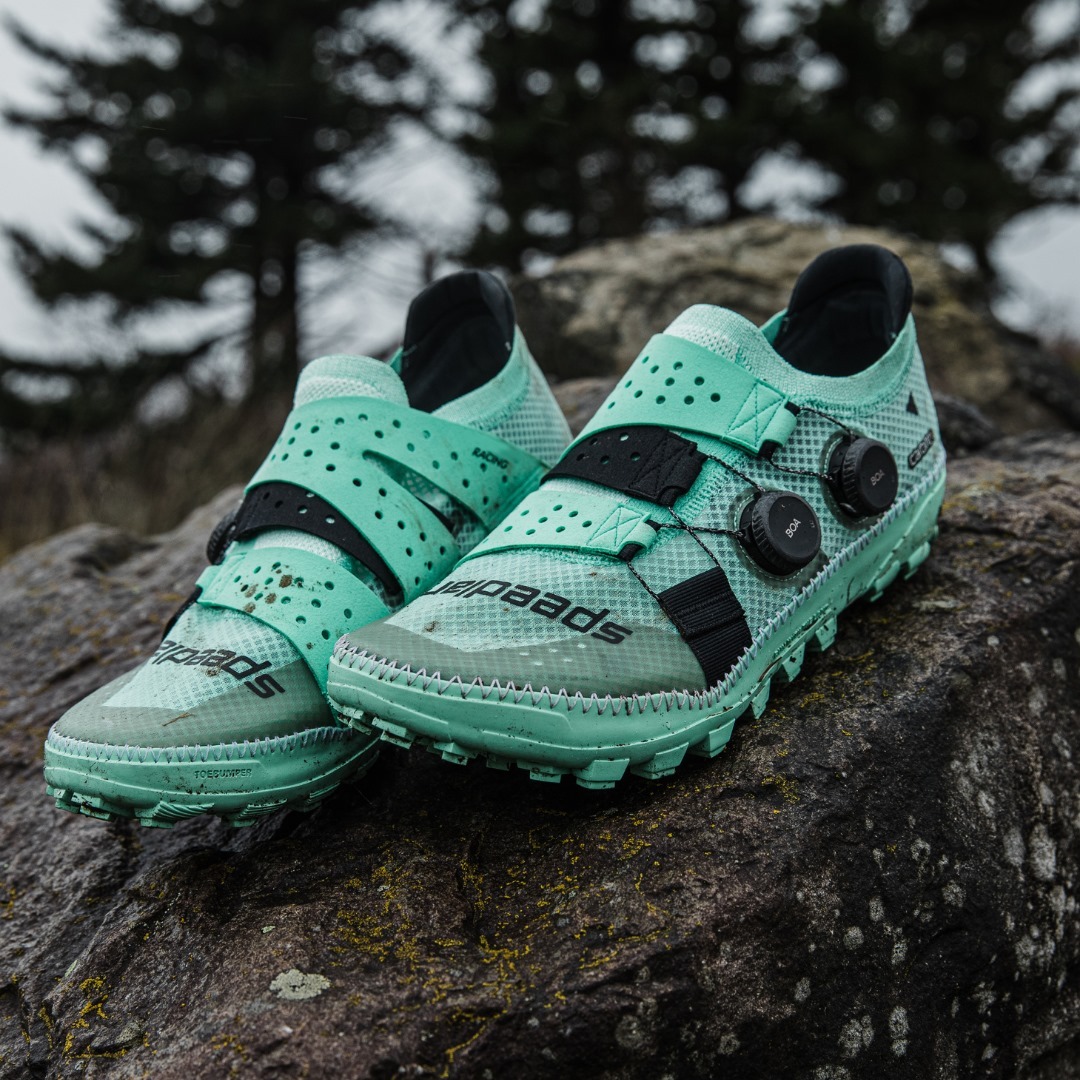
hill.camp does not conduct first-hand product testing. This Norda 005 vs Speedland SL:PDX comparison is a synthesis of independent field tests, specialist press articles, and verified consumer feedback gathered from multiple sources. All technical data and performance observations are drawn from those sources and attributed accordingly.
Here is a comparison that only makes sense at the very top of the trail running market — and one that turns out to be more revealing than most. The Norda 005 and the Speedland SL:PDX are both among the most expensive, most obsessively engineered trail shoes ever made. Both come from small, founder-led brands that refuse to cut corners. Both reject the idea that a running shoe is a disposable commodity. And yet, faced with the same question — what does a no-compromise trail shoe look like? — they arrive at almost perfectly opposite answers. The SL:PDX adds everything: dual dials, a removable carbon plate, cuttable lugs, modularity at every layer. The 005 strips everything away: no plate, no dials, one extraordinary foam and not much else. This is not a fight over which is better. It is a choice between two philosophies of « best. »
Norda 005 vs Speedland SL:PDX: Specs at a Glance
| Spec | Norda 005 | Speedland SL:PDX |
|---|---|---|
| Weight (US M9) | ~215–228 g | ~292–309 g |
| Stack (heel / forefoot) | 28.5 / 21.5 mm | 28 / 23 mm |
| Drop | 7 mm | 5 mm |
| Midsole | 100% Arnitel TPEE, no plate | Pebax SCF + removable Carbitex plate |
| Upper | Bio-Dyneema open mesh, seamless | Knit Dyneema, moccasin-stitched |
| Closure | Fit-Lock + Dyneema laces | Dual BOA Li2 dials |
| Outsole | Vibram Megagrip Elite, 3.5–4 mm lugs | Michelin, 7 mm cuttable lugs |
| Best distance | 20–80 km, race pace | Sub-50K to short ultra |
| Price | €299–315 | $375 |
Two Philosophies, One Price Bracket
Before the components, it is worth naming what unites these two shoes, because it explains why comparing them is interesting rather than arbitrary. Both Norda and Speedland are small brands built on a refusal to design around a price point. Both treat Dyneema, Vibram or Michelin rubber, and premium foams as non-negotiable starting points rather than upgrades. Both sell mostly direct, in limited quantities, to a buyer who already understands why a trail shoe might cost as much as a pair of ski boots.
The divergence is in execution. Speedland’s « equipment, not footwear » thesis leads to maximal configurability — the runner tunes the shoe to the terrain. Norda’s thesis leads to maximal material purity — the runner trusts the foam and gets out of its way. One shoe gives you switches to flip; the other removes the switches and bets everything on the quality of what is left. Neither is wrong. They simply serve different temperaments.
Weight: The 005’s Decisive Advantage
This is the least subjective category, and it is not close. The Norda 005 weighs roughly 215–228 g in a men’s 9 — and dips below 8 oz with its Race Day insole. The Speedland SL:PDX sits around 292–309 g by independent measurement, with reviewers noting it feels slightly bottom-heavy because of the dense one-piece Michelin outsole sitting low underfoot. That is a difference of 70–90 grams per shoe, which on a long climb with thousands of metres of vertical compounds into real, felt energy savings.
The reason for the gap is structural. The SL:PDX carries more hardware — two BOA dials, a carbon plate, and a thick wraparound rubber chassis — and that hardware weighs something. The 005 achieves its featherweight figure precisely by refusing most of it. If outright lightness is your priority, the 005 wins before the conversation even starts.
Midsole and Ride: Plate Versus Pure Foam
This is the heart of the comparison. The SL:PDX runs a layered midsole — a thin EVA base, a removable Carbitex carbon plate, and a Pebax SCF unit doubling as the sock liner. The plate flexes asymmetrically (pliable downward over rock, stiff upward for toe-off) and firms up the faster you run. The crucial point from independent testing is that reviewers experienced this less as a propulsive super-shoe spring and more as a tunable stone guard that adds reactive stability and protection on technical ground. And it is removable: run it plated for protection, unplated for a softer, more natural feel, or swap mid-run. This plate-versus-pure-foam question sits at the centre of a much larger debate, which we unpack in our guide to whether carbon plate trail shoes actually work off-road.
The 005 takes the opposite path entirely. Its midsole is 100% Arnitel TPEE — undiluted, ungassed, plateless. It feels soft under the thumb yet firmly reactive when loaded at pace, delivering over 80% resilience comparable to the best PEBA road super-foams, but with one decisive trait: it does not degrade. Field testers report the midsole feeling identical after 200 km. There is no plate-driven lever action — the foam simply returns what you put into it, organically. The ride is neutral and foot-driven; it amplifies good mechanics rather than manufacturing propulsion.
So the practical contrast is this: the SL:PDX offers protection and modularity but fades in comfort past roughly 30 miles, where its stiff plate can even cause forefoot soreness on multi-hour efforts. The 005 offers a lighter, springier, more consistent ride that holds its character far longer — but asks more of the runner’s own strength and technique, with no plate to lean on. If you want the shoe to do some of the work, lean SL:PDX. If you want the shoe to disappear and let your legs do the work, lean 005.
Upper and Fit: BOA Precision Versus Fit-Lock Simplicity
Both uppers are Dyneema-based and close to indestructible — neither shows meaningful wear after long testing, and both shed dirt and resist abrasion in ways conventional knits cannot. The difference is how they hold the foot. The SL:PDX uses dual BOA Li2 dials with a three-strap PerformFit Wrap, and the near-universal verdict is that it delivers one of the best, most precisely adjustable fits in any trail shoe — slacken the forefoot, lock the heel, micro-adjust on the move. The cost is mechanical complexity: the BOA system is a single point of failure, can collect trail debris, and on steep descents the wrap doesn’t always pull the heel into the counter as firmly as laces would.
The 005 uses Norda’s Fit-Lock System — internal midfoot stirrups connected to double lace gilles, plus 4 mm Dyneema laces. It creates a genuinely three-dimensional hold that keeps the foot planted in descents and lateral moves, without any of the BOA’s failure modes. The trade-offs are humbler: the Dyneema laces are slippery and need a double knot, the heel collar is minimally padded (a problem for sensitive Achilles), and the tongue is very thin. The 005’s fit also runs short — size up half a size — with a broad toe box and high midfoot volume that suits wider, higher-volume feet better than narrow ones.
The honest summary: the SL:PDX fit is more adjustable and more precise, but more failure-prone and fiddlier. The 005 fit is simpler, lighter, and more robust, but less customizable and slightly more demanding on narrow feet. For the material science behind both uppers, our guide to Dyneema explains why this fibre keeps showing up in premium gear.
Outsole and Terrain
The SL:PDX runs a single-piece Michelin outsole with deep 7 mm lugs that the owner can trim toward 3–4 mm. Reviewers found the uncut tread gripped well across wet rock, mud and dry hardpack alike, and most never cut theirs. The full-rubber chassis doubles as the shoe’s structure but drains poorly in water crossings unless you open the optional ports. The 005 debuts Vibram Megagrip Elite — an exclusive compound roughly 15% more adhesive than standard Megagrip — in a 3.5–4 mm Tetris lug pattern. On dry rock, granite slab and abrasive hardpack it is outstanding, contouring over terrain rather than bridging it.
Where they diverge: the 005’s sparser, shallower lugs sacrifice some mechanical bite on loose, steep, off-trail ground and deep mud, and the Megagrip Elite compound wears faster on tarmac. The SL:PDX’s deeper, more aggressive Michelin lugs handle soft and sloppy terrain with more authority. So for muddy, loose or genuinely technical alpine ground, the SL:PDX outsole has the edge; for fast, dry, rocky racing terrain, the 005’s grip-to-weight ratio is exceptional.
Which One Should You Buy?
Choose the Norda 005 if you weigh under about 85 kg, run at pace, value lightness above all, and race mixed-to-runnable terrain from 20 to 80 km. It rewards strong, technically competent runners who want an organic, consistent ride that never goes dead, and who would rather trust a foam than manage a machine. It is also the better road-capable speed trainer of the two, within reason.
Choose the Speedland SL:PDX if you want maximum fit precision, modular protection you can tune to the day, and a shoe built for fast, sharp, technical efforts up to around 50K. It suits runners who love the idea of dialling the shoe to the terrain — plate in or out, lugs deep or trimmed, fit micro-adjusted on the move — and who run rugged, mixed, often sloppy ground where the deeper Michelin tread and removable plate earn their keep.
For the full picture, read our standalone Norda 005 review and Speedland SL:PDX review, and if you are weighing other premium options, our roundup of the 10 best trail running shoes in 2026 sets both against the wider field.
Our Take
If we had to frame it in one line: the SL:PDX is the better-equipped shoe, the 005 is the better-resolved one. Speedland gives you more tools and more protection, at the cost of weight, complexity, and a ride that fades on long efforts. Norda gives you less to think about and a ride that holds its quality for hundreds of kilometres, at the cost of customization and forgiveness on the most brutal terrain. For most fast trail runners chasing efficiency on runnable-to-moderate ground, the 005’s lightness and consistency make it the more modern, more compelling tool. For technical specialists who want to tune protection to the day and prize the best fit system in the business, the SL:PDX still has a singular case. Both are genuinely excellent; the right answer is the one that matches how you actually run. You can explore both ranges on the official Norda website and the official Speedland website.
Frequently Asked Questions
Is the Norda 005 or the Speedland SL:PDX lighter?
The Norda 005 is significantly lighter — roughly 215–228 g per shoe versus around 292–309 g for the SL:PDX in a men’s 9, a difference of 70–90 grams. With its Race Day insole the 005 dips below 8 oz. The SL:PDX carries more weight because of its dual BOA dials, carbon plate, and one-piece rubber chassis.
Does the Norda 005 have a carbon plate like the SL:PDX?
No. The 005 is deliberately plateless, relying on its 100% Arnitel TPEE foam for energy return. The SL:PDX includes a removable Carbitex carbon plate that you can run in for protection and reactive stability or take out for a softer feel. They represent opposite philosophies: the 005 trusts the foam, the SL:PDX adds tunable hardware.
Which is better for long ultra distances?
Neither is an ideal 100-miler for mid-pack runners, but for different reasons. The SL:PDX’s comfort fades past roughly 30 miles and its plate can cause forefoot soreness on multi-hour efforts. The 005 holds its ride longer and is comfortable up to 50–80 km, but its moderate stack and minimal heel structure may not support heavier runners late in a 100-miler. The 005 is generally the better long-distance choice for lighter, efficient runners.
Which has the better fit system?
It depends on what you value. The SL:PDX’s dual BOA Li2 system is more precise and adjustable on the move, widely praised as among the best fits in any trail shoe — but it is mechanically complex and a potential point of failure. The 005’s Fit-Lock System with Dyneema laces is simpler, lighter and more robust, though less customizable and better suited to wider feet.
Which handles muddy or technical terrain better?
The Speedland SL:PDX, thanks to its deeper 7 mm Michelin lugs, has more authority on soft, muddy and loose ground. The Norda 005’s shallower Vibram Megagrip Elite lugs are exceptional on dry rock and hardpack but sacrifice some bite in mud and on steep off-trail sections. For sloppy or highly technical alpine terrain, the SL:PDX has the edge; for fast dry racing, the 005’s grip-to-weight is superb.