Ask ten gravel riders what gravel bike tires they run and you’ll get ten different answers, most delivered with total confidence. Ask them why, and the confidence usually evaporates. That’s not a knock on gravel riders — tire science has genuinely changed a lot in the past few years, and a surprising amount of what still gets repeated as common sense has been quietly overturned by real-world testing.
Your gravel bike tires are the only part of the bike that actually touch the ground. They shape grip, comfort, rolling efficiency and puncture resistance all at once, and unlike a new frame or wheelset, they’re one of the cheapest components on the bike to change. That combination — huge influence, low cost — is exactly why gravel bike tires are worth understanding rather than guessing at. This guide breaks the decision down into the handful of variables that actually move the needle: width, casing, tread, pressure, wheel size and tubeless setup.
Gravel bike tire width: wider is usually faster, not just more comfortable
For years, the working assumption in gravel was that narrower tires were faster, and wider tires were a comfort trade-off you accepted for rougher courses. Independent road-based testing has flipped that logic. Vibration absorbs energy — every small bump a narrow, high-pressure tire can’t soak up becomes a « suspension loss, » which is power you generate but don’t get back as forward motion. Wider gravel bike tires run at lower pressure, transmit fewer vibrations, and on rough surfaces that translates directly into less wasted effort.
There’s a second factor that matters even more on loose gravel: flotation. A narrow, hard tire sinks slightly into loose surfaces and has to displace material as it rolls, and that displacement costs energy — the same principle that lets a shallow bed of loose gravel stop a runaway truck in a few hundred metres. A wider tire spreads the rider’s weight over a larger contact patch and sinks less, so it wastes less energy pushing gravel out of the way.
None of this means unlimited width is free. Very wide, very soft setups can start to feel vague under hard pedaling, and at some point tires get too wide to clear high-performance cranks — which is roughly why most gravel bikes top out in the 45–58 mm range. The aerodynamic penalty of a few extra millimetres of width, meanwhile, is smaller than most riders assume, and largely disappears once the tire is no longer wider than the down tube.
The practical takeaway: check your frame and fork clearance first, then default toward the widest gravel bike tires that fit your bike and your terrain, rather than the narrowest you think you can get away with.
| Width (700c) | Best suited to | Trade-off |
|---|---|---|
| 35 mm | Fast, dry, hard-packed courses; road-heavy routes | Least comfort and flotation on loose surfaces |
| 40 mm | Mixed terrain, all-round riding | Middle-ground compromise on both ends |
| 45 mm | The current gravel sweet spot for most bikes | Needs generous frame clearance |
| 45 mm+ / 650B | Rough, technical, bikepacking-loaded riding | Slightly heavier, requires wide-clearance frame |
Casing: the single biggest factor in how fast gravel bike tires actually roll
If width gets most of the attention, casing quality is the variable that actually separates fast gravel bike tires from slow ones. Casing suppleness is measured loosely by thread count (TPI — threads per inch): a higher TPI generally means finer, more supple fabric that flexes more easily as the tire rolls. A stiffer casing takes more energy to flex with every rotation, in the same way a tennis ball takes more energy to squeeze than a foam ball. That flexing energy is lost as heat rather than returned as forward motion — it’s called hysteretic loss, and it adds up over a long ride.
Real-world lab testing backs this up with actual numbers. One large-scale gravel bike tire group test measured a gap of more than 11 watts in rolling resistance between the most and least efficient tires in a 32-tire field — and once you account for both tires on the bike, that’s over 22 watts, a bigger swing than most manufacturers claim from an aerodynamically optimised frame.
The catch is that supple casings are usually also more fragile, so most tire ranges offer a spread of options — a fast, minimal-protection casing for smooth courses and controlled riding, and a tougher, still-reasonably-fast casing with added puncture protection for rough or unpredictable terrain. Choosing between them is less about finding the « best » casing and more about matching it to how forgiving your riding actually is.
Tread pattern: less important than it looks, except in mud
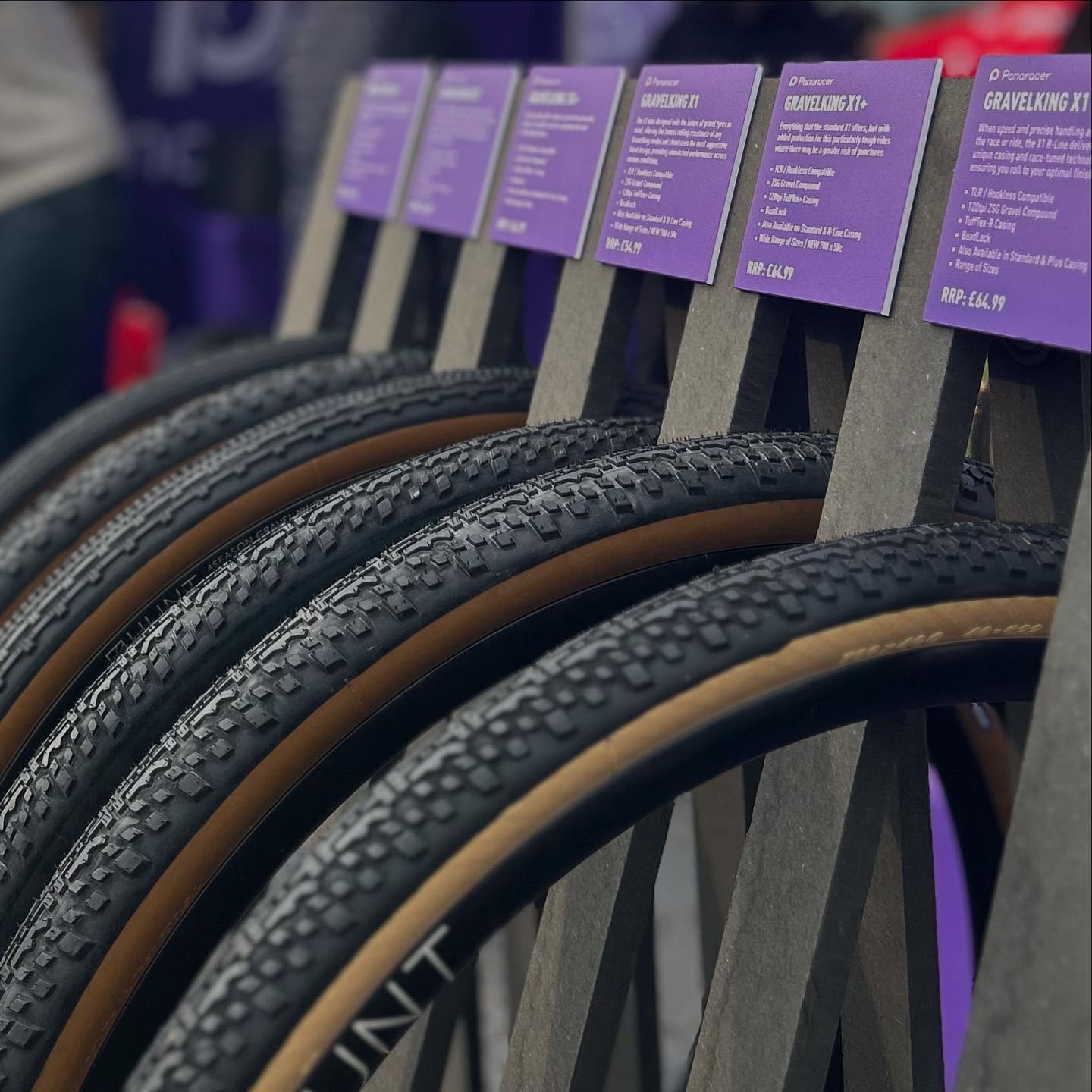
Tread is the part of a gravel bike tire everyone notices first, and it’s also the part that’s most often over-weighted in a buying decision. On dry, hard-packed gravel, small surface rocks tend to slide against the rock layer beneath them rather than against the tire itself — so how aggressive the tread looks makes surprisingly little difference to actual grip. One well-known appearance trap: small, densely packed knobs look grippy but tend to squirm under load, which both slows the tire down and reduces the traction they were supposed to add. Larger, more widely spaced knobs generally roll better and grip better at the same time.
Where tread genuinely matters is mud and loose, soft surfaces. Knobs need something to bite into and somewhere for displaced material to go — tightly packed lugs clog up in mud instead of shedding it, while widely spaced, taller knobs keep working. As a rule of thumb, if you can see the imprint of your tread left behind in the surface you’re riding, the knobs are doing real work; if the surface stays smooth after you’ve ridden over it, tread pattern is contributing very little.
For riders who alternate between technical singletrack and open gravel, running a more aggressive tread up front and a faster-rolling tread on the rear is a common compromise — the front tire does most of the cornering and steering work at low speed, so it benefits most from extra bite.
Tubeless, tubes, or TPU: what’s actually worth the hassle
Tubeless is the default setup for gravel bike tires for good reason: it removes the risk of pinch flats, seals small punctures on its own, and lets you run noticeably lower pressures without worrying about the tire unseating from the rim. The trade-off is setup — some tire and rim combinations mount and seal easily, others require real patience, a compressor, and a fair amount of sealant ending up somewhere it shouldn’t.
There’s a smaller but genuine case for inner tubes too, specifically lightweight TPU tubes. Without sloshing liquid sealant inside the tire, TPU tubes roll measurably faster — a difference of several watts at typical gravel speeds — and if your tires are wide enough that pinch flats aren’t a realistic risk, that speed advantage comes with fewer downsides than it would on a narrow road tire. It’s a setup mostly favoured by riders doing unsupported long-distance or record attempts rather than club rides, but it’s worth knowing the option exists.
Tire pressure: the adjustment that costs nothing and matters the most
Pressure is the cheapest, fastest way to change how gravel bike tires behave, and it’s also the easiest to get wrong. The physics are simple: on rough surfaces, lower pressure means the tire absorbs more vibration instead of transmitting it into the bike and rider, which reduces energy loss and improves comfort at the same time. On genuinely rough terrain, running too much pressure can cost triple-digit watts — far more than most equipment upgrades could ever claim to save.
There’s no single correct number. The right pressure depends on rider and bike weight, tire width, terrain roughness, and personal preference for how a bike feels underneath hard efforts — riders who like to stand and sprint often prefer slightly firmer tires than riders doing steady, seated efforts. Most tire and component brands now publish pressure calculators that account for width and rider weight as a starting point, but treat the output as exactly that: a starting point to fine-tune on your own local terrain, not a fixed rule.
Wheel size: 700c, 650B, and the 32-inch question
Wheel diameter is a perennial debate in gravel, and lab and real-road testing has been fairly consistent on the answer: it doesn’t meaningfully change how fast a bike rolls. That’s counterintuitive, because a bigger wheel intuitively seems like it should roll over bumps more easily — and it would, if bicycle tires were solid discs. But pneumatic tires absorb surface irregularities by deforming, and that absorption happens largely independent of overall wheel diameter. Testing on rumble strips, which simulate extremely high-frequency small bumps, has repeatedly found no statistically significant speed difference between 650B and 700C wheels running the same tire and pressure.
The much-discussed move toward 32-inch gravel wheels — borrowed conceptually from the mountain bike world — remains largely theoretical for now: component and tire availability is still thin, and the claimed benefits (better rollover, more contact patch) come with real costs in rotating mass, steering agility and acceleration. For the vast majority of riders, wheel size is a fit-and-clearance decision, not a speed decision. 650B genuinely earns its place for riders who want maximum tire volume on a smaller-diameter wheel — technical terrain, bikepacking, or anyone prioritising cushion over outright pace.
Our take
If you take one thing from all of this: start with the widest gravel bike tires your frame and fork will comfortably clear, prioritise casing quality over tread aggressiveness, and spend more time experimenting with pressure than most riders ever do. Tread pattern is the variable riders obsess over most and the one that actually matters least on dry terrain — save the aggressive tread for courses where you genuinely expect mud. And once your setup is dialled in, the best tire is the one you stop thinking about mid-ride. For riders assembling the rest of a gravel kit around a new tire choice, our guides to gravel handlebar bags, gravel hydration setups and gravel bike shoes cover the rest of the equation.
FAQ
What’s the best all-round gravel bike tire width?
For most riders and most modern gravel frames, 45 mm has become the practical sweet spot between rolling efficiency, comfort and grip. Riders on smoother, road-heavy routes can go narrower; riders on rough or loaded bikepacking terrain benefit from going wider if their frame allows it.
Do wider gravel bike tires slow you down on pavement?
Not meaningfully, provided the casing is supple and the tire isn’t wider than the bike’s down tube. The aerodynamic penalty of a few extra millimetres is small, and on anything but glass-smooth tarmac, the vibration savings of a wider tire tend to offset the theoretical aero cost.
Is tread pattern important for gravel bike tires?
Less than most riders assume. On dry, hard-packed gravel, tread has minimal impact on grip. It becomes genuinely important in mud, snow or deep loose surfaces, where widely spaced, tall knobs shed debris and keep gripping while small, dense knobs clog and squirm.
Should I run tubeless gravel bike tires?
For the vast majority of riders, yes — it removes pinch-flat risk and self-seals small punctures. The main exceptions are riders prioritising outright speed on wide, well-supported tires who accept the pinch-flat trade-off in exchange for the lower rolling resistance of lightweight TPU inner tubes.
Does wheel size (650B vs 700C) affect gravel bike tire performance?
Not for rolling speed — real-road and rumble-strip testing has found no meaningful difference between the two. Choose 650B for maximum tire volume and cushion on a given frame, and 700C for standard fit and the widest tire selection.
Rene Herse Cycles’ team has published an annually updated deep-dive into the underlying research behind much of this guide, drawing on two decades of real-road tire testing — worth reading in full at renehersecycles.com for riders who want to go deeper into the data.