hill.camp does not conduct first-hand product testing. This review is a synthesis of independent field tests, specialist press articles, and verified consumer feedback from multiple sources.
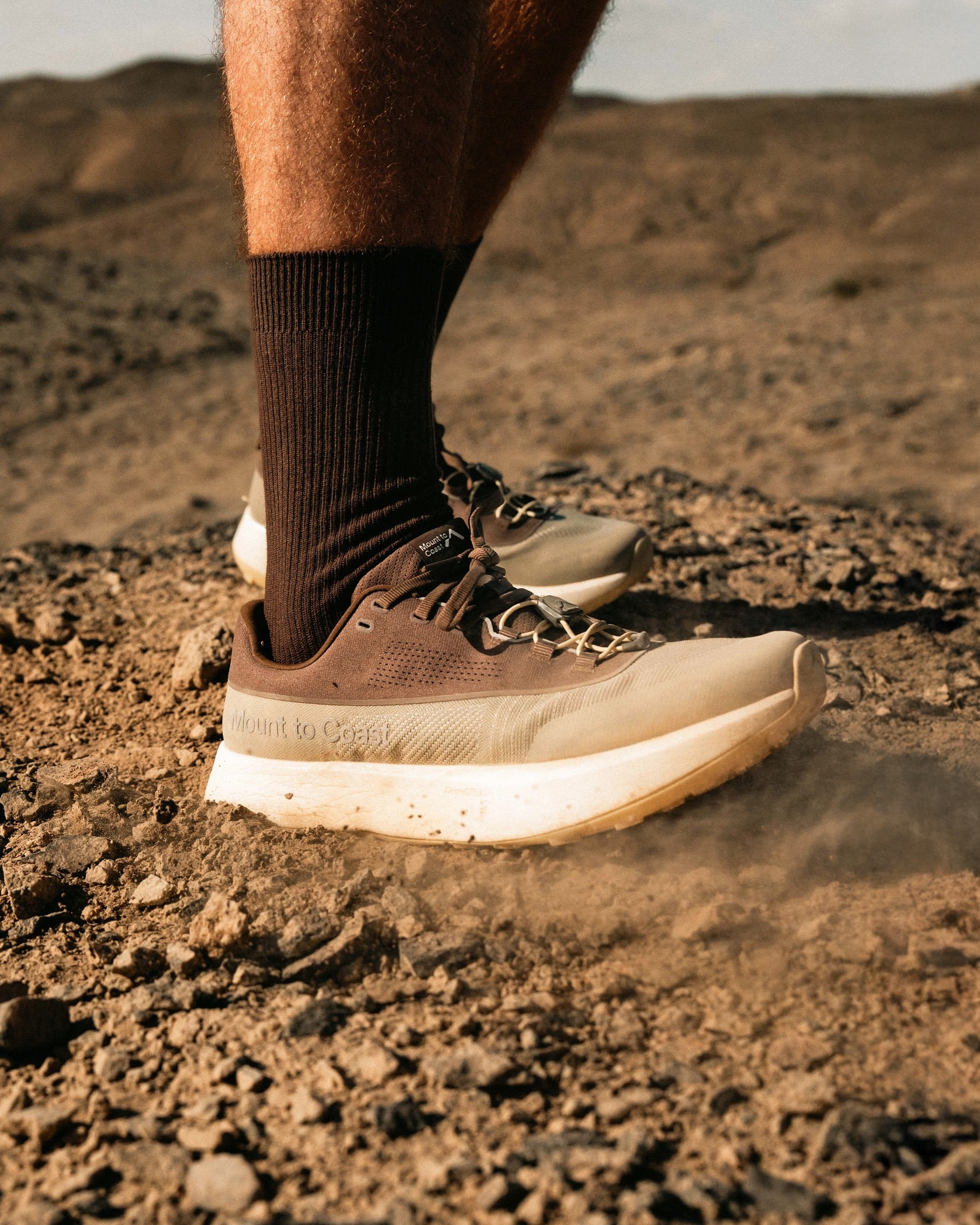
Mount to Coast arrived from Hong Kong with a road shoe philosophy, a clean aesthetic, and a midsole foam that made ultrarunners pay attention. The H1 is the brand’s second trail model — and unlike most hybrids, it genuinely earns the label.
| Stack height | 35 mm heel / 29 mm forefoot |
| Drop | 6 mm (8.1 mm measured) |
| Weight | 242 g (men’s US 9) |
| Midsole | CircleCELL (nitrogen-infused, bio-based) |
| Outsole | VersaGrip CPU rubber, 2 mm lugs |
| Upper | Dual-zone: jacquard mesh + Kevlar aramid fiber |
| Lacing | TUNEDFIT dual-zone system |
| Terrain | Road, gravel, packed dirt, light trail |
| Price | $160 / €170 |
A New Brand With a Specific Agenda
Mount to Coast is not a legacy brand. Founded in Hong Kong, it built its early reputation in the road running world before turning its attention to trail. The brand’s trajectory follows a clear logic: develop a distinctive foam technology, prove it on the road, then extend it to rougher terrain. The H1 is the second step in that trail story — the T1 came first, a short-race-oriented trail shoe that earned genuine respect among testers in 2025. Where the T1 goes to the mountains, the H1 is designed for the in-between: the gravel paths, the forest roads, the training runs that start on tarmac and end on packed dirt.
The brand is building a European presence too, assembling a team that includes French trail runners Baptiste Petitjean, Kevin Vermeulen, and Corentin Play. A third trail model — the M1, aimed at ultra distances — is reportedly on the way. The H1’s credibility in longer efforts was underlined at the 2025 ÉcoTrail de Paris, where Corentin Play raced the 80 km distance in this shoe — and won. For now, the H1 occupies the hybrid slot, and it does so with a level of technical ambition that the category rarely sees.
The CircleCELL Midsole: Sustainable Foam That Actually Performs
The headline technology in the H1 is the CircleCELL midsole. Mount to Coast developed it in partnership with BASF, the German chemical company, using a bio-based material called Ecoflex BMB — made entirely from renewable feedstock, specifically organic waste and residual biomass (roughly 9 kg per midsole), with no additional chemical components added before the foaming process. The nitrogen-infused supercritical foam contains no EVA, which distinguishes it from the LightCell compound used in the T1.
The brand’s marketing claims PEBA-like energy return and double the durability of comparable sustainable foams. Independent lab testing has confirmed strong numbers: 61.2% energy return in the heel and 63.9% in the forefoot — well above the trail shoe average of 55.6%, though short of top-tier PEBA or A-TPU figures. Shock absorption comes in at 136 SA in the heel against a category average of 122 SA. In practice, testers consistently describe the CircleCELL as hitting a « goldilocks » zone: firm enough to keep you rolling, soft enough to remain protective after many miles. The foam is dense and reactive rather than plush — more rebound than cushion, with very little heel sink on impact.
The midsole’s rocker geometry is pronounced, with aggressive toe spring and a moderate heel flare. Stack height sits at 34.5 mm in the heel — slightly above category average — making the H1 a legitimate option for long distances, as demonstrated at the ÉcoTrail. The platform is notably wider than average too, measuring 117.4 mm in the forefoot and 93.2 mm at the heel, which contributes to a stable base despite the absence of any stabilisation technology in the foam itself. Neutral runners are well served; pronators and supinators will find less support than they might expect — a known trait of nitrogen-infused foams. Significantly for year-round runners, the CircleCELL loses only 10% of its softness in freezing temperatures against a category average of 25%, and field reports confirm solid behaviour on hard-packed snow and frozen slush.
VersaGrip Outsole: Built for Gravel, Not Mountains
The T1 uses Vibram Megagrip. The H1 does not — Mount to Coast has instead deployed its own VersaGrip compound, a cast polyurethane rubber (CPU) that the brand uses on its road models. The lug depth is 1.9 mm, against a trail shoe average of 3.5 mm. This tells you everything about the H1’s intended territory before you even put it on your feet.
On tarmac and packed gravel, the VersaGrip is excellent. Transitions from heel to midfoot are smooth, there is no friction at contact, and the rubber adapts well to hard surfaces without the percussive feel that stiffer outsoles produce. Testers note that the H1 behaves almost identically on road and on compacted dirt — the transition between surfaces is seamless in a way most hybrids fail to achieve. The lug pattern provides genuine grip on dry compressed earth and handles mild off-road terrain confidently. Forefoot traction tested at 0.64 in standardised SATRA testing, marginally above the category average. The outsole coverage is generous, with only two strategic cutouts in the midfoot area designed to preserve flexibility.
The limits become clear as terrain becomes technical. On wet roots and rocks, the VersaGrip offers little traction — it is rubber designed for roads, and it behaves accordingly on slippery natural surfaces. On decomposed soil or leaf litter, adhesion drops significantly. In muddy conditions, the shoe becomes unreliable. This is not a criticism so much as an accurate description of what the H1 is: a shoe for the transition zone between road and trail, not for mountain terrain. Runners who frequently head into technical singletracks should look elsewhere — perhaps at a more aggressively lugged option like the Hoka Speedgoat or the Salomon Speedcross, both of which are built for that environment.
Outsole durability is a mild concern: the 1.2 mm thickness is below average, and lab abrasion testing produced 1.4 mm of wear against a category average of 0.9 mm. For runners who regularly hit abrasive surfaces, lifespan may be shorter than expected. That said, user reports of pairs still in good shape past 300 miles suggest the real-world picture is more encouraging than the lab numbers alone indicate.
The Upper: Dual-Zone Construction With Kevlar Durability
The H1’s upper is where the shoe looks most like a road model rather than a trail one. Mount to Coast has used a dual-zone construction: the top portion is a single-layer jacquard mesh, soft and breathable; the lower portion uses a heavier fabric reinforced with aramid fibres and Kevlar microfilaments — the same material found in bulletproof vests, which is reportedly five times stronger than steel. Breathability scores high at 4/5 in testing, exceptional for a shoe with this level of structural reinforcement. Heel padding durability tested at a perfect 5/5.
The TUNEDFIT dual-lacing system reappears from the T1 and R1. Two separate lace zones allow independent adjustment of the forefoot and midfoot: a conventional lace at the rear and an autolocking cord system at the front. Multiple testers report that for most runs they leave the front system untouched and only engage it when heading onto more demanding terrain or when feet swell on longer efforts. One improvement over the T1: the front laces have been shortened to prevent them from flopping during movement.
Fit is medium width throughout, with a slightly narrow toe box (70.1 mm measured against a 74.5 mm average). Runners with wide feet may find it limiting. The heel fits snugly — potentially too snugly for runners prone to Achilles tendinopathy. The midfoot and forefoot open up progressively, and the dual lacing compensates for different foot volumes. Runners coming from wide-toe-box designs like the Altra Lone Peak will likely find the H1’s forefoot more constrained. One recurring note across multiple testers: the collar degrades relatively quickly, with wear appearing after roughly 60 km in some pairs. For a shoe at this price point, that is a legitimate complaint. On the positive side, the Kevlar reinforcement prevents the mesh from deteriorating at high-flex zones, and the overall upper construction feels more robust than many shoes priced above the H1.
On the Run: What Testers Actually Experienced
The H1 runs light — 249 g in lab measurement against a trail shoe average of 288 g. That weight saving comes from two sources: the supercritical foam is inherently lighter than standard EVA, and the CPU outsole is significantly lighter than conventional rubber. The combination gives the H1 a feel that multiple testers describe as effortless — particularly notable for a shoe that covers this range of terrain.
On the road, testers consistently report that the H1 competes directly with dedicated road trainers. The transition between tarmac and packed dirt is described as seamless — the shoe’s behaviour barely changes, which is unusual in a hybrid. At tempo pace, the pronounced rocker and reactive foam reward midfoot strikers. At slower paces, the firmer midsole demands more from the legs, and testers note it is less well adapted to heel-striking or hike-running patterns. No break-in period was reported — testers found the shoe immediately comfortable across varied conditions.
The versatility documented by testers goes well beyond standard running use. One Road Trail Run reviewer reports using the H1 across road and gravel marathon preparation, long days on concrete exhibition floors, sailing in the Caribbean, running the roads of Antigua, hiking rainforest trails in Guadeloupe and Dominica, hard-packed snow and frozen slush in Massachusetts, and travel days — with the shoe drawing unsolicited compliments along the way. The H1’s aesthetic is notably clean — compared by some testers to the Norda school of minimalist design — which contributes to its crossover appeal beyond running contexts.
The lack of stabilisation in the midsole means the shoe can roll on uneven surfaces. On rutted descents or rooted singletracks, the platform offers less predictability than shoes with guide rails or wider lateral bases. This is where the comparison with a shoe like the Norda 001 is instructive: the Norda uses a stiffer, more protective construction that trades some of the H1’s liveliness for security on technical terrain.
Who the H1 Is For — and Who Should Look Elsewhere
The H1 is a strong choice for runners who train across mixed surfaces — road sessions that flow into gravel paths and fire roads, or athletes who want a single shoe capable of handling both without compromise. It works equally well as a daily trainer, a long-run shoe, and a travel companion. At 242 g and €170, it sits at a premium price point for the category, but the technical specification and the documented real-world versatility justify the investment.
It is less well suited to heavier runners who strike hard on the heel and rely on cushioning absorption. Runners with wide feet will find the toe box limiting. Anyone planning to spend significant time on wet, muddy, or rocky mountain terrain should look at a more aggressively lugged option. And runners who need guidance or stability features in their midsole should look elsewhere — the CircleCELL foam, like most nitrogen-infused compounds, is built for neutral runners.
Trail runners focused on hydration setup for longer outings in hybrid terrain will also want to think about carrying capacity — something our guide on choosing a trail running hydration pack covers in detail. And if you’re managing nutrition across longer gravel efforts, the fundamentals in our trail running nutrition guide apply equally to road-to-trail running at extended distances.
Questions Runners Ask About the Mount to Coast H1
Is the Mount to Coast H1 a true trail shoe?
Not in the traditional sense. The H1 is a hybrid or gravel shoe: it performs excellently on road, compacted gravel, and light packed dirt, but its 1.9 mm lugs and VersaGrip compound are not designed for technical singletracks, muddy terrain, or mountain use. If you primarily run technical trails, the T1 is the more appropriate Mount to Coast option.
How does the CircleCELL foam compare to PEBA?
Mount to Coast claims PEBA-equivalent energy return, but lab data puts the CircleCELL closer to a high-quality supercritical EVA: 61–64% energy return versus the 70%+ figures associated with top-tier PEBA foams. That is still well above average for a trail shoe, and the eco-sourced material represents a genuine step forward in sustainable midsole technology without meaningful performance compromise.
Does the H1 run true to size?
Generally yes, though multiple testers note the shoe runs slightly long. The fit is standard to slightly voluminous in the midfoot and forefoot. The heel, by contrast, fits snugly. Running your normal size is the right starting point, with the dual-lacing system allowing fine-tuning once you have the shoe on your foot.
Is the dual lacing system actually useful?
It depends on your foot shape and intended use. For runners with feet that swell significantly on long efforts, or those with high-volume feet who need more forefoot space while maintaining midfoot security, the TUNEDFIT system adds genuine value. For standard-width feet on shorter efforts, most testers report leaving the front zone set and forgetting about it — it functions as a luxury detail rather than a daily necessity.
How does the H1 compare to the Mount to Coast T1?
The T1 is a technical trail shoe with Vibram Megagrip and LightCell foam, built for performance on real mountain terrain. The H1 is a hybrid road-to-gravel shoe with the new CircleCELL foam and a road-derived outsole. The H1 is lighter and more versatile across mixed surfaces; the T1 offers meaningfully more grip and stability on demanding trail terrain. They are complementary tools, not interchangeable ones.
What is the expected lifespan of the H1?
Mount to Coast claims the CircleCELL foam offers double the durability of comparable sustainable foams. User reports of pairs still in strong shape past 300 miles support this. The outsole is the more vulnerable component: at 1.2 mm thickness, it is thinner than average and wears faster on abrasive surfaces. Runners who primarily use the H1 on road and packed gravel should see a solid lifespan; those regularly hitting rough or rocky terrain should expect more wear.
You can find the Mount to Coast H1 and explore the full range at mounttocoast.com.