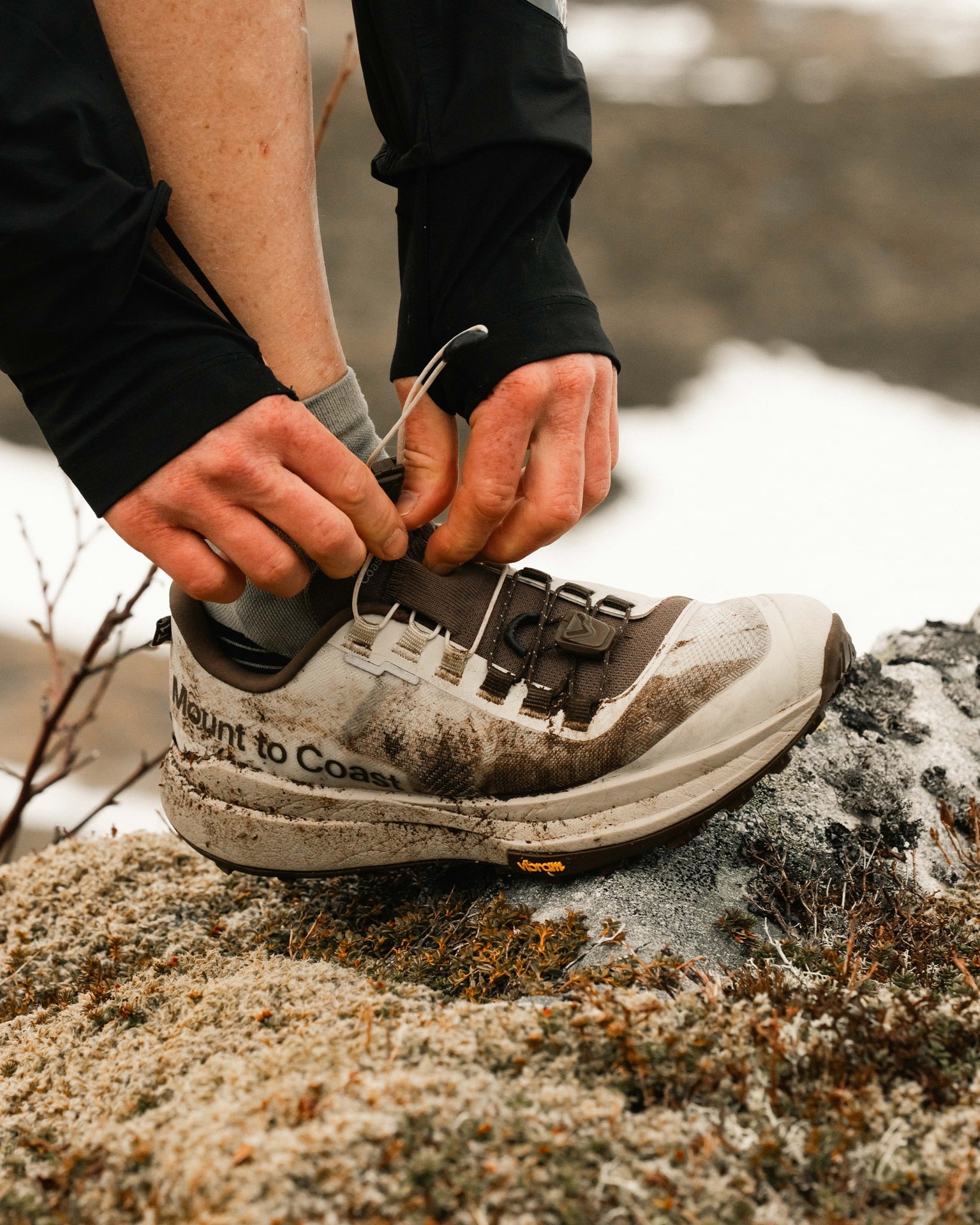
hill.camp does not conduct first-hand product testing. This review is a synthesis of independent field tests, specialist press articles, and verified consumer feedback gathered from multiple sources. All technical data and performance observations are drawn from those sources and attributed accordingly.
Mount to Coast arrived in 2024 with a singular proposition: build the most durable, distance-ready running shoe on the market, and do it without the bloat or the noise. Their road models — the R1, the S1, the P1 — made a loud impression in a quiet way. Clean lines, PEBA foam, Kevlar-reinforced uppers. The kind of shoes that don’t need to shout. When the brand teased a trail shoe, the community paid attention. The Mount to Coast T1 is that shoe. And for a first attempt on dirt, it is a remarkably considered one.
From Road to Dirt: What the T1 Actually Is
The T1 is not a trail version of the R1. It shares design philosophy and midsole compound, but it has been rebuilt from the ground up for off-road use. Trail-specific details include a Vibram Megagrip Litebase outsole, aramid-reinforced woven upper, and a 4 mm heel-to-toe drop — all deliberate choices that signal Mount to Coast’s intention to be taken seriously on dirt, not just marketed there.
The specs: 36 mm heel stack, 32 mm forefoot, weight of approximately 260 g for a men’s size 9. That puts it in genuinely competitive territory — lighter than most shoes at this cushion level, and notably nimble for its protection. Platform width measures 90 mm in the heel, 75 mm through the midfoot, and 115 mm in the forefoot — a broad base that provides stability without the sloppy, rocking-chair feel of oversized ultra shoes.
Quick Specs
| Stack height | 36 mm heel / 32 mm forefoot |
| Drop | 4 mm |
| Weight | ~260 g / 9.2 oz (men’s US 9) |
| Platform | 90 mm heel / 75 mm midfoot / 115 mm forefoot |
| Midsole | LightCELL (PEBA-based supercritical foam, nitrogen-infused) |
| Outsole | Vibram Megagrip Litebase with 4 mm traction lugs |
| Upper | Woven mesh reinforced with aramid (Kevlar) yarns |
| Lacing | TUNEDFIT dual lacing system |
| Sizing | True to size |
| Price | $180 / £170 |
The Upper: Kevlar as a Design Statement
The upper of the T1 is built from a high-performance woven fabric reinforced with aramid fibers — the same material used in ballistic protection and aerospace applications. Mount to Coast claims these fibers are five times stronger than steel, and while that figure is hard to verify on a training run, the construction is immediately convincing. The upper feels structured but not rigid, light but not flimsy. After extended testing across gravel, singletrack, and technical terrain, testers reported zero signs of wear.
Breathability is solid, though some reviewers noted it is not as open as Mount to Coast’s road models. Water drains adequately — the tight aramid weave holds moisture briefly but releases it as pace increases. The fine mesh prevents grit and debris from entering, which is a genuine advantage on loose trails. The heel collar is padded but not excessive, providing comfort without adding unwanted weight.
A semi-gusseted tongue features a unique flex zone that acts as a dynamic bridge between the midfoot and forefoot — a detail more commonly seen on race-oriented models. It allows for natural foot flex without the tongue shifting under load. A lace garage on the tongue allows excess cord to be tucked away, though some versions of the shoe leave the sides partially open, which can feel less secure on very technical ground.
TUNEDFIT: Mount to Coast’s Signature Lacing Logic
The TUNEDFIT dual lacing system is the T1’s most distinctive feature, and the one that divides opinion most consistently. Two independent lace segments — one across the forefoot, one over the midfoot — allow runners to set different tension levels in each zone. The theory is sound: on long ultras, feet swell unevenly, and being able to loosen the forefoot while keeping the midfoot locked is a genuine advantage.
In practice, the system works well once dialed in. Reviewers appreciated the ability to adjust mid-run — loosening the forefoot on long climbs, tightening before technical descents. For runners with asymmetric feet or feet that swell significantly over long efforts, the customisation is meaningful. The shoe also ships with a set of traditional laces in the box, which several users reported improved lockdown significantly when swapped into the upper cord position.
The limitation is volume. The T1’s cabin is generous — designed with ultra swelling in mind — and runners with low-volume or narrow feet may find achieving a truly firm lockdown on technical terrain requires careful lacing. The system took most testers a few runs to optimise, and on highly technical, rooty ground, some reported gradual loosening. It is a system that rewards patience, and one that will likely be refined in future iterations.
LightCELL: The Same Foam, A Different Conversation
The midsole is LightCELL — Mount to Coast’s PEBA-based, nitrogen-infused supercritical foam, the same compound used in the R1. The brand claims 50% less weight than EVA and 45% more energy return, and the feel on foot is consistent with those numbers: noticeably light, resilient without being overly bouncy, and stable without feeling dead.
Where the T1 midsole departs from road expectations is in feel. The foam is cushioned but not pillowy. It does not absorb impact passively — it resists and returns. Testers described it as sitting somewhere between the firmness of a race-focused trail shoe and the plushness of a dedicated ultra model. There is meaningful ground feel, enough to stay connected to the terrain, which the majority found positive on non-technical trails.
The rocker geometry is present but not aggressive. It promotes forward momentum and a smooth heel-to-toe transition without forcing pace — exactly the kind of geometry designed to accumulate miles rather than win short races. At a high stack for a trail shoe, the T1 rides lower than the numbers suggest, a quality several testers highlighted as making it feel more agile than comparable cushioned options.
One recurring concern: forefoot rock protection. Multiple reviewers noted that on genuinely rocky terrain, smaller stones can be felt underfoot — more acutely in the forefoot than the heel. There is no rock plate, and while the foam stack handles moderate impact well, runners targeting very technical, rock-heavy courses at ultra distances may feel cumulative fatigue through the forefoot. For mixed and moderate trail use, it is a non-issue. For 100-mile rocky courses, it warrants consideration. This is one area worth watching in future versions. For context on how the T1 compares to more specialised footwear in this segment, our comparison of the Norda 001 vs Hoka Speedgoat covers the rock-protection tradeoffs in detail.
Vibram Megagrip Litebase: No Excuses on the Outsole
This is where the T1 earns unambiguous praise. The Vibram Megagrip Litebase outsole combines three Vibram technologies: Megagrip rubber for wet and dry traction, Litebase construction for 30% weight reduction without compromising performance, and traction lug micro-features for enhanced grip on irregular surfaces. The 4 mm triangular lugs are shaped with Mount to Coast’s logo pattern and spaced to avoid mud-clogging on moderate terrain.
Across the full range of testing surfaces — hard-packed dirt, crushed gravel, granite slabs, wet roots, light mud, creek crossings — the outsole performed with consistency and confidence. No tester reported meaningful slip on dry or moderately wet surfaces. On frosted rock or deep mud beyond the lug depth, grip predictably diminished, but those are conditions that challenge any trail shoe at this lug height. For runners who mostly run on dry to moderately wet UK trails, the Northern Runner test concluded it was trustworthy on everything except persistently muddy ground — a fair assessment that aligns with all other sources.
The Litebase construction also contributes to the shoe’s flexibility underfoot, allowing the outsole to conform to uneven surfaces rather than bridging across them. This improves the quality of traction on technical terrain and contributes to the natural, connected feel the T1 is repeatedly praised for. If you want more context on outsole strategies across the trail running category, our Speedgoat vs Speedcross comparison breaks down the different philosophies in detail.
Fit and Sizing
The T1 runs true to size across all tested markets. The toe box is generous — wide enough for natural toe splay during long efforts, accommodating for runners whose feet swell significantly over ultra distances, but not so wide that average-footed runners swim in it. A firm toe bumper provides impact protection at the front without contributing meaningfully to weight.
Midfoot fit is comfortable and well-padded in the heel collar, with sufficient structure to hold the foot without pressure points. Runners with narrow feet noted the TUNEDFIT system compensates for the generous volume, though lockdown on technical terrain required more careful calibration. Runners transitioning from New Balance, Hoka, La Sportiva, or Inov-8 may find the T1 runs slightly longer — worth factoring in when ordering.
On the Trail: What Testers Actually Said
The consensus across seven independent reviews is broadly positive, with a clear pattern of strengths and a narrowly defined set of limitations.
On smoother to moderate trail — hardpack, gravel, mixed surfaces, road-to-trail transitions — the T1 is consistently rated as one of the most versatile and enjoyable options at this stack height. The combination of a light, energetic midsole, grippy outsole, and durable upper creates a shoe that handles a wide range of conditions without compromise. Road Trail Run’s multi-tester panel called it an ideal single-shoe choice for travel and multi-terrain running. Outside Online’s Cory Smith described it as one of the most comfortable, versatile all-around trail shoes he had tested. Believe in the Run’s Taylor Bodin — a 100-mile trail racer based in the Colorado mountains — placed it in the same conversation as the Hoka Speedgoat, with more midsole character.
On technical terrain — steep switchbacks, rocky descents, roots — results diverged slightly. Runners with average to wider feet and medium arches found the T1 performed admirably. Runners with narrow, low-volume feet, or those pushing hard on very demanding surfaces, noted the TUNEDFIT system required more management and that lockdown could loosen over time. This is not a shoe for aggressive fell running or highly technical mountain racing. It is a shoe for the vast middle ground of trail running, and within that territory it is excellent.
For reference, the GB Ultra Runner tester — coming from a UK context with wetter, softer trails than the US — found the T1 handled January mud and wet grass without drama, and expressed confidence taking it to more technical terrain in the Lake District and Peak District. That is a meaningful endorsement from a running environment that asks more of outsoles than California or Colorado typically does.
If you are building out a trail running kit and thinking about packs and vests to complement a shoe like the T1 for longer efforts, our guides on choosing a trail running hydration pack and trail running nutrition and hydration are worth reading alongside this review.
Who Is the T1 For?
The T1 positions itself as a distance-first trail shoe with enough versatility to function as a daily trainer. That positioning is accurate. It is not the most technically aggressive shoe for rocky mountain racing, and it is not the softest for runners prioritising pure cushion comfort over everything else. What it is, is honest: well-built, durable, well-fitted for its intended purpose, and designed by people who understand what ultra-distance running actually demands.
Runners targeting 50K to 50-mile efforts on mixed to moderate terrain — the core of the trail ultra market — will find little to complain about. Runners building toward 100-mile rocky courses may want to assess the forefoot rock protection carefully, and may appreciate a rock plate in a future iteration. Anyone looking for a single shoe to cover daily training, long runs, and race day across a variety of surfaces has a very strong candidate here.
The Mount to Coast H1 — the brand’s hybrid road-trail model — remains the choice for runners who spend the majority of their miles on pavement with occasional trail forays. The T1 is for runners who live in the other direction: primarily on dirt, with occasional road sections as a means to get there.
Frequently Asked Questions
Is the Mount to Coast T1 suitable for beginners?
Yes. Despite being designed with ultra-distance racing in mind, the T1’s generous fit, stable platform, and forgiving midsole make it accessible for trail runners at any level. The lacing system takes a run or two to dial in, but once set, it offers a comfortable and adjustable experience.
Does the T1 work on road as well as trail?
Yes, better than most dedicated trail shoes. The Vibram Litebase construction keeps the outsole flexible enough to feel comfortable on pavement, and the midsole transitions smoothly between surfaces. It is not a road shoe, but it handles road-to-trail runs without friction. For a shoe purpose-built for that hybrid use case, see our review of the Mount to Coast H1.
How does the TUNEDFIT lacing system compare to Salomon Quicklace?
The TUNEDFIT system operates on a similar pull-cord principle but adds a second independent segment for the forefoot. Where Salomon’s system cinches the whole upper uniformly, TUNEDFIT allows differentiated tension — useful for feet that swell unevenly, or runners who want tighter midfoot hold without compressing the toe box. The tradeoff is a slightly longer setup time.
Is there a rock plate in the T1?
No. The T1 relies on its LightCELL foam stack for protection rather than a rigid plate. This contributes to its flexibility and natural feel, but means smaller rocks can be felt underfoot on very technical terrain, particularly in the forefoot over long distances.
How does the T1 hold up in wet conditions?
The Vibram Megagrip outsole performs well on wet rock, wet roots, and damp hardpack. The aramid upper drains adequately and dries relatively quickly. In deep mud, the 4 mm lugs can clog — this is a limitation shared by most trail shoes at this lug depth, and the T1 is better suited to firm-to-moderate than consistently saturated conditions.
The Mount to Coast T1 is available directly from mounttocoast.com, priced at $180 USD / £170 GBP. It is also stocked by specialist trail running retailers in the US and UK.