| Founded | 2004–2005 (the brand gives both dates), Colico, Italy and Seattle, USA |
| Founders | Martino Fumagalli and George Kleckner |
| Parent company | Core S.r.l., independently owned, Delebio (SO), Italy |
| Production | In-house, at « The Box » factory in Colico, on Lake Como |
| Flagship product | Union Force binding, launched 2005, now in its third generation |
| Product lines | Strap bindings, Step On® bindings (licensed from Burton), snowboard boots since 2025/26 |
| Certifications | Certified B Corp (score 92.2), Società Benefit |
| Warranty | Lifetime on baseplates and heelcups, one year on everything else |
| Notable riders | Travis Rice, Gigi Rüf, Scott Stevens, Dan Brisse, Danny Kass |
| Official site | unionbindingcompany.com |
A Binding Company, and for Twenty Years Nothing Else
Walk down any lift line in Europe or North America and count the bindings. The little « U » logo on the heelcup comes up again and again. Union has built that presence with a strategy that sounds almost old-fashioned: make one kind of product, make it in your own factory, and keep making the same core model better. Union’s own About page still says the company focuses solely on bindings, and for most of its history that was exactly true. No boards, no outerwear, no camping gear.
That page is now slightly out of date. In the last two seasons Union has launched its first snowboard boots, signed a partnership with its biggest competitor to build Step On® bindings, and released a forged-carbon binding priced like a premium board. The brand that defined itself by staying in one lane is widening the road. This is the story of how it got here, and what the expansion means for riders.
Founding: Two Industry Veterans, Two Continents
Union was started by Martino Fumagalli and George Kleckner, who had both spent years in the binding business before going independent; Kleckner has described their background at Northwave and its binding sister brand Drake. Fumagalli now leads the company as CEO.
Even the founding details depend on which Union page you read. The 20th-anniversary page and its press coverage put the start in 2004; the About page says 2005, which is also the year the first Force binding appeared. The About page names Colico in Italy and Seattle as twin birthplaces, while Kleckner, interviewed by Canadian retailer Empire, located the founding in Seattle. Both versions fit what seems to have happened: an Italian development and production base with a North American commercial arm, set up over the winter of 2004–2005. The company’s legal home today is Core S.r.l. in Delebio, the next town along from Colico.
Why Colico: Lake Como and the Art of Plastic Injection
The choice of a small town at the northern end of Lake Como is the key to understanding Union. Kleckner’s explanation is industrial, not romantic. This corner of northern Italy built a deep expertise in plastic injection moulding: it made most of the world’s ski boot shells, and the region’s reputation for strong, precise plastic parts extended to the Italian sunglasses that dominated the 1980s and 90s. When that production moved to Asia, it left behind skilled technicians and injection know-how. A binding is, at heart, a collection of injected plastic parts that must not break, so Union set up where the people who knew how to make them lived.
In recent years Union moved into a new factory, nicknamed « The Box », about a hundred metres from its original office. According to Kleckner, design, prototyping, production and shipping all happen under one roof, and the building runs entirely on hydro and solar power. The equipment includes a forging machine dedicated to forged carbon, a material Union now uses in its most expensive bindings. Development speed varies widely: Kleckner says a ridable prototype can come together in 24 hours, while a model built around new materials, like the Strata, took two years.
Union goes further and calls itself the only conventional binding maker that owns and runs its own production facility, with no outsourcing at any stage. We have not been able to verify that claim against every competitor, and it is worth reading as the brand’s own positioning. What is clear is that in-house production underpins Union’s two strongest arguments: quality control and durability.
The Force: Three Generations of One Binding
If Union has a single product that explains its reputation, it is the Force, an all-mountain binding with a medium-stiff flex that has been in the range since 2005. Union divides its history into three generations:
- First generation (2005–2012). The binding that put Union on the map with shops and pros.
- Second generation (2013–2022). The long-running design ridden by team riders like Dan Brisse, Scott Stevens and Danny Kass, and still sold today as the Force Classic.
- Third generation (2023 onwards). A full redesign with a new ankle strap, a reworked highback and more symmetrical response between toe and heel.
Union describes the Force as the number one binding in snowboarding. That ranking comes from Union and is not backed by published sales data, but independent testing supports the binding’s reputation. The Good Ride, which has reviewed every recent version, calls the current Force its reviewer’s personal favourite and daily binding, and says the older Force Classic would be its most recommended binding if the new one did not exist. Its main reservation is damping: it would like rubber under the baseplate, as on Union’s Atlas, to take the edge off chatter.
The Range Today: From Flite Pro to Forged Carbon
Around the Force, Union has built a range that runs from entry-level to some of the most expensive bindings on the market. The Flite Pro is the budget model. The Strata is the cushioned freestyle option, the Atlas the stiffer, damped all-mountain and freeride model, the Falcor the binding associated with Travis Rice’s big-mountain riding, and the Ultra a light, tweakable freestyle binding. The Trilogy is the women’s counterpart to the Force.
Two new models for 2026/27 show the range stretching in both directions. The Neo is a unisex all-mountain binding with a three-piece baseplate and a dual-density bushing. The Good Ride found it very damp and comfortable but not very responsive, a binding for long, mellow days rather than hard charging. At the other extreme sits the Source FC, which Union calls the lightest snowboard binding ever made. It has no mounting disc and uses forged carbon for the baseplate, footbed, heelcup and highback, with magnesium buckles and titanium screws. A UK retailer lists it at £899.95, with limited supply.
Every Union baseplate and heelcup carries a lifetime warranty against breaking or cracking while riding; everything else is covered for a year. Union presents this as a direct consequence of its Duraflex nylon and its own injection process, and it is one of the most concrete reasons riders cite for staying with the brand.
Step On: Partnering With Burton
For years, Burton‘s Step On system was a closed ecosystem: Burton boots, Burton bindings, and later licensed boots from DC and Nitro. In November 2024, Union and Burton announced that Union would build Step On bindings of its own. According to the announcement, the two companies had signed a prototyping agreement in 2021 and finalised the deal after visits to each other’s headquarters in 2023. Burton’s chief product officer framed it as collaborating rather than competing; Fumagalli called the Step On system proven and said the partnership would go beyond a single product.
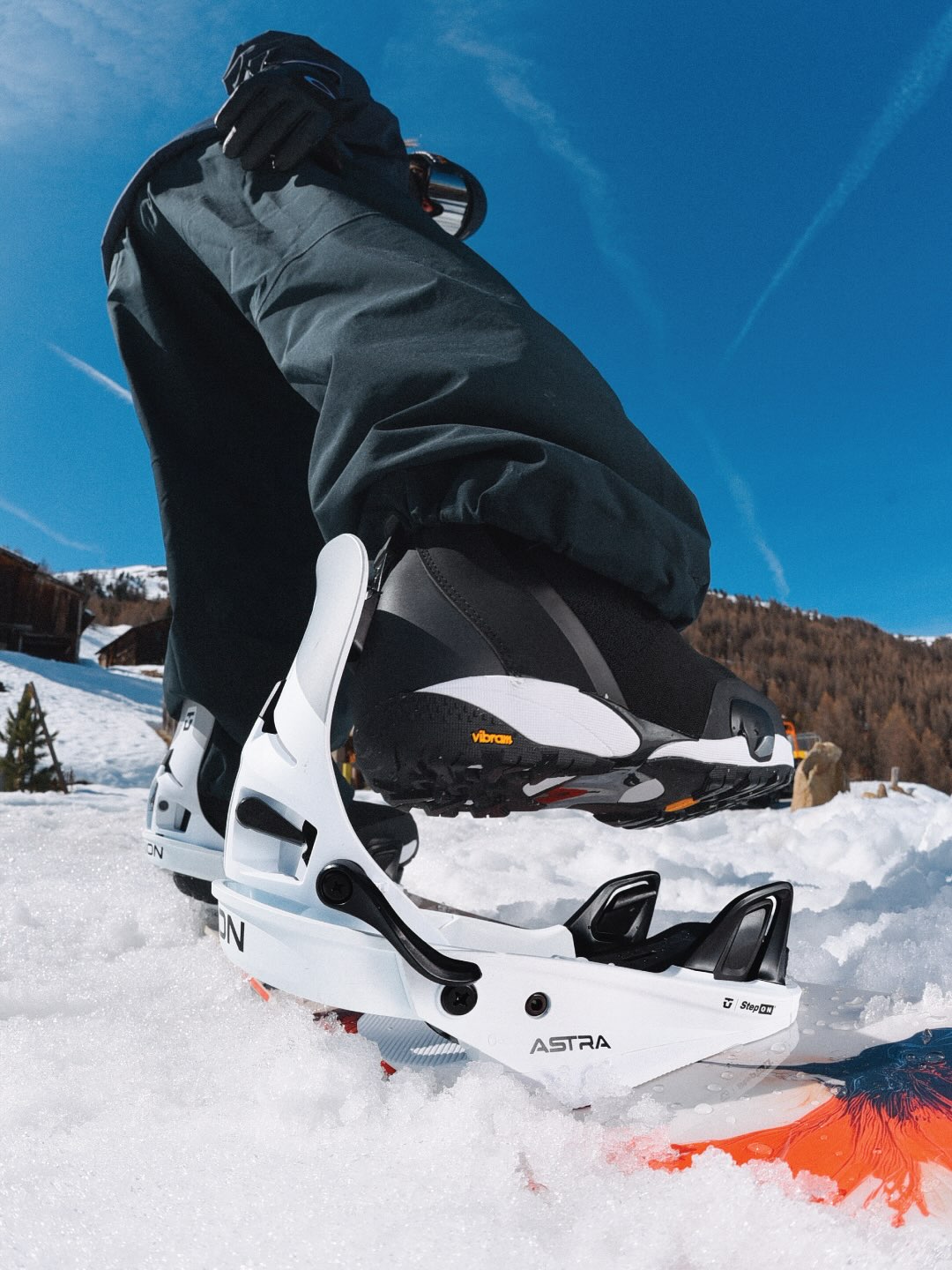
The Step On interface is the only shared element: Union designs the rest of the binding to its own specifications. The first result, the Atlas Step On, arrived as a limited release in January 2025, tested by Union rider Gigi Rüf. It has since been joined by the women’s Astra Step On and, for 2026/27, the Atlas Pro Step On with an aluminium heelcup. All of them work with any Step On boot from Burton, DC or Nitro.
Independent riders have responded well. The Snow Chasers’ instructor, a long-time Step On sceptic, rode Burton’s Highshot X boots in the Atlas Step On and found it « so much better » than Burton’s own bindings. Snowboarding Profiles describes it as light-feeling and particularly good for carving. Whether Step On suits you at all is a separate question, which we cover in Burton Step On vs Nidecker Supermatic.
Boots: The Reset Pro and the Bet on Longevity
Union’s biggest departure came with the 2025/26 season: a snowboard boot. The Reset Pro was designed in Italy and built around a single-piece shell made largely of Pebax, the lightweight polymer used in running shoe midsoles, with very few seams. Union’s pitch is durability: a boot that keeps its flex for 100 days or more instead of softening by mid-season. It sells for $649.95 in the US and €599.95 in Europe, and for 2026/27 gains a new Vibram midsole and outsole. A softer, slightly more forgiving Reset joins it this season.
Early reviews are strong. The Inertia named the Reset Pro its best snowboard boot overall, and a Whitelines tester reported very little change in flex after half a season, with only slight packing-out of the liner. The same tester found the low-volume shell colder in cold temperatures, and one UK retailer warns against heat-moulding it. Half a season is not the multi-season proof the durability claim needs, so the honest verdict is promising but not yet proven. Our Union Reset Pro review looks at the construction in detail, and our best snowboard boots of 2026/27 places it against its rivals.
It is a move in the opposite direction from Deeluxe, the Austrian brand that has made nothing but boots for thirty years. Union is betting that a binding specialist understands the boot-to-binding connection well enough to build both halves.
The Team
Union says its global team includes more than a hundred professional riders, from street riding to Olympic contests to Alaskan big-mountain lines. The best-known name is Travis Rice, whose association with the Falcor gives the brand credibility in freeride. Gigi Rüf, Scott Stevens, Dan Brisse and Danny Kass have all ridden Union bindings in their signature styles over the years. For its 20th anniversary in 2025, Union released a documentary film looking back at the riders and moments that shaped the brand.
B Corp and Società Benefit
In 2025, Core S.r.l. achieved B Corp certification with an overall score of 92.2, against a qualifying threshold of 80 and a median of 50.9 for ordinary businesses that complete the assessment, according to B Lab’s public directory. The company is also registered as a Società Benefit, the Italian legal form that writes social and environmental goals into a company’s bylaws.
Union’s sustainability argument is mostly about durability and logistics rather than exotic materials. Making every part under one roof, Kleckner argues, avoids the trucking and packaging waste of sourcing straps, buckles and baseplates from separate suppliers. A lifetime warranty on the parts most likely to break supports the same idea: the greenest binding is the one you do not replace. Union also emphasises its independence, describing itself as independently owned in an industry where many brands sit inside larger groups.
Union in the Market Today
Union calls itself the global leader in snowboard bindings, and retailers repeat the phrase. There are no public market-share figures to confirm it, but the brand’s presence on retail walls, in review rankings and on pro riders’ boards makes the claim plausible, at least for traditional strap bindings. The more interesting question is what happens next. The rise of fast-entry systems, from Step On to the Nidecker Supermatic and the FASE bindings from several brands, has been the biggest change in bindings in a decade. Union has answered by joining Burton’s system rather than inventing its own, while also moving into boots. Both moves suggest a company that sees its future in the whole connection between rider and board, not just the part it has owned for twenty years.
If you are still deciding between fast-entry systems, our guide to quick-entry snowboard bindings lays out the options.
Union: Frequently Asked Questions
Where are Union bindings made?
In Italy. Union designs, produces and ships its bindings from its own factory in Colico, on the northern shore of Lake Como, a region with a long history of plastic injection for ski boots.
When was Union Binding Company founded?
Union gives both 2004 and 2005 on its own pages. The company was set up by Martino Fumagalli and George Kleckner, and its first Force binding launched in 2005.
What is Union’s most popular binding?
The Force, an all-mountain binding in production since 2005 and now in its third generation. The previous generation is still sold as the Force Classic.
Does Union make Step On bindings?
Yes. Through a partnership with Burton, Union makes the Atlas Step On, Atlas Pro Step On and women’s Astra Step On. They work with any Step On boot from Burton, DC or Nitro, but not with regular snowboard boots.
Does Union make snowboard boots?
Since the 2025/26 season, yes. The Reset Pro is the premium model with a Pebax shell, and the Reset joins the range for 2026/27.
What does the Union warranty cover?
Baseplates and heelcups are guaranteed for life against breaking or cracking while riding. All other parts are covered for one year.
Is Union a B Corp?
Yes. Its parent company, Core S.r.l., was certified in 2025 with a score of 92.2, and is also registered as an Italian Società Benefit.
Twenty years after its founding, Union is still recognisably the company its founders set out to build: Italian-made, obsessive about one connection point, and willing to stand behind its parts for life. What has changed is how far it now reaches into the rest of the setup. The full range, size charts and warranty details are on Union’s official site.