hill.camp does not test products first-hand. This review is a structured synthesis of 5 independent sources — specialist field tests, retailer panels, verified owner feedback and manufacturer specifications — assembled with AI assistance and edited before publication. Sources are selected and verified by runners who follow this equipment closely. That method lets us cross-reference more testing than any single reviewer could, and to flag where sources contradict each other instead of smoothing it over.
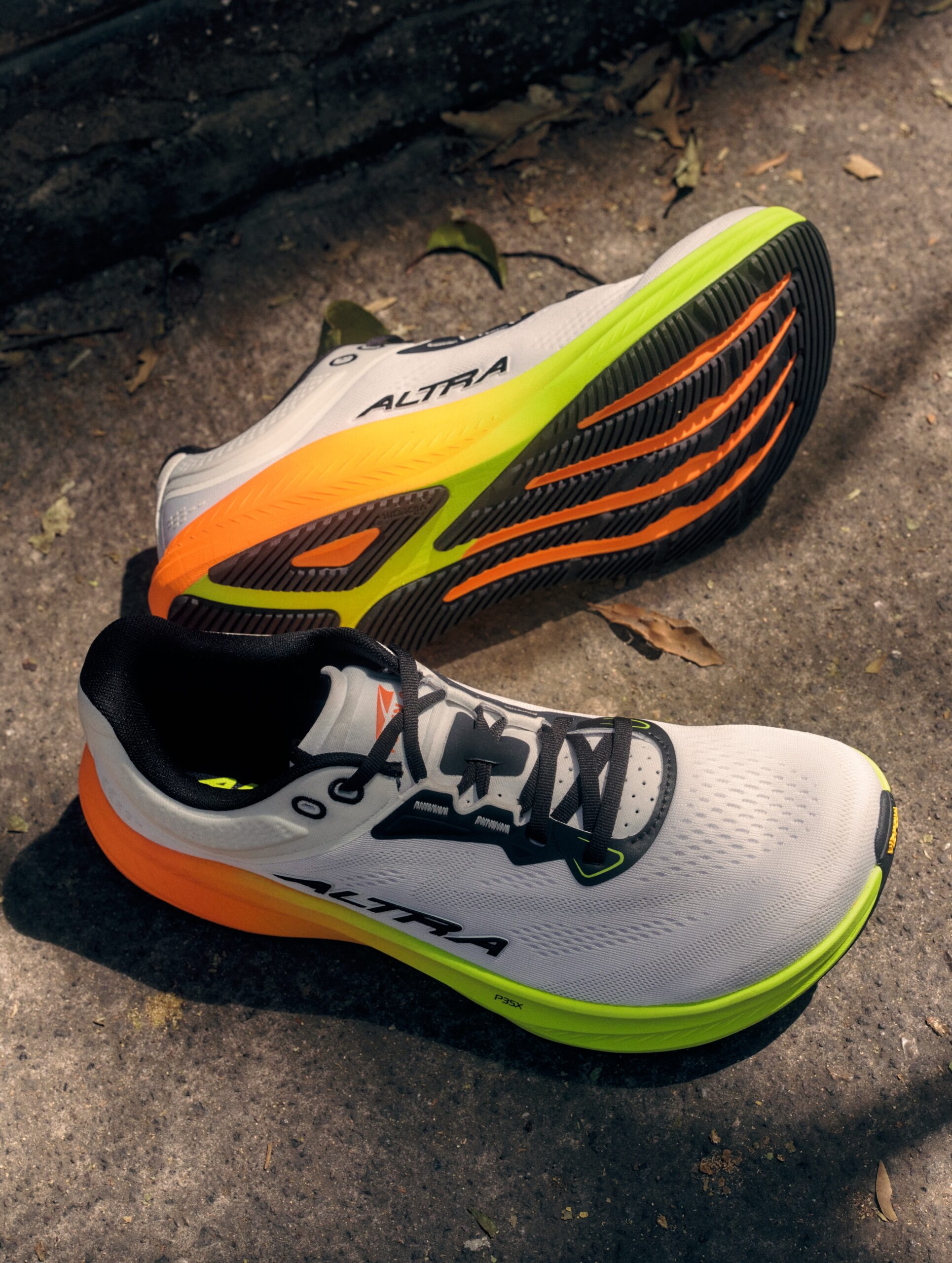
Altra put a Vibram outsole on a road shoe. That sentence alone tells you the Torin 9 is a more serious update than the brand’s recent form suggested — and it is not even the biggest change. Underneath sits an entirely new dual-density foam called P35X, replacing the EGO Max compound that had a habit of going flat somewhere around the two-hundred-mile mark. Two real changes, on the model Altra calls its flagship, arriving in the same summer the Escalante 5 shipped with essentially nothing new. The contrast is instructive: one shoe got a sockliner, the other got rebuilt from the ground up.
Altra Torin 9 Review: Quick Specs
| Weight | ~269–278 g / 9.8 oz (men’s); ~228 g / 8.0–8.1 oz (women’s) |
| Stack height | 28 mm heel / 28 mm forefoot |
| Drop | 0 mm (zero-drop) |
| Midsole | P35X dual-density — firmer outer carrier, softer core |
| Outsole | Vibram XS Run AW, road-specific compound |
| Upper | Breathable mesh, redesigned heel collar, non-gusseted elevated tongue |
| Fit | Standard FootShape; available in wide (D women / 2E men) |
| Intended use | Daily training, recovery, long runs, walking, light gravel |
| Retail price | $160 / €160 |
| Release | June–July 2026 |
The P35X Midsole: The Fix the Torin Line Needed
The Torin’s recurring problem across recent versions was not how it felt out of the box. It was how it felt three months later. Testers who ran the Torin 7 describe a shoe that started well and lost its life after a couple of hundred miles; the Torin 8 drew a similar complaint about the EGO Max foam going flat. That is a durability failure dressed up as a cushioning question, and it is the specific thing P35X is meant to solve.
The construction is dual-density: a firmer outer carrier wrapping a softer core. The practical effect is a shoe that cushions without going mushy, and that finds a degree of stability without any mechanical guidance — no posts, no guide rails, just the geometry of the foam itself doing the work. Testers consistently describe the ride as balanced and evenly distributed from heel to forefoot, protective without disconnecting you from the ground.
Where the reports diverge is on bounce, and the disagreement is worth reading carefully because it tells you what kind of shoe this is. One independent tester found genuine pop in the forefoot, comparing the sensation to a supercritical super-trainer with less foam under it. A retail test team landed in the opposite place: firm without being stiff, not much energy return, and — crucially — argued that was the point, describing a shoe where the spring comes from the runner rather than the midsole. Both can be true. P35X is more energetic than EGO Max and considerably less energetic than a modern PEBA or TPEE foam, and where you land depends entirely on what you are comparing it to.
The stack dropped from 30 mm to 28 mm, which sounds trivial and is not. Combined with the new foam, it produces a more connected, more agile shoe than the Torin 8, and it is the reason multiple testers reach for words like nimble. The shoe also lost close to half an ounce. Whether P35X holds its character over 500 miles is the one question nobody can answer yet — early impressions are promising, but this is a foam with no track record, and the whole point of the update is longevity.
A Vibram Outsole on a Road Shoe
This is the headline, and it deserves to be. Vibram is a trail name — the compound here, XS Run AW, derives from rubber originally developed for approach and climbing shoes, adapted into a road-specific application with thin-cut rubber zones across nearly the full outsole. Altra claims traction is 8.5% better than the Torin 8. (One retailer puts the figure at 20%; we have gone with the more conservative number, which is the one attributed directly to the brand.)
The grip is not in dispute. Testers ran it on asphalt, concrete, wet pavement, groomed paths and packed dirt, and it held everywhere — including in wet conditions, where a lot of road outsoles quietly fail. One independent reviewer called it the grippiest road-specific outsole he has tested on a zero-drop shoe. Durability should follow: Vibram’s reputation on longevity is the whole reason to pay for it, and premature outsole wear has been a genuine weakness of Altra’s road line.
There is one honest caveat. At least one tester found the shoe too grippy on pavement, and another noted that a high-traction compound can be excessive on flat, clean surfaces. This is a real trade-off rather than a defect — more grip means more contact, and on smooth dry tarmac you are paying for security you do not need. Most testers did not find it intrusive, but it is the kind of thing that either bothers you or does not.
The Vibram also makes the Torin 9 genuinely usable on light trail and gravel, which several testers exploited. Be clear about the limit: there are no lugs. It handles packed dirt and mild paths and will not hold on technical ground. For that, our guide to the best trail running shoes in 2026 is the right place to start.
The Tongue: Fixed for Some, Broken for Others
Altra removed the gusset from the tongue on the Torin 9, and presents this as an improvement — a molded, elevated tongue that sits separately from the upper and can be adjusted rather than being fused into the shoe’s structure. Several testers agree emphatically. One named it his favourite feature of the whole shoe, praising the ability to pull the tongue and slide the foot properly into place, something most modern uppers no longer allow. Another described it as a padded pillow across the instep with no lace bite.
But two independent sources report the opposite problem, and they report it specifically. A retail test team described a tester who could not get the tongue to lie flat, with the sides folding over and rubbing, forcing him to stop mid-run to readjust — repeatedly, across multiple outings, until he eventually dialled it in. A specialist retailer independently flags the same issue and attributes it to high-instep and high-volume feet.
Two unconnected sources converging on the same fault in the same foot type is worth more than a single complaint, and it is the clearest practical warning in this review: if you have a high instep or a high-volume foot, try the Torin 9 on before buying. Removing a gusset solves pressure for some feet and creates instability for others, and Altra has traded one problem for a different one rather than eliminating it.
Fit: Standard FootShape, and What That Means
Altra now runs three lasts: Original (roomiest), Standard (middle), and Slim. The Torin 9 uses Standard, which is still wider through the forefoot than most brands’ wide options but is noticeably less generous than Altra’s Original shape. This matters and is easy to miss — one reviewer with wide feet found the Standard fit slightly tight through the midfoot and said she prefers the Original. If you are wide throughout rather than just at the toes, the wide width (D for women, 2E for men) is the sensible starting point rather than an afterthought.
Length is true to size across every source, with one tester stating flatly not to size up or down. The redesigned heel is a clear win: the Torin 8’s high heel tab dug into the Achilles for some runners, and the lower-profile collar on the 9 resolves it, with the added benefit of fewer hot spots in warm weather. The square cutouts on the sides of the Torin 8’s collar are gone too, replaced by a rounded shape that cups the ankle. Testers with narrow heels report better lockdown than the previous version.
One counterpoint on the toe box, for completeness: runners with genuinely narrow feet may find the FootShape forefoot too wide, with the foot moving inside the shoe. This is the mirror image of the complaint Altra usually gets and affects far fewer people, but it exists.
Zero Drop, and the Transition Nobody Should Skip
Heel and forefoot both sit at 28 mm. If you have trained for years in shoes with 8 to 12 mm of drop, your calves and Achilles have adapted to offloading work onto that ramp, and removing it changes which tissues absorb load. The consequence is predictable and every source flags it: runners who switch entirely on day one end up with sore calves, and sometimes worse.
The protocol that keeps coming up is sensible. Run one or two easy sessions a week in the Torin 9, keep everything else in your current shoes, and shift the balance progressively over four to eight weeks. For walkers the demand on the calf is lower and the transition is gentler, though the first week still deserves attention.
Where the Torin genuinely earns its reputation is as the entry point. At 28 mm it has enough foam that it never feels minimalist, which makes it a far more forgiving introduction to zero-drop than the 24 mm Escalante. If even that feels like a step too far, Altra’s Experience line runs a 4 mm drop as a halfway house, and the Mount to Coast R1 offers firm, ground-connected cushioning on a conventional 8 mm platform.
Where It Fits in the Range
The Torin sits in the middle of Altra’s road line: more cushioned and more protective than the Escalante, which skews minimal and quick, and far more agile than the maximalist end of the catalogue. It is the volume shoe — the one built to absorb a marathon block rather than to excel at any single thing.
Altra has also replaced the Paradigm with a Torin ST, adding GuideRail-style medial support to the same platform. Zero-drop stability shoes are close to a category of one, so this fills a genuine gap for runners with mild overpronation who find conventional stability shoes too stiff or too elevated. The standard Torin 9 is fully neutral — the only support it offers comes from the flat geometry and the firmer outer foam, and it will not correct anything.
Our Take
The Torin 9 is the update the Escalante 5 was not, and it is worth saying plainly: this is a serious piece of work. P35X addresses a real, documented weakness in the previous foam, the Vibram outsole is a meaningful investment in an area where Altra’s road shoes have historically underperformed, and the heel redesign fixes an irritation that pushed people away from the Torin 8. Scores from independent testers cluster around 8.5 out of 10, and the reviewers who have run multiple Torin generations are consistently the most positive — which is the group whose opinion carries most weight here.
What it is not is exciting. The ride is smooth, controlled and balanced rather than propulsive, and testers who want a shoe that does some of the work will find it flat. There is no rocker, no plate, and at 269–278 g it is not light for its stack. Several sources describe it as blocky and less agile than rockered competitors, which is the honest cost of a wide, flat, stable platform. The tongue change will suit some feet and actively annoy others, and $160 is a $10 increase over the Torin 8.
Our recommendation: if you are in Torin 8s that still have life, run them out — but when they go, the 9 is a clear upgrade rather than a lateral move. If you have been curious about zero-drop and never committed, this is the most forgiving entry Altra currently makes, provided you respect the transition. And if you have a high instep, try them on first, because two independent test teams found the same tongue problem on exactly that foot. You can see the full range on the official Altra Running website.
Frequently Asked Questions
What’s the difference between the Altra Torin 8 and Torin 9?
Three substantive changes. The EGO Max midsole is replaced by P35X dual-density foam, which is more energetic and should resist going flat over high mileage. A Vibram XS Run AW outsole replaces the previous rubber, adding roughly 8.5% more traction and better expected durability. And the stack drops from 30 mm to 28 mm, shedding close to half an ounce and giving a more connected ride. The upper is also refined: lower heel collar, rounded rather than square cutouts, and a non-gusseted elevated tongue. Price rose from $150 to $160.
Is the Torin 9 a good first zero-drop shoe?
It is probably the best entry point Altra currently offers. At 28 mm it carries enough cushioning that it never reads as minimalist, which makes the adjustment less abrupt than a lower-stack shoe like the Escalante. The transition still needs respecting: plan on alternating one or two runs per week with your existing shoes over four to eight weeks rather than switching outright. If zero-drop still feels like too big a jump, Altra’s Experience line uses a 4 mm drop instead.
Torin 9 or Escalante 5?
Different shoes for different jobs. The Escalante 5 is lighter, lower (24 mm), more flexible and more minimal, better suited to shorter runs, speedwork and runners who want maximum ground feel — and it is $20 cheaper. The Torin 9 has more cushioning, a far better outsole, newer foam, and handles long runs and high-mileage weeks that the Escalante does not. If you are new to Altra, start with the Torin. If you already know you want minimal, the Escalante is the more focused tool. Our full Torin 9 vs Escalante 5 comparison works through the fit, foam and outsole differences in detail.
Can you use the Altra Torin 9 on trails?
On light trails, gravel and packed dirt, yes — and testers reported it performing well there, with good traction and push-off. The Vibram compound is the reason. But it has no lugs, and it will not hold on technical or loose terrain. Treat it as a road shoe that tolerates a detour rather than a road-to-trail hybrid.
Does the Torin 9 run true to size?
Yes, consistently across every source — do not size up or down. The fit note that matters is width rather than length: the Torin 9 uses Altra’s Standard FootShape, which is the middle of their three lasts rather than the roomiest. Runners who are wide through the midfoot as well as the forefoot should look at the wide width (D for women, 2E for men). Runners with high insteps should try before buying because of the tongue.
Is the Torin 9 suitable for marathon training?
As a training shoe, yes. It has the cushioning and the expected durability for high-mileage weeks at easy to moderate paces, and the P35X foam is designed to hold its character longer than the compound it replaces. It is not a race shoe: there is no plate, no rocker, and the energy return is modest. Most runners will want something lighter and more propulsive for race day.
Is the Torin 9 worth $160?
For a zero-drop daily trainer with a Vibram outsole and a genuinely new midsole, the price is defensible — competitors like the Brooks Ghost 18 and Topo Phantom 4 sit at $150 with less premium components underfoot. The value case rests heavily on durability, which is exactly what this update targets and exactly what cannot yet be verified. If the P35X foam holds up and the Vibram lasts as expected, $160 is fair. If you already own Torin 8s in good condition, wait.