hill.camp does not test products first-hand. This review is a structured synthesis of ten independent sources — a specialist lab test, multi-tester long-form reviews from the US trail running press, field tests from the French and European trail press, and one launch-week first look — assembled with AI assistance and edited before publication. Sources are selected and verified by runners who follow this equipment closely. That process surfaced real disagreements on this shoe, including a large gap between Merrell’s listed drop and one lab measurement, which we’ve flagged openly below rather than smoothing over.
For most of its 45 years, Merrell has been the hiking brand — the Moab at every trailhead, the boot your uncle swears by. The Merrell MTL SpeedARC Peak is the company’s attempt to change that sentence. Developed through the Merrell Test Lab over five years, 154 prototypes and more than 13,000 test miles (around 21,000km), it is the brand’s first carbon-plated shoe and the first to pair a PEBA-based foam with Vibram’s top-tier Megagrip Elite rubber. It also costs $290 / €290 / £260, which puts it among the most expensive trail shoes on the market. This Merrell MTL SpeedARC Peak review pulls together ten independent sources to answer the one question that price really raises: is this a genuine trail super shoe, or a lot of expensive ingredients that never quite become a meal? The short answer, as it turns out, is that it may be a different kind of shoe altogether.
| Spec | Detail |
|---|---|
| Price | $290 / €290 / £260 |
| Weight | 305g per shoe (Merrell, men’s US 9 / EU 43) — 303–305g measured independently; 346g in EU 46.5 |
| Stack height | 30mm heel / 24mm forefoot (Merrell) — some sources list 32mm / 26mm |
| Drop | 6mm claimed — 10.9mm measured in one lab test (see below) |
| Upper | Matryx (Kevlar and high-tenacity polyamide), TPU toe bumpers, stretch vamp |
| Midsole | SpeedARC system: FloatPro PEBA-based top layer, forked three-quarter-length Carbon FlexPlate, FloatPro base layer; TPEE footbed |
| Outsole | Vibram Megagrip Elite, 4mm butterfly and chevron lugs |
| Width | Single width, unisex sizing (runs as men’s) |
| Release | July 2026 (US 15 July, Europe 29 July) |
| Best for | Fast training and racing on technical, mixed mountain terrain, roughly 40–80km for most testers |
What Merrell Actually Built
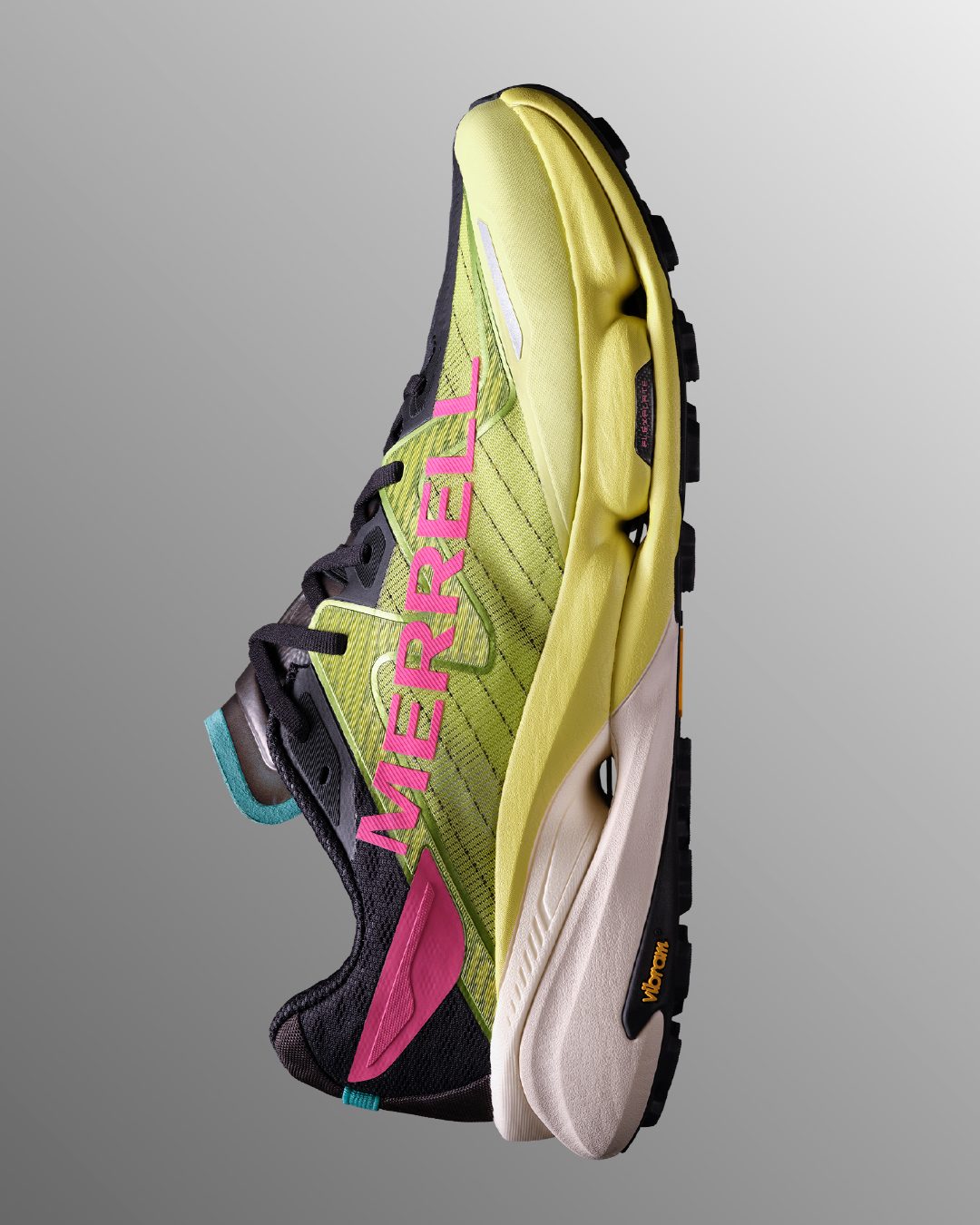
The SpeedARC name comes from a Merrell lifestyle sneaker whose visible plate was the whole point, and the Peak carries that idea onto the trail. Underfoot sits a layered stack: a PEBA-based FloatPro race foam on top for rebound, a forked Carbon FlexPlate in the middle, and a firmer, more durable FloatPro foam at the base for protection and control, with a TPEE footbed above it all. Merrell’s product director has described the brief as putting everything the brand knows about performance footwear into one shoe, with the firmer lower layer there to keep the ride controlled when legs get tired late in a long race. Within the range, Courir Mieux’s tester places it above the short, fast Skyfire and the established Long Sky ultra model as Merrell’s first plated option, aimed at mid-distance to ultra racing on technical ground.
The plate is the design choice that matters most. RunRepeat cut the shoe in half and confirmed a three-quarter-length plate that splits into two prongs toward the forefoot, so each side of the shoe can flex somewhat independently over rocks — the same logic we explored in our guide to whether carbon plate trail shoes actually work off-road. (One French tester describes it as a full, solid plate; the teardown and Merrell’s own description both say otherwise.) Courir Mieux also points to 3mm flex grooves cut into the foam. Large cut-outs along the midsole leave the plate visible from the side. It is a busy, deliberately loud piece of engineering, and the launch colourway — a 1980s-inspired mix of yellow, teal and pink for Merrell’s 45th anniversary — makes sure nobody misses it. Two quieter colourways, including an all-black version, are also available.
The Numbers Don’t Agree: Stack Height and Drop
Before the ride, a warning about the spec sheet. Merrell’s own product page currently lists a 30mm heel, 24mm forefoot and 6mm drop, which is what Believe in the Run, GearJunkie, Road Trail Run, Courir Mieux and Meta Endurance all report. iRunFar, Trail Pro and RunToTheFinish instead quote a 32mm heel, and RunRepeat’s brand spec sheet reads 32mm / 26mm — possibly early launch figures that were later revised, or a difference in whether the insole is counted. Courir Mieux notes that there is no industry consensus on how stack is measured, which explains some of the spread.
The bigger gap comes from RunRepeat’s lab. Measured with its own method, the heel came in at 37.0mm and the forefoot at 26.1mm, giving a drop of 10.9mm — almost double the claimed 6mm. Its testers concluded that the shoe genuinely feels like a high-drop shoe and suits heel strikers, recommending that forefoot strikers look elsewhere. No other source reports an unusually raised heel, and Meta Endurance’s Alps-based tester specifically described the ride as tight and grounded. Lab stack measurements aren’t always directly comparable with brand figures, but a gap this size is worth knowing about if you usually run in low-drop shoes.
Ride and Cushioning: Controlled, Not Cloud-Like
If you’re expecting the soft, bouncy sensation of recent high-stack trail super shoes, most sources agree you won’t find it here. Courir Mieux measured the gap bluntly: at 30mm / 24mm, the SpeedARC Peak sits roughly 10mm lower than the On Cloudultra Pro, The North Face Summit Vectiv Pro 3, the ASICS Metafuji Trail 2 and the Brooks Cascadia Elite, and anyone coming from a Metafuji will feel that immediately. Meta Endurance described a structured, connected ride rather than a springy one, but found the plate came alive on long, steep climbs, with a noticeable forward push on moderate and steep grades.
Within that lower stack, the reports on cushioning diverge. Courir Mieux found the PEBA layer still soft and pleasant, just less of it than rivals offer. RunToTheFinish reported that it seemed to mould to the foot after a few runs and conformed slightly over rocks. Trail Pro’s tester called the PEBA-carbon-EVA combination « a real jewel », describing propulsion that grows with pace yet never tires the legs at slower speeds. Believe in the Run’s Sam Edgin called it the triumph of the shoe, and Road Trail Run found the foam energetic and the heel-to-toe transition smooth. On the other side, Meta Endurance found the ride firm and fairly low on cushioning for anyone below elite pace, and RunRepeat’s lab data helps explain why: heel shock absorption is well above average, but the forefoot scored clearly below its lab average, partly because the thick outsole and lugs add almost 6mm of height without adding much cushioning.
Courir Mieux also noticed something no other source mentions: because the plate stops short of the heel, the rear of the shoe feels softer, with more ground feel, than the forefoot. Midfoot strikers probably won’t notice, but hard heel landings — mostly on descents — make the difference perceptible.
Energy return shows a « better, but not there yet » pattern. RunRepeat measured roughly 62% at the heel and 64% at the forefoot — above average, and a big step up from the Merrell Agility Peak 6, which returned under 42% in the same test. Courir Mieux agrees it is clearly more dynamic than the Agility Peak 6, the MTL Adapt and the Long Sky 2, but returns less energy than the Metafuji Trail 2, the Cloudultra Pro and especially the Vectiv Pro 3. Believe in the Run’s Taylor Bodin never felt especially efficient or excited in it, and suspects the plate shape and midsole geometry don’t quite work together.
The rocker is another point of disagreement. RunRepeat describes a moderate forefoot rocker and Road Trail Run a slight one that helps on flats and climbs, while Courir Mieux found the roll-through almost absent — a surprise from a brand that builds very rockered shoes elsewhere — and would have liked a little more for a shoe billed as high performance. It suspects Merrell deliberately traded rocker for stability.
Stability on Technical Terrain: A Strength for Most, Not All
This is the question that matters most for a shoe Merrell pitches at mountain racing, and here the balance of our sources tips clearly positive — with one loud dissent.
Courir Mieux’s tester is the most emphatic: over 60–70km including properly broken terrain, she ran technical sections without apprehension, without slowing down and without changing her stride, and had never tested a performance shoe so mountain-oriented. She credits the low stack, the near-absent rocker, strong torsional resistance and a wide platform, measuring roughly 120mm at the forefoot, 80mm at the midfoot and 100mm at the heel — a much wider rearfoot than the Metafuji Trail 2. « I have never tested a shoe that combines stability and dynamism this well, » she concludes. Meta Endurance, which raced it on technical Alpine terrain, calls it possibly the most stable shoe in the trail super shoe category. Road Trail Run never felt thrown off bigger rocks by the plate, Trail Pro always felt in control even when taking risks on descents, GearJunkie banked through fast downhill turns with the foot centred, and RunToTheFinish deliberately targeted rocks in Colorado with confidence.
The dissent comes from iRunFar. Its reviewer found it excellent on gravel, soft ground and moderately technical trail, but on highly technical sections and off-trail navigation over loose rock and shale, she felt the plate throwing her around from the ground up — and concluded it was the shoe, not tired legs. Believe in the Run lands in between: Sam Edgin felt surprisingly confident on technical spots for a plated shoe but finished uneven sections feeling he had spent too much energy compensating for the plate, and Taylor Bodin found the forefoot occasionally squirrely. RunRepeat’s lab adds nuance: torsional rigidity is only slightly above average, and its forefoot midsole measurement came in a little narrower than average, making the shoe nimble in quick turns but less planted than wider-platform rivals.
Our reading: most testers — including the two who pushed it hardest in the Alps — found stability to be the SpeedARC Peak’s defining strength, especially compared with high-stack plated rivals. But one detailed report of instability on loose, off-trail rock is worth remembering if that’s exactly where you run.
Fit and Upper: Narrow by Design
Nearly every source calls this a narrow shoe. Believe in the Run notes that the SpeedARC Peak is built on the same slim, aggressive last as the MTL Skyfire 2, RunRepeat’s measurements confirm a toe box and overall fit below its lab averages, Courir Mieux describes a medium-to-narrow fit, and RunToTheFinish compared the width to the Saucony Peregrine. There is no wide option. Trail Pro is the one exception, reporting a forefoot that didn’t compress the toes at all.
How much that matters varies a lot. Road Trail Run’s tester, narrow at the midfoot and slightly wider up front, felt pinky-toe tightness at first that faded after a couple of runs, and Sam Edgin credits a stretchy elastic vamp with keeping him from ever feeling pinched. GearJunkie’s tester, normally in wider shoes, had no issues. iRunFar’s reviewer, who has substantial toe splay, made it work thanks to a flex zone in the medial toe box but capped her own use at 50km races and training runs of around 15 miles. Meta Endurance’s tester had the worst experience: on a sustained 900m descent with dozens of braking turns, the pointed toe box rubbed badly enough that she was hobbling after the finish. The flip side, as Courir Mieux puts it, is precision — the foot doesn’t move and the upper barely deforms under load. If your feet are average to wide, try before you buy, and note RunRepeat’s tip that the thick 6mm TPEE insole is removable, so swapping in a thinner one frees up some toe box volume.
The Matryx upper itself is the most consistently praised part of the shoe. Combining Kevlar threads with high-tenacity polyamide, it shrugged off dense bushwhacking for iRunFar, stayed cool through heatwave conditions and showed no wear after 150km for Trail Pro, and scored well above average in RunRepeat’s breathability and drying tests. Two caveats: Courir Mieux notes the Matryx sits directly against the foot without a lining and feels slightly rough, and Believe in the Run feels that heavy overlays cover so much of the fabric that they partly defeat its purpose and add weight. For another take on a Megagrip-and-Kevlar trail build, see our Mount to Coast T1 review.
The Tongue, the Dye and the Laces
If there’s a single detail almost every tester mentions, it’s the tongue. Believe in the Run’s Taylor Bodin found it rough and stiff, eating into the front of his ankle even with crew socks; Sam Edgin found it pokey but not a dealbreaker, and says Merrell has indicated a change may come even before a second version. GearJunkie’s tester got a small blister on her first 5-mile run, with no trouble afterwards. Trail Pro found the top edge too rigid at first, softening over time, while iRunFar reported the opposite — a soft top edge that hardened after 100-plus miles. Meta Endurance found it too long and folded the edges back, while Road Trail Run found it slightly too short, worrying that the laces might slip over it on long runs. RunToTheFinish was the exception, finding it rigid but comfortable once on. Sources even disagree on its construction, variously describing it as gusseted, semi-gusseted, or held only by elastic side straps.
Two testers independently report the same oddity: the blue dye in the launch colourway bled through socks onto the skin — Road Trail Run after the first run, Meta Endurance after every run. Merrell’s product page carries a general warning that colour may bleed and transfer, so this looks like a known trait rather than a one-off defect. Finally, the laces: Courir Mieux notes that Merrell sells them as elastic and anti-loosening, but found them to be plain flat laces with neither quality, while the rivals it tested all use notched laces. Several other testers also found the laces underwhelming at this price.
Traction: The One Thing Nobody Argues About
The Vibram Megagrip Elite outsole is the SpeedARC Peak’s clearest win. RunRepeat recorded a traction coefficient of 1.02 in its lab — only the second running shoe it has tested to break 1.00, behind the Brooks Cascadia Elite, which uses the same compound — and called the outsole the true highlight of the shoe. Road Trail Run gave traction a perfect 10. Out on the trail, testers reported confident grip on wet rock, damp roots, wet leaves, loose dry granite, gravel and stream crossings, and Trail Pro found the compound softer and grippier than standard Megagrip, with mud clearing well between the lugs. Courir Mieux even found it grabbed some rock almost too hard on early runs, a sensation that faded once the first layer of lug wore in. The 4mm lugs mix butterfly shapes for multi-directional grip with chevrons that flip orientation between forefoot and heel for climbing and braking.
The only criticism is minor, and not unanimous: RunRepeat and GearJunkie noted that a few forefoot cut-outs can trap pebbles and that rubber coverage isn’t complete, while Road Trail Run described the base as nearly fully covered. If you want to understand why this rubber keeps showing up on premium trail shoes, including the Norda 005, our Vibram Megagrip guide breaks down the compound family.
Weight and Durability
Weight is the one criticism shared by almost every source, positive or negative. At 305g per shoe claimed and 303–305g on three independent scales for a men’s US 9–10, the SpeedARC Peak is heavy for a race shoe. Courir Mieux weighed an EU 46.5 at 346g — around 20g more than the Cascadia Elite, 40g more than the Cloudultra Pro and 50g more than the Metafuji, and level with the Vectiv Pro 3, despite carrying roughly 10mm less foam than all of them. RunRepeat called the weight a letdown and hopes for a full-PEBA version 2, Believe in the Run described the shoe as overbuilt, and Road Trail Run and Trail Pro both hope future versions shed some weight. iRunFar was the most forgiving, arguing that the low profile keeps it feeling quicker than the number suggests. (Meta Endurance’s listed 280g matches the women’s-size figure, so we’ve used the men’s number.)
The upside of that heft is durability. In RunRepeat’s abrasion tests the outsole lost slightly less material than average and the toe box scored about average; the weak point is the heel lining, which earned the lowest possible mark. Trail Pro saw no upper wear after 150km, Meta Endurance noted only light scuffing on foam exposed by the outsole cut-outs, and several testers expect a long life overall — a real consideration at this price.
How Far Can You Take It?
Merrell pitches the SpeedARC Peak for everything from 5K racing to 100K-plus efforts, and two testers broadly agree: Road Trail Run believes it can handle anything from a vertical kilometre to 100 miles, and RunToTheFinish calls it suitable for any distance. Most others are more conservative. Courir Mieux sees it at its best between 40 and 80km, and wouldn’t personally go beyond 10–12 hours in it without a planned shoe change, because the cushioning is modest and ground feel remains high. Meta Endurance’s tester found it ideal for a four-hour race but suggests most runners would stop around 60–70km, and iRunFar and Believe in the Run both landed on roughly 50km and under.
Courir Mieux offers the most useful framing: it would happily race the SpeedARC Peak at the UTCAM, the Templiers or the second half of the Échappée Belle, but would skip it for the SaintéLyon, where a bouncier shoe makes more sense, and hesitates on UTMB itself, where genuinely technical sections are relatively rare. In its words, this looks less like a shoe to win UTMB than one to win a CCC, a TDS or the Restonica.
A note on independence: Courir Mieux discloses a partnership with Merrell, including a discount code, so we’ve leaned on it mainly for its measurements and specific observations rather than its overall enthusiasm. Part of GearJunkie’s testing, and some of Believe in the Run’s early impressions, came from the Beast of Big Creek, a race organised by Merrell, and GearJunkie also quotes a professional runner who races in the shoe. Trail Pro’s author has raced several Merrell models and describes himself as a fan of the brand. Journal du Trail’s coverage is a launch-week first look rather than a field test; we’ve used it only for context on price and expectations. We’ve weighted independent lab data and fully self-directed testing more heavily where sources differ.
Merrell MTL SpeedARC Peak vs the Competition
Road Trail Run ran the most direct head-to-heads. Against the Nike ACG Ultrafly, it found a very similar feel, with better grip and technical handling in the Merrell but a wider toe box in the Nike. The North Face Summit Vectiv Pro 3 is far more cushioned and rockered but less stable and controlled on technical terrain. The On Cloudultra Pro is softer and more flexible thanks to a TPU plate. The La Sportiva Prodigio Pro holds the midfoot similarly but has a roomier toe box, and the Hoka Tecton X3 has a higher stack, twin parallel plates and a very similar outsole, with an upper that holds the foot less securely than the Matryx.
Courir Mieux, having tested the Cloudultra Pro, Vectiv Pro 3, Metafuji Trail 2 and Cascadia Elite side by side, suggests fast trail shoes are splitting into two families: plated shoes for runnable trails, however long, and dynamic shoes built for technical mountain terrain — with the SpeedARC Peak firmly in the second group and the ASICS somewhere in between. Believe in the Run compares its build to lighter, faster racers such as the Metafuji Trail 2, the Salomon S/Lab Pulsar 4 and the Arc’teryx Sylan 2, which has a similar forked plate, a similar narrow-toe-box debate and a much lower price. Meta Endurance’s most pointed comparison is the Rossignol Vezor: both are low, narrow, structured 30mm / 6mm plated racers, but the Vezor is around 40g lighter and well over €100 cheaper. RunRepeat suggests the Saucony Xodus Ultra 4 or the Kiprun Kipsummit Max for runners who want strong performance for far less money.
RunToTheFinish points to the Hoka Mafate 5 for a comparable cushioning feel without a plate, while iRunFar sees echoes of VJ’s niche racing shoes. For a broader view of how carbon-plated trail racers stack up against their unplated opposites, our Hoka Tecton X vs Norda 001 comparison and our best trail running shoes of 2026 guide are good next reads. Within Merrell’s own range, Meta Endurance suggests pairing the SpeedARC Peak with the more cushioned, more accommodating Agility Peak 6 for easy days.
Our Take
Judge the Merrell MTL SpeedARC Peak against the high-stack, bouncy trail super shoes it’s usually compared with and it comes up short: it’s lower, less springy, heavier and more expensive. Judge it as what most of our testers actually describe — a dynamic mountain racer — and it looks far more convincing. The traction is among the best available, the Matryx upper is tough and breathable, the PEBA layer is a real leap for Merrell, and the majority of sources, including both testers who pushed it hardest in the Alps, found a combination of stability and liveliness on technical terrain that plated rivals rarely manage. The flaws are real, though. It’s heavy, the tongue irritated most people who wore it, the fit is narrow enough to rule out plenty of feet, one lab measured a drop close to double the listed figure, and one careful tester still found it unstable on loose off-trail rock. Buy it if you have narrow-to-average feet, race roughly 40–80km on steep, broken mountain trails, and value grip and control over bounce. If your races are fast and runnable, or you need room up front, a higher-stack rival will serve you better — and a lighter version 2 could make this one very hard to beat.
Merrell MTL SpeedARC Peak Review: Frequently Asked Questions
Is the Merrell MTL SpeedARC Peak true to size?
Length is generally reported as true to size, and the shoe uses unisex sizing that runs as men’s — Merrell advises women to pick a unisex size one and a half sizes smaller than their usual women’s size. Width is the real issue: most testers describe a narrow last with a tapered toe box, and there is no wide option.
What is the real drop of the SpeedARC Peak?
Merrell lists 6mm, and almost every field tester accepts that figure. RunRepeat’s lab, however, measured 10.9mm, and its testers felt the shoe rides like a high-drop model best suited to heel strikers. If you’re used to low-drop or zero-drop shoes, try it before committing.
Is the SpeedARC Peak good for ultramarathons?
Merrell says yes, up to 100K and beyond, and two sources agree. Most are more cautious, placing its sweet spot somewhere between 40 and 80km, because the cushioning is modest for the category and the fit is narrow. It looks best suited to technical races such as the CCC or TDS rather than long, runnable ultras.
How is the carbon plate different from other trail shoes?
The Carbon FlexPlate is three-quarter length and forked toward the forefoot, so each side can flex somewhat independently over uneven ground. Combined with a low stack and a very mild rocker, most testers found it far less tippy than the full-length plates in higher-stack rivals, though one reviewer still struggled on loose, off-trail rock.
Is the Merrell MTL SpeedARC Peak worth $290?
For narrow-footed mountain racers who prize grip and stability on technical ground, several sources think it can be. For runners on faster, more runnable courses, testers repeatedly pointed to softer, lighter or cheaper alternatives, and one outlet noted that a comparable low-stack plated racer costs over €100 less.
This Merrell MTL SpeedARC Peak review is a starting point rather than the final word — for colourways, sizing charts and current availability, head to the official Merrell MTL SpeedARC Peak page.