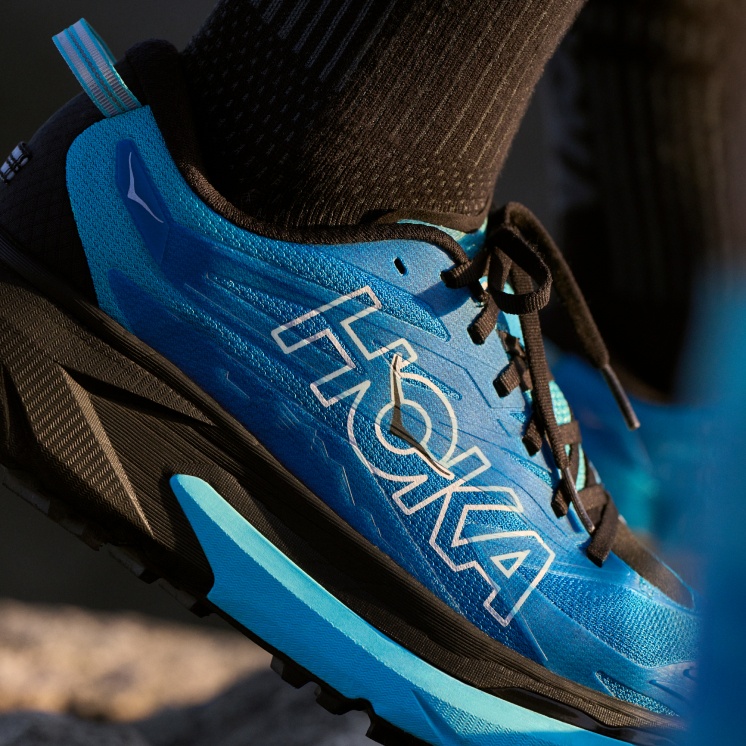
hill.camp does not test products first-hand. This review is a structured synthesis of five independent sources — specialist field tests, a retail buyer’s panel, and manufacturer lab data — assembled with AI assistance and edited before publication. Sources are selected and verified by runners who follow this equipment closely. That synthesis is below, including the places where testers disagreed.
Hoka dropped « Speed » from the name of its flagship ultra shoe this year, and after reading through five separate test reports, that decision looks less like marketing and more like an admission. The Hoka that built its identity on maximal cushion has pushed the Mafate further into that lane rather than away from it: more stack, more drop, more weight, and — according to most of the people who’ve actually run in it — more shoe than most of them expected to like.
Quick Specs
| Weight | 310–332 g / 10.9–11.7 oz (men’s, size-dependent) · ~286–296 g women’s |
| Drop (brand / lab-measured) | 8 mm claimed · 9.0 mm measured |
| Heel stack | 42.9–45 mm |
| Forefoot stack | 33.9–37 mm |
| Outsole | Vibram Megagrip, Traction Lug, 4.4–5 mm lugs |
| Midsole | Dual-density EVA (supercritical top layer + firmer CMEVA base) with a TPU « Rocker Integrity » plate |
| Price | $185 / 190 € — unchanged from the Mafate Speed 4 |
| Best for | Long, technical days where protection and cushion matter more than agility |
A different shoe, not just an update
Every source agrees on this much: the Mafate 5 is a bigger departure from the Mafate Speed 4 than the name change suggests. The drop jumps from roughly 4 mm to 8 mm, the heel stack grows into the low-to-mid 40s, and the shoe picks up a new internal plate — Hoka’s « Rocker Integrity Technology » — sandwiched between two densities of foam to hold the rocker shape and add torsional structure. RunRepeat’s lab work backs this up with numbers: energy return improved from 58.3% on the Speed 4 to 63.7% on the Mafate 5, and torsional rigidity came in at 20.0 Nm against a 15.9 Nm average across the shoes it has tested. On paper, this reads as a shoe built specifically for long, punishing days rather than one trying to also double as a quick, playful trail runner.
That framing matters, because Believe in the Run’s reviewers are blunt that Mafate Speed 4 loyalists should brace for a genuinely different ride, not a refinement of the one they knew. Journal du Trail’s Vincent Gaudin, who tested the shoe on home trails and put it side-by-side with both the Speed 4 and the Mafate X, reaches a similar conclusion from a different angle: more grip and more cushion than the Speed 4, but less rear-foot composure on technical ground.
Cushioning that splits opinion on where it works best
The midsole is the shoe’s clearest strength across every source. It layers a soft supercritical EVA on top with a firmer compression-molded EVA underneath, and RunRepeat’s shock-absorption testing puts the heel at 160 SA against a 123 SA average for trail shoes — a sizeable jump. iRunFar’s Annie Behrend, who trained through a 100-mile buildup in the shoe, found it « surprisingly forgiving, » and Outside.fr’s tester, running it through Chamonix terrain during UTMB week, called it one of the most comfortable trail shoes he’s worn, praising the choice to place the softer foam in contact with the ground rather than under the foot.
Where the sources start to diverge is stability, and it’s worth being honest about the split rather than smoothing it over. Believe in the Run and Journal du Trail — the two reviewers who spent the most time on technical, rocky, rooty terrain — both flag a specific issue: the heel foam is so soft that it can tip laterally underfoot, particularly for heavier runners or committed heel-strikers descending technical ground. Journal du Trail is the most direct about it, warning that the combination of a very plush rear foam and tall lugs « louvoie » — sways — under those conditions specifically. iRunFar, running the shoe through Yosemite granite and the back half of a 100-miler, reports the opposite experience: never once tippy, confidence-inspiring even at night. RunRepeat’s structural data offers a partial explanation for that gap — its lab measurements show a notably wide midsole platform (119 mm forefoot, 99 mm heel, both well above the shoe average) plus the new internal plate, which together should counteract instability on paper. The likely read: the Mafate 5 is stable through width and structure for most footstrike patterns, but the heel foam is genuinely soft enough that heavy heel-strikers on steep, technical descents may feel it move around underfoot in a way lighter or more midfoot-oriented runners won’t.
Fit: roomier than the Hoka norm, with one exception
Hoka’s uppers have a reputation for running narrow, and most testers here say the Mafate 5 breaks from that. Believe in the Run’s wide-footed reviewer found room to spare without the fit turning sloppy, and RunRepeat’s mold-based measurement of 74.2 mm toebox width landed almost exactly on the trail-shoe average — a real shift for the brand. iRunFar’s reviewer, who has bunions, also found the toebox comfortably accommodating.
Journal du Trail is the outlier, and it’s worth flagging rather than ignoring: that tester noted a snug sensation around the front of the ankle depending on lacing, plus a firmer, less padded tongue than expected at first wear. That last point actually lines up with two other sources — both iRunFar and RunRepeat separately single out the tongue as the shoe’s weakest component. It’s short, thin, non-gusseted, and can bite the front of the ankle straight out of the box; RunRepeat measured only 6.0 mm of unevenly distributed padding, and iRunFar’s reviewer never fully resolved her issue with it despite otherwise liking the shoe enough to race a 100-miler in it. Three independent sources landing on the same complaint is a stronger signal than any one review, and it’s the clearest, most consistent flaw in this shoe.
Outsole, weight, and the numbers that don’t quite agree
Nobody disputes the outsole. Vibram Megagrip with 4.4–5 mm lugs and Hoka’s Traction Lug micro-tread shows up as a strength in every single source, from wet Chamonix granite to the rocky climb up Wagner Butte at mile 65 of a 100-miler. RunRepeat’s wear testing found only 0.5 mm of rubber loss in lab conditions, ahead of the trail-shoe average.
Weight is where the numbers genuinely scatter, and rather than pick one figure and present it as gospel, it’s more honest to show the range: iRunFar and RunRepeat both weighed a men’s shoe at 314–315 g (11.1 oz), while Believe in the Run and Running Conseil cite Hoka’s own brand figure of 332 g (11.7 oz) for a similar size. Some of that gap is almost certainly sample and size variation rather than contradiction, but the practical takeaway is the same regardless of which number you use: this is a heavier shoe than the Mafate Speed 4 by a real margin, and every tester who mentions weight treats it as the shoe’s most obvious trade-off. Breathability, by contrast, is a rare unqualified win — RunRepeat’s lab test scored the knit upper at 102 BR against a 68 BR trail-shoe average, and none of the runners who logged hot-weather miles reported wet socks or overheating feet.
Our Take
The Mafate 5 is not trying to be agile, and Hoka seems to know it — that’s presumably why « Speed » left the name. What it delivers instead is genuinely excellent long-range cushioning, a Vibram outsole that inspires confidence everywhere it’s been tested, and a fit that finally lets non-narrow feet into a Hoka without complaint. Set against something like the carbon-plated Tecton X or the more surgical shoes we cover in our carbon plate trail shoes guide, the Mafate 5 sits at the opposite end of the spectrum: it wants distance and protection, not response.
The real question is footstrike and terrain. If you’re a midfoot-striker doing long days on varied ground, the reports here are close to unanimous in your favor. If you’re a heavier runner or a committed heel-striker who spends real time on steep technical descents, take the stability praise with a grain of salt — the two testers who pushed the shoe hardest on that specific terrain are also the two who noticed the heel move. And regardless of footstrike, budget for a different lacing approach or an aftermarket tongue fix, because three separate sources landed on the same complaint independently. Compared with the older Speedgoat, still Hoka’s best-selling and most all-around trail shoe, the Mafate 5 trades everyday versatility for a more specialized, ultra-distance brief — worth knowing before you spend 190 €. If you want the fuller lineup context, our trail shoe guide covers where it sits against the rest of this year’s field, including the Norda 001 and the two Speedland ultra options that occupy similar territory at a steeper price.
FAQ
Is the Hoka Mafate 5 heavier than the Mafate Speed 4?
Yes, by a real margin. Depending on the source, the Mafate 5 weighs somewhere between 314 g and 332 g in a men’s mid-size, up from the Speed 4’s lighter build. Every tester who addresses weight treats it as the shoe’s clearest trade-off against the added cushioning and drop.
Is the Mafate 5 stable on technical descents?
It depends on your footstrike. Reviewers running mostly midfoot found it confidently stable even on granite and steep rocky terrain. Two testers who focused specifically on technical descents with a heel-strike pattern reported some lateral heel movement, likely tied to how soft the rear midsole foam is. Heavier heel-strikers should try it on demanding terrain before committing to it for a race.
What’s the biggest flaw of the Hoka Mafate 5?
The tongue. It’s short, thin, minimally padded, and not gusseted, which several independent testers flagged as capable of biting the front of the ankle and letting debris into the shoe. It’s the one weak point that shows up consistently across sources otherwise positive about the shoe.
Does the Mafate 5 run true to size?
Most sources say yes to a half-size up from a runner’s everyday shoe, with a wider, more accommodating fit than typical Hoka models. RunRepeat’s owner survey leans slightly toward sizing small, so trying before buying — or ordering a half-size up if you’re between sizes — is the safer default.
For full specs, colorways, and current pricing, see the official Hoka product page.